Wakefield in the Great War, page 15


Wakefield Grammar School soon addressed issues around the war. On 25 September the school debating society discussed the motion that ‘In the opinion of this House, warfare is necessary to civilisation, and that which it attains cannot be otherwise achieved.’ Various speakers took part but despite the tales of German atrocities that filled the newspapers, the motion lost 14–7. A few months later, after the famous Christmas Truce of 1914, another debate ‘That Germans and Allies singing carols together is incompatible with Germans and Allies trying to annihilate each other.’ It, too, lost, this time by 7–1. It was soon followed by ‘German nature has gone back, i.e. is a throw back to the nature of savages.’ The motion was lost by 9–4. Whatever else, the students of Wakefield Grammar did not blindly accept anti-German propaganda. A list was placed in the School Hall of Old Boys who had enlisted into the forces but the school magazine noted that ‘other names are known to the School authorities, of those who have offered themselves but have been rejected on physical grounds: to these we offer our special sympathy.’ Those serving covered the whole spectrum of ranks with J.W. Stead listed as Colonel, commanding the City of Leeds Battalion (Leeds Pals) with half a dozen fellow old boys serving as privates under him. By mid 1915, 255 names were on the list. Realising that Grammar School boys would be regarded as prime candidates for promotion, Company Drill using dummy rifles was quickly introduced and, with the Headmaster acting as Company Commander, six squads had progressed on to training on a rifle range.
The ambulance bought by the pupils of Wakefield Girls High School.
Scouts assist in the harvest.
Council schools were not in a position to offer weapons training, but ‘Swedish Drill’ had been part of the syllabus for the past ten years, partly as a cheap form of exercise for schools who couldn’t afford sports equipment but also as a way of instilling discipline into children who had often been left to fend for themselves in the poorer areas of town. At the turn of the century the West Riding Education Committee had limited physical education to just 30 minutes per week but by 1913 its teacher-training college at Bingley included drill, organised games and ‘rhythmic movement’ as part of its course. By then it had also employed military trainers to teach children how to march and even set up drill competitions. Other areas had even brought in dummy rifles for nursery-age children to train with.
The war was brought into the classroom where maps showed the Western Front with the progress of battles marked and updated regularly but more practically, children were put to work knitting for the troops or sewing mailbags and sandbags. Schools enthusiastically raised money and encouraged children to help collect on flag days for a wide variety of causes. Later in the war, the Education Committee was an active part of a campaign to have children collect sphagnum moss for use as packing for medical dressings and to collect chestnuts. These, allegedly, could be processed to create acetone for use in explosives but in reality they were not very effective and thousands of tons collected across the country were eventually left rotting at collecting depots.
School staff dwindled as male teachers went away to war and class sizes grew but their efforts went unappreciated. In 1916, Councillor Mellor provoked a furious reaction when he claimed that ‘almost every class was suffering from the war with the exception of teachers’ and that they should think about labourers working 54 hours a week. By then, staff shortages meant classes at some schools had reached fifty or even sixty pupils and in extreme cases, teachers were trying to teach two classes at once with the aid of ‘pupil apprentices’ acting as assistants. As an angry group of Wakefield teachers pointed out in a letter to the Yorkshire Post, a female teacher could earn a lot more in other jobs than the 17s 4d per week on offer to them. ‘They would find employment of a much less exacting intellectual nature, and certainly more remunerative, on the rear platform of a Wakefield tramcar. War bonuses have been granted by the government to their postal employees, to the railway employees, the munition and other workers; all these are not labourers. The teachers of Wakefield, however, did not ask for a war bonus.’ By 1917, they not only asked for a bonus, they demanded it at a meeting of 500 local teachers at the Cathedral Boys School. It emerged that some had been offered an extra 2s 10d per week, others 1s 11d whilst many more had been offered nothing. The teachers declined the offer and instead held out for the 11 per cent bonus Councillor Mellor’s colleagues had awarded to Corporation officials.
It was outside school that children played their most active part in the war. In 1908, Baden-Powell had launched the Boy Scout movement with the aim of encouraging boys to learn skills that would allow them to serve their country. The outbreak of war was the first test of how successful his plans had been and as early as 11 August, the Boy Scout uniform was officially recognised ‘as that of a public service’, and wearing of it by anyone not a member of a recognised troop was made a criminal offence. A sense of how important scouts had very quickly become comes from an advert in the Middlesex Chronicle that all ‘soldiers, sailors, territorials, scouts, nurses and all persons in uniform’ would be photographed for free at a local photographer’s studio. In September 1914 volunteers of the 1st and 4th Wakefield Scouts, under Scoutmaster Cecil Robinson, left for a month’s tour of duty, living in tents at the Coastguard station at Newton-on-Sea in Northumberland. There they began working as coast watchers on 2-hour shifts day and night to provide warning of any enemy ships crossing the North Sea. By mid October, after they volunteered for a second month’s duty, a cottage had been found to house the patrol and by November a five-room cottage, now named ‘The Hydro’ was home to the boys during their spare time. It was a rugged stretch of coast but despite being out at night in all weather, Scoutmaster Robinson assured families at home that the boys were ‘in excellent health’.
Scoutmaster Robinson would soon take on a new role in London when a new ‘Scout Defence Force’ was formed with the idea that Scouts aged 15 to 17 should be trained as infantrymen for home defence. ‘In case of invasion,’ explained Chief Scout Baden-Powell, ‘a boy of 16 trained to discipline and marksmanship would be worth a dozen men trained to nothing in particular.’ In May 1915 it was noted that Birmingham had 600 boys who had been awarded the newly created ‘Red Feather’ badge of the trained rifleman and that Leicester had 250 but there were none at all in the whole of Yorkshire. It was with a great deal of pride that Cecil Robinson returned to Wakefield in his new role as Staff Officer of the Scout Defence Force, on Saturday, 18 September, to inspect the first unit in Yorkshire to pass the requirements to be accepted. Fifty local scouts paraded of whom thirty had passed their rifle proficiency test by placing seven shots in a 4-inch circle at 25 yards. They became the first in Yorkshire to gain the Red Feather and other War Service badges were awarded to those who had served as coast guards or in other roles with the district efficiency cup going to the 5th Wakefield (Zion) Troop.
The following month around 230 Wakefield scouts paraded for their annual church service conducted that year by Scoutmaster A.L. Leeper and attended by the Bishop of Wakefield. The Bishop spoke of the 2,000 scouts who had enlisted and some of whom had already died as well as the 1,500 scouts still active as coast watchers. ‘This was a time,’ he told them, ‘when everybody able ought to do something, and so far as the Scouts were concerned he would say to them that if they were going to be great they would have to be honourable and pure hearted, have minds not lifted up to vanity and silliness and be kindly towards their neighbours.’ Scouts had thrown themselves into war work with gusto, volunteering to guard water supplies against the threat of German agents, acting as messengers for the army and the emergency services, helping with harvesting, assisting the settlement of refugees and working to help at convalescent hospitals for the wounded. In August 1916 1st Wakefield (City) Troop were hard at work on yet another project organised by Lady Catherine Milnes Gaskell, this time to pick fruit and make jam for wounded soldiers in hospitals in Wakefield and Bradford, and each summer groups of scouts and guides went away to work camps to help harvest essential crops. Prime Minister David Lloyd George was quoted in a special edition of The Times History of the War, describing the role scouts and guides played in helping Britain win the war: ‘It is no small matter to be proud of the fact that the Association was able within a month of the outbreak of war to give the most energetic and intelligent help in all kinds of service. When the boyhood of a nation can give such practical proofs of its honour, straightness and loyalty there is not much danger of that nation going under, for these boys are in training to render service to their country as leaders in all walks of life in the future.’
As with every generation, elders complained about the behaviour of the young and assumed that the lack of fatherly discipline would lead to chaos on the streets. In November 1916 Wakefield’s School Attendance Officer said that the attendance of children at school was ‘shocking’ and blamed ‘indifference on the part of the mother.’ The State Children’s Society wrote an open letter to the Yorkshire Post in 1916 that ‘an outcry has been raised against what is termed the growing depravity of children, and severer and more repressive punishments are demanded.’ The Society explained that the shortage of police, streets darkened by the blackout and the ‘exciting influences of sensational cinema shows’, as well as what were seen as lenient sentences passed by the courts, had all been blamed for what many saw as a growing juvenile crime wave but pleaded for a system that didn’t just lock children away for years on end. Using language that would still be current a century later, one faction argued for ever more harsh penalties whilst another argued that punishment was not enough to break the complex cycle of problems facing some young people. Then, as now, the criminal few attracted all the attention.
Throughout the war children suffered. When food shortages became severe, school attendances fell because small children were needed to stand in food queues to mark the place for their harassed mothers – one in one queue, another in the next, standing for hours in the cold and wet to help keep their families fed. They collected moss, chestnuts, acorns and animal fodder and stood on streets with collection boxes. They ran errands for wounded soldiers or volunteered to put on shows to entertain them. Some committed crimes, most didn’t. Most of all though, they waited for news of their fathers and brothers.
Hospitals
It was only in 1908 that it was realised that in case of invasion, there were no hospitals set aside for treating wounded part-time soldiers of the Territorial Force as there were for the Regular army. Across the Empire there were only around 300 trained military nurses and none at all for the Territorials, so the reforms of the army created a new Territorial Force Nursing Service (TFNS) along with a Queen Alexandra’s Imperial Military Nursing Service Reserve for those who had served as military nurses but returned to civilian life. Plans were drawn up for the creation of twenty-three territorial force hospitals in towns and cities throughout the country, each with planned accommodation for 520 patients and a staff of ninety-one trained nurses. To qualify for appointment as a sister or staff nurse in the TFNS, candidates had to be over 23 years of age and must have completed three years training in a recognised hospital or infirmary.
The problem was that there was a chronic shortage of fully-trained nurses in the country and some members of the Army Nursing Board were against any sort of military nursing service that recruited from the staff of civilian hospitals in peacetime. Sydney Holland, later Lord Knutsford, and Chairman of the London Hospital, was always opposed to the idea of a military nursing reserve because he felt that if the need arose there would be no difficulty in finding nurses for the army, but to allow women to enrol as individuals in a military reserve could leave civilian hospitals in the difficult position in wartime of losing their most experienced staff to military service. As a result, there was no encouragement and little reward for those who offered their services. Volunteers willing to act as matrons in the TFNS were to spend just seven days training in a military hospital every second year, but nurses who joined would get neither pay nor special training during peacetime in return for their commitment. They were required to declare their intention to serve on 1 January of each year while continuing to work in civilian hospitals where it was felt that day to day nursing would provide ample training for whatever might happen in wartime. The only recognition for their offer would be a silver service badge, the design based on the ‘double A’ cipher of Queen Alexandra, which was to be worn on the right side of their dress or apron during the normal course of their civilian duty – if they were given special permission by their employer to wear it.
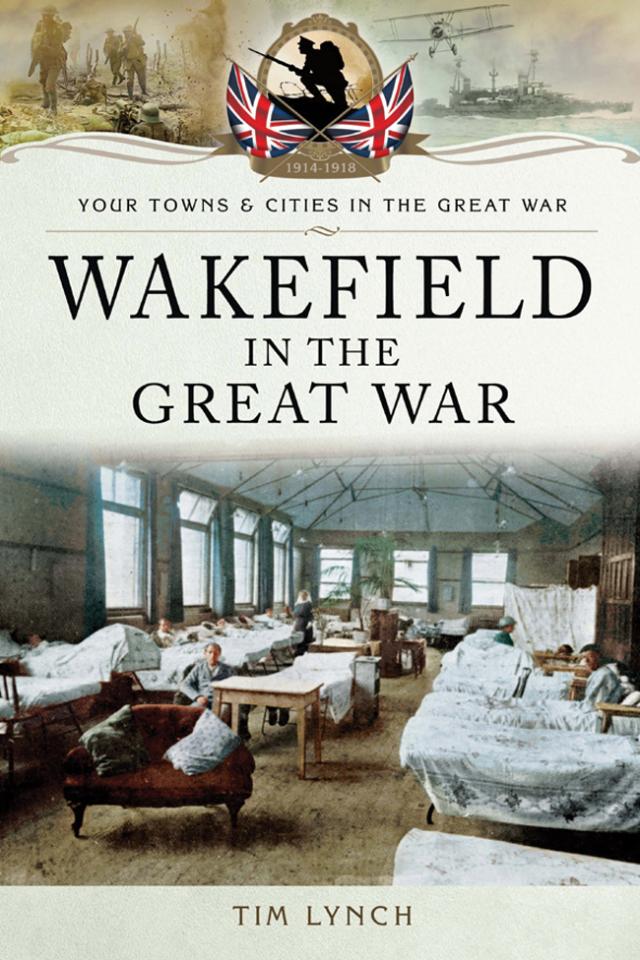
A Voluntary Aid Detachment ward in Clayton Hospital. (Courtesy Kate Taylor.)
The plans for large Territorial Force hospitals were hampered somewhat by the fact that they would not come into existence until war was declared. Buildings were identified but there was no budget for equipment or storage. Everything would have to be found once the go-ahead was given. It is a testament to the organizational skills of those involved that by the end of August 1914, nineteen hospitals were up and running, with the remaining four following close behind in September. In the first week of the war, Leeds’ new Teacher Training College at Beckett Park was handed over by Leeds City Council to become the 2nd Northern General Hospital that would be staffed by over 2,000 and included a 126-bed unit for limbless men from Yorkshire, Lincolnshire, Nottinghamshire and Rutland. To the south, 3rd Northern General was established in Sheffield with a staff of around 1,400. Around these large hospitals there was to be a network of ‘auxiliary’ hospitals operating as an annexe to the General Hospital, often as ‘convalescent’ units where men recovering from treatment could be kept under some sort of military control. Often set up in public buildings or even stately homes, these small hospitals were operated by Voluntary Aid Detachments.
Wakefield was home to several improvised wartime hospitals. (Courtesy Kate Taylor)
Clayton Hospital in Wakefield was quickly earmarked as an auxiliary to Beckett Park and by the end of the first week of war the House Committee agreed that members of St John’s Ambulance could work at the hospital to gain practical experience in preparation for voluntary service. Matron was to be asked to provide a list of necessaries to be ordered for the provision of twenty beds for wounded or convalescent soldiers in the Lower Gaskell Ward. Soon after, it was also agreed that voluntary nurses would act as ward maids and waitresses and funding was based on a calculation that each patient cost 1s a day for food and about the same per day for drugs. By the time it opened in November 1914, Clayton Hospital’s plans had extended to fifty beds spread between two large wards, named Gaskell and Milnes after their benefactors and three smaller wards under the control of Nellie King as commandant. The first men were brought down from Beckett Park in the private cars of ten Wakefield citizens, including that of Lady Catherine Milnes Gaskell, and there was an immediate appeal launched for gifts with an emphasis on cigarettes, pipes and tobacco. The hospital also asked for counterpanes and bedlinen as well as pyjamas and other necessities.
Lady Catherine Milnes Gaskell was determined to see the men well provided for. Each patient was initially allotted a budget of just 2s a week for food by the War Office, so she wrote to Lady St Oswald at Nostell Priory to ask whether her ladyship could spare any rabbits so that she could make pies for them. Lord St Oswald responded immediately by sending an initial ten pairs. In April 1915 she was in action again, this time with an appeal for croquet sets, one for Clayton VAD hospital and one for Thornes House where she planned to entertain wounded soldiers on two days a week for fishing and to play croquet in her grounds. At Christmas, the King himself provided a hamper for the patients, some of whom were fit enough to be discharged or at least able to go home for the holiday so that only eight patients remained in the hospital. They were invited to hang up stockings which were filled – or indeed over-filled – by Mrs Welch, the wife of the Vicar of Wakefield. On Boxing Day they had a visit from Lady Allendale of Bretton Hall and her daughters, who put on an entertainment consisting of dramatic sketches, songs and pianoforte solos.
The aim of the network of auxiliary hospitals was to enable men to be treated as near to home and family as possible but it did not always work. In May 1916, Frederick Baldwin of the Hampshire Regiment, who had been ‘shockingly wounded’ at Ypres, died exactly a year after being admitted. He had no known relatives or friends but had been a pleasant and uncomplaining patient who had become something of a favourite with the staff. Commandant Nellie King made arrangements for his funeral in Wakefield Cemetery where his coffin was carried by members of the Voluntary Aid Detachment. All patients who were able to attended, along with fifty officers and men of the guard from Lofthouse Park internment camp, who provided a firing party salute at the graveside. Nursing staff, kitchen staff, the patients and many private individuals laid wreaths and flowers in front of a large crowd of local people.
Alongside Clayton Hospital’s contribution, in August 1914 Walton Church Committee offered their new Sunday school building to the St John Ambulance Brigade as a convalescent hospital soon after war broke out, but at the time the Brigade was busy with plans to convert the newly-built police headquarters into a 100-bed unit. The plans were quietly shelved in September, but as casualties increased, Clayton Hospital became too small and in any case the wards were needed for local civilian patients. At the end of July 1916, Clayton’s Minute Books reported: ‘30.7.1916 Cannot provide more beds for soldiers – needs of other patients and kitchen could not cope’. By March 1917 the Mayor of Wakefield, Councillor Edmund Stone-house, was under pressure from the government to find alternative and larger accommodation.