High John the Conqueror, page 1
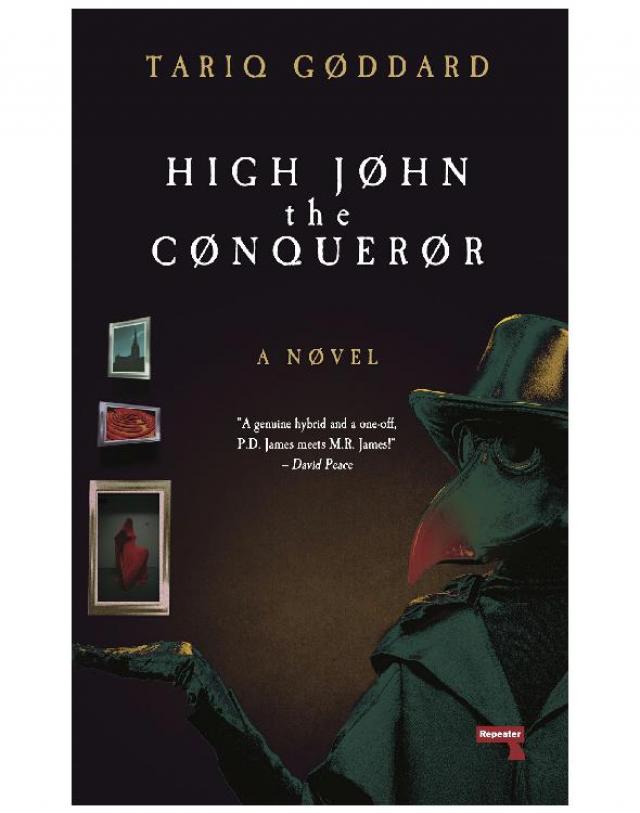


“Deranged police procedural meets darkly comic folk horror in Wild Wild Wessex. Utterly mesmerising.”
JAKE ARNOTT, AUTHOR OF THE THE LONG FIRM
“Pornography by the Cure is the ultimate brown acid album; the magic mirror from Hans Christian Andersen’s The Snow Queen, held up to the idea of the 60s & the summer of love: all optimism, joy, energy and compassion foreclosed only nihilism, horror and collapse ahead. Disintegration by the Cure is a stately review of the wreckage, which, ironically, suggests an attempt at reintegration, though there has been too much decimation for this to work. Both albums are powered by total immersion in LSD, the powerful hallucinogen which (arguably) constituted humanity’s last roll of the dice in terms of us achieving a powerful, wide-ranging and effective consciousness shift, and are soaked in the sense that we are too late. The disaster has already happened. Both albums provide some unique structure to Tariq Goddard’s latest thrilling novel, set in a significant 2016, which (I believe to be) a psychedelic, philosophical, political police procedural black comedy in a wider, solidly weird fiction universe. A Wilshire/Hampshire True Detective. The hardest of hard recommends.”
JOHN DORAN, THE QUIETUS
“Here, as in all of Tariq Goddard’s fiction, the ordinary and the uncanny, the mundane and the metaphysical — above all, the sardonic and the profound — merge with one another in some mysterious borderland that he alone seems to have explored. And High John the Conqueror may be his most entertaining novel yet.”
DAVID BENTLEY HART, AUTHOR OF THE EXPERIENCE OF GOD: BEING, CONSCIOUSNESS, BLISS
“A fantastic mix of high and low literature that just flies. The sense of place is just impeccable — I’ve never read anything that’s so unflinching in its portrait of the real rural England, I loved the tattiness of everything. The final scene is utterly burned on my brain — a truly original piece of work.”
MAT OSMAN, AUTHOR OF THE RUINS
“A wyrd & eerie tale for wyrd & eerie times, High John the Conqueror is, like High John de Conqueror itself, ‘a genuine hybrid and a one-off,’ crafting & grafting police noir, folk horror and occult parapolitics into an altered States of the Nation novel of monsters past and present. P.D. James meets M.R. James!”
DAVID PEACE, AUTHOR OF GB84 AND THE DAMNED UNITED
“It’s going to be every outsider’s beach read, a doorway into the future.”
MARK STEWART, THE POP GROUP
“Tariq Goddard has written a masterwork of the uncanny. High John the Conqueror is a trip into fresh, bizarre, thrilling new territory. Reading it is almost a hallucinatory experience — it takes daring swerves away from what we call reality, but stays close enough to life to get under your skin. By the end you’ll be altered on a cellular level, questioning what you thought you knew.”
ELVIA WILK, AUTHOR OF OVAL
“Enchanting. A novel of acute and weirdly energetic downland Shamnism of a distinctive Wessex Variety, a Hellbent English Pastoral. Goddard here comes into his own as the GrisGris man of English fiction.”
PATRICK WRIGHT, AUTHOR OF THE VILLAGE THAT DIED FOR ENGLAND
Published by Repeater Books
An imprint of Watkins Media Ltd
Unit 11 Shepperton House
89-93 Shepperton Road
London
N1 3DF
United Kingdom
www.repeaterbooks.com
A Repeater Books paperback original 2022
1
Distributed in the United States by Random House, Inc., New York.
Copyright © Tariq Goddard 2022
Tariq Goddard asserts the moral right to be identified as the author of this work.
ISBN: 9781914420306
Ebook ISBN: 9781914420313
All rights reserved. No part of this publication may be reproduced, stored in a retrieval system, or transmitted, in any form or by any means, electronic, mechanical, photocopying, recording or otherwise, without the prior permission of the publishers.
This book is sold subject to the condition that it shall not, by way of trade or otherwise, be lent, re-sold, hired out or otherwise circulated without the publisher’s prior consent in any form of binding or cover other than that in which it is published and without a similar condition including this condition being imposed on the subsequent purchaser.
Printed and bound in the UK by TJ Books
To Margaret Glover;
we live in the country but were built in London.
CONTENTS
Book One
Chapter One One Hundred Years
Chapter Two A Short-Term Effect
Chapter Three The Hanging Garden
Chapter Four Siamese Twins
Chapter Five Plainsong
Chapter Six Closedown
Chapter Seven The Figurehead
Chapter Eight Lovesong
Book Two
Chapter Nine A Strange Day
Chapter Ten The Same Deep Water as You
Chapter Eleven Cold
Chapter Twelve Pornography
Acknowledgments
BOOK ONE
What can you see elsewhere that you cannot see here?
Thomas à Kempis
There is nothing wrong with inherited wealth if you melt the silver yourself.
The Auteurs
I can take anything. I think about Nietzsche a lot. I know what the Overman is… But how much of my balls do I have to chop off to be this new guy?
Mike Tyson
Eventually all things are known. And few matter.
Gore Vidal
I always wanted to be a writer, but I became a policeman instead. I sleep badly, which allows me to brood over my capitulation every morning. Between the hours of three and five in the morning, I consider the coy wife, admiring sons, daughter that looks a little like me and the modernist new-build, on a chalk bank overlooking a view that encapsulates as much of the universe as anyone needs to see, that I blissfully inhabit. Later I read my reviews. I am shortlisted for prizes. I enjoy healthy sales, and I accept the self-assurance and self-respect, the emotional closure and intellectual finality, the lasting satisfaction and deep sleep that are the gifts of being able to sum up everything perfectly in words. Meanwhile my baser needs are met in the adulation, temptations, retreats, opportunities and openings that I accept with stoicism as the social return for being so generous with myself. As the morning chorus commences, I welcome the sliver of sleep that lasts only seconds, knowing that my readers will have to wait until I next close my eyes for the literary carousel to turn again.
Before that, I choose to belong to the world, not record it, to carefully mind and ration the hell I live in, not share it, to manage and understand truth, not tell it, and revel in the vanity of knowing that I carry my own water and give nothing up. I wanted to be a writer, but I became a policeman instead.
PROLOGUE
‘It doesn’t matter if we all die.’
Iggy had no idea why he had just said that, but it was too late to take it back and, unfortunately, wholly in keeping with a number of other disturbing developments in his life. It had taken him several weeks to realise that his belongings really were being moved round his room at night. Once the sun descended over the cul-de-sac at Hanging Hill, Iggy’s trailer was transformed into a limited-run play in which each showing was different. On the first morning of the performance, Iggy discovered his iPhone in the sock he liked to pretend was Wonder Woman’s pumping fist, instead of the device’s usual spot on the floor with the other detritus he emptied from his pockets. As he was still mashed, he found the incongruity funny, though it got him thinking.
The next manifestation of a sneaky presence, to accompany his own, was at least still amusing: a festering bowl of Frosties turned upside down at the bottom of his uninhabited fish tank, brown bubbles and shredded glitter gyrating about its murky sides. In languor he sat and watched the mouldy cereal crud rise patiently to the top, grinning at his reflection, the sock now reunited with his most treasured possession.
The ripping noises were a warning that this was not all going to be fun: eight volumes of A Song of Ice and Fire shredded and scattered by his mattress, the sixth page of each book intact and stuffed into his UGGs like papier-mâché cannon balls. And soon after, other less entertaining messages arrived, not bothering him at once, but slowly turning sour after the novelties of his morning pipe blended into the day’s habitual paranoia. His Ikea storage drawers, instead of being left ajar, with T-shirt and underpants acting as a buffer between the canvas and plywood, were closed, the clothes inside folded with an exactness he was incapable of. The orderly arrangement of these garments seemed to be posing a question about himself, or about what he was not. Iggy knew it was dangerous to make the connection, to draw the conclusion and somehow collude in the process, but he sensed he was being leerily shown up. His feelings were the real target, as they always were when an adult said he was not very good at his life, yet this was not the work of any adult; rather, it was that of a childish mind like his own, reflecting his own sinister ideas of cleverness.
And then all hell broke loose. Items he was ashamed of and had long since banished the memory of appeared outside by the step ladder, amidst the old teabags and cigarette butts, there for his auntie to find and bring in with his breakfast tray. Transformer Rescue Bots, supposedly lost in the fire that he could never remember starting, assembled round his dwelling like DEA agents closing in for a bust, followed by his cousin’s knickers that he had filched from the l
His panic was assuaged by confusion, forever the dominant influence in his life. Most nights he was so smashed he would not have noticed if his room had been taken apart and put back together, as what could be more normal in the life of an aspiring romantic than remembering nothing before going to bed? He was always up for anything after all: jumping into tubs of weedkiller, painting his toenails with varnish. He was the first of his friends to get studs, tattoos and piercings on every coverable surface. Chaos was his master. Could not all of this be consistent with the usual madness? Like most comforting and flawed ideas, Iggy cleaved to this one long after it ceased to be sensible to still do so. Besides, despite all his complaining, he was not yet used to bad outcomes in life or of things, finally and irrevocably, actually turning out for the worse.
And then, in the lonely moment of the last instance, he was woken up by something hitting him, he was sure of it, a hard slap to the face, and there, on the bed, was a boot that he had lost at the party. This party had been unlike any he had attended, culminating in his unrobing and joining the ‘old ones’ in the silver hot tub, the night it all went wrong and he met High John the Conqueror, a lifetime ago, just six weeks earlier.
The chains that dragged Iggy from appearance to disappearance were fastened unobtrusively while he was daydreaming of everlasting things: fantasies in which he saw himself as a rock star photographer, persuading his harem to show a little more flesh, or as a ripped stuntman abseiling into a blast furnace of snakes, watched by everyone who had ever doubted his courage. That he had never used a camera that wasn’t part of a mobile phone, was terrified of heights and physical risk in general, and could still believe in the possibility of greatness few are touched by, came naturally from an anodyne self-confidence bequeathed by a mother who thought he was beautiful and told him so regularly. If life would just let him be more himself, let Iggy be Iggy, then the rewards of hard work would appear, perhaps without him even having to toil for them. This hope saw him through his last summer at school — or ‘fuck-about-time’, as he liked to call it — the final few weeks a glorious riot of getting noticed, insolence and attitude. The party continued into the summer holidays, moving from his parents’ place to the trailer in his auntie’s garden, which provided his wrecking crew with a base for operations and the necessary privacy for intimacy with a couple of classmates who were in a hurry to accrue experience.
Autumn was the start of another story and it hit Iggy hard: a slurry of buddies taking off to university, apprenticeships and, where their parents could afford it, a year out in the sun. It seemed that behind the lively clothing, bids for attention and hopes for a better world, his companions had their eyes set on conventional routes out of Wiltshire after all, but then so, according to what he told them, had he. With the arrival of the coldest winter on record, Iggy still hadn’t heard from his friend’s dad who had promised him work at a recording studio, and was left behind instead with a couple of headcases, a cluster of slow readers and the banshee at Greggs that had already given him the clap. It was a betrayal of his teenage hopes, but as everyone had always suspected he lacked character, there was no one short of his mother he could complain to, and even she was beginning to change her mind now that he was no longer so beautiful but, rather, a whining man-child, approaching twenty with an unfulfillable sense of entitlement. What was so puzzling is that on paper it seemed to him like he had enjoyed himself, without ever actually being happy — the curious space between his activity and the desired state that remained as yet unattainable, his life’s sole accomplishment.
The loneliness of existence in the trailer, depressing odd jobs that he could not get the hang of, arguments with his family, and always waiting — for what, he did not know — corroded away at his surly and foundationless self-assurance. Gravitating towards an older set, already reconciled to a life of paralysing inertia, Iggy accepted mascot status: running errands to the off-licence, rolling joints and preparing needles for those too old and wasted to get their act together. Quietly, he collected the credit for being on round-the-clock call. He knew what he was doing was not exactly fun, in fact no fun at all, but it was at least proof that he still existed. Occasionally, rumours seeped through of bigger and better things, parties where posh birds danced and disrobed on hay bales and millionaire swingers paid to watch unemployed scruffs shag their wives, amongst other, darker happenings in the woods, but there seemed little way into these from the swamp that had now claimed him.
That all changed with ‘the barbecue’ at Sebastopol House on New Year’s Eve. Nick the Well, whose claim to exceptional status at the squat hung on his being part of a road crew in the Eighties, was looking for someone to help him flip gourmet burgers at Toad Hall. This prominent building, whose proper name was Sebastopol House, overlooking the dual carriageway to Ringwood, was sat in the midst of a large estate given to the first Earl of Cardigan for being near a battle in which thousands of men under his command had died. It was now occupied by Mr Toad, Mungo Masters, a hedge fund manager with an interest in young men, astral physics, pagan myth and alternative energy. The Well let it be understood that frying offal and washing lettuce was not all that was going to be required of Iggy, not by a long way, without actually getting into the specifics of what would be. In his present circumstances, the invitation, even if it were no more than signing on as hired help, was nothing short of a summons to the palace, and Iggy did not wait for it to be issued to anyone else before accepting. Besides, he could feel that increase in momentum that graces a vague life, as it churns towards a specific conclusion that it really should have nothing to do with, sensing the redemptive possibilities of cutting into someone else’s destiny, and ignoring all the danger.
The reality did not disappoint. Iggy had never seen a place like it. A Christmas tree that ought to have stood in Trafalgar Square, surrounded by mountains of unopened presents, resided beside a giant staircase that ascended high into the skull of the domed building. Forming a welcoming phalanx, girls in tights, dressed as elves, and boys in Speedos and Santa caps, handed round stockings overflowing with pills in seasonal colours. Iggy did not do much cooking that night, but his mother’s promises came true. He was there for days before he even knew what had happened. Since then he had returned to Toad Hall in his dreams, his recollection of a heavenly ecstasy slowly turning into the fear that a presence had followed him home. And it was not going to leave without him, as what else were these strange goings on in his caravan if not evidence that being scared of the dark is safer than becoming it?
There was a shadow moving across the walls of his room — of that Iggy was sure — closing in and preventing him from physically rising and running away. It was coming for him, and he wanted to scream loudly enough to wake up, but he was too scared to because he knew he was already awake and that life, disappointing as it often was, would still be there in the morning, whereas he no longer would be.
‘It doesn’t matter if we all die,’ he yells, and then the room is quiet. There is no one in it anymore.
CHAPTER ONE
ONE HUNDRED YEARS
Wessex, 2016
I always wanted to be a writer, but I became a policeman instead. On mornings like this the writer is crawling round reality warily, the detective taking credit for turning up — one trying to grasp what days are for, the other putting these insights inexpertly into practice. Today the struggle takes place stood in the careworn bungalow of a missing person’s family: the sixth youth to have disappeared this year from Hanging Hill, our city’s least fondly spoken of housing estate.
‘How long is it since you last saw Iggy?’ asks Detective Chief Inspector Tamla Sioux for a second time, pouting slightly, a sign that she knows she is not being taken seriously, and that short of breaking a nose or two, she has lost her chance to make an authoritative first impression. This is not her fault. We both look like central-casting detectives, put-upon and pretty, which may give the public something nice to look at, but annoys our less telegenic colleagues, suggesting that if we are the lead actors, they are minor characters in the same drama.