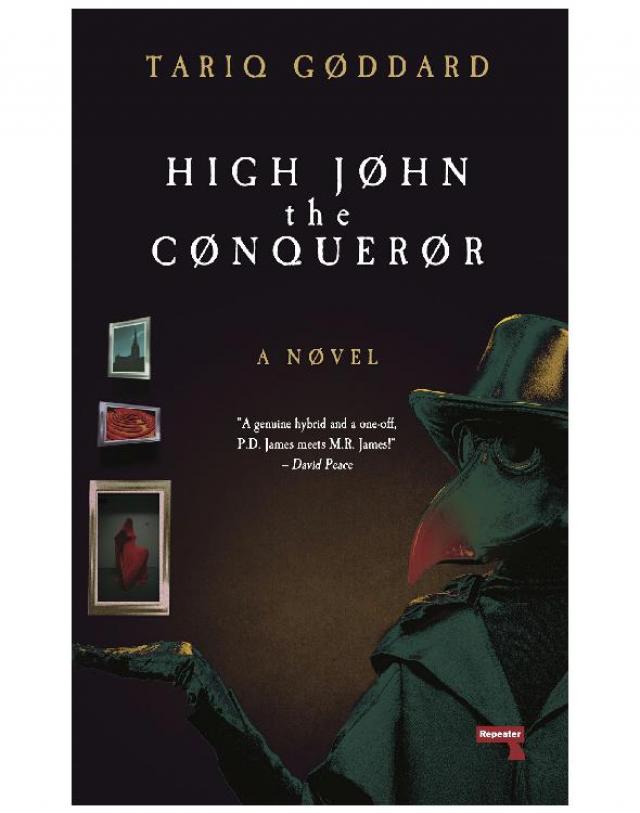
High John the Conqueror, page 15


Hanging about in the Hearse is in danger of becoming even less fun that the usual average for this time of year, and although he lacks the imagination to visualise exactly how matters could be worse for him at this moment, he has seen things with his own eyes and need only play those back to remember that he had better get a move on if he is serious about switching dimensions and indulging in time travel. Word was that if you pre-empted ‘it’, you might even be able to choose what kind of trip you had — maybe even making it your own, undoing mistakes and remaking a future in line with whatever you had wanted your life to be in the first place. There were so many legends about this stuff that it was impossible for a gambling man to not want to eventually play the percentages and take a punt.
That’s why he has already had a cheeky little nibble and is now thinking that there may never be a better time to snaffle the bag, though this requires privacy and some modest security arrangements, as it would not do to unravel in front of Maureen, who has been in a raging piss ever since that fruit and nut job arrived with the toy axe and smashed the place up.
The Hearse had cleared out as soon as the law left, and what a fucking awful pair of pigs they were: Nick Cave and Ed Sheeran, the new kind that had watched the movies you hadn’t and probably had degrees in psychology and scriptwriting. At least no one had added to the ‘he came, he saw, he fucked off’ narrative, though with the way shit accumulates, this counts only as a temporary stay of execution. Soon it will all be in the open and, having closed the pub for the day, and maybe for longer than a day, The Well is ready to find out what the fuss is all about. Painfully, the arthritis having set up shop in his hips, and his back aching from receiving confidences over the bar, The Well ascends the narrow staircase, the combination of its steepness and the small treads meaning that he is on his hands and knees by the time he gets to the top. The lavatory in one of the en suite guest rooms is where he will be safest.
Pulling himself up, resting a hand on two signs either side of the narrow corridor, absolute piss-takes both, a ‘Love Local, Trust Local’ badge on one wall and a plaque pointing towards ‘stunning wedding venue and conference rooms’ on the other, reminders of more ambitious times. The Well shakes his head at the forlorn hope of ever turning this disaster into a normal pub, where speculative punters of the future might have washed their hands after a piss and asked about specials boards, instead of it remaining what it always was: a hen pen that has successfully fought off successive gentrification drives.
The Well squeezes into his room of choice, leaving the unnumbered door ajar as it is less likely to alert potential hunters of his presence than if he attempted to cover his tracks by either closing or locking it. Though spotless by the standards of the building, it nonetheless reeks of sheets that have never been aired or allowed to dry properly, reminding him of a Gucci case he stole at the airport, only to find it full of damp Austrian laundry. He stumbles over the vacuum cleaner and edges his way into the cracked-tile cubicle that punters usually confuse for an ironing cuddy, which is one way to excuse the fools who have taken a crap amongst the coat hangers and magic trees in the cupboard next to it. Their loss though, because this windowless space is his favourite corner of the pub and probably, for his money, the best shitter in the world, combining remoteness and function, the single spot where no one has yet demonstrated the guile to disturb him. He can take himself seriously here and become whatever he wants without fearing how his metamorphosis will appear to the others.
‘Jesusssss…’
The Well does not enjoy recognising the greasy-faced phantom in the silver acrylic mirror sheet, square strips of which are strategically situated through the guest rooms to inspire loving couples to ever greater levels of copulative ecstasy — that was the idea anyway. On the basis of the footage he’s observed, stored in the infra-red ‘burglar alarms’ that double as cameras in every room, this has not quite worked out in practice. Maureen was either too ambitious, kinky or bored to consider standard sexual possibilities; not even the most creative coprophiliac or scat-king was going to enjoy catching their reflection while taking their pleasure over a tatty thunderbox, and what she was doing sticking strips by the plug sockets is anyone’s guess. It’s just as well he has never tried getting it on here, because his hatred of mirrors is equal to that of any vampire. The Well’s problem with looking glasses relates to being the physical subject of his own experience, a relationship he does not like to be reminded of. Usually he knows where not to look, reflexively dodging them at any possible point of contact, but today, in his clumsy haste, he is caught out.
It is too late to ignore the acrylic strip or close his eyes, and, in an instant, he sees his life again: the first time he knew he was ugly, his profile reflected on the mirrored pillars of Topman, Southampton, New Year’s Day, 1986; coming up on a trippy pill as his nose melted in a friend’s bathroom a year later; the awful ritual of his morning shave, before he let his whiskers go; and so on, the compressed highlights of his tawdry facial history. Hard as he tries, he could never make the person he wanted to be out of the one he saw, his compulsion not to register what others perceived every time they looked at him out of control, as he fled from passport photo booths and avoided group shots with his mates. Finally, the burden of wishing his mug was stuck on someone else’s stalk, skulking through adolescence pretending he had no face, gave way to his acceptance that he would have to hide the one he had. And so he created ‘The Well’: the jacket he can zip up to his nose that has been his shield ever since those difficult early days, his comfort garment and saviour.
Summoning his courage, as if fate has brought him to this point with the specific aim of forcing him to confront his demon, The Well zips the collar right down, allowing the light to glance off his chin.
It is only a face, he tells himself; it is not so bad.
But it is.
What he is witness to is so far removed from even his worst imaginings that he cries out aloud in a bid to wake himself up.
‘No, no, no, no, this isn’t happening… it can’t be.’
But it is. It really is. Unaccountably, his face is no longer there. In an awful reversal of causality, The Well reluctantly acknowledges that, without actually turning his head, he is staring at a reflection of the back of his neck and collar. Incapable of accepting the evidence of his senses, fearing what more he might see if he does not look away, he runs his fingers over his eyes and retreats to the squeaky plastic seat, which slips to one side under his weight like a Frisbee. He is no way in control of himself, that much he might have conceded when he hit the whisky as soon as the cops had left, Maureen coolly telling him that she was finally ready to wash her hands of their association and that he should pack his things and leave.
But it is not the whisky that is playing games with him, convenient as it would be to reach for the materialist explanation. Compared to what he has just seen, one knows where one is with whisky. Could the little bit of Old Father Time, Acid Horse or High John the Conqueror — they all belong to the same evil family — he munched have done it to him? Gingerly, he rises to his knees and lifts his crown up to the reflecting tape, prepared for anything other than what he actually sees. Nothing, there is nothing there. He reaches his hand out to make sure that he is level with the void, and perhaps to confirm that his head still exists, touching his nose and then the tape, but there is no reflection at all now, only solid air leading back to the peeling grey plaster of the wall opposite.
There is nothing to do except pretend that it hasn’t happened. It has always been an unlucky room, the bog excepted. Twice he has tried to go cold turkey here, both times falling into a feverish semi-sleep, not deep enough to pass out properly, entering into that indeterminate state that is more like madness. He shudders as he recalls the strange and shrill repetitions of words, jumbled entreaties of voices he accidentally stored, crazed ideas and notions that could not make the journey into the pictures he normally saw as he slept that have haunted him within these walls. A reconfiguration of his body occurred too on each occasion, experiencing himself as a battered container tanker sinking in the oceanic depths of his own sweat, trying to set a course and sail to the dry end of the mattress and land on an island he had purchased with his savings, but the promised terra firma was forever out of reach, leaving him shipwrecked on his back with nowhere to drop anchor, and so on into the delirium of withdrawal without end. Such times, such times.
Perhaps this is more of that? He hopes so.
Now where did he put the goods?
Panicking again, The Well’s hand shoots into his coat pocket, the torn one. No, he wouldn’t be so stupid as to leave it there. He tries the other side — thank God, thank God. Wiping the tears off his cheek with his free hand, crying periodically now like an athlete trying to catch his breath, relieved that he need only concentrate on what he need do next, The Well clasps the bag firmly in his fist, and then, easing it slightly, examines his treasure. He was right to rid of himself of the remaining packs of Acid Horse but to hold on to this beauty, the thoroughbred alpha dog. Christ, it even looks like it’s been delivered fresh from hell, the most potent batch yet, stalks as thick as twigs, the holding bracken dense like a steel afro and the lumps as large as horse turds and heavy like stones. Payola. Old Man is stronger than ’Orse. Truly, if the cops had seen this fucker they wouldn’t even have thought they were looking at drugs and probably sent the lot off to the Science Museum! He licks his lips, feeling a lift at last, and affords himself an approving grunt. The moment before you do something that will fuck you up is always thrilling, bidding goodbye to one state and awaiting the hit of another. In the spirit of a villain who cannot resist a final speech as he stands over the hero with a loaded gun, The Well savours his goods and the moment, picking out and grinding a softish lump between his thumb and forefinger, watching the potent nuggets fall away and gather on his waiting palm like bird food, the process so devoid of the usual encumbrances of being alive that he finds he cannot resist the urge to sing to his redeemer:
‘Oooo, it is a long way to go, a black angel by your side…’
He sounds like a heavy metal chorister, literally long-haired and literally angelic, really he does, laughable as it might be to anyone else to describe him this way. He decides to really go for it.
‘The sirens call a sailor to die, enchanted by the sound,
He’s turning old, he shall never return, sail on to the eternal reward!’
For once he feels his age without really believing it, unconvinced that he has really spent fifty-six years in this body, relying instead on a certain self-possession, a deliberate attention to things, that will keep him young and take him forward. He has grown and learnt but not really liked how he has grown or what he has learnt, and, in this cramped disrespected space, he will soon forget all that and embrace a vision of himself that will brook no contradiction. The redemptive interval between states, typical of every reprieve The Well has ever known, must be luxuriated in to the exclusion of all else, his guard included. On!
‘Oh no you don’t, my lad. You’re not going to pass through my hands so easily!’ Interrupts an unwelcome voice.
‘Let me explain. Fuck!’
‘Can’t do that.’
‘No, no, no…’
The Well permits the intruder to get on with strangling him, pinning his head to the pipe, their bodies barely able to grapple in the tiny cubicle, the thunderous eruption of steps and whack of the door being kicked open that ought to have alerted him to the impending invasion of his sanctuary all registering some seconds too late.
‘Never give your enemy the chance to land on your shore. Always defend your perimeter, you ’orrible man.’
‘You’ll kill me,’ he gasps.
‘It’s the predictability of you, that’s what’s so inexcusable.’
Faced with such passionate certainty, it is hard for The Well to disagree, yet even now he clings to a few stubborn reservations. How can he be predictable when he is doing something for the first time? Why is he scared of the marks that will be left round the wrung neck of his corpse? How can a thing be both true and bollocks? He’ll have to return to that last one another time, if there is one, as it may hold the key to them all — the rough hands he had hoped to stay a dimension ahead of still wrapped firmly round his neck; the slight loosening he had expected, now that his tormenter had made his point, alarmingly slow to transpire.
The waves are crashing in. Time is inevitability. Time is eternal.
But life, especially his, is not.
*
‘How big is the estate, Dexter?’ I ask.
‘Most of the land we’ve driven through since we reached the village is his, I think, boss.’
This amounts to a lot of land. The village is an entanglement of former labourers’ cottages tarted up into second homes, an ugly prefab shop selling shortbread with a post office window jammed in by the till and a church that catches the light on its mauve windows in a way that is more suggestive of God than anything that has occurred within the building.
‘Owning a village, for Christ’s sake. Most of us never even get to own a tree.’ I tap the window and point to the giant outline of Sebastopol House. ‘That thing, I hear it’s a health and safety risk, right?’
‘Tell me about it. The Parish Council would tear down a guinea pig pen without planning permission, but they bend over a barrel for that creepy monstrosity in a heartbeat. There’s asbestos buried all over the property and local builders in every care home who’ve carked it before their time because they have had to handle the stuff. The bigger you are, the harder you are to say no to. That’s life, isn’t it? NFW: Normal-For-Wessex. Masters holds a massive garden party every summer. The worthies are invited — MPs, people off the telly. I mean, it’s not like the Mafia, but they let him get away with…’
‘…murder?’
Christopherson bum-humps his seat awkwardly.
‘I suppose that’s the question, isn’t it? Bit of a leap from turning a blind eye to a toff pushing his luck with agricultural ties to giving their blessings to the ritualistic offing of folk… It’s a given you’re going to be doing the talking. Right, boss?’
‘As Chief Investigating Officer, I can hardly allow you to lead the line. Lurk in the shadows all you want.’
Muttering his thanks, Christopherson catches my eye in the rear-view mirror with the calm of one who suspects the brakes may not work.
‘I’m buzzing,’ he chuckles. ‘They all warned me you’d get me into trouble one day.’
‘You? I don’t know what I was doing letting you talk me into this, Dexter.’
‘Yeah, I should have kept my big mouth shut, eh?’
‘Think of it as one for the grandchildren, when you’re a revered old man living in a house like that one.’
‘Not in this life. I’d rather take my chances sleeping in the woods than upgrade there. Castle Dracula isn’t my style.’
The imposing construction looming in the distance seems to surround the countryside it is so well positioned to unsettle, throwing its long self round us like a constrictor about to suffocate its prey. Its prominence differs markedly from its neighbours: stately homes that lack its confidence and swaggering visibility, preferring to wear their privilege lightly and flaunt their treasures in private. These country piles are discreetly tucked from view, reached through unmarked and innocuous entrances, leading through interminable potholed tracks until they finally show off the buildings the approach is designed to disguise. Sebastopol House shares as much with these relics of a shyer era as stuffing money into a mattress does with walking into the Bank of England. It was built as a deliberate statement of baronial intent, a power play cast over the entire area and a challenge to any usurper who might get it into their head that no one deserves to inhabit anything so resplendent and grand. In bad weather, its vast length and girth stand like a flood barrier against the elements, the mansion’s outline shaped like a cumbersome devil-bat, the outstretched wings of the building intimidating traffic that passes in awe from afar. In the sunshine, its glass façade catches light, transforming it into a colossal magnifying glass, and can be seen as far as the city, blinding tractor drivers and delivery men to the cost of cyclists and pedestrians alike. The most recent modifications carry the assault further into the sky, its shield of solar panels threatening low-flying microlights that make the mistake of looking down, and the RAF, who redeploy their helicopters over the coast so as to not add to the potential carnage. In a property-owning kleptocracy, this is the spot to strike if I am impatient to begin the novel I will never write and embrace early retirement — Christopherson’s get-out: that he had come to keep an eye on a superior he could not say no to.
‘It’s funny. It doesn’t end up looking smaller as you get closer to it. I don’t expect it to literally — I just thought it might fit into the scale of the things around it a bit more.’
‘It’s the whole point, isn’t it? It’s been made so that it can’t.’
We turn off the dual carriageway which connects the cathedral city to a market town that was once notorious for youths ambushing passengers at its bus terminal, the county split into warring fiefdoms that would last until the combatants left secondary school and the sensible ones joined the army or police. The hub is now the fortunate location of an attractive new Waterstones, housed in a former brewery, where the surviving warriors of yesteryear scan staff picks, shoplift stationery and probably miss the old days in their lunch breaks, when life was nasty, brutish and short, but at least their own. For a brief interlude, we lose sight of Sebastopol House. Unnervingly, it feels like the building no longer wants to see us. Our car rumbles over the cattle grids into a phalanx of narrow lanes where our progress is slowed by allowing a four-wheel drive to pass and idling ponies to block the road, the delays informing the illusion that we are going further, and further back in time, than we are.