Temporary Husband, page 1
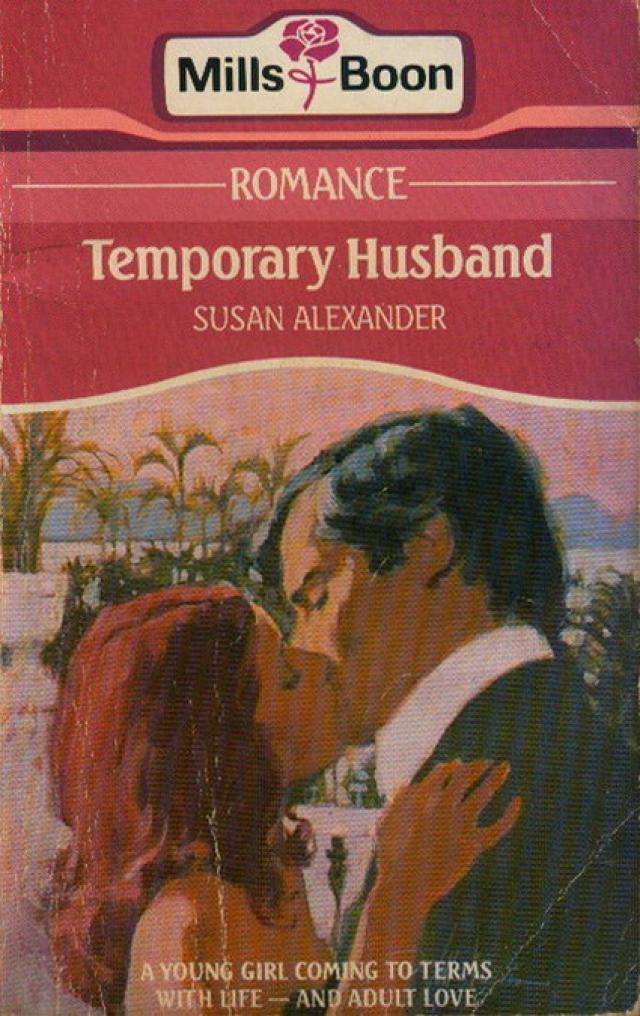


Temporary Husband
By
Susan Alexander
Contents
CHAPTER ONE
CHAPTER TWO
CHAPTER THREE
CHAPTER FOUR
CHAPTER FIVE
CHAPTER SIX
CHAPTER SEVEN
CHAPTER EIGHT
CHAPTER NINE
CHAPTER TEN
CHAPTER ELEVEN
CHAPTER TWELVE
CHAPTER THIRTEEN
TEMPORARY HUSBAND
Kate had been forced into marrying Blake Templeton, the film director, and going on location with him. But how could she stay with him, when he was so cold towards her—and she loved another man?
Another book you will enjoy
by
SUSAN ALEXANDER
THE MARRIAGE CONTRACT
After the callous way he had disowned her mother, the last thing Rosanna wanted was to have anything to do with her autocratic grandfather. Yet now, if her mother was not to die, Rosanna must do as he wanted, go to Sicily, marry the man he had chosen for her, and give him an heir. Even for her beloved mother, could Rosanna nerve herself to do it?
First published in Great Britain 1985
by Mills & Boon Limited
© Susan Alexander 1985
Australian copyright 1985
Philippine copyright 1985
This edition 1985
ISBN 0 263 75002 7
CHAPTER ONE
The large black Rolls-Royce slid silently through the grey stone gateposts of the cemetery, slowly gathering speed as it moved out into the traffic on the main road.
In one corner of the back seat Kate Howard sat bolt upright, her set face a white blur behind the heavy black veil. Her eyes were riveted to the back of the grey uniformed chauffeur beyond the glass partition, but she saw nothing of the reality around her, her mind fixed on the finality of the scene she had just left. Over and over, like an endlessly repeated newsreel she could see the fresh earth fall into the open grave, gradually hiding the coffin from view and eventually covering it, burying it for ever.
It was over.
The phrase beat into her brain, reverberating round in her head, meaningless, hopeless and final.
The tall dark man at her side was also motionless, his face revealing nothing of his thoughts or feelings, his head turned away from his companion, his eyes on the rain hissing quietly against the tinted windows of the car.
As the Rolls ate up the miles into London, Kate's mind began to thaw, her tenacious self-control relaxing its hold. The past twenty-four hours had been a nightmare of frenzied activity, holding emotion at bay, firmly repressing pain and grief.
The telegram had arrived during one of her art classes, and they had tried to break it to her gently. Did she know her father was ill? Had she realised his health was deteriorating? But she had guessed almost at once, breaking out into hysterics, only to be heavily sedated. In the morning she had woken, her mind clear, her feelings frozen, and organised her journey home in time for the funeral. Her goodbyes to friends and teachers at her Paris finishing school had been oddly final, as though it was unlikely she would ever see them again.
Only Henri had refused to accept her outward coldness, her lack of any emotion. Within an hour of her phone call he had appeared at the school demanding to accompany her to London. Driving her to the airport he had argued and pleaded, but she had been firm. It was better she go alone.
And now she wondered if her departure would change their plans. For months they had been hoping for an invitation to Kate from the powerful old lady who had brought him up and still held the purse strings of the du Bois vineyard fortune that would come to Henri as the only male heir. Kate had met Henri's sister and brother-in-law one evening at their Paris house, and the obvious wealth and pride of the aristocratic du Bois family had kept her tongue-tied during the long meal. She had found nothing in common with their talk of horse racing, yachting, French politics and the glittering programme of entertainments and sports with which they seemed to fill their days. But Henri had felt quite differently about the success of the evening.
'They liked you, chérie.' he said happily as he drove her home.
She laughed nervously. 'I don't see how they could. I never said a word.'
'They were interested in only one thing tonight.'
'And what was that?'
'Whether you are a virgin,' he answered bluntly.
She had blushed faintly in the darkness of the car.
'It is the thing of most importance,' he insisted. 'Everything else is secondary.'
'But what about family, wealth, connections?' She'd spoken shyly. 'I don't belong to your world and they must have seen that.'
'When we marry,' he said importantly, 'I will bring you into my world, and they will accept you. Anyway it is only grandmère who matters.'
'Have you spoken to her yet?' she asked anxiously.
'Er… no, not yet.' He hesitated. 'The time has to be right. Now that Gabrielle and Pierre have met you, it will be easier to approach grandmère. Next week I will go to the chateau. She can talk to me about wine and will be pleased with me for coming. That will be a good time. You will see. Everything will be fine.'
He flashed her a smile, showing white teeth in a handsome face. They kissed a lingering good night and, as always, she thrilled in his arms. Henri kissed her intimately and firmly, and had taught her to return his kiss. But he never lost control. Other boys with whom she had gone out in London had handled her clumsily and soon lost control, demanding responses she had no wish to give. But then Henri was much older than anyone else she knew. He was nearly twenty-four and, as her friend Mary always said, French boys grew up much faster and knew a lot more than English boys of the same age.
Following that evening Henri had been away a month while she wavered between anger that he didn't write and despair that she might never see him again. Finally, one morning a note arrived asking her to meet him. It had been snowing and Paris was white and frosty as she slithered in her heavy suede boots along the iced pavements to Notre-Dame.
He had taken her in his arms and kissed her, his face and lips cold against her skin. In the church they talked, sitting in a side chapel, whispering.
'Where have you been?' she began. 'Why didn't you write?'
'It wasn't possible, chérie. Please don't waste time talking about things that are not important.'
Kate looked at him. He was just the same. The regular features, blue eyes with pale straight brows, the full mouth and the skin tanned as always. The slim figure visible under the fur-lined coat was clad in immaculate twill trousers and light sports jacket. He was talking persuasively.
'I had to stay, mon ange, to win her round.' He reached for her hand and carried it to his lips. 'Did you miss me?' She melted at his touch. Perhaps he was sometimes thoughtless, but she did love him.
'Grandmère has agreed you may come and visit. So we go in the summer. She asks only you bring a girlfriend, to make it all respectable.' He laughed. 'Isn't that good? Aren't you pleased? Why do you look so solemn, like a… how you say… owl?'
At that she burst out laughing. 'Oh, Henri, you are funny.' And she had been all eagerness at his plans. 'I'll ask Mary. She'll enjoy it.'
'As long as she is prepared to be much alone, so that we can be together, I do not mind who it is.'
Kate hesitated. 'Well, she's not very well off, you know, and it will be a great treat for her. So we must be nice and show her round.'
'Oui, bien, sur … of course.' He snapped his fingers. 'And now, mon ange, that is enough talk. Let us get out of here. I have not yet kissed you.'
And the invitation had arrived, embossed, heavily crested, and strangely forbidding. A month away. That's when she was due to go.
'We're here.'
The voice penetrated Kate's musings and she turned to her companion, still gripped by her memories, for a moment unsure of her surroundings. But it was not Henri's voice that spoke, nor his face at her side.
It was Blake. He was standing by the car, his hand held out to help her. She touched the hand briefly and walked past him into the house. In the hall she stood for a moment as though waiting… for the door to open to the study, for her father to appear. Almost she could hear his voice: 'Hello, sweetheart.'
But then the reality came crashing into her mind. Never again would he be there, welcoming, affectionate…
Blake touched her elbow, and she became aware of voices behind the closed double doors of the living room. Awkwardly she turned away from Blake.
'I'm going up for a quick wash,' she murmured and walked upstairs. In her room she took off her veil, wondering suddenly if it had been Blake who had organised everything… the funeral, invitations, the sherry and biscuits that no doubt Mrs Buss was serving downstairs. Was it Blake, she tried to recall, who had sent the telegram?
Walking back downstairs she found Blake waiting in the hall. Her face softened. He was probably the only person who would understand how she felt. He had been her father's best friend for as long as she could remember. And over the years there had been countless occasions when she had been excited because he was taking her to a film premiere, the private view of a new art exhibition or merely a dawn gallop along Rotten Row in Hyde Park.
He was looking up at her and she realised they hadn't seen each other for nearly two years, years in which she had learnt to dress with Parisian chic, have her hair styled and use make-up. She must seem quite a stranger.
& nbsp; 'Blake.'
She moved to kiss him as she always did, but he held her firmly at arms' length, his fingers hard on the silky material of her sleeves. Anxiously she looked up at him, her eyes questioning the rejection.
'The day isn't over yet,' he said coolly. 'Come along.' He was right. This was not the time for nostalgia. She drew away from him and walked towards the living room.
Conversation stopped abruptly as she entered, and all eyes turned to her, more people in the room than she'd expected. For the first time her Paris training came to her aid. 'Feelings are private,' Madame always stressed, 'not for public display.' Her lips curved into a polite smile, she moved forward to greet her guests.
An hour later she was alone and exhausted. Reaction was beginning to set in, the large sherry she had sipped on an empty stomach making her feel slightly queasy. She'd find Mrs Buss and get herself something to eat. As she crossed the hall the doorbell rang, and Charles walked past her to open it, while she hurried to the back of the house, unwilling to cope with any more visitors.
'Kath.'
Kate stopped. Only one person ever called her that. She felt a sudden urge to run and hide from that voice she hadn't heard in four long years. Instead she turned and faced her mother.
The front door stood open, and the outline of her mother's figure showed clearly against the light streaming into the dark hall. Slowly they walked towards each other.
'You're too late.' Kate said loudly into the void between them. Charles closed the door and walked past her.
'I'll bring some coffee,' he said quietly.
'I'll need something stronger than coffee.' Her mother had heard him. 'I hope you still keep the drinks where they used to be.' She walked into the living room and Kate followed.
As always, her mother's presence was overpowering. Kate remembered again the desperate years of her childhood with its constant fears of rejection because she was never the daughter her mother wanted… pretty, neat, clean and feminine, to be shown off to neighbours and friends. She always chose the wrong moment to come tearing in, noisy, untidy and heedless of the stable odours she brought with her. Yet how ardently she had tried to be what her mother wanted, dressing in the frills and pastel shades she hated, ready and eager to please. But somehow, within minutes, there was always something outside that beckoned, or, ignored by her mother's friends, she would lie down on the floor with paper and crayons.
Even now Kate could feel the familiar dry throat, the sickness in the pit of her stomach and the sense of inadequacy. It all returned with the full force of childhood passion as her mother faced her, looking her up and down, measuring, evaluating.
'Well.' Bella Howard contemplated her daughter, eyes narrowed in her beautiful face. 'Widow's weeds?' she asked sweetly. 'You look like the widow rather than the daughter.'
Kate didn't say anything. Her mother was still incredibly beautiful. Blonde hair, blue eyes, the small pointed face still flawless. She was elegantly dressed in a fine wool suit, tailored to hint at the curves under its severity, the collar of a cream chiffon blouse cascading from her throat, legs superbly sheathed in silk, tiny feet in handmade leather. The familiar heavy perfume was already beginning to saturate the room.
Abruptly Kate turned away, walking to the french windows, her mind rejecting her mother's presence as she remembered painfully the last time she had seen her father.
It had been Easter and he had come to visit her in Paris. They had laughed and joked as always, and he had seemed less unhappy. Only at the end of their time together he had touched on the subject always near the surface of his mind.
'I don't suppose,' he had asked casually, 'you've heard from your mother?'
She had shaken her head.
'I just wondered. Nothing important.'
He had kissed her and gone back to London, to die… alone, still as desperately in love with her mother as on the day she had left him four years earlier. And he had waited with his memories, hoping always that she would return to him… one day.
In the early months after she had gone, Kate had drawn very close to her father. He had kept her by his side, her bedtimes elastic as a series of housekeepers came and went, unable to cope with the half-child, half-mistress of the house she had become at thirteen.
But in the end, when she was fourteen, he had sent her away to school, and the separations had begun. She had tried to stop him, crying, cajoling, threatening, but he had been quietly firm. And she had loathed boarding school. The girls in her class had wasted no time on a new pupil intruding into the closed community formed when they were all much younger. And she had made no friends, living only for the end of each term and the moment she was free to rush headlong down the steps where Charles was waiting to drive her home.
But home, too, had changed. The farm and the horses had been the first to go. It had distressed her at the time, but she had asked no questions, fearing to trespass on her father's deepest emotions. Then she noticed pictures moved wider apart to cover spaces where some were missing. Finally, one Christmas, she had been shocked to see the half-empty cabinet housing her father's priceless Ming collection. And this time she found the courage to talk to him.
'Dad,' she had begun awkwardly.
'Mm…' He'd been reading.
'I don't want anything for Christmas this year,' she had explained importantly.
'Good heavens, why ever not?' He had looked up in surprise.
'And I'm taking a holiday job in one of the big stores.'
'What's this all about?' His curiosity had been genuine.
'Nothing special.' She had been evasive.
'Come on, out with it.' He laughed. 'You want something so outrageously expensive you're softening me up for the kill.'
'Of course not.' She had been appalled.
At her expression his smile faded. 'You'd better tell me all about it,' he suggested quietly.
'Are we… short of money?' she blurted out and watched his face flush with embarrassment.
She had rushed across the room to him, burying her face against his chest, babbling incoherently.
'I'm sorry. I know it's none of my business.' She gulped. 'But I could leave school and look after you. Then we'd save the fees and we could let Mrs Buss go. I don't mind being poor.' She had finished and burst into tears.
For a moment he had stiffened. Then he put her away from him, calmly and deliberately as he did everything, pressing a large handkerchief into her hands.
'I think, young lady, it's time we had a talk,' he said firmly. 'You're growing up and I tend to forget it.' He smiled down at her. 'Come up here and sit beside me.'
They had settled on the sofa in front of the fire and he began to talk, slowly, hesitantly.
'I have to go back rather a long way… to explain it all, to the time before you were born. When I met your mother I was thirty-eight and she was sixteen.' He coloured slightly and she looked away from him into the fire. 'I was experienced, relatively wealthy and probably appeared rather glamorous to her. I was certainly the only grown man she knew. Her other friends were all lads of her own age.' He cleared his throat.
'We fell in love and were married on her seventeenth birthday. Looking back I've thought many times I did her an injustice when I married her. She was too young to choose her own future. But I cared only that we loved each other, certain that we would continue to be happy together.' He paused, his eyes pensively on the fire. 'Her restlessness began when she reached thirty. It was some kind of threshold in her mind, and she started to wonder about all the things she'd never had, never tried. I let her do as she pleased, confident she needed to indulge her curiosity and would return to me.' He paused painfully.
'But I was wrong, and in the end she wanted to go. I understood, and she went with my blessing. She had given me years of happiness, perhaps more than I deserved for tying her down so young.'
Kate sat quite still, listening to the strong emotion in his voice, waiting for him to continue.
'Naturally when she went she needed money,' he said quietly, 'and I've tried to supply that. Unfortunately my earning days are coming to an end. But I've invested wisely and can now use my assets. I don't care a jot about my art collection, and your college fees are invested in a trust for you. But, sadly, antiques don't last for ever, and my worry is what will happen to her when I'm gone.'