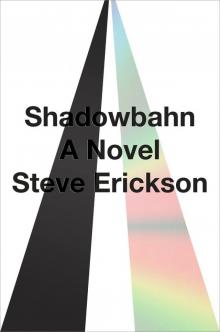
Shadowbahn, page 4


“I am watching the road.”
“You’re not.”
• • •
After a pause he says, “Are we going to have to get two rooms every night? We’ll be broke before we’re halfway.” When the motel in Flagstaff refused them a single room, hair-trigger Parker almost lunged at the owner behind the front desk as Zema pulled him back. “A little fucking twentieth-century, isn’t it?” Parker exploded at the motel manager, who shouted back something about transporting underage girls across the state line, pointing indignantly at Zema. Parker wanted to break off the man’s finger. Only when his sister got Parker outside did it hit him. “Underage?” he said, looking at her in confusion.
third crossfade
Zema said, “Don’t you get it? It’s not a race thing,” and the horror on Parker’s face might have made her laugh if she hadn’t felt as mortified. “Well, we don’t exactly look like brother and sister,” she reasoned.
Parker considered this a moment before announcing, “That’s the most disgusting thing I’ve ever heard.”
“Likewise, dude. Let’s just go on to the next place, okay?”
• • •
But at the next place they still wound up taking two rooms. That Zema has assumed her mother’s last name on her student ID and Parker his father’s on his driver’s license hardly makes less complicated that she’s black and he’s white. “Why didn’t you just keep Dad’s name?” Parker complains outside Winslow behind the wheel of the car. “You used it all the way through seventh grade or whenever it was.”
“I like Mom’s name,” Zema answers quietly, and then, “Not like I’m choosing Mom over Dad.”
song of Sheba
She says, “Where is South Dakota anyway?”
“Why are we going to—?”
“The Twin Towers,” she says, shoving the phone at him, “look.”
“Uh, trying to drive here. . . .”
“Look.” She holds the phone in front of his face and he swats it away. “Jesus, Sheba!” he cries, before correcting himself—“Zema”—under his breath. For years after they adopted her from Ethiopia at the age of two, the family called her Sheba, as in Queen of, a thousand years BC. Now to compound the confusion of last names, Parker’s sister has taken on her given Amharic birth name . . . so how are we supposed to keep straight what to call her? fumes Parker.
• • •
If at least she kept the same last name, we might be able to get one fucking motel room together, he thinks. Zema persists with the phone and he grabs it from her and looks, swerving. She shouts, “Watch the road!”
“You’re the one shoving your fucking phone in my face!” He says to the phone with a glance, “Okay, I see it. Yup, looks just like the Twin Towers.”
“They don’t know if they’re the actual Twin Towers or . . .”
“Well they can’t be the actual Twin Towers,” he replies, “can they? Believe me, I saw them come down.”
the beckoning (one)
He didn’t really see them come down, but it’s something he can hold over her, since it took place five years before she was born. He was three, in the canyon outside L.A. where they lived; his parents kept him home from school that day, like all the other parents. In the hours afterward, the whole country thought planes were falling from the sky. He wasn’t allowed to watch television, and for years after Zema came, their father wouldn’t let her watch footage of it until she finally pulled it up on YouTube when he wasn’t around.
• • •
Now, in the car, Parker forgets about the Towers until he messages his girlfriend—who recently entered a rehab center in Vancouver, putting their relationship to the test—and her only answer asks if he’s seen the news. Brother and sister grab sandwiches off the highway to Albuquerque, where they hope to spend the night. “So far they’re identical to the actual Towers,” she says, sipping her Coke.
“Who says?” answers Parker. “I don’t know what that even means.”
“Me neither,” agrees Zema. She declares, “We’re going,” and Parker shakes his head—just like Mom—smiling a bit at the memory of their father, who always told Parker that if anyone was like his mother, it was her son.
bar code
In black letters against the gray outer walls, a motel west of Albuquerque identifies itself: MOTEL. So generic, muses Parker, “I’m surprised it doesn’t have a bar code next to it.” He and Zema study the letters through the car’s windshield; the art student/conceptualist in Parker likes the idea of the bar code and suppresses the impulse to tag the motel with one, his tagging days having ended when he was Zema’s age and arrested by a sheriff for spray-painting canyon rocks.
• • •
In the motel’s registration “office,” Zema takes charge, as she figures she probably should have back in Flagstaff. “He’s my brother,” she confidently explains to the Native American woman behind the counter. The woman looks at the teenage girl, at Parker, back at Zema, and says, “Okay.” Parker interjects, “She took our mom’s name, we used to both have our dad’s but—” but the woman waves this away and Zema says, “Parker, she said okay. She believes us.”
“Or doesn’t give a shit,” the young man mutters.
“Hey.” The woman behind the counter fixes him with a stare. “I believe you.”
occupancy
Parker lets his sister have the single bed. On the floor he piles towels from the bathroom and an extra blanket from the room’s closet. The two have take-out Mexican for dinner, then with his institutionalized girlfriend in Vancouver the brother texts himself into unconsciousness, as Zema lies on her bed watching the nineteen-inch television. She has flipped through all eight channels a couple of times before settling on the news station broadcasting—in Spanish she doesn’t understand—the story of the Towers in the Badlands and the hundreds of thousands of people descending.
• • •
With the light off and Parker snoring on the floor, Zema looks out the window beside her bed and makes out in the dark a large dead oak and low stone wall beyond it, cacti beyond that, desert wind rattling the sagebrush. Although she realizes the next morning that it must have been a dream, she watches in the night an exodus of displaced Navajos as far as the eye can see, marching past the motel by the hundreds, braves and their women and children at the gunpoint of soldiers on horseback.
cartography
When she wakes to sunlight, she repeats flatly to the window what she said in the car the day before, “We’re going,” figuring her brother—curled beside her among the bath towels—is still sleeping. “You said that yesterday,” he answers from the floor.
Neither is much for maps. After punching “Michigan” into his cell back in L.A. and assuming the device would talk them through the next two thousand miles, now Parker has the revelation that looking at an actual map might approximate the psychological sensation of knowing where they are. This takes on more significance when they’re no longer sure where they’ll sleep.
• • •
Parker tosses aside the towels and blankets on which he’s spent the night and spreads across the floor the map they got at a convenience store in Kingman. He crawls around it several times before he’s sure, more or less, that he and the map are aligned and pointing the same direction.
Determining Albuquerque is in New Mexico is one thing. But now, studying the map—and in part because, even fifteen hundred miles away, he’s disinclined to give his mother the satisfaction of being right—Parker withholds from his sister larger concerns, born of paying just enough attention to the news to know that between here and Michigan is more trouble than roads and routes and maps can resolve.
current events
What Parker hasn’t told Zema is that after all those years when their mother wanted that big Route 66 road trip, now, if it were up to her, they wouldn’t be driving at all. On Interstate 40 through northeast Arizona and the western part of New Mexico, the brother and sister already have passed signs of the Rupture, banners of Disunion flying from flagpoles and fastened to the few bare trees that defy the desert rock. Until she finally looks back up at him across the map there in the Bar Code Motel, Parker studies his sister.
• • •
Silently he stews over territorial frontiers yet to be crossed. He stews over border guards yet to be answered to, and Rupture zones all over Kansas, Oklahoma, Texas, where the siblings need to pick up Route 83 in the Panhandle past Amarillo and head almost due north for South Dakota—or as best as Parker can determine, anyway, given that he hasn’t any more forbearance for figuring out such things than anyone else born within the temporal radius of the twenty-first century. “Dad always said no one in this family has the slightest patience,” Parker muses, expecting nothing from Zema, who, notwithstanding the old playlists on the car stereo, rarely responds to mention of their father. So it’s a surprise when she mutters in return, “As though he did.”
mixtape nation
Parker was also surprised at the trip’s outset when Zema downloaded their father’s playlist onto the car stereo. This was after trying to find a radio station in the fourteen-year-old Camry with two hundred thousand miles on it that Parker inherited to no objection from Zema, who usually protested on sheer principle whenever her brother was favored for anything and any reason.
Shooting her a sideways look, he had said it as casually as possible, “Dad’s playlist.” When Zema didn’t answer, he pressed, “Remember he always wanted to upgrade the sound system in this thing? We were always on him about his boring mu—”
• • •
“I remember,” she had snapped. Now, as they cross Navajo and Acoma lands, a song from the playlist called “Little Sister” comes on the stereo. Parker turns it off. “Don’t need any songs about little sisters, thank you,” he tells his little sister.
“He’s not singing about his little sister,” she explains, “he’s singing about—”
“I know what he’s singing about,” says Parker, slightly stunned when Zema shoots back, “Dad loved this guy,” the first declamatory thing about their father that he can remember her saying in years.
song of Zema
Although he doesn’t want to discourage it, he can’t help answering, “You loved this guy.”
“What?”
“You loved this guy,” he is adamant.
“Uh, I . . .” but even Zema knows her dissent sounds hesitant.
“First it was Mr. English Spaceguy with the red hair who wore dresses,” Parker says, “then it was him,” pointing at the stereo. “Dad liked him, you loved him.”
• • •
Parker thinks it’s typical that the first conversation they’ve had about their father in as long as he can remember, they’re arguing about his music. “What Dad loved,” Parker continues, “was all that sixties shit that doesn’t make sense. The walrus one and—”
“Walrus?”
“The point is, Dad liked him well enough,” he says, gesturing once more at the singer on the stereo, “but you had him on your bedroom wall. You had the birthday party with all his songs. Out went the Jean Genies and in came the hound dogs. You were crushing on his cheekbones when you were seven, before you went all blackedy-black on us.”
EQ (frequency-specific)
Zema looks at him. “Excuse me?”
“Never mind,” he answers.
“Wait—”
“I didn’t mean anything by it,” Parker insists irritably, “forget it, I take it back. Fuck,” he mutters, “I was blacker than you were.” Neither can remember their ever having had a conversation like this, but then they haven’t ever had a real conversation about much of anything.
She does vaguely recall a poster on her wall when she was eight: the singer as a cowboy drawing a six-gun from his holster as though in a gunfight in a Western, no cowboy hat, long-sleeve buttoned shirt and boots and jeans double-belted. The image duplicated, looking not square into the camera but ever so slightly off right.
• • •
That was about the time when her sense of racial identity began to take hold. When she learned of black baseball players in the forties from biopics that their father took her to see, African-American ministers shot down. It was about the time she became more aware of herself as a black girl, their mother quizzing her as to who was singing on the radio. “This?”
“Billie Holiday,” Zema would answer.
“This?”
“Aretha.”
EQ (flat)
Soon, as Parker might put it, out went I’m all shook up and in came I break out in a cold sweat. As the cultural paradox of the times would have it, she did first learn her blackedy-black from her white hip-hop brother, remembering now something their father told Parker the time they were all stranded in London, one night when both father and son thought she was asleep. In the next room her father talked to her brother—younger then than Zema is now—like she had never heard, his voice taking on an uncommon urgency. “You can’t use that word,” he said, “it’s the worst word you can use. I’d rather you use the F-word, not that I want you to use that either. But better that. I know they use it in the music you listen to, but language exists in a context, and if they use that word among themselves, it means something different than if you use it, do you understand?”
• • •
“I’ve never used it,” she heard her brother.
“I know that,” their father answered, “but I’m telling you anyway. It’s important you understand. You use that word and it means four hundred years of terrible shit whether you mean it or not. So I don’t want to hear it from you and I don’t want your sister to hear it. She’ll hear it too soon enough, but not from anyone in this family.”
“All right,” Parker answered quietly, trying to muster some rebellious irritation with little success, and Zema wanted to jump up and run into the next room and defend him.
the secret song
Because Zema has a secret: she adores him. Although she’ll go to extraordinary lengths to dispute it, she adores Parker even more than she adores her mother and even more than her father, whenever she can bring herself to think of her father. When she was two and her mother came to get her from the orphanage in Addis Ababa, among all the gifts and mementos it was Parker’s photo that the girl clutched in her hand and wouldn’t let go, even if subsequent years might have found sister and brother barely on speaking terms, except when she was provoking him or he was insulting her.
• • •
At the depths of their relationship, her secret adoration of him—sometimes almost secret to herself—is such that she has tried to be him. This was during the time she insisted to her family and everyone else that she was a boy, a phase that may or may not be ending now. There have been years she was confused, and more recent years when she may still have been confused or only pretending to be confused. In the thirteen years since Zema came to America, she has never had any idea that having no idea who she is and having no idea where she belongs makes her more American than anyone. For his part, Parker hasn’t so much failed to acknowledge his sister’s adoration as refused to. Neither has yet learned how time lays relentless siege to the denials of hearts drawn most inexorably to the truth.
trans (impunity)
Staring at her cell in the passenger seat, Zema says, “There’s music coming out,” and it’s half a minute before Parker, distracted, barely answers, “Turn it off if you want.”
She looks at her brother and then at the car stereo. “Out of the Towers, I mean,” she says. On the highway they pass slashing blood-red mesas rising like octaves and tiny towns crowned by signs that announce their names from towering bluffs flanked by flags, mostly Disunion. LEVI’S FROM NEW YORK! promises one storefront. Overhead, a skywriter jet unzips the sky. “Music,” she clarifies, “is coming out of the Towers.”
• • •
Parker says, “What towers?”
She rolls her eyes. “The Towers we’re driving four hundred miles out of our way for.” She can’t tell if her brother is still distracted or if distraction has given way to confusion. Finally he says, “Someone inside is playing music?”
“No one is inside,” she explains, “there’s music coming from them. Isn’t that what I said?”
“Like, what, it’s a stereo? They’re big speakers or something? One’s bass and the other’s treble?”
“Speakers? What are you talking about? They’re two buildings a hundred stories tall.”
“No.”
stereo (bass)
Zema says to her brother, “What do you mean no?” As they near the Texas border, I-40 turns into a so-called thruway, federal interstate protected by chain fence trespassing Rupture territories marked by more Disunion flags. Since checking out of the Bar Code Motel, Parker and Zema have heard on three different occasions of a rumored thoroughfare unmarked on any map, a secret highway called the “shadowbahn” that cuts through the heart of the country from one end to the other with impunity.
• • •
Crossing friendly Union and hostile Disunion territories alike, allegedly the secret highway runs from an undisclosed western point to an undisclosed eastern, as though there is no America at all of physicality or fact, only the America of the mind—whatever America that might be, to whatever mind might ponder it. “They’re not a hundred stories tall,” Parker answers.
Zema practically shouts, “They’re the flippin’ Twin Towers!”
“You’re not.”
• • •
After a pause he says, “Are we going to have to get two rooms every night? We’ll be broke before we’re halfway.” When the motel in Flagstaff refused them a single room, hair-trigger Parker almost lunged at the owner behind the front desk as Zema pulled him back. “A little fucking twentieth-century, isn’t it?” Parker exploded at the motel manager, who shouted back something about transporting underage girls across the state line, pointing indignantly at Zema. Parker wanted to break off the man’s finger. Only when his sister got Parker outside did it hit him. “Underage?” he said, looking at her in confusion.
third crossfade
Zema said, “Don’t you get it? It’s not a race thing,” and the horror on Parker’s face might have made her laugh if she hadn’t felt as mortified. “Well, we don’t exactly look like brother and sister,” she reasoned.
Parker considered this a moment before announcing, “That’s the most disgusting thing I’ve ever heard.”
“Likewise, dude. Let’s just go on to the next place, okay?”
• • •
But at the next place they still wound up taking two rooms. That Zema has assumed her mother’s last name on her student ID and Parker his father’s on his driver’s license hardly makes less complicated that she’s black and he’s white. “Why didn’t you just keep Dad’s name?” Parker complains outside Winslow behind the wheel of the car. “You used it all the way through seventh grade or whenever it was.”
“I like Mom’s name,” Zema answers quietly, and then, “Not like I’m choosing Mom over Dad.”
song of Sheba
She says, “Where is South Dakota anyway?”
“Why are we going to—?”
“The Twin Towers,” she says, shoving the phone at him, “look.”
“Uh, trying to drive here. . . .”
“Look.” She holds the phone in front of his face and he swats it away. “Jesus, Sheba!” he cries, before correcting himself—“Zema”—under his breath. For years after they adopted her from Ethiopia at the age of two, the family called her Sheba, as in Queen of, a thousand years BC. Now to compound the confusion of last names, Parker’s sister has taken on her given Amharic birth name . . . so how are we supposed to keep straight what to call her? fumes Parker.
• • •
If at least she kept the same last name, we might be able to get one fucking motel room together, he thinks. Zema persists with the phone and he grabs it from her and looks, swerving. She shouts, “Watch the road!”
“You’re the one shoving your fucking phone in my face!” He says to the phone with a glance, “Okay, I see it. Yup, looks just like the Twin Towers.”
“They don’t know if they’re the actual Twin Towers or . . .”
“Well they can’t be the actual Twin Towers,” he replies, “can they? Believe me, I saw them come down.”
the beckoning (one)
He didn’t really see them come down, but it’s something he can hold over her, since it took place five years before she was born. He was three, in the canyon outside L.A. where they lived; his parents kept him home from school that day, like all the other parents. In the hours afterward, the whole country thought planes were falling from the sky. He wasn’t allowed to watch television, and for years after Zema came, their father wouldn’t let her watch footage of it until she finally pulled it up on YouTube when he wasn’t around.
• • •
Now, in the car, Parker forgets about the Towers until he messages his girlfriend—who recently entered a rehab center in Vancouver, putting their relationship to the test—and her only answer asks if he’s seen the news. Brother and sister grab sandwiches off the highway to Albuquerque, where they hope to spend the night. “So far they’re identical to the actual Towers,” she says, sipping her Coke.
“Who says?” answers Parker. “I don’t know what that even means.”
“Me neither,” agrees Zema. She declares, “We’re going,” and Parker shakes his head—just like Mom—smiling a bit at the memory of their father, who always told Parker that if anyone was like his mother, it was her son.
bar code
In black letters against the gray outer walls, a motel west of Albuquerque identifies itself: MOTEL. So generic, muses Parker, “I’m surprised it doesn’t have a bar code next to it.” He and Zema study the letters through the car’s windshield; the art student/conceptualist in Parker likes the idea of the bar code and suppresses the impulse to tag the motel with one, his tagging days having ended when he was Zema’s age and arrested by a sheriff for spray-painting canyon rocks.
• • •
In the motel’s registration “office,” Zema takes charge, as she figures she probably should have back in Flagstaff. “He’s my brother,” she confidently explains to the Native American woman behind the counter. The woman looks at the teenage girl, at Parker, back at Zema, and says, “Okay.” Parker interjects, “She took our mom’s name, we used to both have our dad’s but—” but the woman waves this away and Zema says, “Parker, she said okay. She believes us.”
“Or doesn’t give a shit,” the young man mutters.
“Hey.” The woman behind the counter fixes him with a stare. “I believe you.”
occupancy
Parker lets his sister have the single bed. On the floor he piles towels from the bathroom and an extra blanket from the room’s closet. The two have take-out Mexican for dinner, then with his institutionalized girlfriend in Vancouver the brother texts himself into unconsciousness, as Zema lies on her bed watching the nineteen-inch television. She has flipped through all eight channels a couple of times before settling on the news station broadcasting—in Spanish she doesn’t understand—the story of the Towers in the Badlands and the hundreds of thousands of people descending.
• • •
With the light off and Parker snoring on the floor, Zema looks out the window beside her bed and makes out in the dark a large dead oak and low stone wall beyond it, cacti beyond that, desert wind rattling the sagebrush. Although she realizes the next morning that it must have been a dream, she watches in the night an exodus of displaced Navajos as far as the eye can see, marching past the motel by the hundreds, braves and their women and children at the gunpoint of soldiers on horseback.
cartography
When she wakes to sunlight, she repeats flatly to the window what she said in the car the day before, “We’re going,” figuring her brother—curled beside her among the bath towels—is still sleeping. “You said that yesterday,” he answers from the floor.
Neither is much for maps. After punching “Michigan” into his cell back in L.A. and assuming the device would talk them through the next two thousand miles, now Parker has the revelation that looking at an actual map might approximate the psychological sensation of knowing where they are. This takes on more significance when they’re no longer sure where they’ll sleep.
• • •
Parker tosses aside the towels and blankets on which he’s spent the night and spreads across the floor the map they got at a convenience store in Kingman. He crawls around it several times before he’s sure, more or less, that he and the map are aligned and pointing the same direction.
Determining Albuquerque is in New Mexico is one thing. But now, studying the map—and in part because, even fifteen hundred miles away, he’s disinclined to give his mother the satisfaction of being right—Parker withholds from his sister larger concerns, born of paying just enough attention to the news to know that between here and Michigan is more trouble than roads and routes and maps can resolve.
current events
What Parker hasn’t told Zema is that after all those years when their mother wanted that big Route 66 road trip, now, if it were up to her, they wouldn’t be driving at all. On Interstate 40 through northeast Arizona and the western part of New Mexico, the brother and sister already have passed signs of the Rupture, banners of Disunion flying from flagpoles and fastened to the few bare trees that defy the desert rock. Until she finally looks back up at him across the map there in the Bar Code Motel, Parker studies his sister.
• • •
Silently he stews over territorial frontiers yet to be crossed. He stews over border guards yet to be answered to, and Rupture zones all over Kansas, Oklahoma, Texas, where the siblings need to pick up Route 83 in the Panhandle past Amarillo and head almost due north for South Dakota—or as best as Parker can determine, anyway, given that he hasn’t any more forbearance for figuring out such things than anyone else born within the temporal radius of the twenty-first century. “Dad always said no one in this family has the slightest patience,” Parker muses, expecting nothing from Zema, who, notwithstanding the old playlists on the car stereo, rarely responds to mention of their father. So it’s a surprise when she mutters in return, “As though he did.”
mixtape nation
Parker was also surprised at the trip’s outset when Zema downloaded their father’s playlist onto the car stereo. This was after trying to find a radio station in the fourteen-year-old Camry with two hundred thousand miles on it that Parker inherited to no objection from Zema, who usually protested on sheer principle whenever her brother was favored for anything and any reason.
Shooting her a sideways look, he had said it as casually as possible, “Dad’s playlist.” When Zema didn’t answer, he pressed, “Remember he always wanted to upgrade the sound system in this thing? We were always on him about his boring mu—”
• • •
“I remember,” she had snapped. Now, as they cross Navajo and Acoma lands, a song from the playlist called “Little Sister” comes on the stereo. Parker turns it off. “Don’t need any songs about little sisters, thank you,” he tells his little sister.
“He’s not singing about his little sister,” she explains, “he’s singing about—”
“I know what he’s singing about,” says Parker, slightly stunned when Zema shoots back, “Dad loved this guy,” the first declamatory thing about their father that he can remember her saying in years.
song of Zema
Although he doesn’t want to discourage it, he can’t help answering, “You loved this guy.”
“What?”
“You loved this guy,” he is adamant.
“Uh, I . . .” but even Zema knows her dissent sounds hesitant.
“First it was Mr. English Spaceguy with the red hair who wore dresses,” Parker says, “then it was him,” pointing at the stereo. “Dad liked him, you loved him.”
• • •
Parker thinks it’s typical that the first conversation they’ve had about their father in as long as he can remember, they’re arguing about his music. “What Dad loved,” Parker continues, “was all that sixties shit that doesn’t make sense. The walrus one and—”
“Walrus?”
“The point is, Dad liked him well enough,” he says, gesturing once more at the singer on the stereo, “but you had him on your bedroom wall. You had the birthday party with all his songs. Out went the Jean Genies and in came the hound dogs. You were crushing on his cheekbones when you were seven, before you went all blackedy-black on us.”
EQ (frequency-specific)
Zema looks at him. “Excuse me?”
“Never mind,” he answers.
“Wait—”
“I didn’t mean anything by it,” Parker insists irritably, “forget it, I take it back. Fuck,” he mutters, “I was blacker than you were.” Neither can remember their ever having had a conversation like this, but then they haven’t ever had a real conversation about much of anything.
She does vaguely recall a poster on her wall when she was eight: the singer as a cowboy drawing a six-gun from his holster as though in a gunfight in a Western, no cowboy hat, long-sleeve buttoned shirt and boots and jeans double-belted. The image duplicated, looking not square into the camera but ever so slightly off right.
• • •
That was about the time when her sense of racial identity began to take hold. When she learned of black baseball players in the forties from biopics that their father took her to see, African-American ministers shot down. It was about the time she became more aware of herself as a black girl, their mother quizzing her as to who was singing on the radio. “This?”
“Billie Holiday,” Zema would answer.
“This?”
“Aretha.”
EQ (flat)
Soon, as Parker might put it, out went I’m all shook up and in came I break out in a cold sweat. As the cultural paradox of the times would have it, she did first learn her blackedy-black from her white hip-hop brother, remembering now something their father told Parker the time they were all stranded in London, one night when both father and son thought she was asleep. In the next room her father talked to her brother—younger then than Zema is now—like she had never heard, his voice taking on an uncommon urgency. “You can’t use that word,” he said, “it’s the worst word you can use. I’d rather you use the F-word, not that I want you to use that either. But better that. I know they use it in the music you listen to, but language exists in a context, and if they use that word among themselves, it means something different than if you use it, do you understand?”
• • •
“I’ve never used it,” she heard her brother.
“I know that,” their father answered, “but I’m telling you anyway. It’s important you understand. You use that word and it means four hundred years of terrible shit whether you mean it or not. So I don’t want to hear it from you and I don’t want your sister to hear it. She’ll hear it too soon enough, but not from anyone in this family.”
“All right,” Parker answered quietly, trying to muster some rebellious irritation with little success, and Zema wanted to jump up and run into the next room and defend him.
the secret song
Because Zema has a secret: she adores him. Although she’ll go to extraordinary lengths to dispute it, she adores Parker even more than she adores her mother and even more than her father, whenever she can bring herself to think of her father. When she was two and her mother came to get her from the orphanage in Addis Ababa, among all the gifts and mementos it was Parker’s photo that the girl clutched in her hand and wouldn’t let go, even if subsequent years might have found sister and brother barely on speaking terms, except when she was provoking him or he was insulting her.
• • •
At the depths of their relationship, her secret adoration of him—sometimes almost secret to herself—is such that she has tried to be him. This was during the time she insisted to her family and everyone else that she was a boy, a phase that may or may not be ending now. There have been years she was confused, and more recent years when she may still have been confused or only pretending to be confused. In the thirteen years since Zema came to America, she has never had any idea that having no idea who she is and having no idea where she belongs makes her more American than anyone. For his part, Parker hasn’t so much failed to acknowledge his sister’s adoration as refused to. Neither has yet learned how time lays relentless siege to the denials of hearts drawn most inexorably to the truth.
trans (impunity)
Staring at her cell in the passenger seat, Zema says, “There’s music coming out,” and it’s half a minute before Parker, distracted, barely answers, “Turn it off if you want.”
She looks at her brother and then at the car stereo. “Out of the Towers, I mean,” she says. On the highway they pass slashing blood-red mesas rising like octaves and tiny towns crowned by signs that announce their names from towering bluffs flanked by flags, mostly Disunion. LEVI’S FROM NEW YORK! promises one storefront. Overhead, a skywriter jet unzips the sky. “Music,” she clarifies, “is coming out of the Towers.”
• • •
Parker says, “What towers?”
She rolls her eyes. “The Towers we’re driving four hundred miles out of our way for.” She can’t tell if her brother is still distracted or if distraction has given way to confusion. Finally he says, “Someone inside is playing music?”
“No one is inside,” she explains, “there’s music coming from them. Isn’t that what I said?”
“Like, what, it’s a stereo? They’re big speakers or something? One’s bass and the other’s treble?”
“Speakers? What are you talking about? They’re two buildings a hundred stories tall.”
“No.”
stereo (bass)
Zema says to her brother, “What do you mean no?” As they near the Texas border, I-40 turns into a so-called thruway, federal interstate protected by chain fence trespassing Rupture territories marked by more Disunion flags. Since checking out of the Bar Code Motel, Parker and Zema have heard on three different occasions of a rumored thoroughfare unmarked on any map, a secret highway called the “shadowbahn” that cuts through the heart of the country from one end to the other with impunity.
• • •
Crossing friendly Union and hostile Disunion territories alike, allegedly the secret highway runs from an undisclosed western point to an undisclosed eastern, as though there is no America at all of physicality or fact, only the America of the mind—whatever America that might be, to whatever mind might ponder it. “They’re not a hundred stories tall,” Parker answers.
Zema practically shouts, “They’re the flippin’ Twin Towers!”