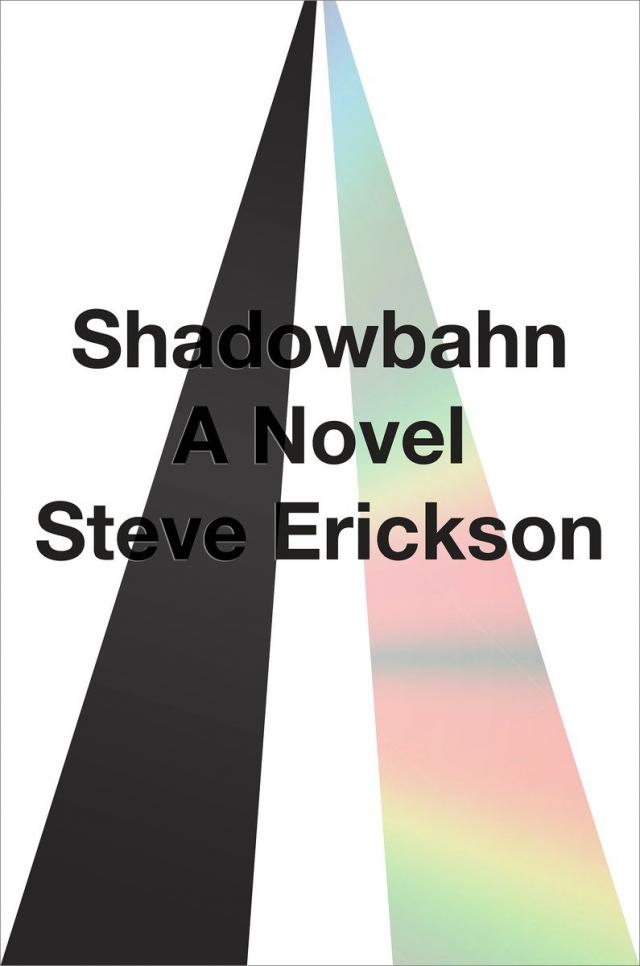
Shadowbahn, page 11


• • •
. . . and with a start he wakes. He’s terrified to realize, for a moment that now feels like hours, that he fell asleep at the wheel. It can’t have been longer than a couple of seconds, just enough to start veering off the road; if you want to wake yourself up good for the rest of a drive, try falling asleep at the wheel for a moment.
But he wakes to his heart pounding, and to a new, open interstate much bigger than what they were on just seconds ago. Pulses of dull light flash alongside them, and other than the dim illumination of the pulses, the highway appears to be entirely unmarked. In the one or two seconds during which Parker fell asleep, the low distant song that his sister broadcasts has opened before them like a tunnel, with the pulses of dull light to each side passing faster and faster until they’re single streaked blurs: and then, with growing excitement and further
adrenalized by his own hammering heart, he hears himself silently exclaiming, Is this it? Have we found it? the secret highway! and over and over he whispers, Zema! or believes anyway that he’s whispered his sister’s name only to realize he hasn’t, that he’s uttered to her nothing but a shadowhisper, and that there’s no point at all to any consultation since they pass nowhere any diversion or exit as they continue to drive, if what they’re doing can be called driving, this one-way thoroughfare with only its single escape at either end of it—assuming they haven’t just disappeared into thin
three
earshot
tracks 07 and 08:
“Pilots” and “Seven Nation Army”
The first song is released to little notice on September 11, 2000. The second is released in March 2003, the same month that—in the name of the incendiary millennial moment that follows the first song by exactly one year—the country invades another that had nothing to do with the moment. All the words are going to bleed from me, sings the second song, which becomes the year’s biggest, recorded by a Detroit ex–husband-wife team posing as brother and sister who could be twins. The song’s opening guitar riff turns into a stadium chant sung together, in unison and full-throatedly. Soldiers drive their tanks across Middle Eastern borders humming the riff, pushing themselves onward to the song’s insistent opening seven notes. Opposing armies hum the same notes back, bolstering their spirits or fleeing with it in their ears. “Pilots” also is written and recorded by a male/female duo, from London rather than Detroit: Armored cars sail the sky, they’re pink at dawn forecasts that morning exactly one year later. Does its ethereal melody float above the clouds with Atta and al-Shehhi in the cockpits of American 11 and United 175, airliners pink in the sun before rendered the red of fire and blood? On opposite sides of a chasm, are these two songs infused with the spirit of a stillborn nation that wanders its own landscape trying to make sense of destiny, trying to make sense of survival, trying to make sense of which twin country is really left? Which is the corporeal and which is the ectoplasm? Which is the reflected and which the reflection? Which is the sun and which is the shadow?
when midnight comes around
and Jesse wakes, he really has no idea what time it is in the vast emporium where it’s always midnight, regardless of whether, outside, it’s two in the afternoon or two in the morning. Whatever dream he was dreaming already fades. Was he in the Tower again, back on the roof of the world where nothing is in the distant dark but moonscape and the twinkling of a thousand lights, back atop the world’s highest building that he seems to dream of every night? if he must concede it’s a dream, which he has nearly convinced himself it must be, since he can’t remember how or when he actually would have been in such a high space, the winds such as to blow him from where he stood into another place and time.
• • •
Yet it all has the vividness and emotional specificity of not a dream but a memory. The song that made its way into his sleep still plays; he can’t be sure, wondering to himself, if it’s a recording or Andy’s new little kraut blonde singing from the next chamber. “Must be evening,” he decides out loud, based on the doings around him, and then sits himself up in the corner of the cavernous room. A series of Moroccan arches link every foiled silver wall of jagged mirror shards to the adjoining red wall. Junkies
June 3, 1968
shoot up in whatever dark corners where couples of indistinct gender aren’t fucking. There’s Gerard with his whips, Mare gyrating before a projection on the wall of Andy’s latest: naked people—mostly guys, so Jesse surely doesn’t need to see that—down at the Mad Hatter Diner not doing anything much, like in all Andy’s movies. Janet from upstate, lately calling herself Viva, railing in her fashion about Catholics. Paul, scowling little Nazi mick on the prowl with his fucking camera like he’s C. B. goddamn DeMille. Jesse catches sight of a woman on the other side of the room glowering at him, all ferocity.
• • •
Val, well shit, Val, li’l dyke psycho, disheveled jeans and work shirt, folksinger’s cap pulled down on her crazy little fucked-up head, bedraggled and agitated and barely able to stand in her own footsteps: glamour-killer if there ever was. Hell, thinks Jesse, she be unhinged by even the standards of this place. She just keeps scowling at him and then it comes back—was it earlier this afternoon he ran into her outside, stalking the steps and lying in wait so she could hit somebody up for some bread or give Andy her latest treatise on lopping off all the men’s dicks, assuming she can’t suck one in the meantime for fifty bucks?
and cry behind the door
Jesse told Val to skedaddle and thought he ran her off but there she is now, who let her in? Couldn’t have been Paul, always threatening to beat her up—well hell, even Jesse would never lay a violent hand on a lady, stretchin’ the definition of the word mightily to include Valerie. Just a few feet away from her, where he’s been every night for the last two weeks, is a silver-haired gent in a wheelchair saying nothing, just watching, small smile. Assume it’s a he; in this place you never can be sure. Jesse still is unsettled by the blow job Candy gave him last week. No way Candy can be a he, Jesse assures himself, dismissing from his mind the gossip and overheard chatter.
• • •
But then there are people who aren’t so sure about Jesse, for that matter, which is just stupid. Jesse thinks about this awhile crumpled in the room’s yawning corner that’s one of the only sources of light, besides, ’course, Andy’s latest movie projected on the wall. Also projected is the now celebrated double image of Jesse in cowboy shirt and holster but no hat, six-gun drawn, looking like the superstar that he is, just on the basis of everyone saying so. There in the corner, with the piercing glare of the projector in his eyes, Jesse covers his face.
factory
Crawling out of the light, Jesse scurries like pestilence, sir (self-revulsion), to a darker corner. He realizes he’s hungover. In the drone of yowling thorazine cello, he gazes into the dark of the room, eyes adjusting to the Sunday clowns and femmes fatale with their streetlight fancies, whiplash children in ermine furs and blackened shrouds and shiny boots of leather . . . but realizes maybe the hubbub is losing its charm. Not the same since Edie left, Jesse mulls with a small pang in his heart.
• • •
Maybe, he thinks, this move down to Union Square will recharge something. Why hell, back on East Forty-Seventh you got yourself wandering folk who are downright mentally disturbed. Or maybe, he thinks, it should all just die, the whole damn scene. “What are you doing down there, cowpoke?” comes a voice from out of the dark above him that’s not quite male, not quite fe—
the smallest taste
Candy, goddamn it, do you have a dick or not? Jesse peers up at her. Have you ever had a dick? “Catching me my beauty sleep, darlin’,” says Jesse.
“Is that all it takes?” she says. “Maybe I should go to sleep and never wake up.”
“Speaking of dead,” Jesse nods, “do it all seem a might moribund to you tonight?” No one had to worry if Edie had a dick, sweet little dollop of New England maple cream that she was.
• • •
Candy says, “It’s midnight. It’s early. You know the witching hour is two. Give it time, it will be fabulous. It will all be very bop, very elvis,” and she looks at the projection of Jesse in the other corner. “Maybe everyone’s waiting for you to make it happen . . . so make it happen, baby. You know I hate the quiet places that cause—”
“Say, darlin’, don’t mean to interrupt what I’m sure is a very poetic thought,” he says, nodding across the room, “but who’s the old earl over there coming in on wheels every night?”
revisions
Jesse has noticed that the man in the wheelchair with the silver hair is watching him. Oh my good lord, thinks Jesse, another Factory-slumming fancyman checking me out, except that when the man’s attention does turn elsewhere it’s to Mare slithering nude across the floor with cat-o’-nine-tails in hand—so maybe the aristocrat’s interests don’t run Jesse’s direction after all, at least not in that manner. Rather the old man, smoking a thin cigar, regards Jesse in the way that Jesse remembers being regarded once before by a young Hamburg exi in black, like someone who knows something from beyond the present moment, as it’s currently defined.
• • •
Gazing over her shoulder, Candy says, “My God, what’s she doing here?”
“That’s a she?” says Jesse. “Man, I don’t hardly know as how I can stand the confusion.”
“Not him,” says Candy, “standing right next to him—isn’t that Valerie? Didn’t Andy excommunicate her, and isn’t it someone’s job to keep her out? Why is she looking at you like that?”
“They both giving me the eye, though I feel something close to certain not for the same reasons—can’t hardly say about the old guy. . . .”
chord of D
Candy shrugs. “He’s not that old. Still this side of fifty—old but not ancient. Hair went all white just last year.”
“What’s wrong with him?” asks Jesse.
“Degenerative something. Got a beautiful wife, I hear, he never spends any time with, up in Bridgeport or Boston or New Haven somewhere. Very rich in the chord of D . . .”
“Decadent,” says Jesse, “downright defiled.”
“Definitely.”
“Deranged, demonic . . .”
“But destined too, as I understand. He is giving you the eye.”
• • •
Jesse says, “You know that’s not my style, darlin’,” but looking down at him on the floor Candy chuckles from so deep in her throat that, even in the dark, he finds it discombobulatin’. She says, “I’m pretty sure he likes the girls. The girls who are girls through and through, of course, just . . . like . . . you do, cowpoke.” She leans over and touches Jesse’s nose. He has the feeling there’s a joke he’s not in on. “Destined?” he says, trying to recover.
“As I hear it,” she shrugs again, “he was in Congress or something. As I hear it, once upon a time, he was going to be president of the United States.”
strobe
Through the rippled dark, in the swoon of the electric tempest wailing around him, Jesse makes his way across the room.
Perfectly still, the other man in the wheelchair with the white hair never takes his eyes off Jesse’s approach. Jesse pulls up a small round table and chair. “Well, sir,” he says, having to shout over a rise in the soundtrack, “buy you a drink there?” The other man just raises from his lap a cocktail glass before taking another puff on his thin cigar, appraising Jesse ever coolly.
• • •
Wondering that moment if the old man can speak at all, Jesse sticks out his hand, “Jesse,” and the other, shaking it after a moment’s hesitation, answers simply, “Hello.”
“Mind if I sit?”
“You already have.”
“I’m, uh”—Jesse gestures at his projection on the wall—“somethin’ of a superstar around here, you might say.”
The man in the wheelchair barely glances where Jesse has indicated. “Congratulations,” he answers flatly, one corner of his mouth hardly turned up.
key of J
For a few moments, Jesse tries to place the accent. “Boston,” he finally assesses. “Like to think I got me an ear for such things, being a cosmopolitan sort—say, bet you’re a friend of Edie’s.” Now he can see Candy was right: Up close the man in the wheelchair isn’t really that old. It seems to Jesse that he takes uncommonly long to answer the simplest thing, constantly measuring every response in the same way that he constantly measures the person across the table from him.
• • •
It’s not that he’s hostile, exactly. He’s remote, his constant appraisal of Jesse unshaken, mouth verging on a smile that’s slightly mocking even as the target of his mockery is unclear: maybe it’s Jesse or maybe it’s the man himself, or maybe just the situation. “Yes, well, I don’t believe I’ve met her,” he says from the wheelchair with the slightest shake of his head, slight smile never changing, eyes never leaving Jesse, “know a bit of the family, of course. They go back pre-Revolution. Long before my own.”
Jack
Wildly optimistic that this is the beginning of an out-and-out conversation, Jesse nods, but when there’s no more, he answers, “Okay, yes sir, pre-Revolution you say,” and now the white-haired man is back to his coolly observant regard, watching through the thin smoke rising from his fingertips. “Well you would know if you had met Edie, she’s fine, or was.” Jesse nods at the naked woman with the cat-o’-nine-tails snaking past their feet in the dark. “That there’s Mary.”
The man nods. “Those days are over for me,” making the slightest gesture at his chair, but Jesse isn’t really sure which days he means.
• • •
Crazy Val has moved to the middle of the room, still watching. She appears more disturbed than ever. “Val there”—Jesse points—“you might want to stay clear of. She got herself this notion to wipe out all the menfolk.”
“How’s that?”
“All the male folk. She’s even written herself a play about it, articles and the like.”
“How’s that supposed to work?”
“How’s what supposed to work?”
“Killing all the men. I mean, after they’re all gone.”
“Yeah, well, you got me there. Not sure Val’s got an answer for that one, or maybe she doesn’t care. I hear you’re in government of some sort.”
“Not anymore.”
“What was it you said your name was?”
“I didn’t.”
“No, actually,” says Jesse, “I didn’t think you had.”
“Jack,” he says, and looks at the projection of Jesse with his six-gun. “So what is it you do, then, uh, when you’re not being . . . what did you say?” and for the first time he flashes a smile. “A superstar?” The smile becomes broader. “You’re not in the movies, are you? You’re not a singer by chance.” He adds, “I’ve known some singers.”
magnum
A chill overcomes Jesse. It’s a handsome smile, the other man’s, maybe even dazzling there in the dark, taking the edge off his mockery only slightly. Everything he says is wry, sardonic, dry as sand—but now there’s something else too, something underneath. “Well, sir, I could have been a singer,” Jesse protests, and Jack answers, “Is that right?”
“Yes, sir. Except I gone into the writing game—right at this here moment I have a magnum opus in the pages of Round Midnight magazine.”
“Can’t say I know it.”
• • •
“Newly reputable jazz journal,” Jesse explains, “of course I’m not aware if you’re cottoning to jazz—don’t know as how I ascertain much about the subject my own self. In any case I’ve become a man of letters.”
“Last refuge,” Jack nods, “of the socially impotent.”
“Say what?”
“What’s this, uh . . . magnum opus about?”
“Why . . .”
“Jazz?”
“Not exactly, it’s about . . .” Jesse shrugs helplessly. “Why, it’s about . . .”—he throws open his arms—“. . . everything!”
everything
Jack says, “Well of course it is. Everything that every writer writes is about everything. I doubt there’s ever been a single word written by any writer who’s ever lived that wasn’t about everything.” Jesse glares at Jack, assessing whether he can just get up and leave rudely, as is his inclination, or is bound by some social grace to be more polite than either the other man or the conversation warrants. “I used to be a writer myself,” adds Jack.
“Is that right,” says Jesse, just as the other man said it a moment before, in just the same tone.
“Journalist . . .”
“Did you write about everything?” Jesse seethes.
“I wrote about history. Published a book or two. Won an award or two. Then I thought, Why write about what you can change?”
“So you changed everything then.”
“No,” Jack says, leaning as far across the small table as the prison of his body and chair allow, the smile vanishing as quickly as it flashed, “you did.”