Genies, Meanies, and Magic Rings, page 6


The garden seemed different, now that his task had been accomplished. He could take it in now, and he saw for the first time how very beautiful it was. When he looked at the branches of the fruit trees, he could see many kinds of birds, and he could hear them singing their hearts out. The chorus of birds sounded like a chorus of children’s voices, and he was so moved by their songs that he thought he could almost understand what they were saying.
As Aladdin looked at the branches he became aware that they were covered not with fruit but with sparkling jewels: diamonds, emeralds, sapphires, pearls, rubies, and many other kinds of precious stones. Some of them were as big as oranges, some even bigger than grapefruits; the smallest of them were of a size that dwarfed even the most splendid gems owned by the richest monarchs in the world. Since Aladdin was a poor boy and had no experience of jewels, he thought that they must be made of glass. But they were very beautiful, and he decided to take them home to add to his collection of rocks and pebbles, which he kept hidden under a loose board in his bedroom. So he filled his pockets with jewels. After his pockets were full, he stuffed more jewels under his belt and inside his shirt and socks, until his clothes were bulging with precious stones. With every step he took, he could hear the click, click of jewels tapping against each other.
Finally he arrived at the staircase that led out of the cave. Step by step, with difficulty—all the jewels that he’d stuffed into his clothing were weighing him down—he ascended the staircase. When he reached the final step, which was higher than the rest, he called up to the sorcerer, “Lend me a hand, Uncle. I don’t think I can make it by myself.”
“First give me the lamp, my boy,” the sorcerer said. “Then I’ll help you up.”
“No, no, Uncle,” Aladdin said. “It’s not the lamp that’s weighing me down. Just lend me a hand. I’ll give you the lamp as soon as I’m out of here.”
“Don’t be stubborn, boy. Give me the lamp!”
“But, Uncle, it’s buried under—”
“I don’t care where it is, you little scoundrel. Give me the lamp right now! Do you hear me? Right now!”
“But, Uncle—”
“Don’t you ‘But, Uncle’ me! Hand over that lamp, you filthy little beggar! Hand it over right now if you know what’s good for you!”
“I can’t,” said Aladdin. “Just listen to me for a moment. The reason I can’t is …”
But the sorcerer was so consumed by rage that it was as if his ears were stopped up with wax. He couldn’t hear what Aladdin was saying. His fear and greed could only see fear and greed in Aladdin, and he thought Aladdin was trying to steal the lamp from him. He was so furious about Aladdin’s treachery that he ran over to the fire, threw more incense onto it, and uttered some magic words. Immediately the earth quaked, there was a loud thunderclap, and once again the marble slab sealed the entrance to the cave.
“God curse you!” the sorcerer shouted into the ditch. “I was so close to my heart’s desire! And now you have ruined it forever, you miserable little wretch. You can die here in this dark cave, never knowing what a treasure you possess. And may it be a slow, agonizing death.” Then he stamped off, shouting and cursing, and headed back to Morocco.
After a dozen steps he turned around and shouted toward the ditch, “Oh, and when you begin to die of starvation, my boy, remember that there’s plenty of fruit on the trees.”
Chapter 5
For an hour Aladdin screamed, begged, and pleaded for help. Finally he gave up and sat down on the steps, crying.
He was in total darkness. He didn’t know what to do. He couldn’t think of anything to do. He was frightened, but not too frightened, because he knew that there was nothing dangerous in the cave. He was aware that he might starve to death, but perhaps there was something to eat in the garden, if only he could find his way there with his hands instead of with his eyes. For the time being, he thought, the best course of action was to stay put.
How could his uncle have buried him alive like this? How could a man do such a mean thing to his own nephew? To react with such rage just because Aladdin couldn’t follow his orders right away: it wasn’t natural. It wasn’t what an uncle would do. Hmmm, he thought. There’s something awfully strange here.
Aladdin began to review the facts. It was clear that his uncle (if he was his uncle) didn’t love him—didn’t even care about him. It was also very clear that he was a sorcerer and had some impressive magical powers. And, obviously, the only thing he wanted was the treasure. Then there was the fact that he didn’t look at all like Aladdin’s father. And his whole story about the dangerous mission, now that Aladdin remembered it, could easily have been a pack of lies.
The more Aladdin thought about the sorcerer, the more suspicious he became. Finally, he came to the conclusion that the man couldn’t have been his uncle, and that whoever he was, he was not a kind man.
Aladdin was so tired by now that he fell asleep on the steps. He woke up hours later, cold and very hungry. He felt his way, in the pitch dark, down the steps to the first room. He flattened himself against the wall, so that he could be sure not to get anywhere near the golden urns. When he arrived at the fourth room, he slowly moved to the garden door. The door was locked. Aladdin shook the handle with all his might, but it wouldn’t budge. All he could do now was feel his way back to the steps.
He was really frightened now. He was cold, he was hungry, there was no food, no light, no way of getting out, no one who could help him.
He slept and woke, then slept again. Hours passed, days passed. He completely lost track of time.
Finally, in despair, he put his palms together and began to pray. “Dear God,” he said, “please help me. I know I haven’t always been a good boy, but …”
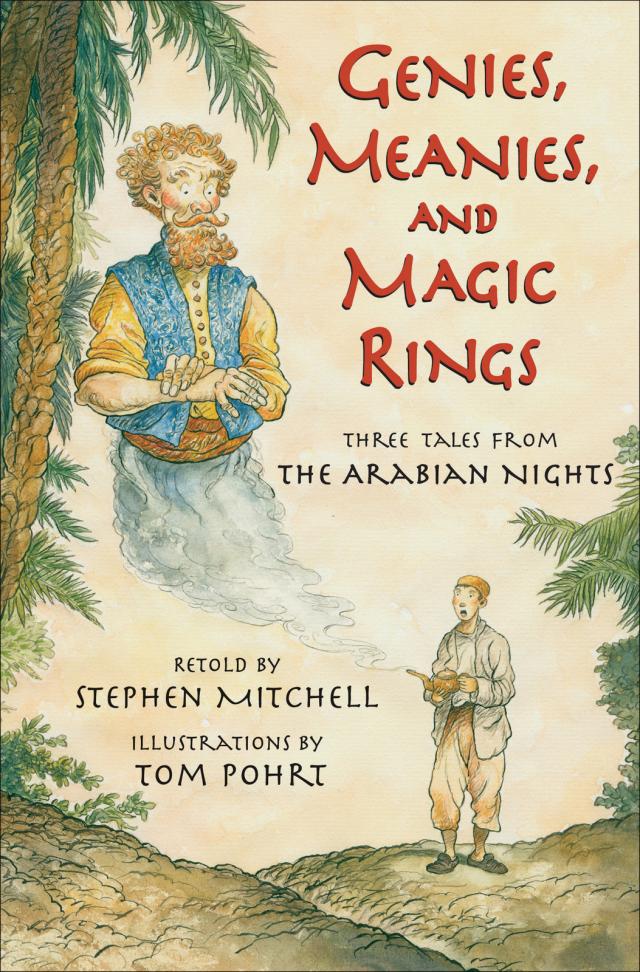
As he said these last words his right hand happened to make a tiny movement, so that his fingers, ever so gently, rubbed against the sorcerer’s ring on the middle finger of his left hand. All at once there was a flash of light, a sound like a thunderclap, and there before his eyes stood an enormous genie. The genie was ten feet tall and very muscular. He was wearing a vest of crimson velvet and royal-blue silk pants. He looked very fierce, and with his thick golden hair, thick golden eyebrows, and bushy golden beard, he seemed rather like a lion, if a lion had been transformed into a very tall man.
“O Master, your wish is my command,” the genie bellowed. “Ask me for anything your heart desires, and I shall make it happen. For I am the slave of whoever wears the blessed ring.”
At first Aladdin was frightened, then he was astonished, then he was absolutely delighted. “Genie,” he said, “take me out of this cave and put me back on the ground.”
No sooner had he issued the command than he found himself standing outside the cave. He had been in the dark so long that the sunlight hurt his eyes, and he had to cover them for a few minutes with his hands. When he was finally able to look, he recognized that he was on the very same patch of ground from which he had descended into the cave. Only now there was no ditch, no marble slab, and no copper ring. The earth was completely level, without a trace of an entrance. Over to the left were the charred remains of the twigs he had gathered for the fire.
He looked around for the genie, but saw no one. He wanted to go home quickly, because he was very tired and hungry, and for a moment he considered rubbing the ring again and commanding the genie to take him home. But on second thought, he decided to walk home. After all, there might be a limited number of commands that the genie would obey, and he didn’t want to waste one on something he could do for himself.
When Aladdin got home, he was so weak and hungry that he fainted as soon as he walked in. His mother revived him, fed him, and put him to bed. He slept uninterruptedly for a day and a half.
When he finally woke up, his mother asked him where he had been, what he had done, and where his dear uncle was. Aladdin told her everything that had happened to him and ended with his conclusions about his so-called uncle.
“It was too good to be true,” his mother said, crying. “It’s not for the likes of us to be dreaming about silk clothes and merchants’ shops. Poor you were, and poor you will always be.”
“But, Mother,” Aladdin said, “at least we have the silver coins the imposter gave us. We’re better off than we were before.”
“It was too good to be true,” his mother repeated. “And as I always said, you will end up a beggar in the streets.”
Chapter 6
That afternoon Aladdin took all the pretty stones he had come home with and put them under the loose board in his bedroom with the rest of his rocks and pebbles. The lamp he put by the side of his bed.
Because of the three silver coins, Aladdin’s mother worked much less than before. After all the coins had been spent, though, Aladdin’s mother came to him and said, “I haven’t needed to work for a while. But all our money is gone now. So I will have to go back to the spinning wheel.”
“Wait, Mother,” Aladdin said. “I have a better idea. You know that old lamp I brought back from the cave? I’m sure it’s worth something. I’ll go to the market and sell it, and we can live off that money for a while.”
“All right,” Aladdin’s mother said. “But let me clean it first. It’s filthy, and it will sell for a higher price if I polish it.”
“Good idea,” Aladdin said. He hurried to his room, picked up the lamp, ran back, and handed it to his mother, who began rubbing the dirt off it.
All at once there was a flash of light, a sound like the crashing of cymbals, and there before their eyes stood an enormous genie. Aladdin’s mother fainted.
The genie was twenty feet tall and very muscular. He was wearing a vest of royal-blue velvet and royal-blue silk pants. He had a fierce expression on his face, thick red hair, thick red eyebrows, and a bushy red beard.
“O Master, your wish is my command,” the genie roared. “Ask me for anything your heart desires, and I shall make it happen. For I am the slave of whoever owns the blessed lamp.”
Aladdin was not at all frightened. He had been through this before. “Genie,” he said, “my mother and I are hungry. Bring us something to eat, and let it be something delicious. Please.”
“Yes, Master,” the genie said, then vanished. A split second later he reappeared with a huge silver tray the size of the kitchen table. On the tray there were twelve silver plates, each one piled high with the most exquisite food Aladdin had ever seen or smelled: roast beef, filet mignon, barbecued chicken, lamb chops, charbroiled fish, and sumptuous vegetable dishes, all of them prepared in a variety of ways according to recipes that the greatest chefs in the world would have envied. There were also ten loaves of bread, each one made from a different grain; pitchers of juice, tea, and coffee; five flasks of vintage wine; and thirteen different desserts, ranging from the most luscious, flakiest-looking cherry and apple pies to gigantic chocolate-chip cookies to cheesecake and chocolate cake to crystal bowls filled with pistachio, almond, cherry-chocolate, and mocha-chip ice cream.
Aladdin had never even dreamed of this kind of food. His eyes bulged. His mouth watered. He was about to help himself when he remembered that his mother was still stretched out on the floor. He put a little water on her forehead and woke her up. “Mother,” he said. “Get up! Look what we have for dinner!”
Aladdin’s mother took one look at the splendid meal and fainted again.
When Aladdin woke her a second time, she said, “Dear God! Where did all this luxury come from? Is this real? Am I dreaming?”
“No, Mother,” Aladdin said. “It’s all real. I’ll explain it later. Let’s eat.”
After they had eaten to their hearts’ content (and their stomachs’ content as well), Aladdin told his mother about the genie of the ring and the genie of the magic lamp and how they had promised to do whatever he commanded.
“I’m frightened of these genies,” Aladdin’s mother said. “I don’t want to have anything to do with them. Poor folks like us shouldn’t deal with this kind of power, anyway. It’s not proper. Please, I beg of you, throw away the lamp and the ring. They’re dangerous and will only cause you grief.”
“I see how frightened you are, Mother,” Aladdin said. “But the ring and the lamp are gifts from God, and I wouldn’t feel right about throwing them away. I know that I can use them wisely. Don’t worry. I promise you, you won’t ever have to deal with a genie in the future. I will take care of that myself.”
“Well,” said Aladdin’s mother, “the lamp and the ring belong to you—you’re the one who has to decide. Just don’t ever bring that big, horrible red monster into my kitchen again.”
Chapter 7
In two days the food was gone. Aladdin wrapped one of the silver plates in a cloth, went to the bazaar, and asked around until he found a goldsmith’s shop. He walked in, took out the plate, and said, “I would like to sell this, sir. How much is it worth?”
The goldsmith looked at the plate admiringly, weighed it, and said, “This is pure silver, young man. I haven’t seen such fine merchandise in a very long time. I will give you seventy-two gold pieces for it.”
“Really?” Aladdin said. “That’s wonderful. Thank you, sir.”
“How did you come upon such extraordinarily beautiful merchandise?” the goldsmith asked.
“It was a gift, sir,” Aladdin said, “from a very tall friend of mine.”
“Well, young man,” said the goldsmith, “if your friend ever gives you more gifts of this sort, bring them to me, and I will always be glad to pay you a fair price for them.”
That is precisely what Aladdin continued to do. Every time the money was gone, he would bring in another plate, and the merchant would buy it. After all twelve plates had been sold, Aladdin brought in the huge silver tray. And after the silver tray had been sold, Aladdin would take out the magic lamp, rub it, and command the genie to bring him a whole new meal. (He would always make sure that his mother was out of the house when he did this.) After the food had been eaten, he would start selling the plates again.
A dozen years passed in this way. Aladdin was now twenty-two years old. He and his mother were no longer poor. They always had more than enough money now to live a comfortable life, though they lived quite modestly and didn’t even move out of their poor neighborhood. The neighbors were aware that Aladdin’s mother no longer had to spin yarn. But no one knew how she earned her living. There were rumors about a wealthy uncle or wealthy friends. But when people asked Aladdin, he would just smile and say, “Friends are such a blessing, aren’t they?”
During these years Aladdin’s habits changed. He began to spend more and more time in the bazaar. He was no less playful and creative, and he still loved games and dramas and hijinks, but he took a great deal of interest now in business as well. He learned much from the goldsmith and through him was introduced to some of the most prominent jewelers and merchants in the city. Some of them became his friends and mentors, and he was grateful for their teaching. Over the years he learned not only how to buy and sell, but also how to appreciate the beauty of the merchandise that he saw—the cups and dishes of silver and gold, the satins and silks, the porcelain and crystal, the jewels, the sculptures and paintings. He also quickly became aware that the stones he had brought back from the cave weren’t made of glass at all, but were extremely rare and precious gems, and that even the largest diamonds, emeralds, sapphires, rubies, and pearls that the jewelry merchants sold to the king were half the size of the smallest of the jewels he had brought home.
Chapter 8
Aladdin was now well known and well respected among the merchants of the city but was still living a very modest life in his old neighborhood. He hadn’t needed to call on either genie for years, because he was making a great deal of money as a merchant. Life was good, and he was very satisfied with it.
One day, as Aladdin was walking to the bazaar, the town crier began to call out, “Make way for Princess Laila! Make way for the princess!” Immediately everyone hurried to either side of the broad street. They stood there, tightly packed, like a crowd waiting for a parade to pass. People pushed and shoved to have a better view. Women asked other women to please shut their parasols. Fathers took their little children and lifted them up onto their shoulders.
Soon the princess arrived, attended by her ladies and her slaves. The court ladies were wearing magnificent gowns of blue and green and red and yellow, with designs of flowers or birds or trees on them, and headdresses and necklaces studded with precious stones. But the princess was dressed very simply, in a cream-colored silk dress, and the only jewelry she wore was a pair of pearl earrings. As she walked down the street she seemed not to notice the cheering of the crowd, or its oohs and ahhs. She seemed to be completely absorbed in her inner world, and there was a small, peaceful smile on her lips.
Aladdin had never seen anyone or anything so beautiful as the princess. He felt his heart opening to her, the way a flower opens in the sunlight. Even though he had just seen her for the first time, it was as if he knew her better than anyone he had ever met—as if she were his best friend and they had known each other a long, long time ago and he had just recognized her again after all that time. From the first instant he saw her face, he knew that his life would never be the same.
After the princess and her attendants had gone and the crowd had dispersed, Aladdin walked home. He was so deeply absorbed in his feelings about the princess that he looked like a sleepwalker as he entered his house. His mother spoke to him several times, but he didn’t hear her. Finally she had to shout, “Aladdin! Aladdin! What’s the matter with you? Are you sick?”
Aladdin shook his head. “No, I’m fine, Mother. I can’t talk to you now. But I’m perfectly all right.”
“Why can’t you talk to me? Tell me how you are. Please. I’m worried about you.”