Genies, Meanies, and Magic Rings, page 10


“So do I,” said the princess.
“And to tell the truth,” Aladdin said, “I’m very grateful to him. If it hadn’t been for him, I wouldn’t have become the person I am, and I would never have been able to marry you.”
“Yes,” the princess said. “In a very strange way, we both owe him a lot.”
“Still, we can’t just let him go,” Aladdin said. “He’s a dangerous man. I suppose I could command the genie of the lamp to imprison him somewhere. I could seal him up in a cave forever. Or I could have him carried off to a tribe of savages a thousand miles away.”
“True,” said the princess. “But that doesn’t seem very kind. Besides, he is such a clever man that he might escape.”
“You’re right,” Aladdin said. “Hmm.”
They were both silent for a while. Then the princess’s face lit up. “I’ve got it!” she said. “Summon the genie of the lamp.”
“Good,” said Aladdin, and he rubbed the lamp. All at once there was a flash of light, a sound like the faintest whisper, and there before their eyes stood the genie of the lamp, in his vest of royal-blue velvet and his royal-blue silk pants. “O Master,” the genie said, “your wish is my command. Ask me for anything your heart desires, and I shall make it happen. For I am the slave of whoever owns the blessed lamp.”
“Genie,” Aladdin said, “my wife has a command for you. Is that all right? Can she command you, even though I am the owner of the lamp?”
“Yes, Master,” said the genie. “Husband and wife are one flesh. Her wish is my command.”
“Well then, genie,” the princess said. “I command you to erase all memory of us from the old man’s mind. Erase all memory of the lamp, of the treasure, and of you. And erase all memory of sorcery and magic. When he wakes up, let him be just a simple man, with a simple past that never happened.”
“Yes, Mistress,” the genie said. “It is already done.”
“Brilliant!” said Aladdin. “This way we don’t have to hurt him, and he can no longer hurt us. Why didn’t I think of that?”
“I’m sure you would have,” the princess said, raising an eyebrow, “if only we had waited one more second.”
Aladdin smiled. Then he said to the genie, “Take us home now, and put this palace exactly where it was before.”
“As you wish, Master,” said the genie. “I am glad that you have the lamp again.”
Chapter 17
The next morning was the fortieth day, the day of Aladdin’s deadline. The king woke up as usual, and as usual he walked, slowly and sadly, to his bedroom window. He looked out, expecting to see the level ground that meant that his daughter was still missing. But to his amazement, there before him was Aladdin’s palace, in all its splendor. He could hardly believe his eyes; he had to rub them to make sure that he wasn’t dreaming.
Soon his bedroom door opened, and Princess Laila walked in, with Aladdin right behind her. The princess ran into her father’s arms, and they embraced. They were so overcome with emotion that they didn’t know whether they were laughing or crying.
It was a long time before they could speak. Finally the princess told her father the whole story, how she had given away the magic lamp, how the sorcerer had transported the whole palace to Morocco, how Aladdin had rescued her, and how the sorcerer was now a harmless old man who had gone into the used-lamp business.
After she had finished, the king turned to Aladdin and said, “I have a request.”
“Ask me anything, Your Majesty,” Aladdin said. “I will be happy to oblige.”
“My request,” the king said, “is that you forgive me for my thoughtlessness. I almost took your life, because I leapt to the wrong conclusion. It was very stupid of me. I was so upset about my daughter that I just couldn’t think straight. Please forgive me.”
“Of course I do,” said Aladdin. “You thought I had harmed your daughter. It’s hard to be fair when that’s what you believe. But it all turned out well in the end.”
“Yes, it did,” the king said. “And now that I have you both back safe and sound, I will try to be wiser in the future.”
The king kept his word, and from that day on, he was a much more sensible person. He even fired his prime minister and appointed Aladdin in his place.
After a dozen years he died, and since the princess was his only child, Aladdin became king. He treated his people with so much justice and wisdom that they began to call him King Aladdin the Kind. Everyone loved him, and everyone delighted in the love that he and Queen Laila had for each other and for their children. They lived a long life together, filled with happiness and charity and peace.
Afterword
The collection of anonymous tales known in English as The Thousand and One Nights or The Arabian Nights is universally considered to be among the classics of world literature. The tales originated from the Indian, Persian, Arab, and Chinese merchants who traveled on the Silk Road between northern China and the Middle East. These travelers would stop in caravanserais for the night and relax by telling stories.
The tales circulated orally for hundreds of years and were kept alive by professional storytellers, who would recite them in bazaars and coffee houses in Persia and throughout the Arab world. The first written version that we know of is a book of Persian tales called Hazar Afsana (A Thousand Tales), which was translated into Arabic during the ninth century; in 947, the Arab historian al-Mas’udi refers to this book as Alf Layla (A Thousand Nights). Neither the Persian nor the Arabic book has survived.
Except for a single-page fragment from the ninth century, the oldest surviving text is a three-volume Syrian manuscript that dates from the fourteenth century. This collection contains only 282 of the 1001 nights. Thousand and one was originally a symbolic phrase meaning “a very large number.” Later, literal-minded copyists kept adding tales from the Indian, Persian, and Turkish traditions, so that the total would add up to exactly a thousand and one tales.
The four earliest printed editions are known as Calcutta I (1814–18), Breslau (1825–43), Bulaq (1835), and Calcutta II (1839–42). The origins of these texts are unclear. Scholars consider the Bulaq text to be the most significant.
The first European translation of the Nights was by Antoine Galland (1646–1715). His twelve-volume version (first edition, 1704) was widely read and had a powerful effect on European literature. The three best-known English translations are by Edward Lane (1839–41), John Payne (1882–84), and Sir Richard Francis Burton (1885–88). T. E. Lawrence (“Lawrence of Arabia”) accurately said of them, “The rivalry in English isn’t high. Lane is pompous, Payne crabbed, and Burton unreadable.”
Galland worked from the fourteenth-century Syrian manuscript, but his translation included a number of tales that he had heard in 1709 from his friend Hanna Diab, a Maronite Christian from Aleppo. These additional tales include “Aladdin” and “Ali Baba.” None of them have been found in any surviving Arabic manuscript predating Galland, and scholars think that subsequent Arabic versions are actually retranslations from Galland’s French version. This doesn’t necessarily mean that “Aladdin” and “Ali Baba” are not very old stories; we simply don’t have the manuscript evidence.
I chose “Aladdin” and “Ali Baba” for this book because they are probably the most famous tales in The Thousand and One Nights. “Abu Keer and Abu Seer,” which is much less well known, is the most modern of all the tales. It can be dated because of its reference to tobacco, which was introduced to Europe from the Americas by 1560 and didn’t become common in the Near East until the seventeenth century.
For “Ali Baba” and “Aladdin,” my starting point was the translations of Lane, Burton, and Husain Haddawy (1995); for “Abu Keer and Abu Seer,” I used the Burton translation, which is the only one of the three that includes it. My retellings are free adaptations. I have kept the main story lines, but I have abridged, deleted, and expanded incidents, added and deleted dialogue, modified motivation and character, and made whatever other changes seemed appropriate in order to bring these tales to life in the English of today.
Copyright © 2007 by Stephen Mitchell
All rights reserved
You may not copy, distribute, transmit, reproduce or otherwise make available this publication (or any part of it) in any form, or by any means (including without limitation electronic, digital, optical, mechanical, photocopying, printing, recording or otherwise), without the prior written permission of the publisher. Any person who does any unauthorised act in relation to this publication may be liable to criminal prosecution and civil claims for damages
Published by Bloomsbury U.S.A. Children’s Books
175 Fifth Avenue, New York, NY 10010
First published by Bloomsbury U.S.A. Children’s Books in August 2007
Electronic edition published in January 2013
www.bloomsburykids.com
For information about permission to reproduce selections from this book, write to Permissions,
Bloomsbury Children’s Books, 175 Fifth Avenue, New York, New York 10010
The Library of Congress has cataloged the hardcover edition as follows:
Mitchell, Stephen.
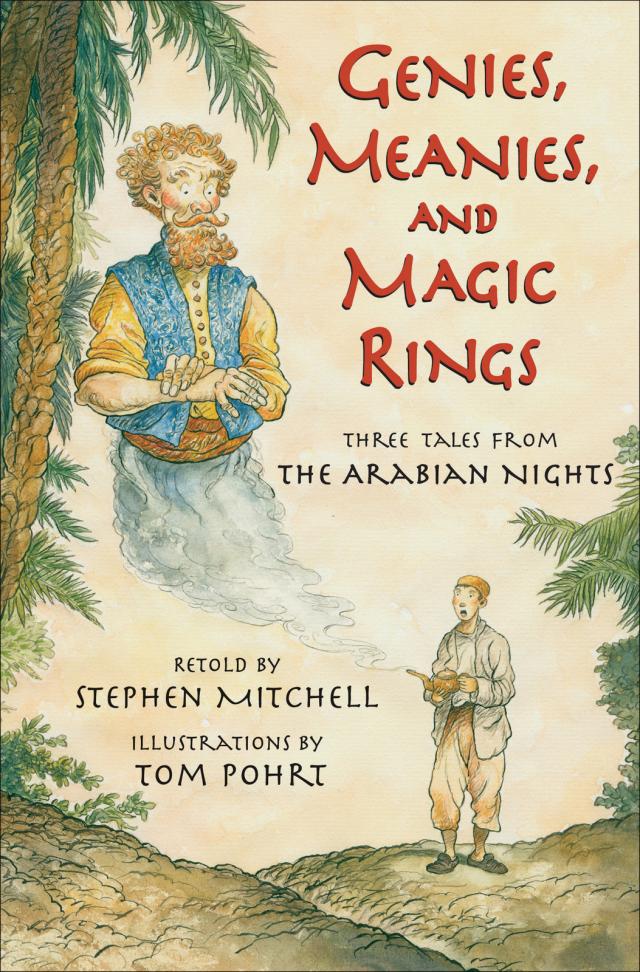
Genies, meanies, and magic rings : three tales from the Arabian nights /
retold by Stephen Mitchell ; illustrations by Tom Pohrt.
p. cm.
Summary: A retelling of three tales from the “Arabian Nights”—
“Ali Baba and the 40 thieves,” “Abu Keer and Abu Seer,” and
“Aladdin and the magic lamp.”
[1. Fairy tales. 2. Arabs—Folklore. 3. Folklore—Arab countries.]
1. Pohrt, Tom, ill. II. Arabian nights. English. Selections. 2007. III. Title.
PZ8.M6955Gen2007 398.2—dc22 2006027620
The illustrations for this book were created with pen and ink.
ISBN 978-0-8027-3531-7 (e-book)
Stephen Mitchell, Genies, Meanies, and Magic Rings