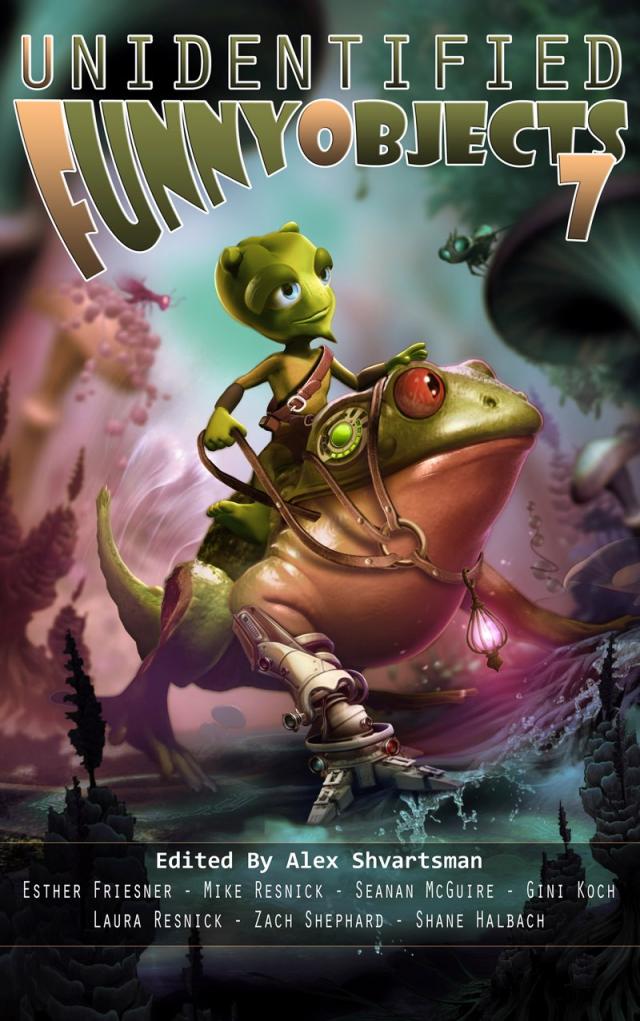
Unidentified Funny Objects 7, page 16


She didn’t.
The gravity began to cycle rapidly, leaving Rona to bounce back and forth between the hull and the bounce house until she came to her senses and grabbed hold of the nearest handgrip. I went limp, hanging when the gravity was on, sinking into the plastic when it was off, not bruising myself by simple dint of not fighting against the laws of nature. The sound of gunfire stopped, replaced by a ringing silence.
“I . . . hate . . . you,” rasped Rona, as the gravity settled into the “on” position. “I hate every single person on this ship.”
“Don’t worry,” I said, stretching out one leg and hooking my toes around the hatch that would seal the access tunnel. “We hate you, too.”
The hatch closed with a satisfying clang. Gravity rules.
“Doc? What’s the status on comms?” I started pulling my way around the edge of the bounce house, using the hand grips to keep myself from dropping to the floor or getting smothered by plastic.
“Still locked. The pirates have our systems.”
“Cool. That won’t last.”
“What do you mean, ‘that won’t last’?” I looked back. Rona was glaring bloody murder at me. If looks could kill . . . “They are a highly trained crew of professional criminals.”
“Yeah, but I have a pissed-off genius with a short attention span and control of their gravity. I’m pretty sure Violet’s still bouncing them like rubber balls over there. They’ll disengage soon, just to get away from us.”
As if in response to my statement, the ship shuddered around us, and the gravity cut off again, gently this time, sending us drifting upward. I beamed at Rona.
“That was your pirate ship departing,” I said. “Doc, check the comms.”
“Open,” he reported.
“Thought so. Go ahead and set up a distress beacon.” We could have been fined for broadcasting on important government channels when we were just dealing with a broken gravity generator. Eventually, we would have done it anyway—around when the chocolate cereal started to run out, probably—but scanning for civilian signals was usually the fiscally safe option. Now, with a bunch of unconscious pirates in our halls and an actual criminal to hand over, we were just being good galactic citizens.
Maybe we could even get a tow back to planetary orbit. Way better to fix things when you have access to proper facilities.
I looked back to Rona. She was staring at me, mouth slightly open, expression torn between rage and respect.
“You can’t hand me over,” she said. “My employer will kill me.”
“I doubt that,” I said. “But also . . . I don’t care.”
“You’d kill your own sister?”
“No. I’d let my own sister live with the consequences of her actions, though. Especially when that sister was perfectly happy to hand Violet over to her ‘employer,’ who probably wouldn’t have been inclined to give her back. I can’t save you, Rona. Not when you’re the one who keeps running into danger, expecting to be pulled back at the last second. I haven’t been able to save you for a long time.”
I let go of the bounce house and pushed gently away, drifting out of reach before she could get any funny ideas about taking a swipe at me. I wouldn’t put it past her. She’d been awfully physical when we were kids.
“I’ll ask them to give you your own holding cell, when they get here. I can do that much for family.” Sure, they wouldn’t listen, but it’s the thought that counts.
Rona was still swearing at me as I kicked off the wall and flew out of her sight. Maybe getting the last word in would make her feel better, even if the last word wasn’t fit for polite company.
I doubted it, though.
Violet booted up the repaired gravity generator, smiling a small, content smile as our feet settled firmly to the deck once more. The police ship that had answered our distress beacon had been delighted with our gifts of groggy, concussed pirates and criminal clone, and had been willing to let our resident techie dig through their spare parts before they flew off. Personally, I suspected it was to keep us from claiming any rewards that might be associated with Rona or the others.
They didn’t have to bother. Clones are legally banned from collecting rewards, lottery winnings, or life insurance payouts for other clones. Just one more way of keeping us from dominating the galaxy. But I was still glad to have a working generator again.
“No more hitting it with a spanner,” said Violet, looking at me sternly.
“Yes, ma’am,” I agreed.
“I mean it,” she said. “No more hitting it with a spanner, or a wrench, or a hammer, or anything else you happen to have lying around. If there’s a problem, you call me. I’ll fix it.”
“What about when you’re not on the ship anymore?” I asked. “Can I hit it then?”
Violet blinked. Then she smiled, slow and broad and sweet as opening day on a new colony world, where no one knew our entertainments and everyone wanted to lay their credits down, play a game, share a laugh, and keep our accounts stable enough to keep us flying.
“Who says I’m going anywhere?” she asked, and laughed at my expression. “Oh, Nora, you should see your face.”
“But the Dyson Spheres . . .” I said.
“Are doing just fine without me,” she said. “Where else in the galaxy can I watch my captain play Whack-a-Weasel with live pirates?”
This time, I didn’t correct her. I just smiled, and everything was perfect.
Seanan McGuire lives and works in the Pacific Northwest, where she shares her home with a variety of strange animals, large cats, comic books, and horror movies. Her first book, Rosemary and Rue, was released in 2009, and more than twenty others have followed, in a variety of genres. Seanan has been the recipient of the Campbell, Hugo, Nebula, Locus, and Alex awards.
Seanan is also science fiction author Mira Grant, and is widely rumored not to actually sleep.
Mission Log Nuptials
Langley Hyde
MISSION GOAL: To successfully court Lieutenant Magrioka’althoa, hereafter to be referred to as Maggie, in order to win eir hand in marriage, because Maggie is the awesomest person in the galaxy. I’d like Commander Q Fortier—who’s like a father to me—to marry us. Since he announced he’s retiring in a week, I need put the moves on Maggie fast.
* * *
DAY ONE: I already know that Sheshmin, from planet Xy, don’t date or engage in romance. Maggie’s no exception. But they have to select mates somehow. I asked around the station to see if anyone knew how. My best friend Dale in structural maintenance said “look it up” as if I hadn’t tried. Thanks, Dale.
* * *
BACKGROUND: I’ve worked with Maggie in the Station Mandela’s biology lab for five years. I know the exact moment I fell in love with em. A year ago, Mx. Baggart, from the diplomatic corps, returned from an aborted mission with the Semt and forwent quarantine—as if diplomatic immunity applied to disease!—and three weeks later, half of Mandela came down with the Solo virus. (So named because the first victim, believing he was Han Solo, engaged in a well-publicized gun fight attempting to escape Jabba the Hutt in a case of mistaken identity that our Commander Fortier will never live down.) Solo hit the Sheshmin so hard that most Sheshmin on the station had to be temporarily institutionalized.
Maggie and I worked twenty hours straight to slow the rate of viral replication in the infected. Seventeen hours in, Maggie keeled over. Maggie had Solo, too. I held em on my lap and stroked eir finely scaled face to comfort em. Eir scales weren’t rough, like I had expected, but fine as silk. In my fingers’ wake, ey pearled with a gasoline-like rainbow. Maggie blinked eir four golden eyes open, the nictitating membranes lavender, and grasped me with eir two arms and two subarms.
“I’ll sleep when I’m dead,” Maggie said. Who else could make a badass Bon Jovi reference when stricken with an alien plague, and then go on to cure it?
* * *
DAY TWO: I coughed up some courage in the lab today. I asked Maggie how Sheshmin select a mate. Like, just to cite a completely random example, is profession a factor? Would maybe a devastatingly attractive biologist make a good partner? If so, what would the procedure involve? Hypothetically speaking.
Maggie swiped eir desk surface clear. Ey had been reading The Galactic Guide to Human Marriage: Show Your Intended What You’re Intending.
Ey explained how although Sheshmin don’t date, they do fall in love. After two potential mates indicate mutual interest through numerous tacit signals, an involved courtship process causes a Sheshmin to form a lifelong chemical bond with their beloved. Every marriage is until-death-do-we-part.
After Maggie described the courtship process, I had one question left. “Tacit signals . . . Like what?”
Maggie swiped open eir book. “Oh, you know. Little hints.”
* * *
OBSTACLE: Before I can ask Maggie to marry me, I need to:
1.) win the right in combat, defeating no less than three rivals;
2.) gain eir parents’ blessing; and
3.) acquire the objects needed for a traditional proposal, including:
one bottle of remembrance,
seven candles scented with my admiration,
all the ingredients to a hem-la feast, and
a jalopy beast to propose in.
* * *
DAY THREE: I asked Dale to be my rival. He said no.
I asked Rachel—she’s a librarian—to help me look up Maggie’s parents in the Sheshmin homeworld. It’ll take a few days for the embassy to decide whether or not they want to hand over directory information. In the meantime, Rachel’s helping me learn how to say, “I ask for your blessing to marry your child” in Ni’sa’nai, the local dialect that Maggie’s parents speak.
* * *
DAY FOUR: The only jalopy beast on Station Mandela is in the zoo. What do you think their security is like?
* * *
DAY FIVE: Well, I’m out of jail now. Who knew the zoo was so well-guarded.
I don’t think Maggie’s parents like me very much. I’m pretty sure they were upset that Maggie paid my bail. I called them up to apologize in Ni’sa’nai.
It turns out that Rachel, who’s only ever practiced on language-learning programs, overestimated her expertise. Most parents don’t tend to look fondly upon suitors that inquire: “Have I your unholy permissions to masticate your juicy baby and slaughter your limbs to sate the unnamed gods?”
* * *
RESEARCH:
Jalopy beast: Resembles a cross between an elephant, a hammock, and a Jamaican flag. Good-natured. Excretes a sticky resin from its legs that captures unwary thieves. Smells like a cigar, results in a contact high. Note to self: In the future, don’t giggle when arrested. Unnerved police officers use Tasers, and that resin really conducts electricity.
Seven candles scented with admiration: A Merkta shopkeeper infused my admiration into the buttery yellow candles. My admiration for Maggie’s curiosity smells like a Sharpie. I don’t think we’ll burn that one very often. Unfortunately, the process also involved a lot of heat. Do you think Maggie will care if I have eyebrows when we get married?
Bottle of remembrance: Derived from tears wept during a memory duplication ceremony, the resulting liquor contains both parties’ recollections of falling in love. It ferments, is drunk on every anniversary, and only gets better with time.
Hem-la feast: Dale came through on this one.
* * *
DAY SIX: Maggie’s parents arrived today. They got the first tickets they could from planet Xy, located in the same solar system as the gas giant Station Mandela orbits, although Xy is in the inner system, about half a billion kilometers closer to the sun. They thought I might be threatening Maggie, even though Maggie already reassured them. They think Maggie has T’Pol Syndrome. (T’Pol Syndrome is like Stockholm Syndrome, except it develops among colleagues that work closely together and results in improbable office romances.)
Since it was my day off and Maggie had to work, Maggie asked me to give eir parents a tour of Station Mandela. We relied on voxes to communicate because I refused to mangle Maggie’s childhood language. I showed them around the shopping gallery, the biogardens, and brought them to the viewing deck for the Swing. Two yellow-gold moons orbit the blue gas giant Mikon only about a hundred miles apart, and when they draw close enough, they swing around each other and swap orbits. In person, it’s breathtaking and unnerving.
Maggie’s parents asked me about falling in love with Maggie (see above), how I felt about interspecies relationships (they did not approve), what my family was like (being orphaned indicates a subpar genome, low survivability), and how I intended to provide Maggie with children (adoption). I asked them when Maggie had developed eir interest in biology (a school trip to the seashore) and when ey had first become fascinated with American pop culture and classic rock of the 20th century (they didn’t know).
Also, they wondered if Maggie told me what would happen to em if ey bonded with me and I abandoned em? Maggie would pine emself to death. To prove my zeal, I quoted Dolly Parton’s “From Here to the Moon and Back.”
Maggie’s parents were NOT comforted and sternly stated that Earth satellites have no bearing on mating. (I reported to Maggie later that I did not laugh at their inadvertent pun. Mating. Bearing. Hey, Maggie thought it was funny.)
Meeting them explains a lot. I think Maggie developed humor in self-defense.
After that joke flopped, I brought them to Cooking Provençal, Maggie’s favorite restaurant. Maggie and I have lunch there on Fridays. They started to warm to me. Until the oysters.
Shellfish allergies, apparently, are universal. Always learning!
At least Dale, Rachel, and Mx. Baggart—of Solo virus infamy—have agreed to fight me tomorrow for Maggie’s hand in marriage. They’d better lose. Or else.
* * *
DAY SEVEN:
Dale packs a punch. He gave me a shiner but broke his hand, which says more about me than his metacarpals. I like to think that biologist skulls can rival diamond on the Mohs scale. While he gasped in pain, I took the opportunity to put him in a hold. I choked him out.
Maggie and eir parents watched by the koi pond, a distance from the chalk dueling circle. Maggie, especially resplendent in golden threads and bangles, whispered to eir parents. Maggie wrung eir subhands so tight that eir white scales shimmered iridescent green, purple, and pink from the pressure.
By the time Rachel stepped up, about a dozen station personnel, two dozen citizens, and a handful of tourists had gathered to watch. Rachel, before becoming a librarian, had a brief stint as an amateur wrestler. She picked me up and threw me. Several wrenched limbs and a prolonged struggle later, she tapped out.
Maggie’s parents remarked that they would’ve needed at least a dozen more eyes to see that one coming.
Mx. Baggart, apparently less diplomatic corps and more extra-diplomatic corps, had been trained in unarmed combat. After Mx. Baggart broke my arm, Baggart strode as if to leave the dueling circle. No way would I let Mx. Baggart, or anyone else, win Maggie! I dove, catching them around the legs. I bit Baggart in the ankle, and they went down. While Mx. Baggart groaned and clutched their fibula, I remember shouting “hahahaha!” until I passed out.
I came to, hearing Maggie’s parents fighting with Maggie over my limp self. You can guess the subject of the argument: me. General gist: if you marry this human, you’ll be making a huge mistake, and you’ll regret it. Maybe not today. Maybe not tomorrow, but soon and for the rest of your life. Figured they’d like Casablanca. Somehow I levered myself to my feet, and shouted with all the coherency I was capable (admittedly, not much): “I. Am. Not. Paris!”
I recall their shocked, puzzled silence, and Maggie’s nictitating membranes drew over eir irises in concern. Then I blacked out again. That hadn’t taken long.
I awoke in the zoo to the scent of tobacco and Sharpies.
Maggie and I lay in the hammock of the jalopy beast’s body between its two spines. A hem-la feast had been packed in a standard picnic basket, complete with a red-and-white gingham cloth, and the bottle of remembrance poked out at a rakish angle. Admiration candles burned on the knobs of the jalopy beast’s protruding vertebrae.
The jalopy beast didn’t seem to mind the waxy dribbles. It lumbered through the singing grass grove, banging against the grove’s bamboo-like flutes. Wind chime-like bongs echoed throughout the enclosure.
I felt creamy as a caramel toffee melted in the sunshine. I recognized my profound state of comfort and relaxation as the combination of many, many painkillers and the jalopy beast’s unique resin. My haze made Maggie seem soft-focused.
“You’re the best,” I slurred. “I’d do anything for you.”
“You should’ve spent more time learning how to fight,” Maggie said. “I had Commander Fortier marry us while you were unconscious. Otherwise he would’ve missed his flight.”
“Oh, good. I proposed, right?” Concern bubbled up in me like champagne fizz. “What about your parents?”
“It’s my life, and it’s now or never,” Maggie said.
“I ain’t gonna live forever,” I replied; I didn’t need to live forever. I just needed to live with Maggie. “How’s the hem-la feast?”
“It’s good. Unless you’re allergic to shellfish.” Maggie dug two brass bells out of the basket and handed one to me. “So that we can exchange rings.”
“Rachel translates for you, too?”
Solemnly, we waved our bells and exchanged rings.
MISSION ACCOMPLISHED.
Langley Hyde’s short stories have appeared in Podcastle, Persistent Visions, Terraform, and Unidentified Funny Objects 6. Her steampunk novel, Highfell Grimoires, was named a Best Book of 2014 in SF/Fantasy/Horror by Publishers Weekly.
The gravity began to cycle rapidly, leaving Rona to bounce back and forth between the hull and the bounce house until she came to her senses and grabbed hold of the nearest handgrip. I went limp, hanging when the gravity was on, sinking into the plastic when it was off, not bruising myself by simple dint of not fighting against the laws of nature. The sound of gunfire stopped, replaced by a ringing silence.
“I . . . hate . . . you,” rasped Rona, as the gravity settled into the “on” position. “I hate every single person on this ship.”
“Don’t worry,” I said, stretching out one leg and hooking my toes around the hatch that would seal the access tunnel. “We hate you, too.”
The hatch closed with a satisfying clang. Gravity rules.
“Doc? What’s the status on comms?” I started pulling my way around the edge of the bounce house, using the hand grips to keep myself from dropping to the floor or getting smothered by plastic.
“Still locked. The pirates have our systems.”
“Cool. That won’t last.”
“What do you mean, ‘that won’t last’?” I looked back. Rona was glaring bloody murder at me. If looks could kill . . . “They are a highly trained crew of professional criminals.”
“Yeah, but I have a pissed-off genius with a short attention span and control of their gravity. I’m pretty sure Violet’s still bouncing them like rubber balls over there. They’ll disengage soon, just to get away from us.”
As if in response to my statement, the ship shuddered around us, and the gravity cut off again, gently this time, sending us drifting upward. I beamed at Rona.
“That was your pirate ship departing,” I said. “Doc, check the comms.”
“Open,” he reported.
“Thought so. Go ahead and set up a distress beacon.” We could have been fined for broadcasting on important government channels when we were just dealing with a broken gravity generator. Eventually, we would have done it anyway—around when the chocolate cereal started to run out, probably—but scanning for civilian signals was usually the fiscally safe option. Now, with a bunch of unconscious pirates in our halls and an actual criminal to hand over, we were just being good galactic citizens.
Maybe we could even get a tow back to planetary orbit. Way better to fix things when you have access to proper facilities.
I looked back to Rona. She was staring at me, mouth slightly open, expression torn between rage and respect.
“You can’t hand me over,” she said. “My employer will kill me.”
“I doubt that,” I said. “But also . . . I don’t care.”
“You’d kill your own sister?”
“No. I’d let my own sister live with the consequences of her actions, though. Especially when that sister was perfectly happy to hand Violet over to her ‘employer,’ who probably wouldn’t have been inclined to give her back. I can’t save you, Rona. Not when you’re the one who keeps running into danger, expecting to be pulled back at the last second. I haven’t been able to save you for a long time.”
I let go of the bounce house and pushed gently away, drifting out of reach before she could get any funny ideas about taking a swipe at me. I wouldn’t put it past her. She’d been awfully physical when we were kids.
“I’ll ask them to give you your own holding cell, when they get here. I can do that much for family.” Sure, they wouldn’t listen, but it’s the thought that counts.
Rona was still swearing at me as I kicked off the wall and flew out of her sight. Maybe getting the last word in would make her feel better, even if the last word wasn’t fit for polite company.
I doubted it, though.
Violet booted up the repaired gravity generator, smiling a small, content smile as our feet settled firmly to the deck once more. The police ship that had answered our distress beacon had been delighted with our gifts of groggy, concussed pirates and criminal clone, and had been willing to let our resident techie dig through their spare parts before they flew off. Personally, I suspected it was to keep us from claiming any rewards that might be associated with Rona or the others.
They didn’t have to bother. Clones are legally banned from collecting rewards, lottery winnings, or life insurance payouts for other clones. Just one more way of keeping us from dominating the galaxy. But I was still glad to have a working generator again.
“No more hitting it with a spanner,” said Violet, looking at me sternly.
“Yes, ma’am,” I agreed.
“I mean it,” she said. “No more hitting it with a spanner, or a wrench, or a hammer, or anything else you happen to have lying around. If there’s a problem, you call me. I’ll fix it.”
“What about when you’re not on the ship anymore?” I asked. “Can I hit it then?”
Violet blinked. Then she smiled, slow and broad and sweet as opening day on a new colony world, where no one knew our entertainments and everyone wanted to lay their credits down, play a game, share a laugh, and keep our accounts stable enough to keep us flying.
“Who says I’m going anywhere?” she asked, and laughed at my expression. “Oh, Nora, you should see your face.”
“But the Dyson Spheres . . .” I said.
“Are doing just fine without me,” she said. “Where else in the galaxy can I watch my captain play Whack-a-Weasel with live pirates?”
This time, I didn’t correct her. I just smiled, and everything was perfect.
Seanan McGuire lives and works in the Pacific Northwest, where she shares her home with a variety of strange animals, large cats, comic books, and horror movies. Her first book, Rosemary and Rue, was released in 2009, and more than twenty others have followed, in a variety of genres. Seanan has been the recipient of the Campbell, Hugo, Nebula, Locus, and Alex awards.
Seanan is also science fiction author Mira Grant, and is widely rumored not to actually sleep.
Mission Log Nuptials
Langley Hyde
MISSION GOAL: To successfully court Lieutenant Magrioka’althoa, hereafter to be referred to as Maggie, in order to win eir hand in marriage, because Maggie is the awesomest person in the galaxy. I’d like Commander Q Fortier—who’s like a father to me—to marry us. Since he announced he’s retiring in a week, I need put the moves on Maggie fast.
* * *
DAY ONE: I already know that Sheshmin, from planet Xy, don’t date or engage in romance. Maggie’s no exception. But they have to select mates somehow. I asked around the station to see if anyone knew how. My best friend Dale in structural maintenance said “look it up” as if I hadn’t tried. Thanks, Dale.
* * *
BACKGROUND: I’ve worked with Maggie in the Station Mandela’s biology lab for five years. I know the exact moment I fell in love with em. A year ago, Mx. Baggart, from the diplomatic corps, returned from an aborted mission with the Semt and forwent quarantine—as if diplomatic immunity applied to disease!—and three weeks later, half of Mandela came down with the Solo virus. (So named because the first victim, believing he was Han Solo, engaged in a well-publicized gun fight attempting to escape Jabba the Hutt in a case of mistaken identity that our Commander Fortier will never live down.) Solo hit the Sheshmin so hard that most Sheshmin on the station had to be temporarily institutionalized.
Maggie and I worked twenty hours straight to slow the rate of viral replication in the infected. Seventeen hours in, Maggie keeled over. Maggie had Solo, too. I held em on my lap and stroked eir finely scaled face to comfort em. Eir scales weren’t rough, like I had expected, but fine as silk. In my fingers’ wake, ey pearled with a gasoline-like rainbow. Maggie blinked eir four golden eyes open, the nictitating membranes lavender, and grasped me with eir two arms and two subarms.
“I’ll sleep when I’m dead,” Maggie said. Who else could make a badass Bon Jovi reference when stricken with an alien plague, and then go on to cure it?
* * *
DAY TWO: I coughed up some courage in the lab today. I asked Maggie how Sheshmin select a mate. Like, just to cite a completely random example, is profession a factor? Would maybe a devastatingly attractive biologist make a good partner? If so, what would the procedure involve? Hypothetically speaking.
Maggie swiped eir desk surface clear. Ey had been reading The Galactic Guide to Human Marriage: Show Your Intended What You’re Intending.
Ey explained how although Sheshmin don’t date, they do fall in love. After two potential mates indicate mutual interest through numerous tacit signals, an involved courtship process causes a Sheshmin to form a lifelong chemical bond with their beloved. Every marriage is until-death-do-we-part.
After Maggie described the courtship process, I had one question left. “Tacit signals . . . Like what?”
Maggie swiped open eir book. “Oh, you know. Little hints.”
* * *
OBSTACLE: Before I can ask Maggie to marry me, I need to:
1.) win the right in combat, defeating no less than three rivals;
2.) gain eir parents’ blessing; and
3.) acquire the objects needed for a traditional proposal, including:
one bottle of remembrance,
seven candles scented with my admiration,
all the ingredients to a hem-la feast, and
a jalopy beast to propose in.
* * *
DAY THREE: I asked Dale to be my rival. He said no.
I asked Rachel—she’s a librarian—to help me look up Maggie’s parents in the Sheshmin homeworld. It’ll take a few days for the embassy to decide whether or not they want to hand over directory information. In the meantime, Rachel’s helping me learn how to say, “I ask for your blessing to marry your child” in Ni’sa’nai, the local dialect that Maggie’s parents speak.
* * *
DAY FOUR: The only jalopy beast on Station Mandela is in the zoo. What do you think their security is like?
* * *
DAY FIVE: Well, I’m out of jail now. Who knew the zoo was so well-guarded.
I don’t think Maggie’s parents like me very much. I’m pretty sure they were upset that Maggie paid my bail. I called them up to apologize in Ni’sa’nai.
It turns out that Rachel, who’s only ever practiced on language-learning programs, overestimated her expertise. Most parents don’t tend to look fondly upon suitors that inquire: “Have I your unholy permissions to masticate your juicy baby and slaughter your limbs to sate the unnamed gods?”
* * *
RESEARCH:
Jalopy beast: Resembles a cross between an elephant, a hammock, and a Jamaican flag. Good-natured. Excretes a sticky resin from its legs that captures unwary thieves. Smells like a cigar, results in a contact high. Note to self: In the future, don’t giggle when arrested. Unnerved police officers use Tasers, and that resin really conducts electricity.
Seven candles scented with admiration: A Merkta shopkeeper infused my admiration into the buttery yellow candles. My admiration for Maggie’s curiosity smells like a Sharpie. I don’t think we’ll burn that one very often. Unfortunately, the process also involved a lot of heat. Do you think Maggie will care if I have eyebrows when we get married?
Bottle of remembrance: Derived from tears wept during a memory duplication ceremony, the resulting liquor contains both parties’ recollections of falling in love. It ferments, is drunk on every anniversary, and only gets better with time.
Hem-la feast: Dale came through on this one.
* * *
DAY SIX: Maggie’s parents arrived today. They got the first tickets they could from planet Xy, located in the same solar system as the gas giant Station Mandela orbits, although Xy is in the inner system, about half a billion kilometers closer to the sun. They thought I might be threatening Maggie, even though Maggie already reassured them. They think Maggie has T’Pol Syndrome. (T’Pol Syndrome is like Stockholm Syndrome, except it develops among colleagues that work closely together and results in improbable office romances.)
Since it was my day off and Maggie had to work, Maggie asked me to give eir parents a tour of Station Mandela. We relied on voxes to communicate because I refused to mangle Maggie’s childhood language. I showed them around the shopping gallery, the biogardens, and brought them to the viewing deck for the Swing. Two yellow-gold moons orbit the blue gas giant Mikon only about a hundred miles apart, and when they draw close enough, they swing around each other and swap orbits. In person, it’s breathtaking and unnerving.
Maggie’s parents asked me about falling in love with Maggie (see above), how I felt about interspecies relationships (they did not approve), what my family was like (being orphaned indicates a subpar genome, low survivability), and how I intended to provide Maggie with children (adoption). I asked them when Maggie had developed eir interest in biology (a school trip to the seashore) and when ey had first become fascinated with American pop culture and classic rock of the 20th century (they didn’t know).
Also, they wondered if Maggie told me what would happen to em if ey bonded with me and I abandoned em? Maggie would pine emself to death. To prove my zeal, I quoted Dolly Parton’s “From Here to the Moon and Back.”
Maggie’s parents were NOT comforted and sternly stated that Earth satellites have no bearing on mating. (I reported to Maggie later that I did not laugh at their inadvertent pun. Mating. Bearing. Hey, Maggie thought it was funny.)
Meeting them explains a lot. I think Maggie developed humor in self-defense.
After that joke flopped, I brought them to Cooking Provençal, Maggie’s favorite restaurant. Maggie and I have lunch there on Fridays. They started to warm to me. Until the oysters.
Shellfish allergies, apparently, are universal. Always learning!
At least Dale, Rachel, and Mx. Baggart—of Solo virus infamy—have agreed to fight me tomorrow for Maggie’s hand in marriage. They’d better lose. Or else.
* * *
DAY SEVEN:
Dale packs a punch. He gave me a shiner but broke his hand, which says more about me than his metacarpals. I like to think that biologist skulls can rival diamond on the Mohs scale. While he gasped in pain, I took the opportunity to put him in a hold. I choked him out.
Maggie and eir parents watched by the koi pond, a distance from the chalk dueling circle. Maggie, especially resplendent in golden threads and bangles, whispered to eir parents. Maggie wrung eir subhands so tight that eir white scales shimmered iridescent green, purple, and pink from the pressure.
By the time Rachel stepped up, about a dozen station personnel, two dozen citizens, and a handful of tourists had gathered to watch. Rachel, before becoming a librarian, had a brief stint as an amateur wrestler. She picked me up and threw me. Several wrenched limbs and a prolonged struggle later, she tapped out.
Maggie’s parents remarked that they would’ve needed at least a dozen more eyes to see that one coming.
Mx. Baggart, apparently less diplomatic corps and more extra-diplomatic corps, had been trained in unarmed combat. After Mx. Baggart broke my arm, Baggart strode as if to leave the dueling circle. No way would I let Mx. Baggart, or anyone else, win Maggie! I dove, catching them around the legs. I bit Baggart in the ankle, and they went down. While Mx. Baggart groaned and clutched their fibula, I remember shouting “hahahaha!” until I passed out.
I came to, hearing Maggie’s parents fighting with Maggie over my limp self. You can guess the subject of the argument: me. General gist: if you marry this human, you’ll be making a huge mistake, and you’ll regret it. Maybe not today. Maybe not tomorrow, but soon and for the rest of your life. Figured they’d like Casablanca. Somehow I levered myself to my feet, and shouted with all the coherency I was capable (admittedly, not much): “I. Am. Not. Paris!”
I recall their shocked, puzzled silence, and Maggie’s nictitating membranes drew over eir irises in concern. Then I blacked out again. That hadn’t taken long.
I awoke in the zoo to the scent of tobacco and Sharpies.
Maggie and I lay in the hammock of the jalopy beast’s body between its two spines. A hem-la feast had been packed in a standard picnic basket, complete with a red-and-white gingham cloth, and the bottle of remembrance poked out at a rakish angle. Admiration candles burned on the knobs of the jalopy beast’s protruding vertebrae.
The jalopy beast didn’t seem to mind the waxy dribbles. It lumbered through the singing grass grove, banging against the grove’s bamboo-like flutes. Wind chime-like bongs echoed throughout the enclosure.
I felt creamy as a caramel toffee melted in the sunshine. I recognized my profound state of comfort and relaxation as the combination of many, many painkillers and the jalopy beast’s unique resin. My haze made Maggie seem soft-focused.
“You’re the best,” I slurred. “I’d do anything for you.”
“You should’ve spent more time learning how to fight,” Maggie said. “I had Commander Fortier marry us while you were unconscious. Otherwise he would’ve missed his flight.”
“Oh, good. I proposed, right?” Concern bubbled up in me like champagne fizz. “What about your parents?”
“It’s my life, and it’s now or never,” Maggie said.
“I ain’t gonna live forever,” I replied; I didn’t need to live forever. I just needed to live with Maggie. “How’s the hem-la feast?”
“It’s good. Unless you’re allergic to shellfish.” Maggie dug two brass bells out of the basket and handed one to me. “So that we can exchange rings.”
“Rachel translates for you, too?”
Solemnly, we waved our bells and exchanged rings.
MISSION ACCOMPLISHED.
Langley Hyde’s short stories have appeared in Podcastle, Persistent Visions, Terraform, and Unidentified Funny Objects 6. Her steampunk novel, Highfell Grimoires, was named a Best Book of 2014 in SF/Fantasy/Horror by Publishers Weekly.