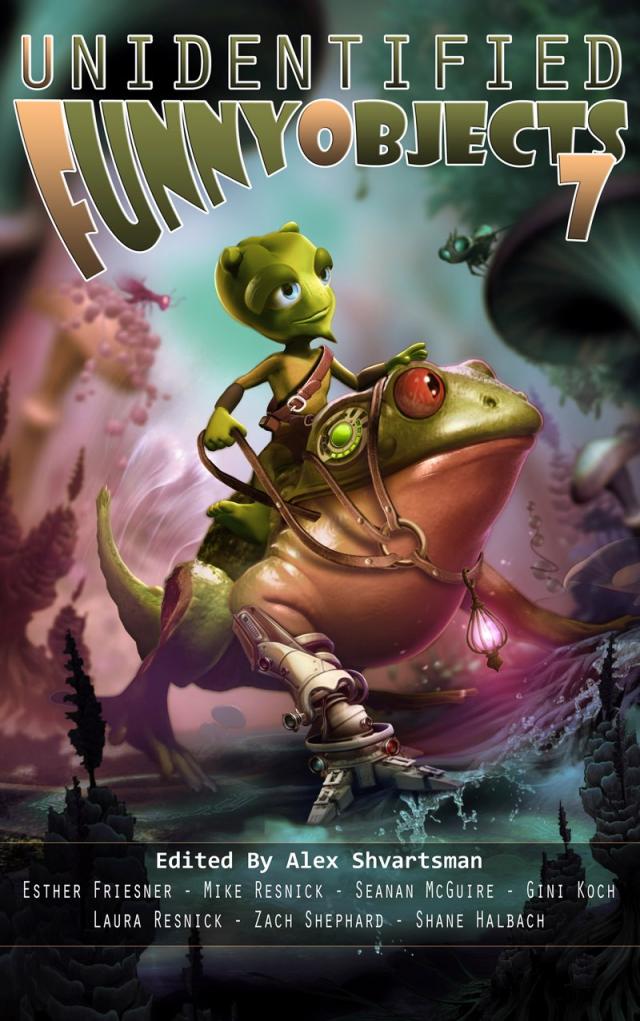
Unidentified Funny Objects 7, page 10


Desiree had softened her outfit while they kissed. It was still business ready, but the cut was demure. She gazed rapturously into Melvin's face with the biggest blue eyes I'd ever seen.
Her voice was as pure as a child's as she whispered, "Your Honor, please don't take him away from me. I love him."
I couldn't have coached her better. There wasn't a dry eye in the jury box. Beelzebub didn't even attempt a closing counterargument.
The verdict was announced before the judge's third gavel beat. Case closed. Melvin and the succubus had sacrificed themselves for each other. It was an equitable exchange, but I had to find a new intern.
A week later I got an invitation to their wedding. Verbal contracts may be tough to break, but the nonverbal ones are absolutely bulletproof.
C. Flynt is the husband-and-wife writing team of Clif and Carol Flynt.
Clif is the creator of Editomat (along with many other software projects) and a technical book author (Tcl/Tk: A Developer's Guide; Linux Shell Scripting Cookbook).
Carol has followed multiple careers, finally retiring as a freelance bookkeeper.
Both are musicians and singer-songwriters.
They amuse the three cats who own them with hours of argument over plots, themes, characters, grammar, and whose turn it is to write the first draft.
They write science fiction, historical fiction, fantasy, romantic suspense, and query letters.
Their fiction has been published by Grey Wolfe Publishing, Atthis Arts, and, now, UFO.
Bimble Bimble Bop Bop!
Richard Anderson
In the year 2222, humankind finally discovered the true purpose of penguins. For years they’d just stuck them in zoos and let schoolchildren throw donuts at them, until, at 11:03 p.m. on a dreary Thursday night, their great secret was discovered. And it was this: if you played the song “Bimble Bimble Bop Bop!” to a penguin, whilst simultaneously feeding it rhubarb pie, the penguin would explode, releasing enough energy to heat a small town for a month, with sufficient left over to keep the Imperial Army’s laser guns fully charged in their really quite dull war against the Mutant Hedgehogs of Mars.
The world’s energy problems were solved in an instant. Penguin refineries sprang up across the globe, stock markets echoed with the cry of "buy rhubarb," and every nation on planet Earth (except Peru) adopted the song “Bimble Bimble Bop Bop!” as their national anthem.
In 2223, a penguin-powered sports car won the 24 Hours of Le Mans endurance race. By 2227, it was possible to fly from New York to the city formerly known as London in under an hour on a jet fueled by a single (albeit slightly tubby) penguin.
By the turn of the decade, nuclear, oil, gas, and those windmill things they stick in the middle of the countryside to annoy old people, were redundant energy sources. A brief, but passionate debate did erupt over the ethics of blowing up all these penguins just to provide cheap, renewable energy, but then somebody invented an affordable penguin-powered jetpack, and very soon even the animal rights activists were zooming around shouting "Yee-hah!"; "Fly baby, fly!"; and "Mind that wall!", "What wall?" SPLAT!!!
Life was good for everyone. Everyone, that was, except the penguins (for whom the average day consisted of listening to the song “Bimble Bimble Bop Bop!,” eating rhubarb pie, and then exploding), the people of Peru (who, having welcomed the Mutant Hedgehogs of Mars with open arms, and changed their national anthem to “O Prickly Saviors from Beyond the Stars” were disappointed to be first enslaved by their guests, and then eaten), and finally, Ian Jenkins.
Ian Jenkins was a bog-standard man who lived a bog-standard life. Apart from his mildly offensive elbows, there was little to distinguish him from the next bog-standard man. He worked in a bog-standard office, lived in a bog-standard house, and on Tuesday evenings played squash with Graham, another bog-standard man. At the age of nine, during National Lemon Week, Ian Jenkins won a competition to guess how many lemons were inside a large box of lemons (403), and that, until an incident at 11:03 p.m. on a dreary Thursday night had been the highlight of his life.
Of all the people to discover the true purpose of penguins, Ian Jenkins was not it. He was not a scientist. He had no formal rhubarb training. And most curiously enough, he had never owned a copy of the song “Bimble Bimble Bop Bop!” Yet, on that fateful night, Ian Jenkins gave the people of the world cheap, reliable, energy.
And the people of the world hated him for it.
They loved the energy. They couldn’t get enough of that. What fun they had flying around on their penguin-powered jetpacks or plugging their most annoying aunt directly into a penguin and seeing how high they could launch her.
They loved all that. They just despised the man.
And it wasn’t only mankind that hated Ian Jenkins. The two alien armies currently (but independently) invading planet Earth at the time detested him with a passion. The Mutant Hedgehogs of Mars suspended their hostilities for a full week, and spent the time drawing uncomplimentary pictures of Ian Jenkins’s mildly offensive elbows and sticking them to lampposts. Such was their outrage, and such was their level of output, they very quickly ran out of lampposts. In the end they had to spend another week building and erecting new lampposts, just to stick their pictures to. This made them even angrier, and when they did finally resume their interplanetary war, they gave the Imperial Army a right good pummeling, for if there’s one thing that annoys a Mutant Hedgehog of Mars, it’s when there just aren’t enough lampposts to go around.
The other invading alien army also chose to draw uncomplimentary pictures of Ian Jenkins’s elbows. Unfortunately, the Wibbles of Wobble weren’t able to stick them to anything, for shortly after landing on planet Earth, they managed to get themselves locked inside a cupboard, and so far, no amount of wibbling or wobbling had helped them escape.
And the reason that everyone hated Ian Jenkins was simple:
“Bimble Bimble Bop Bop!”
“Bimble Bimble Bop Bop!” was an amazingly awful song. It was written and performed by Peru’s third most populous pop group, the Seventeen Enricos, and was the surprise winner of the 2193 series of Peru’s Got Talent. Its awfulness wasn’t the surprise, that was a prerequisite for entry; indeed, the previous year’s winner had been a drunk member of the audience who’d accidentally wandered on stage, vomited over the orchestra, accused the judges of stealing his clothes (for he was wearing none), and then curled up in a ball on the stage and had a nice little sleep. No, the surprise about the song “Bimble Bimble Bop Bop!” winning Peru’s Got Talent was that the song was so bad, the group was only allowed to perform it in semaphore, and also, halfway through the performance the Seventeen Enricos abruptly vanished in a cascade of sparkling blue light. Most viewers presumed they had just been selected for dinner by the Mutant Hedgehogs of Mars, but the truth is rarely as simple as being eaten by an invading alien army with a lamppost fixation.
That was the first and only public performance of the song, “Bimble Bimble Bop Bop!”, until some twenty-nine years later when Ian Jenkins condemned the world to listen to it almost constantly, every day, over and over again.
And so, the world hated Ian Jenkins. He tried to protest his innocence, insisting it was all an accident, but he could never quite explain what he was doing with a penguin in his house at 11:03 p.m. on a dreary Thursday night, why he was feeding it rhubarb pie, and why he was listening to the song “Bimble Bimble Bop Bop!,” a song that to all intents and purposes, didn’t actually exist.
Shunned by society, Ian Jenkins decided on a life of self-imposed exile, far from the evil stares and the uncomplimentary pictures of his elbows stuck to every lamppost he happened to walk past. And it wasn’t hard to find the perfect place: Peru. Which, thanks to the dietary habits of the Mutant Hedgehogs of Mars, was now entirely devoid of Peruvians.
Ian Jenkins packed a few meager possessions, and headed for that barren, uninhabited wilderness to live a life of solitude. He settled upon a windswept prairie, built himself a wooden shack, worked the land, and befriended a family of native tortoises. In the evening he would sit on the porch of his shack, sip fresh cactus juice, and look up at the stars, to watch the red and green lights sizzle across the sky as the war between the Imperial Army and the Mutant Hedgehogs of Mars entered its third, and most tedious, decade.
And it really was a stinker.
The low point was a battle fought across a swathe of featureless farmland. The battle had been going on for months, and the monotony of getting up every morning, just to fire some laser bolts across a field of moldy old potatoes was getting to both sides. It wasn’t long before the Mutant Hedgehogs of Mars couldn’t even be bothered to turn up, which suited the troops of the Imperial Army, who preferred to stay in their barracks and watch the telly anyway. As a compromise, one Mutant Hedgehog and one human were sent out to the battlefield every day, just for the sake of appearances, but all they did was wander listlessly around the farmland, kicking up dirt, and now and then lobbing a moldy potato at each other, just to relieve the mind-numbing tedium.
Occasionally, both sides would rally themselves out of their stupor, jump into their spaceships or war tanks, and blast each other to bits. But it was never with any great sense of enthusiasm. And if a Mutant Hedgehog of Mars happened to call home and speak to its mother, and was asked "Did you do anything interesting at work today, dear?" they would invariably reply "No."
Still, Ian Jenkins enjoyed watching the lights sizzle back and forth across the sky, and it passed the time as the days, weeks, and months of his solitude drifted by.
As the years came and went, Ian Jenkin’s hair grew wild and his clothes faded to gray. He tended the land, fetched water, and became ever more attached to the family of tortoises. And, as families do, it grew. Ian Jenkins welcomed each addition to the family with pride and joy. His life was one of blissful contentment. His days spent shuffling across the dusty outback, leading the tortoises from cactus to cactus so they could sip its green, luscious juice. Together, Ian Jenkins and the tortoises shared happy and peaceful days, utterly cut off from the outside world.
Which on the whole was a good thing, for when a virulent strain of penguin flu swept the Earth, the Imperial Army’s war was as good as over. Their penguin-powered laser guns useless, they made a valiant last stand against the war machines of the Mutant Hedgehogs of Mars armed with only large sticks and some frying pans they found in the catering tent. General JJ Zowalski rallied his troops with an epic pre-battle speech, but sadly the speech (eight minutes in duration) lasted slightly longer than the actual battle (three minutes).
The Mutant Hedgehogs of Mars took control of planet Earth, and buoyed by their unexpected success in the war (they had previously suffered eight straight defeats to the Jumping Jellyfish of Jupiter), decided to exterminate all life forms on the planet, just to be sure of the win. In a trice, the entire population was wiped out, save for Ian Jenkins, safely hidden in the seclusion of Peru, and the Wibbles of Wobble, who still hadn’t managed to escape from their cupboard.
Ian Jenkins, his clothes ragged, his hair wild, was out on the prairie, the vast family of tortoises clattering slowly behind him, sipping their cactus juice. A light in the sky made him stop in his tracks. A spacecraft. The first sign of life he’d witnessed since the Mutant Hedgehogs of Mars upped and left to have another crack at those pesky jellyfish.
The craft hovered high in the sky. A cascade of sparkling blue light burst out of its undercarriage and shot down to shimmer on the dusty land.
Ian Jenkins shielded his eyes. The light faded. He blinked, scrunched his face, and then looked on in amazement as human-looking figures stepped out of the last embers of the cascading light.
Human!
How long had it been since he had seen, let alone conversed with another human? And what news would they bring? What stories could they share? He became breathless with excitement. He tucked in the tattered ends of his faded shirt and watched as the figures walked towards him in a line.
He counted them.
They numbered seventeen.
They carried guitars and appeared to be singing.
Worrying memories stirred.
Ian Jenkins felt a terrible sense of dread. He turned toward the tortoises, innocently sipping their cactus juice, and then back to the figures.
He ran toward them, waving his arms, begging them to stop singing, but barely made ten yards. His cry of horror was drowned out by the sound of the explosions.
That's when Ian Jenkins made the second and last great discovery of his life. And it was this: if you feed a tortoise cactus juice, whilst the Seventeen Enricos sing their follow up single, “Flirty Flamingo,” there is a terrible, terrible chain reaction.
Richard Anderson lives in Gateshead, UK with his wife Sarah and son Thomas. He is the author of the Uncle Wizard series of children's books and has had short stories broadcast on BBC radio. He is currently writing Captain Canoe, a sitcom for radio.
The Sit Down
Laura Resnick
It was after midnight by the time me and Joey “the Chin” Mannino got to the spot where we had decided to dump the body.
“Nah, don’t stop here, Vito,” Joey said. “Get closer to the pit.”
He pointed past the mounds of garbage around us, to the place we planned to conceal what was left of Little Mikey Corvino.
“No way,” I said. “I just bought this car. Retail.”
Yeah, I know, a Jersey landfill ain’t no place to bring a brand-new 1987 Cadillac DeVille. But this was kind of an emergency. We only found out a few hours ago that Sammy “the Beast” Bordino, who was in federal custody, was ratting out the family.
And since Sammy knew where all the bodies was buried, me and Joey had dug this one up and were moving it now.
“The Beast shoulda never got mixed up in politics,” Joey said, sounding philosophical. “That’s dirty business.”
“The dirtiest,” I agreed.
That’s how Sammy got pinched. He was working on getting the right people elected: politicians who’d make sure no one interfered in the family’s perfectly legitimate business interests as long as Sammy laundered Corvino money through their personal “charities” and bought nice condos for their mistresses.
“Trusting that congressman . . .” Joey shook his head. “Talking to him on the phone.”
As soon as Congressman Squeaky-Clean got caught with his hand in the cookie jar (and up the skirts of his staffers, and covered in narcotics), he rolled on Sammy Bordino to save himself.
It was so predictable, even a well-cooked steak could’ve seen it coming. But not Sammy. What a dope. Looking back, I guess he always was more ambitious than smart.
“Oh, my aching back.” Joey winced and shifted in the passenger seat. “I’m gonna need to see my chiropractor. And it’s all that asshole politician’s fault.”
“No, it’s all the Beast’s fault. Politicians are scum. You expect them to rat on you.” I shook my head sadly. “But Sammy knew better.”
“Sure, he did. He used to be a stand up guy.”
“I guess facing three hundred years in prison changes a guy,” I said, trying to be charitable. “And now we gotta make sure no one ever finds this stiff.”
“Look, the condition Mikey’s in now . . . what’s left of him will rot away real quick in a landfill,” Joey said, trying to cheer me up.
“I hope you’re right, ’cuz this is the only plan we got. Come on.”
We got out of the car, opened the trunk, and started hauling the body out of there.
Eight years ago, Johnny Corvino showed respect for the dead by wrapping his brother in some garbage bags and then burying him, with Sammy’s help, in his backyard.
Now, as we wrestled Little Mikey out of the trunk, one of the garbage bags slipped, exposing his decomposing corpse.
“Aw, jeez.” Joey fell back a step as the stench hit us.
I gave him a handkerchief. A lot of people don’t know this, but he’s a sensitive guy.
We reached the edge of the pit, did a heave-ho, and tossed Mikey into it.
“We need to cover him up,” said Joey, turning to go back to the car. “I’ll get the shovels.”
“Bring the flashlight, too. I can’t see a damn thing.”
That changed a second later when bright light flooded the whole place.
“Whoa! What the . . . ?” Joey flinched, looking around.
I looked up and saw search lights in the dark sky, pointed straight at us. “It’s the Feds!”
And here we were, caught red-handed with Little Mikey’s corpse. Even in death, he was fucking up the family.
“The Feds? Run for it, Vito! Come on!”
I knew it was crazy—we’d never get away from a helicopter with such bright lights—but I started running to my car, anyhow. The lights were getting even brighter, like the Feds were bearing down on us, maybe trying to land.
But . . . why didn’t I hear the engine? All I heard was some wind and Joey screaming at me to run.
I looked up, and now I could see a big shadow behind those lights, moving toward us . . . But it was moving without making no sound, and it didn’t look like no helicopter.
“Vito!”
The lights started flashing and dancing, and by the time this thing was almost on top of us, I could see it was shaped like . . . “A flying saucer?”