

City of a Thousand Suns, page 1
part #1 of Ace Double Series


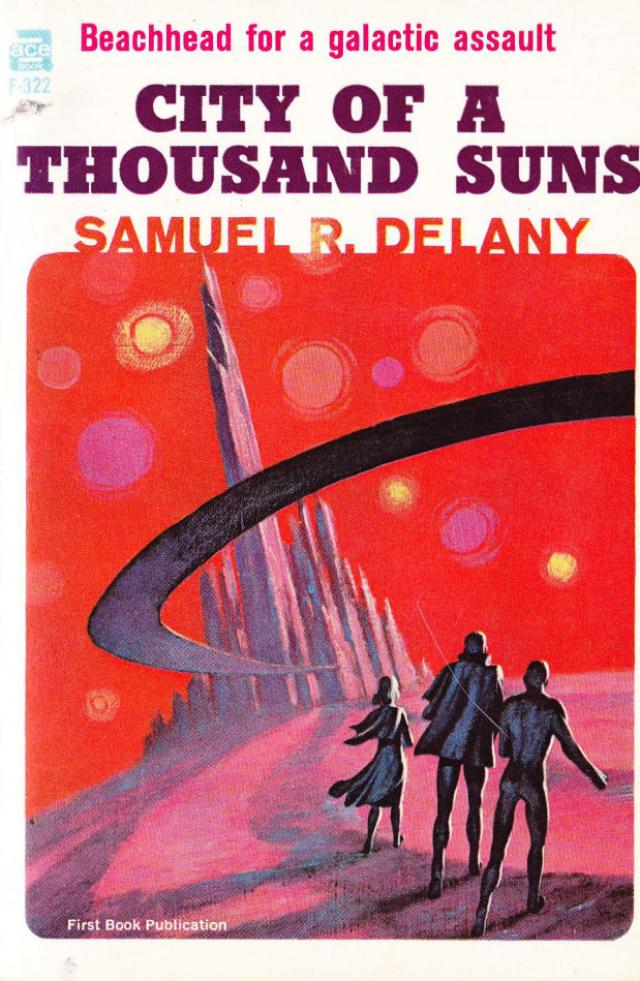
CITY OF A THOUSAND SUNS
ENEMY FROM ANOTHER UNIVERSE
SAMUEL R. DELANY
Copyright ©, 1965, by Ace Books, Inc. All Rights Reserved
Beachhead for a Galactic Assault
The war was over. The great computer which had arranged and directed the complex military operations of that future nation was to be dismantled. But the computer had become expert in the science of self-defense . . . and it resisted!
The government buildings were blasted! Rockets rained on the great city, and the Empire of Toromon, the first great hope of humanity after the millenia of radiation wreckage, faced disaster at the hands of a super-scientific monster of its own creation.
But, unknown even to Toromon’s desperate leaders, was the fact that behind the berserk computer lurked the unearthly mind, of a real enemy — a foe from the most distant realm of space, intent on making the Earth the first victim of galactic conquest.
.
This is for Joan Baez, and Bob Dylan, and Marilyn who showed me how to make the words.
I
What is a City?
There is at least one on the planet Earth, isolate among deadly seas, alone on an island near a radiation-pitted continent. Some of the sea and the land at the edge of the continent have been reclaimed; among these silent tides and still plains, there is an empire. It is called Toromon. Its capital city is Toron.
Halfway around the universe, in a dispersed galaxy is another — City.
A double sun throws twinned shadows from a tooth of rock jutting in the sand. The gullies sometimes shift in the rare breeze. The sky is blue, the sand lime-white. Low on the horizon are faint streaks of clouds. And down the steep side of one powdery dune is the City.
What is the City?
It is a place in the sand where a field of energy keeps the octagonal silicate crystals in perfect order, lined up axis end to axis end. It is a place where a magnetic compass would spin like a top. It is a place where simple aluminum has the attractive capacity of sensitized alneco. And although, at the moment, it houses hundreds of inhabitants, there is not a building or structure of any kind in it. The sand does not even appear more smooth, and only a microscope could have detected the difference in the crystalline placement.
At times, the City seemed a lake of water, at others a catacomb of caves. Once it had seemed a geyser of flame, and occasionally it looked like buildings, towers, looped together with soaring roadways, with double light glinting from thousands of sunward windows. Whatever it was, it stood alone on the white desert of a tiny planet halfway around the universe from Earth.
A meeting was being called in the City now; and with merely a turning of attention, the inhabitants met. The presiding intelligence was not single, but a triple entity much older than any of the others present. It was, in fact, the builder of the City.
“We have called you here to help us,” it began. “Simply by being here you have already contributed greatly. There are only a few more of you to arrive, but we thought it better to begin now than to wait.” To one group at the meeting, immense, thirty-foot worms, the City seemed a web of muddy tunnels and the words came as vibrations through their hides. “As we have explained to you before, our universe has been invaded by a strange, amoral creature whom we have called till now the Lord of the Flames. So far he has only engaged in scouting activity to find out as much information about life in this universe as possible.” A metallic cyst received the words telepathically; for him the city was an airless, pitted siding of rock. “But even through his methods of experimenting, we know him to be dangerous. He thinks nothing of completely perverting or destroying a culture to gain his information. We have tried to drive him out, and keep the various cultures of the universe intact. On your several worlds, as our agents, you have all had contact with him. And you have all had brief contacts with each other.” To the fifty-foot eyestalks of one listener, the atmosphere of the City was tinged with the green of methane.
“He has been gathering information for a full-scale attack, but since we have dogged him to each planet, we have been able to see the information he gathers. Each of your cultures was undergoing some serious political and social upheaval when he chose to examine you. His method of observation in each culture has been to activate the elements that would push the upheaval a little too fast, would bring it to its conclusion a little too rapidly. Then, oddly, his point of concentration would be, not the workings of the economic or social upheaval itself, but rather an intense study of the personal life of some socially alienated individual, a madman, an upper echelon political figure often, an outlaw, a dispersed genius at the edge of society." To one living crystal in the City, the words of the Triple Being came as significant progression of musical chords.
"Now I’d like to discuss one particular incident of his observation." A sentient cactus shifted its tentacles and beheld the City almost as it was in reality, a stretch of pastel sand; but then, who can say what was the reality of the City? "You have all arrived here except our agents from Earth, and we want to take that opportunity to discuss their specific situation.” To a casual observer of the meeting, the statement that the Earth representatives had not arrived would have seemed a flagrant oversight; one of the attendants was an attractive, auburn-haired woman with wide hazel eyes. But a minute examination would have shown her slim almond-nailed fingers, her cream and honey skin to be a bizarre cosmic coincidence. Internal examination and genetic analysis would prove her a bisexual species of moss.
“Self-contained and self-providing, the empire of Toromon has rested on Earth for fifteen hundred revolutions about the star Sol. The upheaval that Toromon went through was a complex economic, political, and psychological reorganization coupled with a tidal wave of technological advances in food production that the degenerate, thousand-year-tired aristocracy was unable to redistribute.” Tidal wave was the metaphor that a web-footed, triple-lidded marine creature from a world all water heard; to others, it was earthquake, sandstorm, volcano.
“Their solution was to simulate a situation which existed only in the libraries from the time when the whole planet was populated with nations of their number; to simulate a war, a war that would rid them of their excess, in energy, in production, in lives. The vestigial skeleton of a military organization that had survived from before their isolate period (when just such real wars had completely demolished other nations, leaving Toromon alone), was enlarged -to a tremendous figurehead; armies were recruited, equipment was prepared, and a vast fantastical war was staged near the radiation-saturated rim of their empire, controlled by an immense random computer situated in the ruined remains of a second City in their empire called Telphar. Thanks to the radiation around them, evolution has run wild in Toromon, and there is one atavistic section of the population that has regressed to a point that race had passed three million years ago, while another segment has jumped a million years ahead and become a race of giant telepaths. The telepaths tried to remain above this war, but were at last dragged into it, during the final days. Our agents, a telepath among them, convinced them in an effort to find some other solution less destructive than this mock war, to establish a momentary telepathic link among all the inhabitants of the empire. The fact that the war was not real came out among the people. The results have been too violent to predict accurately. The whole structure of Toromon was weak; it may be crumbled beyond hope already. Outlaw bands of malcontents — or malis — roam the country. There was an attempt to establish a new, young king, and for a while that worked, but the governmental system had been designed to rule a peaceful, calm nation, not a nation at war." A strange life-form composed solely of thermal vibrations oscillated pensively in the City, listening, contemplating.
“The reason we go into this situation in so much detail is because of the strange action of the Lord of the Flames when he encountered Toromon. First of all, his attempts to bring the situation to a rapid termination were immensely more violent and destructive than in any of his previous endeavors with other worlds. We, who can sense the energy of his concentration, realize that the intensity of his observation has quadrupled. Whatever he had been looking for desultorily among your worlds, he found in Earth. Our Earth agents drove him out once; he returned. They drove him out a second time; he still hovers near, ready to invade again. We can only have three direct agents on a planet: we can only house ourselves in three minds. But with the help of the telepath, we contacted two more who became our indirect agents for a while. One of our indirect agents was killed in the mock war, and so there are only four people left on earth who are our contacts. As I said, we can only inhabit three of their minds at once; this leaves one, already used to contact with extra-terrestrials, open for infiltration; this time we are sure that the Lord of the Flames, on his third return to Earth, will choose one of our own agents, whichever one is left outside our protection. If we let them know directly, the results would be disastrous to their own psyches. Therefore, our contact, already rare, will have to cease entirely after our next message.” A great bird ruffled its golden feathers, blinked a red eye, cocked its head, and listened.
“The reason for the Lord of The Flames’ interest in Toromon is quite clear. He is making ready to begin a war on our universe; he is now trying to find out all he can about how a life form of this universe conducts itself during a war. And this war of Toromon is a pure war, because it has no real enemy. Well, perhaps we can learn something too. We have the advantage of knowing where to look, for everyon e in this City is so much more akin to each other and to the Earth men than is the Lord of the Flames, that ideas such as ‘intelligence,’ ‘compassion,’ ‘murder,’ ‘endurance’ mean nothing to him, and he must learn them by alien observation. Similarly, he has characteristics of which we literally have no idea. To further our own understanding, we have requested our agents to bring with them three documents, products by three of the most sensitive minds on earth: the Poems of Vol Nonik, the Unification of Random Fields by Dr. Clea Koshar, and Looms of the Sea: A Final Revision of the History of Toromon by Dr. Rolth Catham.”
There was silence in the City, and then a faint life form spoke, a form that existed only as a light-sensitive virus who saw from the star-wide waves of novas to the micro- micron scattering of nutrinos, a life form disturbed occasionally by a fragment of ionized hydrogen, a loose photon, the aethric hum of a spinning galaxy eternities away from its home in cold, intergalactic space. “What will stop them from getting these . . . works?’
Then the Triple Being returned: “These works, remember, are written by the most sensitive minds of earth and will never reach the common man as books or periodicals, and among our four agents, there will constantly be a traitor, the Lord of the Flames himself!”
And a Universe away . . .
. . . and she was beautiful, beautiful with sun through the cracked window caught in her falling hair, beautiful with her closed eyes and olive lids, darker than the rest of her face, the rest of her skin, which was beautiful with colors like honey and the blush of kharb fruits going from white to pink, before they become speckled, orange, ripe; beautiful with textures like velvet, like polished sun-brown stone where her knee was drawn up and the skin tight; and where her body curved slightly toward him, at her side, and the skin was loose — like velvet.
The cracked pane in the window made a jagged line of shadow over the worn floor boards, up the side of the bed, over the crumpled, thrown sheets, a serpent of shadow over the curve of her stomach. Her lips were opened and the bright white of her teeth was faintly blued by the shadow of her upper lip. She was beautiful with shadows, the long violet shadows that fell across the waterfront streets where he had walked with her last night, beautiful with light, the glare of a mercury street light which they had stopped under briefly to talk to a friend of his . . .
(“So you went and got married after all, Vol. Well, I thought you would. Congratulations.”
“Thanks.” They both said it, and his voice, low tenor, and hers, rich alto, were even musical together. “Renna, this is my friend Kino. Kino, this is my wife, Renna.” He spoke that solo, yet like a single instrument after a chord, it implied symphonies to come between them.
“I guess you won’t be having too much to do with your old gang anymore.” Kino dug a dirty finger in a dirtier ear. “But then, you never were a gang man really. Now you can sit around and write poems like you always wanted to, and enjoy life.” And when the grimy youth, too old for urchin, too young for derelict, said ‘life,’ he glanced at her, and all the yearning of his restless age flamed in his black eyes and lit her beauty.
"No. I’m not a gang man, Kino,” Vol said. “And what with that stupid feud between me and Jeof, I figured this was as good a time as any just to drop out of the whole mali business. We’re going to be moving to the mainland in a couple of days. There’s a place we’ve heard about that we’d like to look at.”
Kino moved a bare toe around the oblong block of a cobblestone. “I wasn’t gonna mention Jeof, but since you did first, I guess I can say I think getting out is a good idea. Because he is a gang man, to the root of every rotten tooth in his jaw.” Suddenly he ducked his head and grinned apologetically. “Look, I gotta go someplace. You just don’t let Jeof see her,” and he made a motion toward Renna, and with the motion Vol looked at her, her dark skin pale under the light of the mercury lamp; Kino was gone, and she was . . .)
. . . beautiful with shadow again as they walked through the dark streets of the Devil’s Pot and at last turned into the ramshackled tavern-boardinghouse, beautiful as they went upstairs and darkness closed over her, blackening details. Just then someone opened the door at the end of the hall and a pale wash of yellow threw her into silhouette as she walked a step ahead of him, and he learned with his eyes as he already knew with his hands the shape and outline of her whole body, waist, breasts, neck and chin, were beautiful. And they had gone together to his room.
On the wall was an exquisite picture she had done of him, red chalk on brown paper. On the rickety table in front of the window was a sheaf of paper, the top of which bore the final draft of a poem that was, in its way of word and bright image, exquisite, a portrait of her.
He sat cross-legged in the crumpled, body-warmed bedding and looked at her beside him until his eyes ached with keeping the lids open, looking not to miss the beauty of her breathing, the faint flare of her nostrils, the rise of her chest, the movement of her skin, a millimeter back and forth across her collarbone as she breathed. His eyes flooded with her gloriousness and tears. He had to blink and look away.
When he saw the window again, he frowned. Last night there had been no crack.
He followed the line down the window where the two pieces of the pane were fractionally dislocated against one another to the lower left hand comer, where a sunburst of smaller cracks surrounded a three-inch hole. Some object had knocked a comer from the window. He stood up and went to the table. Broken glass glittered over the paper. (As my words should glitter, he thought.) Then he picked up the rock with the strip of cloth wrapped several times around it. When he straightened it out and read the words, blurred where the ink ran into the fiber, there was no glitter. Instead, small trip hammers struck against a hard ball of fear he had carried in his mind for so long now, and set it ringing with each word of the choppy, jerked out message, reverberating with the immense fear caught in the oscillation from declarative to imperative:
Saw Jeof after you. You get. Says he’ll eat you for breakfast. Go now. He means it. Kino
He spent two seconds trying to figure out how they could have slept through the sound of the rock, then spiraled to the conclusion that perhaps the rock was what had awakened him at first. The thought was cut off by a crash on the first floor. He turned, and saw her open her eyes, beneath those rising olive lids, brown pools where gold flecks surfaced in the proper light, and smiled, the smile vaulting toward him across the grimy boards, ricocheting from clapboard wall to stained, clapboard wall (where the only thing beautiful was perhaps her red chalk portrait of him) and from the wave of elation that filled him, even the dawn-tired sphincters of his irises relaxed, and against the rods and cones deep in his eyes, the room brightened. “And I love you this morning, too,” she said.
As his own smile came, the dark thought made an ominous rippling in his mind: she also wakes to a sound that she did not hear, seeing only me, as a moment before I saw her.
Below, furniture toppled again.
She asked him a question with her face, silently, lips parting further, tilting her head on the pillow. He answered her with the same frown and a shrug of his flat, naked shoulders.
A rush of feet on the stairs; then the sharp sound of the voice of the woman who ran the boardinghouse protesting along the hall. “You can’t just break in here like this! I run a respectable boardinghouse. I have my license. You ruffians get out of here! I tell you I have my . . .”
Then the voice stopped, the wave broke, something hit the door, hard, and it flew inward, banging the foot of the bed. “Good morning. I thought I’d find you up.”
“What the hell do you want?” he said.
There was no answer, and in the silence, he looked at the squat body, disproportionate torso, short bowed legs; the cheek had been laid open a half dozen times, and the scars crossed and crossed again. There was a wide maroon scab over the left eye from a recent injury. The edges were pink and wet. Ugly, he thought. Ugly.
The weight shifted from right foot to left, slowly, and the hip that was up went down, and the one that was down went up. “I want to make you miserable,” Jeof said, and stepped into the room. Three others stepped in behind him. “I see you got Kino’s message.” He laughed. “We took it away from him last night when he made his first try.” Then a repentant look superimposed itself over the gross, grinning features. “But then I thought maybe I’d toss it up here this morning before I came to say hello.” Jeof took another step into the room, looked sideways, and saw where she sat in the bed, eyes wide and completely golden, skin pale, hands, mouth, eyes, and shoulders terrified. “Well, hello . .


