Whistled Like a Bird, page 25


As I came to the end of Dofry’s story, I reread two letters she wrote me three years before her death. “To you, probably forty seems ancient—and so OLD. To me however, you’re still in your ‘salad days’—just really starting to know yourself—and what it’s all about!! Then you’ll spend the next forty years trying to find a satisfactory answer.… Nowadays I’m learning about the birds, the bees and a few ‘buntings’—always so much that is fascinating. By the way, it takes ten years to have a friend.”
In the second letter she thanked me for the banana bread I had baked, reminded me of her photo albums and clippings saved over a lifetime, and described her garden in Rye, where she and Junie buried one hundred daffodil bulbs throughout the woods. In the same letter, she responded to the idea of my writing her story, “It’s real work and I’ve done all the ‘dirt’ and research on two books for G.P. years ago! And I know!…”
At the age of ninety-three, she began to fail, but she continued to keep up her diary entries.
JANUARY 5, 1982 The pain is always present now: there used to be periods without it, & I could draw a breath in without being conscious or my “insides”—it’s the lower right side… a diseased ovary? It’s in that area… even at night when I rouse for a few minutes it’s there.
JANUARY 8, 1982 Too much pain & distress…so lie down on my bed for 2 hours. Only the 2nd time I’ve really caved in with pain.
The following day, the pain grows worse. “How much longer. How much? I am now nearer 94 than 93 & weary. Read more than ½ a book ‘Heat’ by Ed McBain. So much better than sweet old Agatha Christie!”
She writes of her concerns with the citrus crops and a possible freeze, about the birds at her feeding stations, and the fluctuating value of her family-owned stocks. The month of February is a blank, except for two doodles showing a stick figure with a rod, reeling in a fish.
MARCH 3, 1982 Pain increases once in a while out when it does return it is more intense.
MARCH 7, 1982 It’s a pleasure to see folks & no [sic] someone still cares that I’m alive. But also it wears me out, & by late afternoon I&m SUNK.
Her handwriting appears fainter with each entry. By now, she was attended by a twenty-four-hour nurse whom she describes with typical candor: “Practical nurse, 4 yrs, experience as a ‘Field Nurse.’ In Korean War. (Short, heavy, kinky red hair—husky & able. Also common background.)”
That month she learned her granddaughter Cynthia was pregnant. She wrote of her excitement over the news, but complained of too many caretakers, “and no one really ‘in charge.’”
MARCH 25, 1982 Sometimes the pain is more than I can bear! So what? Surgery at 93??? No, definitely. No.
The following day my grandmother for the first time saw her death as a welcome release. “Is there NO END to this? Why? Why?”
On April 2, her writing appears bold and strong. Not surprisingly, one of her final entries is devoted to her birds at Immokolee: “Buntings still here—but fewer and fewer. Perhaps some flocks have already gone N. to Va.…Dry weather—we need rain.…”
In those final days, my grandmother’s memory was still sharp. Closing her pale blue eyes, she rested peacefully as faded snapshots from the years past filled her dreamlike state. Blue satin ribbons and long cotton dresses, the thrill of grandchildren swimming the full length of her pool for the first time, the smooth warmth of her father’s hand in hers. The essence of orange blossoms, pine needles in the sun, and the predawn singing of the thrush. The splendor of Mount Whitney, the endless blue horizon that hot summer day as she flew above the clouds with Amelia, laughing wildly. The infinite pride in her two sons, the sound of piano music, and those carefree, childlike days playing house in the Great Smoky Mountains.
And always, she remembered G.W., and daisies from the garden. Lying on Laddin’s Rock, singing “Blue Skies.”
His inviting smile, his clean, strong hands, his intimate knowledge of her hidden private self that belonged to him:
… I should like to rind myself with him on some golden rain drenched day where I could completely ignore or forget age, distance, and geography, society—all the controlling influences or my everyday life. To be held warm and responsive—completely feminine—in arms strong to the point or hurting.
On Sunday, May 9, 1982, Dofry died. It was Mother’s Day.
Only an hour earlier, my father arrived and was upstairs alone with his mother, holding her frail hand. As if to be certain that he had come, and with just a hint of a smile, Dofry opened her eyes one final time, and then let go with a long sigh.
George Junior arrived soon after she had passed away. For over fifty years the magnificent wooded garden had held Junie’s childhood memories, and on that exact date he had also celebrated his birthday. Wandering through the dark hammock of trees, he was stunned by the absence of any other living soul and by the deadly silence. The usual drone of crickets, frogs, and whippoorwills, the roaming raccoons and possums, the barn and screech owls, and the occasional fox and bobcat were hushed. There had come an eerie quiet that George had never known before. Looking up at the closed blinds and sensing the reverent stillness of the home place, he knew why.
When I arrived in Florida the following day, I was met at Miami Airport by my father. We drove north to Fort Pierce, both of us overcome by sadness. Struggling with his own grief, yet wanting to share his mother’s last moments with me, he described every detail of Dofry’s passing. I can still see his enormous hand trembling as he wiped his tears away. And then, after taking a long, deep breath, he added: “You know, Sally, leaving us on Mother’s Day was just like Mother.”
MEMORANDA
IN APRIL 1985, ALMOST THREE YEARS AFTER my grandmother’s death, my husband Jack and I, with our sons David and John, were invited to Tampa to attend a party being given by our third son, Steven, and his business partner, Tom duPont. The event was to launch their new automobile magazine, the duPont Registry.
Jack and I arrived early, and John and David were the first to meet us outside the rented airplane hangar. We were all thrilled that Steve’s concept had become a reality. Inside, glaring spotlights bounced off the polished bumpers of the rare classic automobiles. The formal party featured a million-dollar Duesenberg; I was nearly blinded by the hot lights from television crews filming the event. Steve had told us all about these plans excitedly weeks before. But what he had not told me and could not possibly have known was that a strange twist of fate that evening would pull me directly into the heart of my grandmother’s past.
Steve was waiting inside the door, along with Tom and his parents, who had also flown in for the occasion. “Sally, I would like for you to meet my mother, Kathy,” Tom said. We greeted each other warmly as two very proud mothers. Then he turned to his stepfather and said, “George, I don’t believe you have met Steve’s mother, Sally Chapman.”
There was a slight pause before he turned back to me. “Sally, this is my stepfather, George Weymouth.”
I was stunned. Standing before me was the romantic figure with the same blue eyes my grandmother had so often described in her diaries. Looking up into his distinguished face, I flushed with emotion, the power of their unconventional love so fresh in my mind from reading her words. The tall; still handsome eighty-one-year-old gentleman took my hand tenderly in his. My eyes filled with tears.
“Mr. Weymouth, do you know who my grandmother was?” I asked.
“No,” he responded softly. “Who was she?”
“Her name was Dorothy Binney Putnam,” I said.
He looked down at me for what seemed like an eternity, and then slowly turned to his wife, standing beside him. “Dear,” he said with quiet dignity, “do you remember only yesterday I told you of a woman who whistled like a bird?”
Immokolee
January 15, 1997
BIBLIOGRAPHY AND ADDITIONAL SOURCES
Backus, Jean. Letters from Amelia, An Intimate Portrait of Amelia Earhart. New York: Beacon Press, 1982.
Bartlett, Captain “Bob.” Sails Over Ice. New York: Charles Scribner’s Sons, 1934.
Beebe, William. The Arcturus Adventure. New York: G. P. Putnam’s Sons, 1926.
Blanding, Don. Floridays. New York: Dodd, Mead & Co., 1941.
——. Vagabond’s House. New York: Dodd, Mead & Co., 1943.
Chronicle of Aviation. Jacques Legrand, 1992.
Cochran, Jacqueline, and Maryann Bucknum Brinley. Jackie Cochran. The Autobiography of the Greatest Woman Pilot in Aviation History. New York: Bantam Books, 1987.
Crowell, James LeRoy. “Frontier Publisher: A Romantic Review of George Putnam’s Career at the Bend Bulletin, 1910–1914, with an Extensive Epilogue,” Master of Science thesis, University of Oregon School of Journalism, June 1966.
Dunne, Colin, et al., eds. Rye in the Twenties. New York: Arno Press, 1978.
Earhart, Amelia. The Fun of It. New York: Brewer, Warren & Putnam, 1932.
——. Last Flight. New York: Harcourt, Brace/Harrap, 1938.
——. 20 hrs. 40 min.: Our Flight in the Friendship. New York: Grosset & Dunlap, 1928.
Edgar, Bob, and Jack Turnell. Brand of a Legend. Basin, Wyo.: Wolverine Gallery, 1978.
The First Hundred Years of American Yacht Club. Centennial Book Editorial Board of the American Yacht Club, 1983.
Ford, Corey. The Time for Laughter. Boston: Little, Brown, 1967.
——. Salt Water Taffy. New York: G. P. Putnam’s Sons, 1929.
Greenwich. The Historical Society of the Town of Greenwich and Greenwich Time, Connecticut, 1990.
Hutchinson, Hubbard. Far Harbors Around the World. New York: G. P. Putnam’s Sons, 1924.
Kitchel, Helen B. Memories. Self-published.
——. More Memories. Self-published.
——. Oaklyn. Self-published.
Lindbergh, Anne Morrow. Hour of Gold—Hour of Lead. London: Chatto & Windus, 1973.
Lindbergh, Charles A. We. New York: G. P. Putnam’s Sons, 1927.
Lovell, Mary S. The Sound of Wings. The Biography of Amelia Earhart. New York: St. Martin’s Press, 1989.
Milestones of Aviation. Washington, D.C.: Smithsonian Institution National Air & Space Museum/Crescent Books, 1991.
Miley, Charles S. Miley’s Memos. Indian River, FL: Indian River Community College Historical Data Center, 1980.
Morrissey, Muriel E. Courage Is the Price. Wichita, Kan.: McCormick-Armstrong, 1963.
——, and Carole Osborne. Amelia, My Courageous Sister. Santa Clara, Calif.: Osborne Publishers, 1987.
Oakes, Claudia. United States Women in Aviation 1929–39. Washington, D.C.: Smithsonian Institution Press, 1978.
Putnam, David Binney. David Goes Voyaging. New York: G. P. Putnam’s Sons, 1925.
——. David Goes to Greenland. New York: G. P. Putnam’s Sons, 1926.
——. David Goes to Baffin Land. New York: G. P. Putnam’s Sons, 1927.
——. David Sails the Viking Trail. New York: Brewer, Warren & Putnam, 1931.
Putnam, George Palmer. The Southland of North America. New York: G. P. Putnam’s Sons, 1913.
——. In the Oregon Country. New York: G. P. Putnam’s Sons, 1915.
——. “The Putnam Baffin Island Expedition,” Geographical Review, vol. XVIII, no. 1 January 1928), 1–40. Reprinted by the American Geographical Society.
——. Soaring Wings. New York: Harcourt, Brace & Co., 1939.
——. Wide Margins. New York: Harcourt, Brace & Co., 1942.
——. Mariner of the North. The Life of Captain Bob Bartlett. New York: Duell, Sloan & Pearce, 1947.
——. Up in Our Country. New York: Duell, Sloan & Pearce, 1950. Railey, Hilton Howell. Touch’d with Madness. Carrick & Evans, 1938. Thadden, Louise. High Wide and Frightened. Stackpole Sons, 1938. Who’s Who in America. New York: A. N. Marquis Company, 1897–1947.
PERIODICALS
Rye Chronicle
The New York Times
New York Herald Tribune
MULTIMEDIA
Sierra Club. Microsoft Encarta, Microsoft Corporation, 1993; Funk & Wagnall’s Corporation, 1993.
* * *
In the summer of 1928…
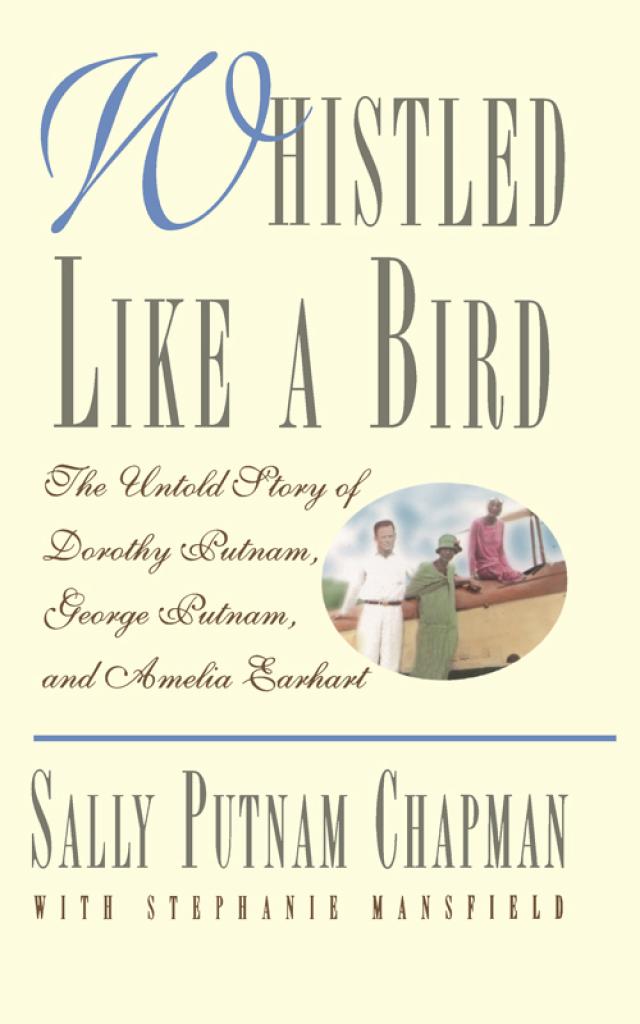
Dorothy Binney Putnam… free-spirited heiress to the Crayola crayon fortune and George Putnam’s wife, was becoming Amelia Earhart’s new best friend.
Amelia Earhart… having just flown across the Atlantic to make aviation history, was staying at the Putnam family mansion in New York.
George Putnam… the famous New York publisher and avid explorer who had arranged her flight, was falling in love with her.
The bond between the two women would change their lives forever as a story of passion and discovery began…
Late on the night of 17 August Amelia came to Dorothy: “Dottie, I’d like to dedicate my book to you, if you think it’s good enough; and if you don’t, I won’t. But I’d like to.” This was a surprise; does she really want to? Or is it a sop to me because she monopolized George all summer? She’s deep and silent, one phase of her life all hidden.
—Dorothy Binney Putnam
* * *
* Amelia’s final dispatches had been published in 1938 as Last Flight.
*Open to several interpretations, and applicable to all.
Sally Putnam Chapman, Whistled Like a Bird