Whistled Like a Bird, page 20
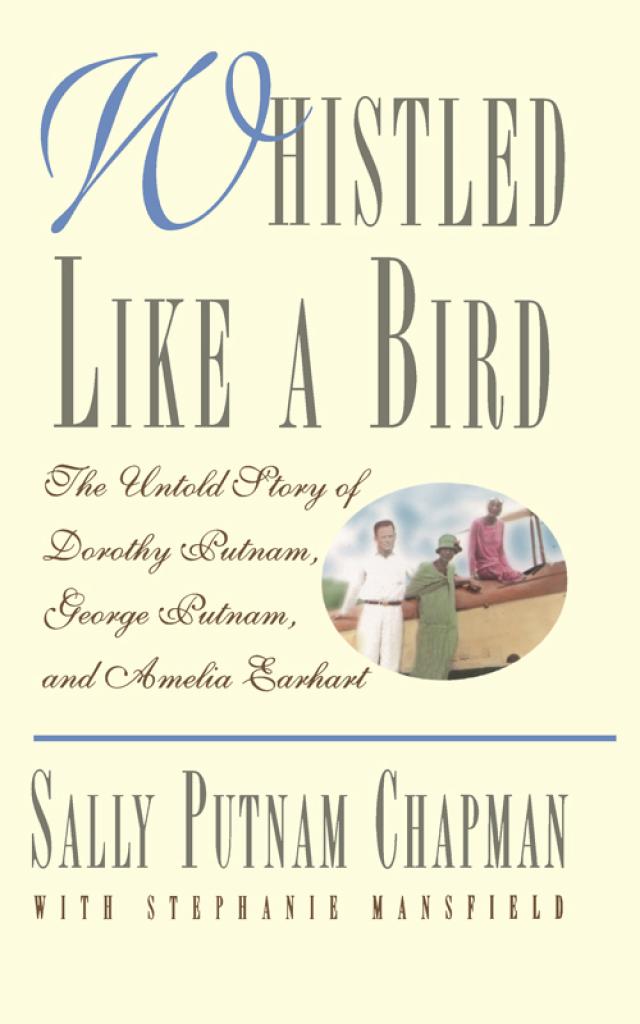


It is possible that Amelia and Dorothy took the opportunity to become reacquainted during Amelia’s brief stay in Fort Pierce, for I suspect that the two women (who now shared a grandchild) met privately. There are, however, no diaries for this time.
Though the two old friends had traveled a different road, they still had much in common. While Dorothy had felt little pride as G.P.’s subservient wife, she would eventually become the powerful matriarch of the entire family, with Immokolee as its “home place.”
It was a misty morning in May 1937 and the evening showers had paved the way for a low-lying fog. From the loggia on the second floor, Dorothy spotted David as he appeared through the cloudy trees that circled the lily pond. Five minutes along the woodsy trail beside the honeybell trees was all it took to walk from the clearing where David and Nilla lived. No sooner had he loped up the outside staircase, two steps at a time, than his mother welcomed him with her traditional glass of freshly squeezed orange juice.
David was preparing to leave for Miami, where he would spend the following week at the Columbus Hotel with his father and Amelia. Over the years, the relationship between Amelia and her stepson had deepened into a close friendship. She admired his adventurous spirit as a young author and explorer. David was a kindred spirit and Amelia loved him as a son. “She was wonderful to me,” he recalled. “From the age of fifteen to eighteen, a whole three-year period, I flew all over the country with her as part gofer and bodyguard. She was absolutely delightful, friendly, a real sharp gal and everybody loved her.” My father always described her to me as a shy woman, not seeking publicity, and he regarded his father George as being protective of Amelia almost to a fault.
My grandmother not only understood David’s bond with Amelia but encouraged it. She knew that Amelia had given David his first flying lessons, had bought him his first car, and that she had attended several of his football games with G.P.
On this morning in May, he had come to tell his mother everything he knew about Amelia’s highly publicized attempt to be the first person to fly around the world. My grandmother had read about a first attempt, and had been concerned when Amelia and her crew, Captain Harry Manning and navigator Fred Noonan, crashed on takeoff in Honolulu. David had heard from his father that the Lockheed Electra was being repaired in Oakland, California, and that Amelia—along with Noonan—planned to try again.
A former navigator on the Pan American Pacific Clipper routes across the Pacific, Noonan had made a number of trips in this area and had experience in celestial navigation. It was rumored that the darkly handsome Noonan drank heavily, but coworkers said it had never interfered with his job. At forty-four, he was newly married and planning to start a navigation school, and the free publicity from the round-the-world trip with Amelia Earhart would be invaluable.
In my grandfather’s private papers is a wealth of material never before published. It includes Amelia’s papers as well: letters (both personal and business), photographs, publishing documents, speeches, cartoons, and other memorabilia. For years I have studied them, searching for answers to questions about his marriage to Amelia and their vastly different personas. For instance, I have read that my grandfather was a cold and calculating husband and that they did not have a loving marriage. In the privacy of their home, however, Amelia spoke of his public image but felt helpless to soften it, trying to give him credit for his efforts whenever possible.
He was a sensitive man and must have suffered a great deal. I know he was impatient and often irritating, and he did not suffer fools gladly. But he adored Amelia, and she knew the depth of his love for her. Among the unpublished papers she saved were letters from George written to her during the around-the-world flight that were sent back to him for safekeeping prior to her disappearance. One reads:
… I have carefully analyzed our situation and appraised the last several days in your company. My considered conclusion is that I love you very much and would rather play * and work with you than with anyone I have yet encountered or could imagine—comb that out of your carefully tousled hair.
G.
The reference to their lovemaking will probably come as a shock to many who believe the couple did not share a physical relationship. As my mother and father reminded me so often, “in the privacy of their home, they were lovingly demonstrative.”
Included in these papers is a poem submitted for publication and rejected. As a budding writer, Amelia used the pen name “Emil A. Hart.” There are also cartoons that she placed in an envelope; in pencil she had written, “For A.E.’s funny scrapbook—made while sitting by the fireside someday.” I have held her passport in my hands and stared at the weary-looking young woman whose dark circles under the eyes are testament to a record-breaking Atlantic crossing and a willful determination to prove that women were not the weaker sex.
In their correspondence, my grandfather and Amelia usually divided their letters into two halves. The first portion was devoted to their business affairs; the second half was reserved for their personal sentiments for one another. In their private vows to one another, they promised never to expose their personal lives. Thus my grandfather never published these or other letters. But one letter to Amelia, written shortly before her final flight, reveals a sensitivity that belies his stiff public image.
It is clear that the decision for her to take this trip was a joint one.
Sunday evening.
Dear Hon:
I have been thinking a lot about your book. There is such a wealth of material. Probably the right thing for this book to concern solely “world flight,” if or, and when! Possibly it might embrace a chapter each on the Atlantic, first Pacific, and Mexico. These flights by themselves, with us as a background or in between. Which would leave for another (and more important book) the rich material of these full five years (“A Full Five Years” is a possible title)—people, places, lecturing, Purdue, education, modern flying, philosophy, politics, women, etc. Anyway, the immediate chore is to get down on paper, even roughly, a graphic record of what you’ve just done. Likely it breaks up somewhat thusly. 1. Planning; 2. Oakland-Honolulu; 3. Birchlots, of which #2 is the one to tackle immediately, while it is warm in your mind. Then #3. L’ll get together the fabric of #1. At the end I may do a chapter myself regarding the business end. Much of all this we can serialize in advance of book, hon, if we wish.
Hon, I miss you.
I alternate between spasms of contentment and of worry. I’m so happy with you and we really do have such a swell time together, in all ways. And I wish this flight wasn’t hanging over us. You know I sympathize fully with your ambition and will abet it, and 98% I know you’ll get away with it. But we both recognize the hazards, and I love you dearly—I don’t want to run the risk of perhaps having to go on without you—that makes me terribly sorry for myself? (Entirely disregarding your end of it!)
But gosh, once this is out of your hair, what a very happy interesting time we can have. We can have it, too, should you for any reason decide to quit.
Love you lots,
G
In another letter, my grandfather seems depressed and worried.
Hon;
I’m just recovering from a slump! Two days of feeling punk + mental depression—the one produces the other, but at the time that’s hard to rationalize.
Please, Ma’am, know that I am deeply in love with you.…Hon, I’ve been having the heebies a lot again… it is wearing—this waking up and countering the dangers the gal I love is preparing to face again. By the way, thanks for the generous paragraph in your last story as to the help I give.
I’ll be SO happy when it’s over. I want peace—and you. I’m never really content anymore, when I’m away from you. So face the horrid likelihood of being mighty close to me the rest of your days! Please love me a lot.
G
George and Amelia’s kind of equality of the sexes was unusual for the time, although their union was a forerunner of “power marriages” today. “I loved his humor and could see why A.E. was so attracted to him,” Amelia’s sister Muriel told me. “It was a difficult role he had to play, being the husband of a famous person, but there was never any bitterness or antagonism.” The playwright Robert E. Lee said, “Husband and wife both knew they had a good thing going. I suspect she probably needed him more than George needed her.”
Having studied their private papers for twenty years, I don’t believe this was the case. I think they both took advantage of each other’s skills, and were equal partners in their loving and adventuring.
During an interview in 1978 with Cap Palmer, my grandfather’s former business associate, he described his experiences with George. “There’s a general impression that he was a supreme egotist. That he was all for one and that one was himself… that when he promoted Amelia, he was promoting himself” Cap told me. “But in fact he had no conceit on his own or about himself. He knew his notoriety, which is a better word for George than fame. He was very much like Cecil B. DeMille, always selling tickets, never himself”
Cap Palmer added, “He promoted Amelia, not for the glory of the country, he just loved to promote things.… Amelia was older than her years. She was a very mature, balanced person. She was the only person who had George under complete control. He was dominant by nature, but Amelia was someone in her own right. She could handle George. When he would get a little expansive, Amelia would catch his eye, lift her eyebrows a little and go pphhhsss and George would cool it.”
I have also learned that my grandfather was the more cautious of the two. The legend that his P.T. Barnum instincts forced the trip is a false one.
In an article dated September 26, 1937, he recalled that “we seriously discussed abandoning the flight. This she was unwilling to do.”
Amelia’s response to G.P. would not surprise anyone who had ever met the headstrong aviatrix. She was eager to take the risks as a final coup in her career. The Milwaukee Journal quoted Amelia telling her husband, “Please don’t be concerned. It just seems that I must try this flight. I have weighed it all carefully. I want to do it. There’s just about one more good flight left in my system. I’m getting old and ought to make way for the younger generation before I’m feeble.”
A month shy of her thirty-ninth birthday, Amelia had begun to consider her own mortality. In one handwritten poem found among her papers, she writes: “Merciless life, laughs in the burning sun, and only death, slow circling down, Shadows.”
Earlier that spring of 1937, while visiting the noted flyer Jackie Cochran Odlum’s ranch in Indio, California, she had met a psychic called Eldon Smith. The unconventional and spirited Cochran was absorbed by “thought transference” and confided that she herself had such a power. Amelia also felt she was blessed with psychic gifts, and the two women became confidantes.
I was fascinated to read the penciled document written in Amelia’s own handwriting. The notes summarize a brief question-and-answer session with the medium. She asks him if there is any way to get “explanation of world” and if “table tapping” is the only means to conjure up the spirit of the dead. He answers, “Develope [sic] more right thinking.”
A.E.: I asked if he meant higher minded thinking.
E.S.: Yes.
A.E.: I asked if broad minded attitude meant [sic].
E.S.: Yes, very vehemently. We fly with you.
A.E.: Fly with me?
E.S.: Yes, very vehemently.
A.E.: How can I get the message.
E.S.: Concentrate. Vision will come. Follow your hunches.
While her plane was being repaired at the Lockheed Factory in Burbank, California, Amelia received a letter from another psychic.
Dear Miss Earhart,
I hesitate to write you this letter, but the urge comes upon so strongly, that I feel I must write. Do not make another attempt to fly around the world, you will not make it. You will meet with accidents, and you may loose [sic] your life through them. You have finished in the flying world; Let others do, what you have achieved.
I am writing you this, that you may enjoy a long life, and have a happy future. Higher powers rule our destinies, and we cannot go beyond them, we can get so far, and then we cannot go any further, you are entering into a critical period.
Yours very truly,
Miss E. M. Blair
As if tempting fate, Amelia left behind a lucky rabbit’s foot someone had given her and took off with Noonan on May 20, this time flying from Oakland toward the East Coast. My dad had received a message from his father to come down to Miami, the third stop along the new route, and help with the loading of the plane. Since both my mom (Nilla) and he would be making several trips to Miami before the takeoff, Dad had arranged for Dofry to baby-sit my three-year-old sister, Binney, at Immokolee during their absence.
Mom and Dad joined Amelia and my grandfather in Miami. The day before the flight, Mom accidentally walked into their room to discover them in a warm embrace, reassuring one another that the daring attempt would be a success. Neither had pulled apart as my mother stood there. Recalling the intimacy between G.P. and Amelia, my mom, who was five months’ pregnant with me at the time, wept when she later described the scene to my father. They had shared so many wonderful times over the past two years and had been among the few to witness George and Amelia’s intimacy, something the couple protected with a vengeance.
Although Amelia had a reputation for aloofness, my mother found her to be a tender and affectionate woman. She was touched by the flyer’s sensitivity. As Amelia prepared to depart, she reached down, gently placed her hand on Mom’s swollen belly, and whispered, “Take care of yourself, little one.” Amelia also spoke to my father, “David, please keep an eye on your dad for me.”
On sheets of lined school paper, my mother scribbled down details of the historic departure from Miami on the morning of June 1, 1937:
…I was there several times during the week or so of preparations. But I had to leave one little girl at home (well cared for) and had another with me soon to be born.
It was an eerie feeling being awakened at 4:00 a.m. for departure for Amelia’s flight, from the 36th Street Airport. We stopped en route for coffee and donuts to take along the way.
Once at the airport, there were things to be gone over and final arrangements to be made. The plane was ready and sitting on the runway. Amelia and Fred Noonan walked to the plane. There was a faint light in the morning sky when the two engines were fired.
Dave, G.P., and I stood alone on the upper deck of the airplane hangar as the plane took off…Amelia was on her way around the world. G.P. flew back to New York, and Dave and I came home to Fort Pierce. In the middle of the night a week or so later I woke Dave and told him that I had seen Amelia through a thick pane of glass in deep water pleading for me to help her. I knew I could never reach her, nor help her, nor ever see her again.
My mother later recalled, “we watched until she faded in the east. It was kind of an eerie feeling you had, mysterious or scary in a way.”
Amelia eventually flew over 22,000 miles, down the coast of South America, across the Atlantic, over the heart of Africa, and over India and Indonesia, stopping along the way whenever she needed to sleep, to take on fuel, or make repairs. Once, at the end of June in Bandoeng, Java, in the Dutch East Indies, a crew of mechanics worked three days on the Electra’s engines. In a telegram, Amelia asked George to send thank-you notes to the hosts who had housed her along the way.
It seemed that Amelia’s fame preceded her and she was amused by the lack of red tape. “No one has asked for passports. No customs, no inspections. We signed the police register in St. Louis, that is all. Better not mention this ’till it’s all over as someone might get in trouble.… Lots of love, A.”
The entire world was riveted, as newspapers and magazines followed Amelia’s progress. At every stop along the way, she collected gas and mechanic receipts, weather reports, and notes, which she sent back to my grandfather. He carefully saved them for her upcoming book. They fill a brittle manila envelope and are the tangible and fragile evidence of the flight.
In several handwritten notes, Amelia addressed him by her affectionate nickname, “Mugs.” Before publishing another highly publicized letter following the Pacific crossing in 1935, George edited out this closing: “Well, anyway, here’s hoping and cheerio to my Pugs. A.E.” Both husband and wife were intent upon keeping their affections to themselves. (It is curious that Amelia called George both Mugs and Pugs.)
On one page, torn from a spiral notepad, Amelia sounds frustrated and anxious: “I certainly wish I were alone. Oh well I’ll try to do a good job anyway. Not that Freddie is not okay. He is in many ways. But I do better alone whenever possible. I wish you were here, so many things you would enjoy. Perhaps someday we can do a pleasure trip.…”
The most difficult leg of the trip lay ahead: 2,556 miles of Pacific blue between Lae, New Guinea, and Howland Island, “an almost microscopic bit of land,” the final destination. Among these same papers is a Western Union telegram Amelia sent from Lae on July 2, 1937, while she and Noonan waited to take off. The dispatch, which runs to seven pages, begins with Amelia’s concern over the method of navigation she had chosen.
ANY LACK OF KNOWLEDGE OF THEIR FASTNESS AND SLOWNESS WOULD DEFEAT THE ACCURACY CELESTIAL NAVIGATION HOWLAND SO SMALL SPOT TO FIND THAT EVERY AID MUST BE AVAILABLE.
DESPITE RESTLESSNESS AND DISAPPOINTMENT NOT GETTING OFF THIS MORNING WILL STILL RETAINED ENOUGH ENTHUSIASM
During the layover, the pilot and navigator spent their time in coconut groves and picturesque villages. Amelia pays one of the natives two shillings for a dictionary of pidgin English and tells her husband she’s “up.” The natives refer to her Lockheed Electra as “Biscuit Box” because the smooth metal resembles the tins of imported crackers from England.