The Gate of Worlds, page 5
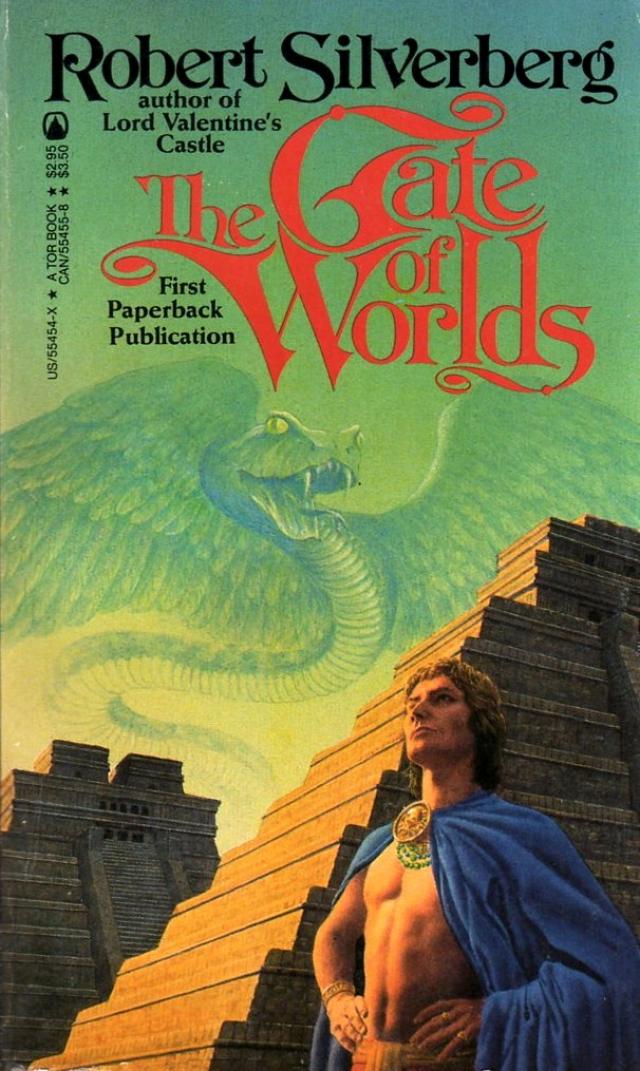


Quequex went on, "When a few Portuguese sailors came to Mexico in 1585, they were seized and put to death by Moctezuma III. He was a strong, forceful man who knew that strangers were dangers. But what if the Europeans had come seventy years earlier? Moctezuma II was on the throne then. Do you know what kind of man he was?"
"I'm afraid not. Medieval Aztec history-"
"Of course. How would you know? But he was a poet, a dreamer, a mystic. He feared the coming of Quetzalcoatl, the white-skinned god from the east. If Europeans had come to him, would he have flayed them alive? He would not. He would have bowed down to them and called them gods! He would have given them Mexico!"
"Perhaps," I said.
"Another thing. Our empire was new at that time. We had imposed our rule on the states around us. We had recently conquered Chalco, Coyoacan, Xochimilco, and dozens of other states, but they hated us as all conquerors are hated. We had not even yet subjugated Tlaxcala. If invaders had come, the vassal states would have risen up in rebellion against us. They would have allied themselves with the Europeans and destroyed us. And in Peru it would have been the same. The Incas, too, were new masters. Their empire would have collapsed if Europeans had attacked it in 1515. But by the end of the century it was too late. The Aztecs and Incas had consolidated their power. No Europeans could possibly overthrow them now."
"What would the world be like," I wondered, "if England or Spain or Portugal had conquered the Hesperides in 1515?"
Quequex smiled. "White men would rule the New World. We would be slaves. Our temples and pyramids would be gone, and the cross of Christ would rise everywhere. Perhaps there would be more machines in the world, for we have never been so interested in making machinery as you Europeans. Perhaps there would be flying machines, and machines that would permit men to talk across great distances. Who knows?"
"But it did not happen."
"It did not happen, no. The Black Death shattered Europe. We were granted the extra hundred years we needed to make our power permanent. Today we are the masters here, and the Incas in the south, and so it will remain. You know, you white people might have conquered Africa too. You have the seed of conquest within you. But Africa also was spared your fury and its black kingdoms remain. Perhaps your plague was the vengeance of the gods upon you, to teach you not to invade other lands."
"But we are peaceful people," I protested. "Meek-kind-loving-turning the other cheek-"
"Tragedy made you meek. But what were you like before the plague? Do you know the story of your Crusades? How your soldiers marched into Syria and Palestine as bloody conquerors? That was what you were like."
"The Crusades had a religious purpose!"
"Did they? Oh, yes, you Christians wanted Christ's homeland for yourselves. It belonged to others, but you stole it. And in the same way you would have stolen Africa and our lands, all in the name of holiness, if the gods had not broken you. You would have come to us and forced your cross down our throats and killed our kings and burned our temples. But you were prevented from doing it! The gods sent you the plague, and then they sent you the Turks! Instead of being masters, you were mastered! And only now, when it is too late, are you beginning to recover. It is 1963, not 1500. Too late for conquest!"
Quequex' voice had taken on a shrill, unpleasant pitch, and I sensed that this had become something more than a philosophical discussion. It was almost as if he had looked through the Gate of Worlds and had actually seen that other Earth, in which his people were slaves to mine. And real hatred was ripping and inflaming him now.
But of course it had never taken place, that conquest which he denounced so bitterly now. Christian Europe had gone under in the fifteenth century. Aztec Mexico and Inca Peru ruled the Hesperides. In Africa, black men wore the crowns. Why get so excited, then, over a fantasy, a dream, an airy speculation?
He realized after a while that he had lost control, and subsided, becoming once more his familiar ironic, sarcastic, lighthearted, slightly disreputable self. He ceased to assail the imaginary conquest, or to belabor a Europe that could never have remotely begun to do such a thing.
"It is an interesting idea, this Gate of Worlds," I said. "But one mustn't take it seriously. It leads to headaches and disagreeable emotions."
"You are right, Dan Beauchamp. Let us forget all I have said. It is time for sleep, anyway."
We curled up in the grass and closed our eyes. But for me sleep was a long time in coming. I could not free my mind from that vision of a world transformed. My mind seized on it, embroidered on it, until I seemed almost to be looking through the Gate of Worlds myself. I saw both the Hesperides thronged with the descendants of Europeans. Great cities, mightier than London and Paris and Istanbul, mightier even than Tenochtitlan of the Aztecs and Cuzco of the Incas. Flying machines! Motorcars that ran smoothly without exploding! Buildings towering to the sky! And the men with copper-colored skins, the defeated ones, the natives of the Hesperides-driven back into primitive ways, forced to the borders of their world.
Mind you, I had no wish to see the Hesperides conquered by Europeans. As an Englishman who bears the hereditary sorrow of a land throttled by pagan Turks for so many centuries, I could hardly be eager to see other folk under Europe's yoke-except, perhaps, for the Turks. But I had not opened this box of miracles. Quequex had, and I could not help but remain within the fantasy he had built for me. All night long, now dozing, now dreaming, now lying awake with throbbing eyes, I saw that other world.
Once I looked over at Quequex. He lay on his back, hands clasped across his middle, belly slowly rising and falling, faint snores ebbing from his nostrils. No visions tormented him tonight!
Toward dawn my imagination gave me surcease. The cities I had invented-New York, New London, New Paris, New Rome-faded into misty shadows. The next thing I knew it was dawn, and yellow sunlight was splashing into my eyes, and Quequex was prodding me awake. "It's many miles to Tenochtitlan, boy. Up! Up and onward!"
"Quequex-?"
"Yes, lad?"
"In all your sorcery, do you know a way to pass along the Gate of Worlds, to go from world to world?"
He laughed at me. "I spoke philosophy last night. The Gate of Worlds is an abstract concept, a way to understand the myriad turning points of history. It's not a tangibility. There's no crossing it."
"Then New York and New London are only dreams?"
"What are they?"
"Cities I imagined in the New World you spoke of, where Europeans had conquered."
Quequex tugged at his chins. He said, "Yes, only dreams. There's no New York. There never will be. And even if there were, you'd never reach it. Untether the horses, now, and we'll be on our way. Breakfast lies miles ahead of us."
FIVE
Tenochtitlan the Proud
The road became steeper, now. We were climbing toward Mexico's hilly heartland. I, for one, was glad to see the sweltering lowlands behind us. The air was cool and clean here, sometimes even a little too cool for comfort, but much to be preferred to the stinking soup that passes for air by the coast.
We now were in the province of Cuauhtochco and plodding northwest across Mexico's middle toward glittering Tenochtitlan. As he neared his home, Quequex became less talkative; he regaled me with little philosophy here. Perhaps the journey had wearied him, or possibly he was uneasy about the reception he'd receive at the royal court.
At night, when we stopped at hostels along the way, he'd talk a bit of Aztec mythology. A few bowls of chocolatl would get his tongue working, and he'd fill me with stories of the primordial Seven Caves from which all the Aztecs and other Mexicans had originally come, and the paradise they'd left behind to go to Mexico. I listened respectfully. Folktales always interest me. He told me, too, how King Moctezuma I, five hundred years ago, had sent messengers to the Seven Caves to check on the old traditions, and to visit Coatlicue, the mother of the god Huitzilopochtli, who still dwelled there. And the messengers went, and found the natives of the place were immortals, ageless servants of Coatlicue. The goddess, the snaky lady, lived atop a lofty hill, but Moctezuma's envoys could not climb it, for they sank to their knees in sand and stumbled back. "What is wrong with you, O Aztecs?" the servants of the goddess asked. "What has made you so heavy? What do you eat in your land?" And the envoys told the immortals, "We eat the foods that grow there and we drink chocolatl." The immortals replied, "Such food and drink, my children, have made you heavy and they make it difficult for you to reach the place of your ancestors. Those foods will bring death."
The envoys waited, and the immortals went up the hill to fetch hideous Coatlicue. "Welcome, my sons!" she cried, and the Aztecs presented her with gifts, and told of their plight: they lived only fifty or sixty years, and then died. She told them how her servants change their ages at will; the higher they climb on the hill, the older they become, but when they descend the years drop from them. "We become young when we wish," she said. "You have become old, you have become tired because of the chocolatl you drink and because of the foods you eat. They have harmed and weakened you. You have been spoiled by those mantles, feathers, and riches that you wear. All of that has ruined you."
And the priests sent by Moctezuma as ambassadors wept, for they could not ascend the hill to view the place of their origin. They turned away, and returned to Tenochtitlan.
"It would have been better, perhaps, if we had never left the Seven Caves," said Quequex, taking another swig of the chocolatl and patting his ample waist. "But it could be that it is better to live down here, eat and grow fat and die, than to be ageless upon the hill of Coatlicue. Eh?"
I felt some answer was necessary. I said, "The important thing is to be on the move. To be going somewhere, doing things, seeing, learning, feeling. What's the use of immortality if it has to be spent on the same old hill?"
"You believe this?" he asked.
"I do."
"Good." Quequex leaned forward and jabbed a stubby forefinger deep into my knee. "Remember all your life what you have just said. To reach out-to make voyages-that's what we are human for. I would not ascend Coatlicue's hill, not while I'm yet to glimpse the shining palaces of Cathay. And you, young Englander far from home-you are on the true path already. Stay to it."
* * *
In the morning, Quequex' mare balked at carrying his load another day. He sold her and bought a new steed, and off we went. The cities were close together now-and they were cities here, not peasant villages- so that we often plodded along in traffic-thick streets. It disturbed me to think that three or four of these Aztec cities had populations greater than London's. Of course, London has more to her than people; she wears two thousand years of history. Caesar trod those streets, and King Arthur, and Harold of Wessex, and James the Valiant, and many another hero unknown to these beak-nosed people of Mexico. Yet today London boasts no more than a hundred thousand citizens. Aztec cities whose names I could scarcely pronounce were twice as populous.
One of the finest of those cities had a name easy on the tongue: Cholula. We entered it by night, when it glowed with the electrical lights that the great cities of the Hesperides have installed, and the sight of it was like a hand reaching within my chest to wrench my heart. I gasped at my first glimpse. Such a city! If this were Cholula, a mere provincial town, what could Tenochtitlan possibly be like?
A religious festival was going on as we arrived. Priests in white cotton surplices paraded, some carrying trumpets, others flutes, others drums. The smell of incense was thick and sweet in the air. Quequex and I rode down the broad thoroughfare following the procession; I was too fascinated even to think of seeking lodging, and he seemed to be willing to humor me in my curiosity.
In the distance I saw a colossal pyramid with more than a hundred steps leading to a temple at the summit. The white-clad priests were ascending the pyramid, and I suspected that we had arrived in time for the climax of the ceremony. In the great square below the pyramid hundreds of thousands of Cholulans had gathered, packed elbow to elbow. I had never seen so many human beings all at once before, and the sight was moderately terrifying: an ocean of bobbing heads, a sea of painted faces.
I whispered, "Are they going to cut out a man's heart up there?"
"There is no human sacrifice at the Great Pyramid of Cholula," Quequex said scornfully.
Notice how the old fox phrased that. He did not claim outright that the Aztecs had given up their bloody ways; he merely denied that such savagery took place here. The official Aztec claim, of course, is that human sacrifice was abolished in the seventeenth century. And, since the Mexicans are a prosperous and civilized lot, I suppose that's basically true. But their gods are blood-drinkers, all the same. It would not surprise me to learn that in the small towns of the back country the old rites still are practiced: the obsidian knives flash, and Huitzilopochtli gets his red offering.
As Quequex explained, this temple was sacred to Quetzalcoatl, an austere god of peace to whom only partridges, doves, and game are sacrificed. He did not out-and-out insist that human sacrifice was extinct. But I was fairly sure that no infidel eyes would ever glimpse such a rite in Mexico, and Quequex wasn't one to talk about those things.
The ceremony ended. The crowd dispersed. We found ourselves lodging in a large hotel, and stabled our horses. Then we went out to walk about Cholula.
It was a sobering experience. The electrical lights dazzled and awed me. Buckingham Palace has electricity now, and so do the Houses of Parliament. But to see an entire city glowing with yellow light after dark-it made me want to sink to my knees in prayer at such wonders! And this, I stress, was a minor city of no more than five hundred thousand people. Temples everywhere, towers, giant statues, an air of wealth and power: that was Cholula. I looked forward almost in fear to my first glimpse of Tenochtitlan.
We left in the morning. Our road was a mountain pass, cold and forbidding, between two snow-covered peaks. There was a tunnel for motorized traffic, but we on horses had to take the ancient road. I was happy that we did, despite the chill that invaded my bones and the thinness of the mountain air. For at midday, fifteen miles or so out from Cholula, we rounded a bend in the pass and suddenly there lay out before me on my left the most awesome mountain I ever expect to see.
"Popocatepetl," said Quequex softly. "The smoking mountain."
Popo was a stunning cone, his flanks gleaming with a snowy whiteness so bright it numbed the eyes, his summit an ashy zone of blackness from which smoke belched forth. I thought I saw red flaming tongues licking out of the volcano, too, but that may have been merely the workings of an over-stimulated imagination. I reined the black colt and sat a while in wonder. I had not traveled much before this journey, you understand. They say that Switzerland has some fair mountains, but to reach Switzerland from England one must cross France or Italy or the Teutonic States, and my patriotic English blood boils at having to live even a day in countries that swear yet by the Koran. So I have forgone the sight of the Alps-not that my family could ever afford to send its boys around as tourists, even if I could overcome my religious prejudices. Once as a lad I vacationed in Wales, and saw Mount Snowdon, which in its way is a lofty peak. But Snow-don's way is not the way of Popo, and beside this towering monster of a volcano the pride of Wales would be lost.
When my mind had come to terms with the hugeness of Popocatepetl, Quequex seized my arm and pointed it toward the right. I narrowed my eyes, squinting into the noon sun, and saw a second snowcapped mountain far away.
"Ixtaccihuatl," he murmured. "The white woman. The bride of the sun. Popocatepetl is her guardian."
I began to wish I had never come to Mexico. Such wonders are a severe strain on a boy from a small island without great natural splendor. We rode on. Quequex told me tales of the mountains: the rain of ashes and cinders from Popo's cone that in the 1540 eruption had reached Tlaxcala, thirty miles away; the rivers of lava; the rumbling of the earth. We picked our way daintily past the mated volcanoes; I could not help but fear that the drumming of my colt's hooves on the highway would awaken the sleeping giant and bring liquid fire to envelop and destroy.
We spent that night at a place called Huexotzingo. In daylight we ascended another mountain pass, this one so high that it stung the nostrils to draw a breath. Popo and Ixta still lay to the left and to the right, miles away. But a greater sight greeted me that morning, with such an impact that I felt tears bursting from the corners of my eyes at the sight of such a spectacle.
What I saw was Mexico's great lake spread before me, with all its swollen cities along its borders, and Tenochtitlan the proud within the lake itself.
"You see?" Quequex said, pointing. "The big lake is Lake Texcoco. There to the south: Lake Xochimilco. Adjoining it, toward us: Lake Chalco. And in the north, barely to be seen: Lake Xaltocan. All the lakes are joined now. And there, see the cities!"
His voice trembled, as did his pointing arm. If a native Mexican could be shaken with emotion upon seeing such a view, what effect do you think it had on me? I was speechless. Along the eastern shore of the vast lake was a continuous band of habitation. I knew that more people lived about this lake than in all of England, France, and Spain combined, but a statement like that is only words, a string of noises, while the sight before my eyes brought the meaning of those noises home with stunning force.
Quequex called off the names of cities: Chalco, Ixtapaluca, Itztahuacan, Chimalhuacan, Coatlinchan, Huexotla, Texcoco, Tepexpan. I saw only that unbroken line of buildings, and no hint of borders between city and city. He named the cities on the western side of the lake, too, though they were only graynesses in the haze: Xochimilco, Colhuancan, Coyoacan, Mixcoac, Chapultepec, Tlacopan, and his own native city of Azcapotzalco. The unending stream of strange syllables cast a hypnotic spell, and my head swam with words of x and z and tl and oa and ua, and at last I snapped from it and said, "I have a friend in Texcoco. When we pass through there, can we visit him?"