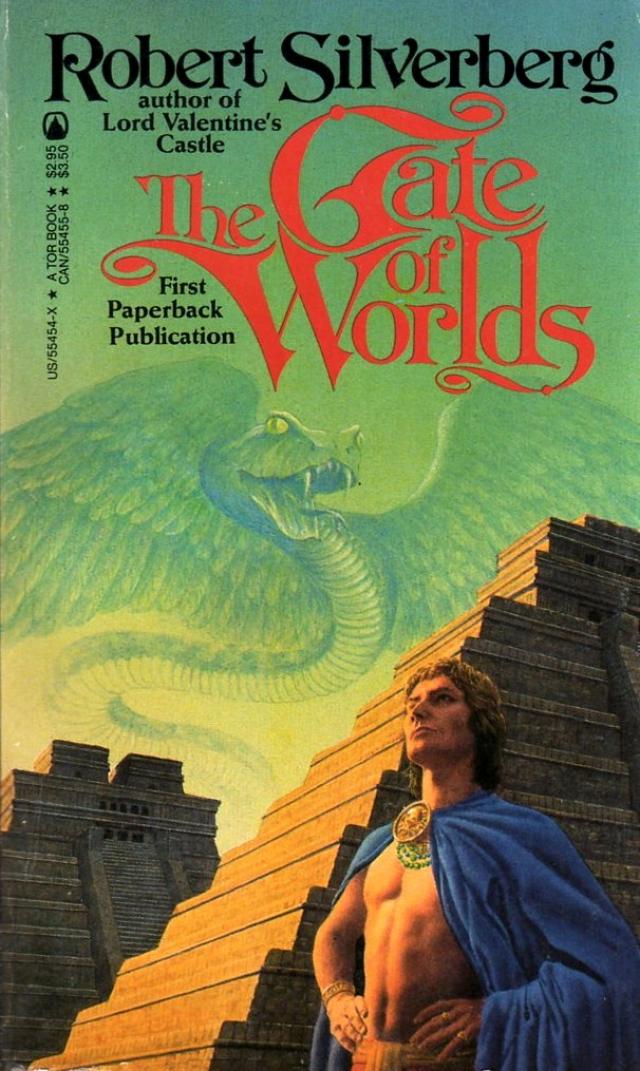
The Gate of Worlds, page 4


Quequex tried to look calm, but I could see that he was inwardly troubled by the car's performance. Children were running alongside us, laughing and cheering, but now the car had picked up such speed that it had left our followers behind. It tended to wobble all over the road, too, and Quequex' pudgy hand gripped the steering lever in earnest.
"These new cars," he muttered. "This is the 1960 model-designed for our wild young men. Give me a good, reliable '45 car any time."
"How long does it take to get to Tenochtitlan this way?" I asked.
Quequex' reply was drowned out by an immense barrage of noise from the boiler. In the fierce heat of the day, sitting with my back against that blazing furnace was no pleasure, even with an insulating plate between. I was covered with sweat and soot. I saw Quequex fumbling with the brake, and to my immense relief the car slowed to a halt.
When it had stopped Quequex said, "Now we change seats. I will teach you how to drive."
I would sooner have learned how to ride to Tenochtitlan on the back of a crocodile. But I had no option; it was hardly fair to force Quequex to do all the driving. Trembling only slightly, I took my place in the driver's seat.
"To go left," he said, "you turn the lever to the left. To go right, you turn the lever to the right. To go straight ahead, you hold the lever in the middle. Understand? Good. When you see an obstacle in the road, you apply the brake. Otherwise you drive forward."
The car was quivering like a snaffled horse trying to bolt.
"Release the brake," Quequex said.
I released the brake.
"Depress the starter."
I depressed the starter.
And just like that I was driving.
I hung on to the steering lever and chewed my lower lip a bit as we plunged forward. Luckily the road was straight and wide, for the Aztecs know a trifle about road building, and I'm told their roads are the best in the world, save only for the masterpieces done by the Inca engineers. This was flat countryside, too, with swamps and stinks on all sides, and that vast sun hanging about sixteen feet above us.
The road was wide, but unfortunately not empty. Peasants on donkeys joggled along next to us, occupying the shoulder of the road and paying absolutely no attention to traffic. Occasionally some nobleman on a high-spirited horse would prance by. Horses, like motorcars, are imports from Europe; the Hesperideans had none of their own until we began selling them to them in the seventeenth century. To this day, our Russian friends do a lively business peddling Siberian ponies in the New World. But just now, with mules and donkeys and drayhorses and Arabian chargers wandering all over the road while I was so desperately trying to control the car, I found myself profoundly wishing that we had never entered the horse trade.
When I got in trouble, though, horses had nothing to do with it.
I had been driving perhaps ten minutes, threading my way through the obstacles on the road and magically failing to hit anything. Just ahead of me now was a cart drawn by two plodding llamas, those sawed-off camels from Peru. One llama chose the moment of my approach to stop dead in his tracks.
Unless I changed course rapidly, I'd smash right into the cart at top speed. There was nothing to do but swing over into the eastbound lane, and I did it, pulling the car to the left just in time to avoid the llama-cart.
However, there was no time to see if anything else was occupying the eastbound lane. And of course just as I entered it there appeared another car, the first I had encountered since we had left Chalchiuhcueyecan. It was a low, shiny, sporty model, newer than ours, containing half a dozen lively young Aztec bucks. They had thoughtfully decorated its front end with one of those nightmarish Mexican gods, so that I had a view of red teeth and yellow eyes zooming toward me.
At the last moment they swerved as far as they could to the outside of the road, and I pulled back to my own lane as well as possible considering the presence of the llama-cart. We passed each other with some six inches to spare. The Aztecs shouted multi-syllabled curses at me as they rocketed past.
I began to realize I was still alive. I pulled the car around the llamas, drifted to the edge of the highway, and braked it to a halt. I looked at Quequex. His face was beaded with blobs of bright sweat, and his swarthy skin was nearly as white as mine from fright. But he was in better shape than I was, right then.
When my teeth stopped chattering, I indicated the steering lever to him and walked around to the passenger side of the car.
"It's your turn to drive," I said.
FOUR
The Gate of Worlds
I was glad that Quequex was driving when the boiler exploded.
It happened on the second day of our western journey to Tenochtitlan. We had covered perhaps sixty miles that first day, driving across a flat muddy plain shimmering with heat, passing from a zone of swampy jungle to a zone of barren desert. Despite occasional terrifying moments when the boiler throbbed and palpitated like a diseased elephant, we had no mechanical difficulties with the car.
That night we halted at a small country hostel where I saw Quequex practice some of his sorcery. The room we were given was infested with crawling insects, and until you have seen Mexican insects you simply have not seen insects. These were upwards of an inch long, with legs meaty enough to have visible thighs. From his luggage Quequex produced a small green candle which he lit to the accompaniment of murmured spells. Whether it was the spells or the smells, I don't know, but the insects vanished soon after the fumes of the candle penetrated our room, and we slept soundly.
No witchcraft could save the car the following day, though.
We gave it a fresh load of coal in the morning and set out on the broad highway soon after breakfast. From the start that day the boiler was behaving strangely, delivering itself of odd burbles and wheezes. The engine went by fits and gasps, too, and each time it caught its breath the whole frame of the car shook violently.
Quequex drove the first stint. After an hour he turned the car over to me.
I drove for an hour.
He drove for an hour and a half.
We stopped in sandy, hilly country and had lunch. The usual food, plenty of spice ground into it, and something mildly intoxicating to drink.
I drove for an hour and a quarter after lunch.
He drove for an hour.
We got out and rested under a shady tree for a while, because the engine seemed to be overheating.
I drove a while. He drove a while. Twilight began to fall. The engine began to fail.
It emitted a series of rasping coughs. I looked back and saw bluish smoke coming from the boiler vent. I told Quequex about it, and he looked, and said something unintelligible under his breath. We drove on, another mile or so, and abruptly the engine whined and the boiler boomed and Quequex slammed on the brake.
"Run for it!" he yelled.
He grabbed his luggage and I grabbed mine and we sprinted for safety. As I've indicated, Quequex was on the ponderous side, and the ground shook beneath his feet, but he ran as he probably had never run before. At one point he was actually moving faster than I was.
From behind us came the sound of a mighty explosion. An instant later I felt hot raindrops striking my skin; the water in the boiler was spraying down on us. We kept on running. At last Quequex flung himself face down on the ground, moaning and groaning, and buried his head in his arms.
But there was nothing more to fear. The blast was over. I looked back and saw the heap of twisted metal that our car had become. It was sad; I had come to like the noisy, smoky beast since learning to drive.
"It happens," Quequex said. "The horseless chariot is still in an early stage of development."
"What do we do now? There aren't any settlements in sight."
"We walk. We purchase horses when horses are seen for sale. We proceed to Tenochtitlan."
"And the car?"
"We leave it where it is. I am an official of the court of Moctezuma; we will settle things without difficulty. A slight payment, perhaps-"
He heaved himself to his feet, and we walked. For a plump old man, he had plenty of rubber in his legs, because we marched at least five miles through gathering darkness before we came to a town, and he complained not a whit. Beneath the blubber and the braggadocio, Quequex was tough.
We bought horses that night. I didn't see any money change hands, but the awed peasants delivered over a swaybacked mare for Quequex and a husky little colt for me, and off we went. We rode till midnight. I was unaccustomed to the Aztec saddle, which is so skimpy that it might as well not be there at all, but my ebony colt was swift and agile, and I enjoyed riding him. Whether he enjoyed being ridden is another matter entirely, into which I made no inquiry. I doubt very much that the red mare enjoyed carrying the corpulent Quequex, but the mare did not complain in any language we understood, and we sped along quite satisfactorily.
When no hostel appeared, Quequex suggested we camp in an open field for the night. There should have been a hostel somewhere on our route, for the Aztecs have borrowed from the Incas the useful idea of spotting accommodations on every royal highway, but we must have missed the last one somehow. Sprawled we out in thick tall cool grass. From the depths of his pack Quequex produced a few cornmeal cakes that he had stowed away at dinnertime, and we munched.
"Huitzilopochtli!" Quequex expostulated, slapping his fat haunches. "Never since my ancestors left the Seven Caves has a man been as tired as I am now!"
We were both tired, but not sleepy. The moon was huge and bright, a coppery plaque nailed to the sky, and the air was too warm for sleeping. We talked, instead, sitting cross-legged in the grass.
Quequex spoke of wonderful Tenochtitlan and of the Aztec nobles who thronged it. I detected in his voice a note of irony when referring to the royal ones; tall they were and handsome, but to Quequex sleek limbs were nothing without a shrewd brain, and I gathered that the nobility was not distinguished for intelligence. Of King Moctezuma XII, though, Quequex had nothing but praise. The King, he said, was a shrewd, dynamic, ambitious monarch who would make Mexico the greatest nation on the planet.
"Of course," he added, "we may never be certain what lies on the far side of the Gate of Worlds. Who knows in truth what the future holds?"
"The Gate of Worlds?" I asked.
"You do not know what that is?"
I shook my head.
Quequex smiled and looked at the moon, and his face took on the crafty expression of the professional sage. "The Gate of Worlds," he said in a portentous voice, "is the gate beyond which all our futures lie. For each of us at any time many futures lie in wait. And for each possible future, there is a possible world beyond the Gate."
Mystified, I said, "The more you tell me, the less I understand."
Quequex ripped a dozen blades of grass from the ground. He laid one down and arranged the others so that each radiated from it at an angle.
"This," he said, pointing to the edgewise blade, "is the Gate of Worlds. And these"-he indicated the blades at angles to it-"are the possible worlds coming forth on the far side of the turning point."
"But-"
"Silence and listen! Every time a man makes a decision, he creates new worlds beyond the Gate, one in which he did this, one in which he did that. The peasant ploughs his fields, and halts to slap at a bothersome fly. In one world, he slaps. In another, he does not, but proceeds down the furrow. It makes small difference in that case. But what if the peasant, by halting to swat the fly, avoids the claws of a jaguar lying in wait at the end of the field? In one world, the peasant swats a fly. In another, he goes to the end of the field and perishes. Again, it makes small difference, except to the family of the peasant. The world is unchanged whether he lives or dies. Unless, of course, one of his descendants is to go to Tenochtitlan and murder the king. If the peasant dies, that distant descendant never is born, the king lives out his years, and all is different from the way it would have been if the peasant, pausing to swat, had lived to engender the ancestors of the assassin."
My head swam with all this talk of probable worlds. Peasants? Jaguars? Assassins?
Ignoring my evident confusion, Quequex swept serenely on with a torrent of further examples.
"The more important the individual, the more complex the working of the Gate of Worlds must be. Consider King Moctezuma. If he lives, he will bring Mexico new greatness. If he slips in his bath tonight and dies, Axayacatl is king, and the future is different. For each of us at every instant the Gate lies open and an infinity of worlds spreads from it."
"You mean-there is a world in which the car blew up and killed us, and there's a world in which the car didn't blow up at all, and there's a world in which the car didn't work in the first place?"
"Exactly." Quequex beamed. "Also there is a world in which the bandits killed both of us back in Chalchiuhcueyecan. A world in which you were lost at sea before you ever reached Mexico. A world in which you never were born, for your grandfather died in his cradle. A world in which I never was born. A world in which I was King of Mexico. A world in which Mexico was conquered by Europe five hundred years ago. A world in which there were never any men at all, but only green snakes with many legs. A world in which-"
"Stop!" I cried, dizzied. "Please stop!"
Quequex laughed. "It shakes the mind, does it not, to peer through the Gate of Worlds?"
It certainly does. For a moment I had looked upon infinity, and that had been no pleasure.
I said slowly, "But some of the possible worlds you spoke of were ridiculous ones."
"Ridiculous, of course. But possible. If man's mind can imagine it, then it exists in the realm beyond the Gate. All possible worlds exist there. An infinity of worlds, created at every moment. Some are all but identical to others. There are a billion worlds in which I have made different gestures with my little finger in the past ten minutes, all other things being the same. There are a billion worlds in which I have arranged my words in slightly different ways while explaining to you, all other things being the same. There are a billion worlds in which-"
I was afraid I had launched him on another trip to infinity, and my head was still rocking from the last one. So quickly I cut him off by asking, "How could some of those far-fetched worlds come into being, though? The one in which Europe conquered Mexico, for example?"
"You don't see how that could happen?"
"Europe? We couldn't conquer anybody. It was all we could do to get rid of the Turks, and even that took hundreds of years and had to wait until the Turks themselves got soft at the core from easy living. So how could we possibly conquer Mexico, of all countries?"
"It could have happened five hundred years ago."
"Impossible, Quequex! Five hundred years ago we were in worse shape than we're in now. The Turks had conquered us, and-"
"That's in this world," he said. "But this is not the only world to have come through the Gate. Envision a different kind of world in which you were strong and we were weak."
"I can't see it at all. Unless you throw in a lot of implausible nonsense."
He shook his head. "Think, my young friend. Step by step by step, find the turning points, see the reasons why the worlds split apart beyond the Gate. How well do you know European history?"
"Well enough. I've been to school."
"What does the year 1348 mean to you?"
"The Black Death, of course," I replied instantly.
"Excellent. The Black Death! The plague that entered Europe and destroyed whole cities. Millions of people dead. Between Poland and Britain, six people dead out of every eight. Europe a vast cemetery. Empty roads, empty houses, corpses rotting in the streets, silence everywhere. A great silence. The deathblow of Europe. Two people left alive out of every eight."
"I see!" I burst in. "If the Black Death had hit the Hesperides instead of Europe-"
"Slowly, slowly, slowly. No need to make such a huge shift in events. Let us say that the plague did strike Europe, but not nearly so savagely. One fourth of the population dead, instead of three-fourths. Europe is wounded, but not robbed of all strength. France, England, Spain still have vitality. It takes time to recover, a hundred years until the population is what it was before the plague. But Western Europe does recover. By 1450 it is strong again."
"And when the Turks invade us-"
"You are seeing the pattern now," said Quequex. "In our world the Turks, like the Russians and the peoples of Africa, did not suffer anything like the devastation experienced in Western Europe. So when the Turks moved westward, they met no opposition. By 1420 they take Constantinople, which you know as Istanbul. By 1440 they are in Vienna; by 1460, Paris; by 1490, London. And at the same time the Arabs come out of North Africa and occupy Spain once more, as well as Italy. Then the Turks and Arabs quarrel, and when the smoke clears the Turks are masters of all of Europe except for Russia. And the Russians have done the same thing in the opposite direction, coming down out of Siberia to seize China and Japan and the rest of Asia."
"That's in the real world. But in this other world where the Black Death wasn't as devastating-?"
"Aha! The Turks invade Europe in this other world, but they are thrown back. They are stopped before they pass Vienna. France, England, and Spain are free to reach outward. Portugal too, perhaps. Ships begin to explore the Ocean Sea. Someone goes around Africa and finds India; someone else sails west and discovers the Hesperides."
"As Diogo Lobo did in 1585."
"Yes," said Quequex. "But the discovery comes earlier. A century earlier, possibly. By 1500, Europeans have reached the New World."
I tried to capture this vision of distorted history, in which Europe had had strength enough to defeat the Turks and send ships to sea. I knew what the Europe of 1500 had really been like: a dismal, desolate, sickly land, forcibly converted to Islam and suffering under Turkish misrule. The population of London in 1500 had been something like 6,000. How could such a miserable nation send ships overseas?