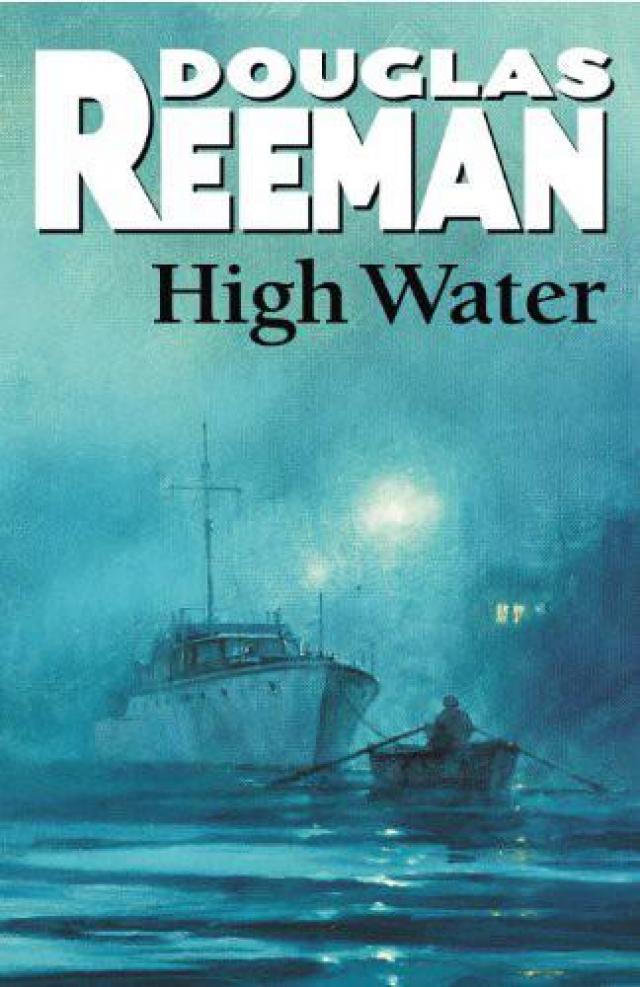
High Water (1959), page 1


Contents
About the Author
Also by Douglas Reeman
Title Page
Author’s Note
Chapter 1
Chapter 2
Chapter 3
Chapter 4
Chapter 5
Chapter 6
Chapter 7
Chapter 8
Chapter 9
Chapter 10
Epilogue
Copyright
About the Author
Douglas Reeman joined the Navy in 1941. He did convoy duty in the Atlantic, Arctic and the North Sea, and later served in motor torpedo boats. As he says, ‘I am always asked to account for the perennial appeal of the sea story, and its enduring appeal for people of so many nationalities and cultures. It would seem that the eternal and sometimes elusive triangle of man, ship and ocean, particularly under the stress of war, produces the best qualities of courage and compassion, irrespective of the rights and wrongs of the conflict … The sea has no understanding of the righteous or unjust causes. It is the common enemy, respected by all who serve on it, ignored at their peril.’
Reeman has written over thirty novels under his own name and more than twenty best-selling historical novels, featuring Richard Bolitho and his nephew Adam Bolitho, under the pseudonym Alexander Kent.
Also by Douglas Reeman
A Prayer for the Ship
Send a Gunboat
Dive in the Sun
The Hostile Shore
The Last Raider
With Blood and Iron
HMS Saracen
Path of the Storm
The Deep Silence
The Pride and the Anguish
To Risks Unknown
The Greatest Enemy
Rendezvous – South Atlantic
Go In and Sink!
The Destroyers
Surface with Daring
Strike From the Sea
A Ship Must Die
Torpedo Run
Badge of Glory
The First to Land
The Volunteers
The Iron Pirate
In Danger’s Hour
The White Guns
Killing Ground
The Horizon
Sunset
A Dawn Like Thunder
Battlecruiser
Dust on the Sea
For Valour
High Water
Douglas Reeman
Author’s Note
It is often said that a novelist’s second book is the hardest thing he will ever have to write. This is probably because his first book was to have been the one, or because he never expected it to be published at all.
The writing of my first novel, A Prayer for the Ship, was a gentle and leisurely task. I had no previous experience, other than short stories, and had nobody to point out the pitfalls or to explain the mysteries of construction and plot. This was probably an advantage. I wrote it without notes or research, building the story around events and characters I had known during the war. It was something I felt I had to do, if only for my own satisfaction.
Eventually, I sent the manuscript to a publisher, the choice of whom was made by the simple method of studying his previous book-lists. My work was done, or so I thought.
The first excitement at being told that my story had been accepted soon gave way to something like panic when my publisher asked me what new work I had to show him. A second book? It had never crossed my mind.
And so I wrote High Water, basing it on the times and environment of the late fifties. It was a period when many people were just discovering the real difficulties of settling down after a war. Some lost their livelihood and savings while trying to adapt in a world they did not understand. The skilful and ruthless affairs of day-to-day business were seen by many as an extension of combat, so they were able to delude themselves that crime was merely another way of claiming what was theirs by right.
At the time of writing High Water I lived aboard my own motor yacht, and well aware of the temptations for quick profit with no questions asked, and of the shortages left by war’s aftermath.
If the theme of the story is different from all my subsequent work, it is because I was not then sure which way I was going. High Water gave me the time and the breathing space to decide whether or not I could face up to a new career. For that I am eternally grateful.
1972
D.R.
1
THE GREY, STONE walls of Torquay harbour reached protectively out and around the countless small craft which lay anchored and hardly moving in the warm, blue water. The sun, which poured down relentlessly from a bright, clear sky, seemed to sap the very last ounce of energy out of the after-lunch wanderers who thronged the baking stonework, as they shuffled aimlessly in search of shade, the gay, multicoloured dresses and bathing costumes of the brown-legged girls clashing with the white shirts and braces of the perspiring business men from the Midlands, and with the blue jerseys and caps of the old fishermen who leaned silently across the breastworks, sucking at their pipes.
The high, white buildings at the back of the harbour shimmered in a fine heat-haze, and made a perfect setting for the holiday-makers in their quest for pleasure and simple excitements.
Although the summer was all but ended, everyone agreed that it had been a season to remember, and even the thought that soon the water would chill with the first touch of the cold Atlantic, and the promenades would be deserted but for the fishermen and the empty deck-chairs, could not remove the deep feeling of satisfaction, especially on the part of the boarding-house owners, and the prosperous hoteliers.
Philip Vivian was probably the only person who did not share those views, as he hurried through the slow-moving throng, unaware of the appraising glances from the groups of parading girls, or in fact of anything but the realization that he was almost certainly about to become bankrupt.
In his faded yachting cap, open-necked shirt, and khaki-drill trousers, he made an interesting figure, his tall, well-muscled body swinging with the easy grace of a professional seaman, and his tanned face proving that he at least was no temporary resident. It was his face which usually caused his few friends to think and to ponder, for although only a young man, thirty-four to be exact, he had a certain sadness, and even wistfulness, in his wide, grey eyes, which made him seem old before his time. Beneath the peak of his cap, the short, brown hair curled rebelliously, and the proud tilt of his chin, and firm mouth, gave the general appearance of recklessness.
As he approached the stone steps which ran down to the lower mooring jetties, one of the blue-clad figures detached itself from the wall and grasped him by the elbow. A smile flickered across Vivian’s features, as he looked down into the wrinkled face of the old boatman. Arthur Harrap was a particular friend of his, who made a casual living by fishing and running the visitors out for short trips in his dilapidated motor-boat, the Glory, and his round, red face was a familiar sight indeed in most of the local bars.
‘Oi bin keepin’ an eye on yer boat, Cap’n,’ he wheezed, ‘but there ain’t bin no callers. Did yew ’ave any luck?’
‘Not a damn thing, Arthur. I think I’ve just about had it.’
He shrugged, and thrust his hands deep into his pockets. and together they stood, staring down at the rakish motor-yacht moored beneath them.
With the sun glistening on her gleaming brass fittings, she made a proud sight, forty-five feet of grace, power, and a shipbuilder’s love of beauty. From her creamy, teak-laid decks, with the neatly coiled ropes, to her shiny, white hull, which reflected the dancing ripple of the gentle tideway, she looked every inch a thoroughbred.
Speaking as if to himself, Vivian controlled his voice with a great effort, so that his companion squinted up at him inquiringly. ‘I’ve just been on the ’phone again to London, and the mortgage people won’t allow me even another month to pay them, so unless you’ve got seven hundred pounds you don’t want, I guess they’ll take the Seafox from me,’ he said bitterly.
The old man shook his head. ‘It’s what oi’ve always said, yew just can’t compete with the big hire-boat men.’
He spat accurately into the water.
‘But what’s gone wrong this time? After all, yew’ve bin ’ere nigh on two years with your boat, and yew’ve always ’ad plenty of payin’ customers before, what does it matter that yew’ve ’ad a bit of a bad patch lately?’
‘It’s like this, Arthur,’ he answered wearily, as if repeating a lesson. ‘As you know, when I came out of the Navy I had another job in London for a bit. I had some money put by, and that, with my gratuity, plus what I could save, I put down as a deposit for the boat with a yacht mortgage firm. I thought I could make a living during the summer months by hiring myself and the boat out for holiday cruises, and pay off the rest of the cash. I just happened to forget a few points, that’s all.’ He laughed harshly. ‘One, I forgot that I could go a whole season like this with practically no customers, and two, I forgot that my boat’s just about trebled her value since I got her, so that these bastards want to get her off me, to sell again at a nice, fat profit.’
He kicked viciously at a stone.
‘God, it makes you sick! Where am I going to raise that sort of money, eh?’
They crossed the narrow gangplank, and entered the wheelhouse, both grateful for the shade, and thankful to be out of the noise and the crowds.
As Arthur busied himself with the kettle, he watched Vivian moving slowly about the snug, panelled saloon, like a caged animal,
A brief shadow flitted across the open door of the sunlit wheelhouse, and a second later a large, black-and-white cat pounced heavily down the steps, and stood blinking uncertainly on the saloon deck. Having made sure that both the occupants were friendly, the cat strode stiffly to a battered cushion secreted beneath the table and began to wash.
Vivian stood looking down at the animal for some moments.
‘Dammit!’ he exploded suddenly. ‘I’ll be damned if I’m going to give up all this without a fight! I’ll go up to London and see the perishers!’
He paused, and grinned ruefully. ‘Don’t forget to keep an eye on old Coley here while I’m away, you know, the usual.’
‘Aye, Oi know, Cap’n, a pahnd of blessed fish a day. Reckon ’e’ll burst one day!’
The old man brightened considerably, now that a plan of action was being evolved.
‘Now don’ yew worry about a thing. Oi’ll run the generator, wash the deck, feed the cat, keep the local kids from runnin’ abart the boat an’ …’ he paused, wrinkling his forehead. ‘’Ere, what’ll Oi do if some gen’elman wants to ’ire the ol’ Fox for ’is ’oliday, eh? ‘Ow can Oi get in touch with yew?’
‘Hm, you’d better ring me at the R.N.V.R. Club. That’s where I shall stay. After all, I probably won’t be able to afford to renew my membership next year, so I might as well make the most of it.’
He reached for the railway time-table, feeling again that dead sensation in his stomach. He had to do something, anything. He felt the boat stir beneath him, as a pleasure launch, jammed with laughing holiday-makers, cruised past, and he knew that unless he could think of something fantastic, he would lose his home, his livelihood, and his only love, all in one swoop.
He glanced down at Coley, now slumbering heavily, and smiled, in spite of himself. A luxury yacht, an overfed cat, and himself. At least his problems were a little different from those of the noisy people outside.
Like Arthur, he felt almost relieved that he had decided on some form of action, no matter how futile it might be, and as the old man chattered and made endless cups of tea, he started to pack a small bag in readiness for an early start, first thing in the morning.
The R.N.V.R. Club, at the back of Piccadilly, was practically deserted as Vivian came down from his room. The afternoon sunlight pierced the lounge and the bar in great spears of harsh light, and he wrinkled his nose at the unfamiliar smell of exhaust gases which drifted in through the pillared entrance, and listened to the distant roar of London’s busy streets. He consulted his watch, wondering what to do to fill in the time. He had telephoned the broker’s office, and had been informed, rather icily, that he could not see the general manager until the following morning. The secretary had been very short with him, and gave no doubt as to what the verdict would be.
One of the club stewards, who was polishing some brasswork by the wide, curving staircase, looked up, surprise written on his face.
‘Good heavens, Lieutenant Vivian, isn’t it, sir? We’ve not seen you for a very long time. I do hope you’re keeping well?’
Vivian murmured his thanks, and wandered into the lounge to read the magazines. The hall porter peered after him.
‘’Oo’s that then, Bert?’ he queried.
The steward picked up his polish once more.
‘You’ve just had the good fortune to look at one of the best motor gunboat skippers we had in the last do, chum,’ he said slowly. ‘Two D.S.C.s, wounded, you know, the lot. An’ look at him now. Not two pence to rub together, I shouldn’t think.’
‘You an’ your bleedin’ officers!’ grumbled the porter darkly, and resumed his study of the cricket scores.
Vivian, unaware that he had caused any interest, sat lazily in a large armchair, idly scanning the bright periodicals. He felt at ease in the club, and secretly enjoyed its quiet atmosphere of memories which were very precious to him. Even the pictures around him brought back the pang of wild excitement which he had once felt when his small gunboat had hurtled across the Channel, night after night, to do battle in a holocaust of noise and fire. Even then, he had dreamed of having a boat of his own, and, even then, he had sworn that he would never be tied to some wretched, soul-destroying office. But he had made that dream a hard reality, although now it looked like turning into a nightmare.
The long train journey from Devon, the warm afternoon, and the comfortable chair, began to have their effect, and he dozed quietly, the magazine falling to the floor.
He awoke with a jerk, to find that the club’s evening life had begun, and although the sunlight was still bright, a rising murmur of masculine voices filtered from the bar. He sauntered into its friendly atmosphere, and, having ascertained that he knew none of its occupants, he asked for a beer, and then, leaning on the well-worn counter, he stared thoughtfully at the gleaming bottles, which seemed to mock him.
How long he stayed like that, he didn’t remember, but suddenly he received a violent thump between the shoulder-blades with a hard fist, which made him reel awkwardly to one side, his glass rolling over in a pool of beer. He spun round to face the other man, his nerves on edge.
‘What the bloody hell d’you think you’re doing!’
He stopped dead, staring at the other’s beaming, red face.
‘God in heaven!’ he gasped. ‘Felix! Felix Lang! Why, you old devil! It really is good to see you!’
They pumped each other’s hands, ignoring the amused stares of the others in the bar, and studied one another with apparent delight.
Felix Lang was a round-faced, heavily built man, who was inclined to run to fat. His pink, confident face, with the rather full, sensuous mouth, had the appearance of the prosperous and good-living business man, and although only four years older than Vivian, he certainly looked as if he enjoyed the more comfortable attractions of life. Of the once-feared officer who had originally commanded Vivian’s flotilla of gunboats, there was little evidence but, perhaps, for a certain hardness of his dark brown eyes.
Lang waved a pudgy finger in the direction of the barman. ‘Two large Pink Plymouths!’ he barked, and then he turned to beam once more at Vivian.
‘What a bit of luck, old boy,’ he chuckled, his eyes taking in the old reefer jacket, and the neat but well-worn flannels. ‘This has made up for a thoroughly dreary day. I was only wondering about you this morning. Felix, I said, whatever became of that other handsome chap?’ He chuckled again. ‘And here you are.’
He knocked back the gin as if it had been water.
‘Now, tell me what you’ve been up to, old boy.’
Vivian signalled the barman, painfully aware of the two solitary pound notes in his wallet, which, with his return ticket, were about his only available assets.
Fatter, perhaps, he thought, but still the same Lang. Still laughs at his own jokes, and still one of the bravest men he had ever met. In a lightweight, grey suit, which was obviously born in Savile Row, and hand-made shoes, he looked the picture of prosperity.
As he opened his battered wallet, he felt Lang’s glance over his arm, and he flushed.
‘Hallo then, boy, what’s that photograph you’ve got in there, a girl or something?’
‘No, it’s my boat, as a matter of fact,’ he said, and handed it to Lang defiantly.
Blast him, he thought affectionately, he’s landed on his feet all right, but I bet he hasn’t got a boat like her. He grinned awkwardly at his own childishness, and was pleasantly surprised at Lang’s sudden, obvious interest. For a moment, the casual, bantering air had fallen like a much-used mask, and in that brief instant, he saw him as a man of other, unknown talents, hitherto unsuspected.
Lang took him by the arm. ‘Look here, old boy, let’s go somewhere quiet, and have a good yarn. We’ll have a bite to eat round at a little place I know, if that’s okay by you?’
Lang piloted him out into the cool evening air, to a long, low, silver-grey Bentley saloon.
Vivian whistled softly.
‘My, Felix, you are in the chips!’
Lang waved his arm embracingly. ‘Well, let’s face it, boy, if you don’t look after yourself, nobody else will!’