High Water (1959), page 22
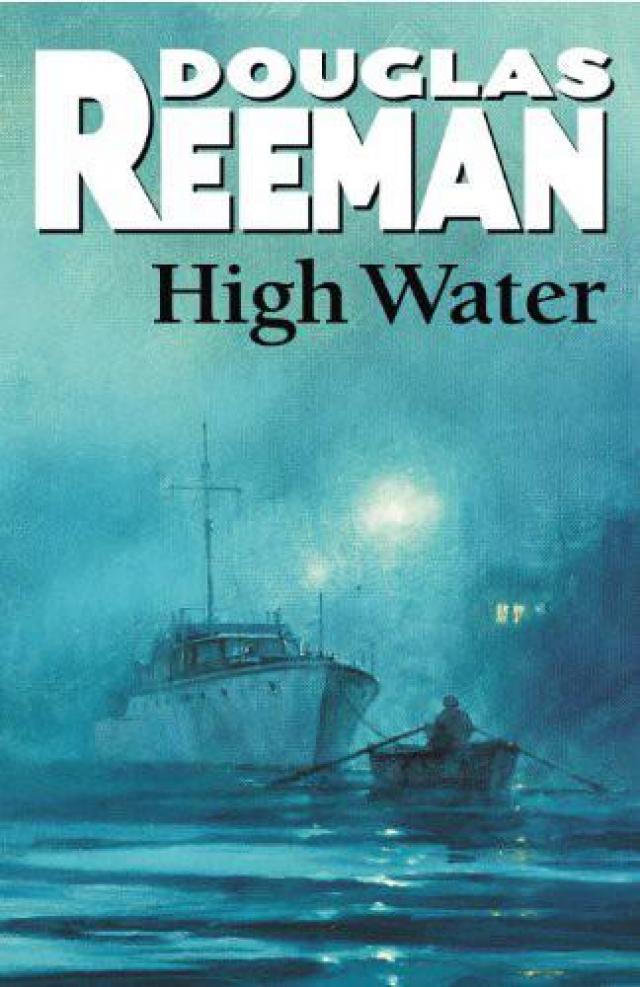


Switching on the light of the chart table he spread the local chart over the lighted glass and studied it carefully, trying to estimate and mark his exact position.
He shivered, the fog had got into his lungs. There was still some whisky in the saloon and he poured a large glass, downing it in one gulp. He refilled the tumbler, and absently held it up to the cabin lamp, watching the warm, amber fluid, and feeling the neat spirit burning his throat. Seafox gave an even heavier roll than before, and a book thudded on to the carpet.
He bent to pick it up, raising his eyebrows when he found it to be his copy of the A.B.C. time-table. Straddling his legs against the boat’s slow wallows, he stood looking at it dazedly, remembering how he had looked up the fatal train which had taken him from Torquay to London. It was a century ago, and in a sudden, blind rage, he held the book up, looking for somewhere to throw it, as if by destroying it he could blot out the memories for ever.
As he did so, he noticed the edge of a match-stick wedged in between the pages. His natural curiosity acted upon his temper, like water on a fire, and putting down the glass, he flicked open the book, scanning the two pages with dulled interest.
A tremor of excitement sent a cold chill up his back. Against the town name of Margate was a line of pencilled figures, and as he held the book up to the light, his hands shaking, he noted that they appeared to be a collection of train times. Trains from Margate to London. He banged the book down, sending the glass shattering across the cabin. Of course! What could be simpler? Lang must have sat here, idly checking the train times, whilst waiting for Vivian to get on his way with the plates. He slapped his forehead with an open fist. He had sailed for Margate in his boat, just to make it far enough from Ramsgate not to attract attention. Then up to town, a quick switch to the anxious employer, doing his best to help the police!
He ran back to the chart, his mind racing hard. He’d be there by now, but he’d have had to anchor a good way out in this weather. It was unlikely that he’d risk rowing ashore either, he thought, remembering his own nightmare in Ramsgate.
He stopped dead, his thumb poised over the starter buttons, the breath stilled in his throat. Karen! How easy it would be to get rid of her on the trip round the North Foreland.
Deliberately he pressed the buttons, and one by one the engines roared to life, the shattering rumble settling down to a steady, confident beat. He hardly noticed them as he eased the gear levers ahead, his mind was coldly steady again, his heart filled with consuming hatred.
He spun the varnished spokes in his hands, feeling the yacht cant over and settle on her new course, the bows climbing over each roller, and cutting a white wake through the oily water. He checked the course, and watched the swaying compass card, as it danced in its small pool of light.
‘Come on, old girl!’ he breathed, between his set lips. ‘Don’t let me down now!’
With a steady pressure, he eased the twin throttles wide open, a thing he would never think of doing under normal circumstances, until the whole boat shook and trembled as she leapt through the invisible sea. The needles on the revolution counters crept higher and higher, as the screws bit deeper and deeper, thrusting the sharp stem forward with almost savage force.
10
IT WAS A weird experience. A blank wall of fog surrounding the boat, and the bows only just visible from the wheel, as she hurtled into what appeared to be a solid mass, which clawed and clutched at the hull as if to slow her passage.
He switched on the Automatic Pilot, and having satisfied himself that it was behaving correctly, he started his other preparations. If another ship was coming straight for him, he’d never see it, and above the scream of the engines no fog-horn could warn him in time.
He tipped the First Aid box impatiently on to the side seat, giving a grunt of satisfaction as the long automatic pistol fell glinting evilly on to the cushions. With an ease which he had forgotten he possessed, he pulled back the slide, his eyes expressionless, as the little bullet slid forward into the breech.
You’ll be sorry you gave me this, Felix!
He stuck the weapon in the top of his waistband, only pausing to consider the depths to which he had been brought. Next, he found another sort of pistol, his Very Light gun, which was always near to hand in case of real emergencies. He slit open the packet of flares, and inserted one of the fat, red cartridges into the pistol’s wide breech, and clipped it shut.
If I’m in a position to call for help, I’ll need it fast! he mused.
He took a look around the boat, realizing that it might well be his last. Then, again by the wheel, he settled down to watch the boat’s progress.
The fog showed no signs of thinning, and he ducked involuntarily as a large, grey cloud reared over the stem. He glanced at the luminous clock on the dashboard. About another ten minutes before he altered course towards the west, a course which should take him well clear of the treacherous Foreland and in towards Margate. Provided his calculations were correct, as he told himself repeatedly, while he studied the thin, pencilled lines on the chart.
Treading carefully on the spray-washed planks, he climbed up on to the forward deck, tasting the salt on his lips, and feeling the clammy moisture clinging to his face and hair. Rising and falling to the powerful thrust of the boat, he steadied himself against the guard rail, listening intently. The thunder of the engines was deadened up on the sloping deck, and he noted with satisfaction the throaty blare of a distant fog-horn. He counted the intervals. North Foreland lighthouse, he observed.
It was easy to lose all sense of time and direction. He stood right up in the bows of the yacht, his legs taking each plunge with ease, while the bow wave hissed and sparkled beneath him. It was as if he was flying through the air, skimming over the surface, like an avenging sea-bird. He wiped his streaming face, his eyes and ears playing him tricks, which he knew well enough to ignore, but his mind wandered in vague fantasies that could not be so easily cast aside.
Suppose he just took one step forward? If Karen had gone, life was no more use to him anyway, so why prolong an agony which was certain to destroy him?
He imagined the boat driving on, smashing him down with her keel, guiding him into the racing screws. With her course held by the Automatic Pilot, she would drive on alone, a ghost ship, until she dashed herself on the shore, or was found abandoned by some wondering persons elsewhere.
He swayed slightly and tightened his grip on the rail. Fool! he cursed, there is one thing you have to do yet.
Another blast of a horn sounded out of the fog, nearer this time it seemed, but he knew that it must really be well over to port.
He returned to the wheel, and, as he noticed the clock, he cursed and spun the wheel on to her new course. The minutes ticked by, minutes charged with mounting tension and a fierce, growing determination.
The engines slowed, and the yacht ran on more quietly, while Vivian, with every window open, peered ahead, waiting calmly for the sight of any small vessel which might be anchored here to ride out the fog. He knew that somewhere over the salt-caked bows lay Margate, and here, in the Road, he would find Lang. He wasn’t quite sure how he could be so definite, he just knew.
The area for yacht anchorage only measured about two miles in length, so it would be a job for the dinghy again. He lifted his head higher, hearing the plaintive squawk of the fog-horn guarding the end of Margate’s tiny harbour. Getting pretty close, he decided, and slammed both engines into neutral, allowing the boat to glide forward silently, the water slapping against the sides in protest. The tide was running out fast, and he knew that in a while the area beyond the small, stone breakwater would be just a mass of treacherous mud.
Taking his time, he went once more on to the forward deck, and when the bow wave had died to a sullen ripple, he started to lower the anchor, swearing softly at the grating clink of the cable, as it ran jerkily through the fairlead. He felt the chain slacken, as the swinging flukes dragged along the sandy bottom, and as the boat moved away crabwise with the current, he carefully paid out more and more cable, until the boat swung gently to her moorings.
Thoughtfully, he strapped a small compass on his wrist. Rowing a dinghy in the fog, in a definite direction, would be difficult enough as it was, without adding to his troubles.
With a sigh, he lowered himself into the little boat, which bobbed obediently astern. He checked his two weapons, and shoved off from the yacht’s side, experiencing a strange curdling feeling in the pit of his stomach.
He chased all other thoughts out of his head, and pulled off strongly, the dinghy feeling light and free without the yacht dragging behind it, and within seconds he had lost sight of Seafox, although he could still hear the chafing clink of her taut cable.
Occasionally he rested on his oars, checking his compass, and listening so carefully that it hurt. He reckoned that he was pulling about half a mile from the beach, or probably less, and even allowing for the current, he should still be parallel to it.
Twice he swerved to avoid what he thought was a moored and unmarked vessel, but each time it was a thicker bank of fog, which seemed to jeer and mock at his desperate efforts, which, as the time wore on, appeared fated and hopeless.
He rested again, the silence closing in on him like a blanket. Nothing. He lowered his head, watching the water swilling about under the boat’s bottom boards.
‘No boat here,’ he said, as if addressing the silence. ‘Not one bloody thing!’ His shoulders slumped, and he felt himself drifting sideways across the busy current.
What a damned fool I am, he pondered. I don’t even deserve to live!
Ding! Ding! Ding! Ding! The tinny note of a bell, being struck with inexperienced vigour, brought all his senses alert, and he found himself craning round, trying to trap the sound, to hold it and plan its direction.
He waited, the glistening oar blades poised inches over the water. How well he understood that sound, a ship’s bell being rung to denote she was lying at anchor in a fog. He knew that he had another minute to wait before the next few strokes, provided the person doing it was abiding strictly by the rules.
There it was again. His heart pounded with excitement, as he pulled slowly and silently towards it, the blades biting deep into the water.
Like a stalking hunter he moved, waiting for each new group of sounds before he pulled onwards. His head was strained round over one shoulder, his eyes staring into the fog, regardless of the salt smarting under his lids and the ache in his neck.
Ding! Ding! Ding! The ringer must be getting tired. Much nearer now, he decided, it would be any second and he would find this invisible vessel.
As he lay on his oars, waiting for the bell, two things happened at once. The bell clanged, apparently overhead, and at that very instant, before the notes had time to fade away, he saw the swaying shape of a yacht’s stern, only feet away. He watched her in silence, hardly daring to breathe, and licking his dry lips in cold anticipation of what he had to do next.
She was quite a large yacht, from what he could see, about five to ten feet longer than Seafox, and with tapering, twin masts to carry her auxiliary sails. Her dark blue hull gleamed dully even in the fog, showing her metal sides, and the name Grouville in bold letters across her stern.
As he waited, a figure detached itself from the dark hump of the yacht’s wheelhouse and stamped noisily to the rail. Then, with an impatient glance at his wrist-watch, he moved back again, his shape merging with that of the boat. Another loud ringing clanged and rolled around the fog, and Vivian realized that the man, whoever he was, would be remaining on deck to maintain the constant signal. He bit his lip angrily. There was nothing for it but to swim for the yacht’s side. At the first scrape of the dinghy alongside, the alarm would be given in a second. He’d just have to let the boat drift away on its own, there was nothing else that he could do, he concluded.
He hardly made a splash as he slid into the water, and floating on his back, he watched anxiously, as the dinghy curtsied and bobbed out of sight.
In a few strokes he was feeling his way under the bulging curve of the stern, his knees scratching along the rough, encrusted waterline and one foot touching a protruding propeller. Being a steel boat, there was little to hold on to, and a pang of anxiety caused him to move more quickly along the high side, which rose above his face like a sheer wall. Three square, window-like ports, blazing with light, glared out from the middle of the boat, and he reached up cautiously, the tips of his wet fingers exploring the edge of the first one. There was a small flange at the bottom, so with both hands he pulled himself bodily out of the water, until his eyes rose above the level of the brass overhang.
At first he could see nothing, the glass was caked and smeared with salt and fog stains, then as he hung with his ribs rubbing against the cold, steel plates, he saw a figure move rapidly across his vision. He swallowed hard. It was Mason, his face twisted into a frown of anger or fear, as he paced to and fro, tossing remarks to someone sitting against Vivian’s side of the boat, and who was out of his range of view. Faintly, through the thick, toughened glass, he heard only snatches of Mason’s high, agitated voice.
‘How did he escape? That’s what I’d like to know.’ And, ‘If it’s all so damned foolproof, why are we squatting out here like this?’
Vivian grimaced with the pain in his arms and fingers. He could feel his grip slowly slipping from the tiny, brass ledge, but he hung on, determined to hear as much as possible. They must have heard about my escape on the radio, he thought. Once Mason glared straight at him and Vivian froze, but he continued his pacing and storming without interruption, so he stayed where he was, feeling the swell of the water pulling at his dangling thighs.
While he watched, Mason took a decanter from a well-stocked sideboard, and filled two glasses with a shaking hand.
Of course, the yacht’s name came back to Vivian’s racing brain, it was one of the travel agency’s hire yachts. Lang had mentioned it to him when they had been discussing the subject in the first place.
The very thought of Lang made a great surge of anger tear right through him, nearly making him lose his last precarious hold. He was about to slide back into the water, to look for a fresh method of boarding, when an arm reached forward to take the other glass from the table.
For the short time it took, he saw again the plump, fresh-complexioned face, and smooth, well-groomed hair. Even after Lang had leaned back again, out of sight, Vivian still stared, his eyes cold with hatred.
It was almost a relief to feel the embrace of the sea, as he slid back down the smooth side, and paddled further along the yacht’s length.
‘Soon, soon,’ he breathed, ‘I’ll make it even with you, Felix!’
There was nothing within reach, so he swam to the anchor cable, and, hand over hand, pulled himself up to the high stem, straining and sliding his streaming body over the wide flare of the bow, to roll, panting, on the deck. Breathless though he was, he was up, and crouching behind the capstan before he had time to realize he was aboard, and before the man by the bell had finished his last stroke.
He crouched, counting the seconds until the bell started to jangle again, and at the first stroke he scrambled noiselessly along the wide deck, and as the bell stopped ringing he flung himself down flat on the wet planking, taking his weight on his hands. He listened, his heart thudding in his breast, so that he thought it must be heard. He caught the scraping sound of a match, and lifting his head only slightly, he saw Cooper’s face bent over a cigarette, his eyes squinting against the flame. He was standing on the other side of the wheelhouse, as Vivian had anticipated, and the sight of him made him clench his fists, as the memories came flooding back.
He turned his face away, concentrating on the lighted glass of a deck skylight, which should, he thought, be right over the saloon. He eased his body forward, until his nose was practically touching the coaming, and when the bell jangled its message once more, he peered over the edge. Lang was talking now, his voice sharp, but completely at ease.
‘… and so that’s it,’ he was saying. ‘We’ve taken years to build this thing up, and to break away from the other people in the game; why,’ he shrugged expressively, a gesture that sent a shaft of pain through Vivian as he watched, ‘it’s madness to let anything or anyone spoil it now!’
A girl’s voice made Vivian start, and twist his head further round. At the other end of the saloon, slumped on the wide settee, was Janice Mason. Her eyes were red, as if she had been crying for a long time, and she looked completely miserable. From the slur in her speech, he observed that she was also very drunk.
‘Whyja do it?’ she said, looking desperately at Lang. ‘You didn’t tell me you were going to kill him.’ She sniffed loudly, and lowered her eyes to her empty glass. ‘He was such a nice old man,’ she added, almost to herself.
‘Well, we’re all in it!’ Lang sounded quite cheerful. ‘You too, Janice!’
‘But I———’
‘Don’t forget, you drove the girl’s car up to the house, with the horn blaring, a very convincing double I thought! Oh yes my girl, we’re all in it!’
‘You swine.’ She said it without emotion. ‘I’ve been a fool!’
‘Nonsense! We’re all right, I keep telling you. What does it matter if he has escaped, eh? Only makes it look more convincing if he runs away for a bit. He doesn’t know where we are, so what the hell!’
Mason refilled all the glasses. He seemed a bit calmer now.
‘So you say, Felix. I must confess that when you explain it, it does seem a bit easier.’