

Leave No Trace, page 2
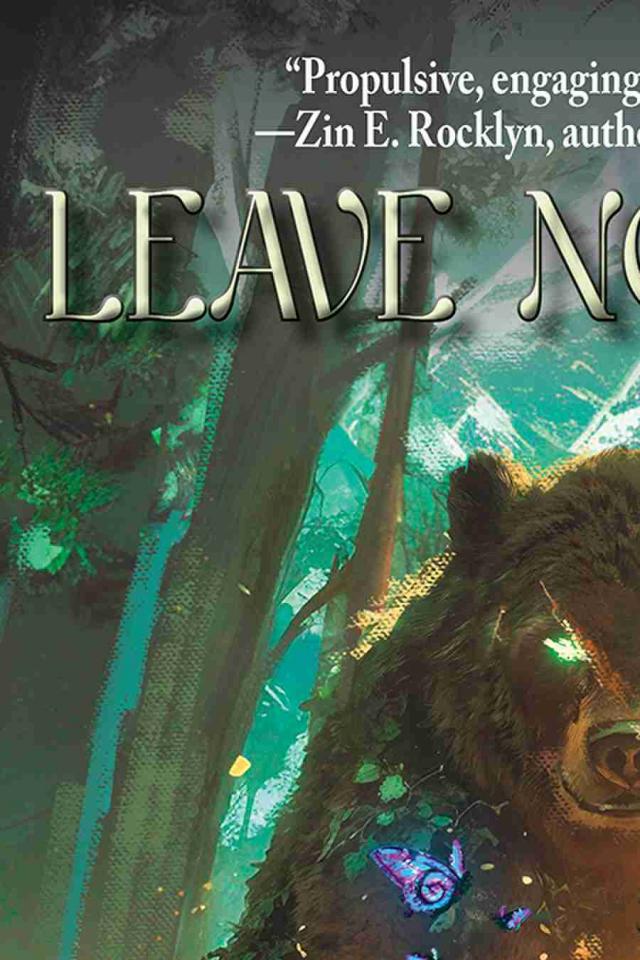


He sets down the half-eaten apple and stares at it. Pats it. Looks up at me. “Aye,” he says. “Ye will be taking some visitors a-huntin’.”
“Aye,” I say back with a smile, trying to ape his voice, but I always sound silly. “They want a deer.”
“That’s nae all,” he says. “They want more.” Mair, it sounds like. His face goes green-brown. “They want Artio.”
There are other bears in the forest. But Artie—Gil said she was really named Artio but I like Artie better—is the only one I’ve ever seen. She’s a whole lot bigger than most and full of unxpected things and I wonder if she’s got her own abracadabras. Sometimes I walk in the forest and I see her deep in the trees and she’s looking at me hard. I know what to do when I see a bear. I know how to not get eaten. But Artie never seems to want to come after me. She just looks.
No way Gil is gonna let them take Artie. He knows we gotta hunt, time to time, but there are limits.
“She’s not easy to find,” I say. “I bet they won’t get her.”
“They will ask ye to help,” he says.
“Well,” I say, poking at the needles. “That’s our job.”
“But ye will nae find her, ye ken?” he snaps. “She’s nae for them.”
I sit up straight and look him in the eye. He’s never ordery with me. That’s what Gillie does. But first time I met Gil he did stop me from getting a deer I wanted. Ye came to hunt, he said to me then. Five winters back. But ken that isnae how ’tis done in this part of the forest.
What isn’t done? I asked him then. He was impossible, standing there all bright green in the middle of our snowy winter. But there he was. I was littler and I believed everything about him.
Death, he told me. Willful an’ unnecessary death.
As the Ghillie Dhu, Gil is in charge in certain parts of the forest. He shows up with his stand of birches, these amazing glowy trees that move on their own. He watches, he takes care of things. He shoos off animals that are in danger if he can. But this is the first time he’s asked me for something so partic’lar, something about a job. First time he has instructions for me.
“Okay,” I say and it’s easy because I’m sure we won’t see her. I don’t know how to feel about Artie. Her watching is not like what a bear is supposed to do. Bears are supposed to be afraid of people and when they’re not, people just have to stand their ground or get crouched and low and hope for the best. She’s strange. I wouldn’t mind her gone but I don’t want to be the one to do it. “But Daddy—”
“Artio’s in yer care,” says Gil and it’s almost like he’s angry. He’s so serious I look careful to make sure he’s not really Gillie this time. “Ye will nae go after that creature. An ye will stop her being harmed, it comes to that, so ye will. Ye will do this for me.”
Gil saved me once. So I owe him. I promise. “But the deer—”
He sighs. “Ye know how I feel.”
Willful an’ unnecessary death. He doesn’t care if we kill so we can eat. Everybody has to eat, even Gil. He just doesn’t like the jobs, when people come in so they can take pictures and horns and heads. Sometimes I swear he’s spooked deer we were tracking, would be easy shots, and the clients get mad at us though nobody knows why xcept maybe me. Gil doesn’t xplain.
“But you won’t stop us.” Actually, I don’t know if he could stop us xcept to scare any prey away again. I only know I don’t want him to be mad at me.
He shakes his head and grass rains off it. “Nae,” he says. “I dinnae want anythin’ to do with those folk.” He lifts the apple again and smells it and takes another big bite. “Other thing,” he says after chewing and swallowing. His voice is small and slow and he waits for me to look into his eyes. “Ye must listen, for ’tis a hard thing I share.”
I sit up straight and feel like I’m falling into those black holes.
“There ’tis one who will come in this hunting party, one that disnae like my kind,” he says. “His blood boils. He’s full o’angry bits an cannae be trusted.”
“Why?”
More grass falls. “ ’ Tis a long story for a very other day. But. In the world beyond these trees, beyond the ocean, battle wages ’tween his folk and my folk.”
I tilt my head. “A battle? Which folk am I?”
The colors on his face shift. “In some ways ye are more like my kind. But I am all sìthean, and there’s no way ’round it all. An’ this one who comes, he fears and hates and harms we sìthiche.”
It’s a new word for me and sounds like shee.
“Who started the fight?”
He stares into the trees beyond his birches and doesn’t say anything for a long time. “ ’ Tis a war, more like. I ken not all of the story. Nae enough time today to tell more. Know only that he isnae ye’s friend. Ye need not know more. An ’tis why I will stay clear ’til he departs.”
I can hardly move. Ordery and now talking about the Outside—the real Outside, outside the trees—this is all new to me from Gil. He never’s like this. I know it must be important but I get that sick feeling in my belly whenever I think about what’s past the trees. When part of me is so excited about what might be there and part of me thinks I would be eaten up the minute I left the forest.
“The center cannot hold,” I say, remembering a line from a book we have in the cabin.
“Aye,” he says and we both go quiet. “Nae anymore. So. Ye ken?”
“I ken,” I say, but I don’t. Not really.
Gil brightens and he’s the friend I’ve always known. He reaches over to the backpack and upends it. The book slides out and falls between us. “Well, wean?”
Business is done. Now he’s hoping for something else. I open the book, which he stares at like it’s another apple. He’s heard the whole thing prolly five times by now. Every time I finish he wants to start over. I say there are more books to read but he doesn’t care. He can’t read our words so he says it’s up to me to tell him the tales of the Hundred Aker Woods. He says he likes them because they have animals and there are trees. Since he likes them, I like them.
I look up and there’s a smile on his brown-gold face. His white teeth shine and his eyes are deep dark pools. He takes my hand and gives it a squeeze and my chest gets tight. Then he lies back in the soft brown needles and stretches like a cat. His eyes go closed and he points a finger in the air. “Now, wean. Speak ye’s words to me. How is the Eeyore this morn?”
I begin, and we both tumble into a hole in the world that takes us to familiar places and windy days and jars of hunny. I keep reading and traveling until I hear it: a high whoot-whistle that soars over the cliff and into my ear. It’s Daddy’s call, our signal.
I keep reading. Daddy can wait.
The whistle comes again and I stop, but I don’t move. Gil is watching me now. “Ye will go,” he says.
“I don’t want to.” I want to stay right here, doing just this. And I can’t decide if someone whose blood boils is scary or something I really want to see. Don’t I ever get to decide?
Daddy’s voice comes to me from a distance, a low growl that sounds like a puma getting ready to pounce. “Don’t make me wait,” he calls to me. “I know you’re up there. I hear your voice.”
That freezes me up. He can’t know I’m talking to anybody. Gil’s eyes meet mine, and he nods.
“Coming!” I shout so loud Gil flinches, but he holds open the invisible door to his trees and waves at me. I slam the book closed and stuff it in my pack.
Gil smiles, offers a hand. I touch his fingers and back out of the shelter.
Time to go to work.
Burt Fuckin’ Badass Reynolds
When T.J. Furey is nineteen years, six months, and fourteen days old, he gets stoned in his hotel suite and watches Deliverance on one of the classic movie streams. Unlike most people who watch the film, he does not come away having learned any of its lessons, the two key ones of which are don’t go into the woods unprepared and don’t screw with the locals.
Stephanie Holliday, who is watching him watch the movie while pretending to read a book on the other side of the couch, sees the change unfold. T.J. sits back against the room’s leather sofa and takes another toke. “Burt Reynolds,” he mutters. “Burt Fuckin’ Reynolds. Burt Fuckin’ Badass Reynolds.”
Stef supposes she can see why. In the movie, the classic film star is White Man Incarnate. Or at least what White Man Incarnate was back when her grandparents were kids. Virile, tough as nails, loaded with a bow and arrow. She calls up Reynolds’s bio on the Cloud and scans to see what T.J’s plugged into, nodding. The movie Burt is before the mustache and the naked magazine spread and a hairpiece that settled on his head like a badger that died of heatstroke. Movie Burt could handle a broken leg while riding the rapids and still come up swinging. He wasn’t a joke then.
Over the last few days, Stef has seen how quickly a person can go from being on the top of the world to being a joke. It pains her, and she knows that is not how T.J. sees his life playing out. She knows this without having to hear him say it; they’ve been best friends most of their lives.
T.J. leans back and howls like a wild animal. Then he turns to one of the roadies and snaps his fingers a few times. “Toss me the rest of those cookies, Bud.”
The roadie isn’t called Bud; it’s Kwame. Stef has made sure to know the names of all the crew and roadies, since it’s just good sense to know who you’re hitting the road with for months at a time. But T.J. never remembers anybody’s name until it’s important to him.
“Toss yer own cookies,” T.J.’s manager Tony Garcia growls, but sends the pack of Mallowmars over in a neat arc. T.J. scrabbles for the soft, sweet wonders and stuffs three into his mouth.
Stef likes watching T.J. move. First of all, he’s a seriously beautiful young man. She’s observed him for years, watching as he went from a string bean of a boy with a persistent acne rash to a clear-faced, doe-eyed, sturdy young man with a carefully curated flop of bright blond hair that tumbles over one eye and makes the girls sigh and press their legs together tight. He’s pale as the underbelly of a fish, and white boys aren’t usually Stef’s thing. But T.J. exists in a universe of his own, like he’s from some better world and just got lost here on Earth for a while. Get to know him a little while, like Stef has, and the truth comes out—he’s far from perfect. In fact, he’s her imperfect jerkface soulmate of a foster brother and they’re tight as if they were blood. That is, if you can sometimes have hot and sweaty thoughts about your blood, which you’re not supposed to.
For his part, T.J. is lost in the fog of the smoke and his own spinning brain and only barely aware of others in the room. The suite is full of people who’ve been lingering and sponging off him for days now. They range from the roadies, Tony, and the guys from the band up to another six or seven hangers-on from the label, groupies, and journalists. Stef half turns in her seat, one spiraled dreadlock dangling over her glasses, and counts. Right now, there are sixteen people in this room and she knows perhaps a third of them. None of them are paying her any attention; she’s not the star attraction. She just writes the songs.
Passed out on the floor, head on a pillow, lies their guitarist Daryl Wu, gangly legs making everybody nearly trip over him as they pass, a slick curl of drool waterfalling onto his digitally tattooed hand. The pool of spit is covering up this week’s semiperm inking: a line from one of T.J.’s hit songs. Daryl knows where his bread is buttered. Drummer Ian Altschul perches on the couch’s edge between T.J. and Stef, sitting ramrod straight and absolutely still, platinum hair standing up in twelve different spears—the more spears, the more anxious and argumentative he is—and balancing the shared joint between two fingers like he’s David Bowie or some other space oddity. The others are pasted around the rest of the suite like ink spots: dressed in black, continually sliding from the snacks in the fridge to the drinks at the minibar to the toilet and back again.
And then there’s Tony, who wears his expensive fitted suit like a uniform, jet-black hair carefully pasted back, always on high alert. Like he’s still out there on the battlefield, fighting mysterious forces no one else can see. He’s actively doing much of what Stef is pretending not to: monitoring T.J., the man whose situation has kept them trapped in here for the last few days. The two-bedroom bungalow at the Chateau Marmont has been their prison ever since the headlines broke a week ago, and while Stef can’t speak for anybody else, she’s getting serious cabin fever.
Of course, they can leave anytime they like. Step out into that monotonous California sunshine for some Vitamin D and keep on keeping on. But nobody in the band or crew will depart unless T.J. goes first, and T.J. isn’t going anywhere. It’s T.J.’s face that’s been plastered on the cover of every virtual tabloid CloudPage around the world and in the vids of millions of wannabe newsmakers, and he won’t risk a paparazzi ambush. Some of the others might be staying out of inertia, or loyalty to his cause, or because he is their meal ticket. Doesn’t matter, really—they stay.
In his high flying state, T.J. is magnanimous and adores them all.
Most days, they aren’t alone. The room gets regular visitors—the pot doc comes like clockwork, always making the same stale joke about room service. The record label PR lady Tiffanee pokes her fluffed head in the room once a day, seven p.m. sharp, coughing ostentatiously to remind everyone that smoking in a nonsmoking room will rack up extra charges. Charges that Stef knows the label will absorb for now, but will ultimately get hoovered out of T.J.’s royalty checks down the road. The back end, they’d explained it when she and T.J. first signed contracts, and at the time T.J. snickered that of course it comes out the back end, all his earnings just pour out of his ass. Everybody in the room—his lawyers, the label heads, the marketing goofballs—laughed, but it was a brittle candy sound.
That’s a sound T.J. never made before they got discovered. Before the songs took off. But Stef’s gotten used to hearing that noise a lot over the past couple of years. And every time she hears it, she thinks of lollipops cracking against your teeth when you get sick of sucking out all the sweet and just want to crunch the life out of the thing.
How many licks does it take before we get to the center of T.J. Furey and want to hear him pop?
Stef dreams of blowing this clam stand with him, going down through the service entrance after they scramble their GPS chip signal, smartglasses on tight and blackout hoodies pulled up. That way even if the papweasels take their pictures they won’t register on cameras. But they both know T.J. would be spotted eventually. Whatever he does, wherever he goes, they know where he is. Everyone is a snitch in this town; paparazzi have a network of DigiCoin informants who’ll call the hotlines and say yes, indeed, T.J. Furey is sitting at the bar/having a slice/dipping his toe in the pool/buying toothpaste in their establishment and please come over right now.
Or one of the informants might just turn on the camera in his enhanced contact lenses and film it for themselves. Stream it to the On Demand PayCloud, make a couple thou without taking two steps left or right.
Naw, it’s easier to hide out and dodge the questions, dodge the embarrassment. Smoke a lot of pot and try to forget about Mandy Kowalski, that thirty-seven-year-old waitress out of East Fucking Jesus Nowhere, who popped up in the middle of T.J.’s current tour to announce she was having his baby. When that happened last week, Stef felt like they’d all woken up in the middle of that Michael Jackson song Gramma liked.
The one about the kid not being his baby. Or son. Or something.
Whole idea is disgusting, T.J. tells Stef later that evening. Like he’d even consider poking some old bat who has more years on her than his mom.
“You protest too much,” Stef shoots back. “Methinks.”
Every night around midnight the room clears out—hangers-on, friends, crew, even the rest of the band go to their respective rooms or homes or alleys. Stef remains, and they both prefer it that way. They go out on his patio and leave the sliding glass door open, clear out the day’s fug of smoke and body odor, and stare out at the jewel-bright city beyond.
“Methinks?” T.J. snickers. “You’re starting to sound like your books, Peps.”
“She’s not a bad looking lady, that Mandy. Your mom’s not bad lookin’ either, come to think of it.”
T.J. makes a swipe at her, but she’s already dodged aside. She’s always been fast on her feet; Stef was tops on the high school baseball team, back when they both had normal lives. That’s another reason for having her around: In addition to her ability to assemble some pretty terrific tunes, Stef isn’t afraid to tell T.J. what time it is. Knowing somebody since you were practically in footie pajamas gives you special privileges. “Last I checked, my mom is your mom, yanno,” he says.
Stef grins with a Cheshire cat smile, imagining that her gleaming teeth are the only feature of hers he can make out as night closes in. They do have a funny history. T.J.’s mom and pop died when he was ten in a crazy FreeCar crash that wasn’t ever supposed to happen. Landed him a nice trust fund after the lawsuits settled. The Fureys and the Hollidays had been pals since college, and when nobody on the Furey side stepped up to take care of the kid, the Hollidays arranged things so T.J. came to live with them.
“Admit it, though,” says Stef.
“Admit what?”
“That you’d’ve had her if offered.”
“Mandy Kowalski?”
“Sure as hell don’t mean our mom.”
T.J. laughs. Stef sensed he would. She can read people; she’s spent a lot of time observing. She studies people all the time in books, in school, in the world, backstage. Helps with her writing, makes it easier to come up with the words T.J. will eventually sing on stage—the ones that get the girls’ hormones spiking and let them know what an orgasm will feel like eventually. Stef thinks for some of his fans it isn’t even imagination—she’s seen their faces during the shows. It’s like this special power T.J. has—sure, there are other PoppyStars who give the girls nice dreams, but he’s got it a little stronger than anybody else does. Always has.


