

Leave No Trace, page 18
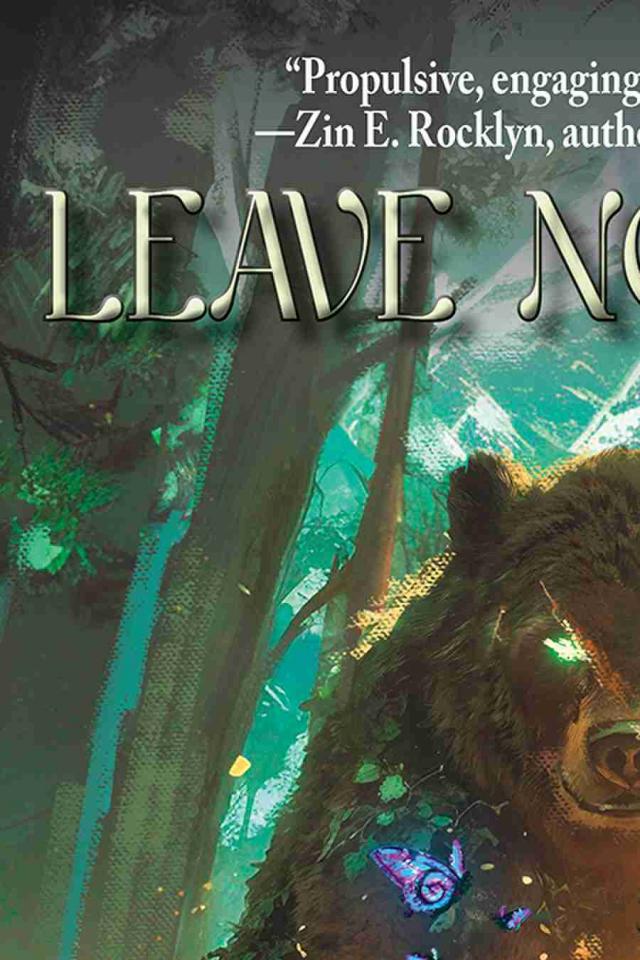


Don’t move, Stef tells herself, even as every inch of her cries out to flee. You can’t outrun a bear; she knows this from a guidebook. Bears are faster. They will chase. They can climb. They will tear you up. But would Artio? The bear protected by the Ghillie Dhu? The one responsible for crushing Samuel earlier that day—an event that seems so long ago it’s as if it happened in another lifetime?
The bear stops so close that her hot, meaty breath brushes up against Stef’s face and fogs her glasses. Her mind stills, the aural black hole in the world claiming her. Stef stands in a vast empty space, head awhirl with its own silent storm, echoing—but clear.
Raise your hands, the guidebook said. Be big. Sing.
As if her empty brain has any songs in it at this moment.
She prepares to raise her arms, to try and appear larger than the giant creature before her, this mass of fur and musk and paws the size of dinner plates, of moist breath and one ragged, destroyed eye encrusted with blood. But then she meets the gaze of that keen second eye, that tiny yellow thing—
Stef removes her fogged-over glasses. She grew up with two dogs, three cats, and a hamster. She rode horses for three years, until the expense of equipment and dress and rentals went beyond her parents’ ability to pay. She loved every animal that came across her path and spent hours staring into their faces in the hope that one day one might speak to her—that there might be some communication beyond adoration or wide-eyed confusion. It never came.
Artio’s good eye is different. It gleams like glowing sea glass or a moon of Jupiter, filled with an uncommon depth and perception that Stef knows is beyond any animal recognition she has ever witnessed. Gasping, cheeks aflame, Stef sees it now: something beyond instinct in that eye—a gleam, focus, recognition.
“Artie—Artio—” she stammers, fitting her glasses back on. “I have—” she takes a step backward. “I have to—to go. Please let me go.”
A low growl from the back of the bear’s throat begins, followed by a muffled whoofing sound that fans out its muzzle. A flicker in the bear’s eye like the shadow of a person walking across a darkened stage makes Stef momentarily fearful, but then the incredible depth in the gaze returns. Slowly, the bear bends one front leg under itself, then a second, going down before Stef in a bow.
Artio twitches her head briefly to one side.
Had the bear been a horse, there would be no question. The offer is being made. But Artio can’t be asking Stef to go for a ride, can she?
Stef scans the campsite for Gillie or a stand of birches but sees nothing. Just the wind bending the trees, picking up speed again. She shivers.
Artio’s growl is like a steely purr. Definitely an invitation.
Stef places her hand on the beast’s enormous head. If this is real, she can be at the meadow in a matter of minutes, not an hour. Unable to believe she’s really doing it, Stef runs her hand around to the animal’s broad back.
“The meadow,” she says. “We have to go there.” Her voice is halting and stiff. “You can’t take me anywhere else.”
Another whoofing noise.
She grasps one hank of the coarse fur, surprised by how it feels like caressing a very large dog, one that badly needs a bath. Artio’s body is a vast warm pelt that calls to her, and she’s grateful for the warmth. Sliding one leg across her back, Stef grips another fistful of fur with a free hand and sits up straight.
Artio rises up on four paws and begins trotting.
Stef instantly loses her balance, sliding to one side and scrabbling at the fur before slamming into the ground. Artio stops and doubles back, nosing at her.
“Yeah, yeah, I’m an idiot,” she says, climbing up again. It’s been a long time since she rode a horse, and she forgot one of the basic premises of riding: to hold on with your whole body. Rider and ridden are one beast in these moments. Squeezing with her thighs and holding tight to the fur, she leans down into the pelt. “I’m ready now,” she whispers.
This time the bear does not hesitate, and they fly through the late afternoon like an arrow shot across the forest.
Rebalancing the Scales
Tony is in a circle of hell.
Sweat coats his face and neck, despite his coat hanging unzipped to the elements. His shoulders are leaden from the weight he’s perched across them for the past hour or so. They’re close to the Great Meadow now, he can feel it, but he won’t make it without at least a short breather.
His gaze falls on a thick pine tree with a wide, spreading base that’s relatively snow-free, and he lays T.J. down on the pine needles and forest detritus. He makes a pillow of T.J.’s blue scarf and sets it under the kid’s head, then bends down to listen for a heartbeat and steady breathing. He gets both.
He’s all right. For now, Tony assures himself. Help is on the way.
He hopes.
Half collapsing next to T.J., Tony struggles to get his wind back, but his breaths scrape against his dried-out throat like a line of strung needles that reaches from his gut to his mouth. Each step this morning has rung like a gong through his body, sending ripples out from under the bandages to his fingers, his toes, the small hairs on the back of his neck. He bites off his gloves and with trembling fingers unbuttons the strange shirt he woke up in, not surprised and yet horrified to see what is lurking beneath.
Stef’s homemade stitches have torn open, and the gouges from Artio’s claws are expanding. It’s as if he’s slowly being turned inside out. He’s not cold; the freezing temperatures should have seeped into his bones by now, but instead he feels as if he’s home in New Miami. He should have known a swipe from Artio would be like no other. Artio, as he learned in training: bear goddess, protector, and defender. High Payoff Target, Level C. Recommendation: Approach with extreme caution, never solo.
Tony allows himself a third joint once his breaths normalize. The sweet, pungent aroma of the fine drug courses through his system, and he concentrates on the soughing of the wind in the trees, the scraping of the snow and ice, and closes his eyes.
He thinks of her face. Clíodhna. The banshee queen. Back in Brittany she appeared to him through an air hole—that’s the jokey word they used for it in the field, but it was an aperture, a way to see a whole other perfect green world—and spoke with him. Asked for his help. And he saw her and he saw the emerald perfection behind her and the crystal blue of the sky above her, and who could say no?
I love you, he told her, and said yes to whatever she asked.
And so, was damned.
Not then. Not in that moment. But as soon as he told his superiors about the request for help, he was yanked from the field. Given a debriefing. Eventually returned to the field, but transferred to the pits. That was where he made his greatest mistake: sympathizing with the doomed enemy.
I tried, he thinks. I tried to help. He opened the cages, let the fey go free, helped them escape. He even ran with them as far as the Channel. But of course they were tracked. Recaptured. Incinerated. It broke his heart. And when they took him in for reprogramming a second time, it broke his soul. Now he has nothing left but contempt for the fey and all their diseased magic.
Or, almost nothing. There is an ignored corner of his heart that burns like the last ember in a firepit to see her again. To visit Clíodhna’s Green Place. To be welcomed there, despite his sins. Perhaps because of them. To prove he is not the monster they believe him to be.
Or to prove to himself that he is.
Thup thup thup.
The sound of flying heartbeats rouses him, and he starts from his doze. The joint has burned out, hanging from his bottom lip. He reorients, trying to hear the rotor again. How long has it been coming? Has the chopper arrived? Is it waiting for him in the field right now with Stef and the others?
Tony leaps to his feet, his back an agony, his gashes bleeding freely again. He can’t see the field from here, but in that short time since he fell asleep under the pine tree he realizes he can’t see a whole lot of anything: The wind has picked up mightily and the snow is coming down in sheets. They have a very small window of time in which they can be carried out of the mountains safely, and that window is closing.
Hefting T.J. against his chest in a bridal carry, he lurches toward the field and the noise. The chopper is closer now, but the sound is different. There’s a pause and a slow whine. It whistles metallically and then cuts out. Then the heartbeats return. And then they stop. There is a long moment of pausing, and Tony tries to put on speed but knows he’s not close enough. The copter must have arrived while he was out and is now taking off—for whatever reason—without them. Weather? Still, it can’t leave. They can’t be left behind here.
Tony bursts into the field and skids down a small embankment, wobbling. The field is empty, dotted with orange sacks and empty food wrappers dancing in the wind. He squints into the snow blow and can’t see the other side of the field—there’s too much of it. Turning his back to the wind, he sets T.J. down and grabs the blue scarf, waving it like a signal flag, staring up into the sky where the copter is rising higher and higher.
“Hey! Jesus, hey!” he shouts, knowing it’s useless. He reaches the middle of the field and halts just in time to see the wind pick up the copter like an invisible hand and turn it three-hundred-sixty degrees. It sways, trying to regain control, but the southerly gale is too strong for it, and it blows it hard and fast toward a high cliffside.
Almost before it happens, Tony knows what will occur. It’s like dropping a paper boat into a typhoon. Perhaps it wasn’t snowing back in Eagle where the copter originated; perhaps they came simply because the world-famous T.J. Furey appeared to have called. But whatever reason the pilot might have had to take off two hours ago, it would be the last trip he would ever take.
Time hangs for a long breath, and the beats of the helicopter match the beats in Tony’s chest. Then everything happens: The helicopter ceases to fly, and starts being flown. It soars high and nearly clears the cliffside, but its rotor halts, and a few seconds later the chopper collides with the rock face. There’s a sickening, awful crunch and several small explosions, then one giant one. The last one radiates out at Tony, and he stumbles in the snow, agog and staring. Hot burning metal chunks begin raining into the field like giant black snowflakes, and something not metal spears into the snow near where he stands. He steps over to the smoking, raw thing and understands it is a hand and a wrist, the latter painted with a temporary tattoo of one of T.J.’s lyrics. There’s a sweet, burnt odor to it and his stomach turns over, but he has nothing inside that can come out.
He’s smelled burnt flesh before. He’s smelled all kinds of burned things.
Get a grip, soldier, he tells himself. Focus.
Tony bolts back to the meadow’s edge, bending down to scoop up T.J. and preparing to return him to the safety of the trees.
Anthony.
Tony halts in place at the voice, which exists in his head—not in the whirling snow around him.
We have unfinished business, do we not?
It’s a voice he hasn’t heard in years, but it lights something inside him he thought had been seared away long ago.
“Clíodhna,” he murmurs, heart thudding. A white pain slices into his gut, and he sets his hand over the wound, fingers coming away wet and slick with blood. His head spins, and he believes for a moment he will faint. Biting down hard on his tongue, he tastes salt and iron. It rouses him again.
Look at me, Anthony.
He faces the field again. The swirling white gale that destroyed the chopper moments ago—killing anyone riding in it—has coalesced into a tremendous crystalline tornado of snow and ice. It hovers in place several feet above the ground, tremendous, terrible, beautiful. Then it takes true shape.
The fae queen fashioned from ice and snow before him is as breathtaking as he remembers from their first meeting on a field in France. But she is not as she appeared through that aperture. Now she is a projection of the weather around them, eyes empty shells and with a flat, unreadable, unearthly visage. She watches him as expanding, crackling icicles fashion her hair from frozen rivers and flowing snow crystals quilt a gown around her body. Her cloak billows and sweeps behind her like a peacock’s tail, The Green Place shimmering within her transparency, faint and pulsing in the space where her heart should be.
Four gone, she says, words that form in his mind. Yet the scales remain unbalanced.
“You remember me,” he whispers. A part of his mind begins counting: Daryl, Ian, the pilot—the cook, Martinique—not five? What of Stef? Was she not on the copter already?
I forget nothing.
He scans the field’s edges, looking for the girl. Where would she be? Did she never get to camp? If not, who set off the beacon?
To me, she orders, and he whips around to the fae queen, mind racing.
“Help,” he pleads. “Unless you’re hanging out to add to your total. Won’t be long now. Your bear did a pretty good number on us.”
Artio does as her unseen bids her. An icy smile creeps across the fey queen’s head. Are you asking for a boon?
He knows what this means. He knows he will owe her. But what choice is there? “I don’t figure you flew all the way out here just for the hell of it,” he says. “Help us.”
So I shall, she says in a voice of absolute cold, and then she is on them.
The Truth of a Blue Knit Scarf
The Great Meadow stands empty. Whispering and wailing with the winter wind, jagged pellets of snow swirl and soar amid the open plain, scraping across a landscape freshly pockmarked with smoking bits of black, gray, red.
But it doesn’t stay empty. From the distance comes a galloping approach of heavy footsteps. Pawsteps. Artio emerges from the treeline, slowing to a stop at the meadow’s edge, her gallop ceasing so abruptly that Stef nearly tumbles off.
Artio goes low to the ground, giving her passenger time to recover.
Stef lifts her face from the creature’s musky, oily fur and blinks ice from her lashes. The beast moved as fast as she seemed capable of, and there were times the passing forest trees were just brown blurs.
Here, Stef thinks excitedly. I’m here. They’re here. She takes in the smoking wreckage, the smell of death, the blood-sprinkled snow: Not here. Can’t be here.
Because no one is here. And there is no sound but the shrieking and swirling and crackling of ice that bites against her exposed cheeks like tiny mouths. Her heartbeat thuds in her ears. Shivering without her protective bear pelt, Stef steps into the vast whiteness, nose wrinkling from the high, acrid scent of metal and burned rubber. She breaks into a run—or an approximation of one—and beelines to a twisted piece of metal. Touches it, jerks away: Despite the freezing temperatures, it is still warm. There are numbers painted on one side and twisted rivets protruding from the other.
There should be a helicopter here. A T.J. A Tony. Maybe a Daryl and an Ian and a cook named Martinique. All that is here, though, is evidence of disaster. Scanning the field, Stef spies another blackened piece of metal, then a torn leather seat cushion and a dented first aid kit. Half a piece of hoverluggage. Her fingers tremble as she brushes against each one in its turn.
Her heart won’t let her believe what her mind insists is so.
A blue knit scarf scampers across the snow like a playful animal wanting attention. She catches it in one hand and brings it to her nose. It still smells like him. Like T.J.
She buries her face in the weave and bursts into tears.
The wind swirls on.
And Artio waits.
PART 2
“A watch is not a world.
A voice is not a cure.
A direction is not destiny.”
— Clíodhna
Forest Dreams
W inter comes fast, stays long in the forest. Everything goes to sleep under the snow blanket, but down there, it’s dreaming. Come spring—any day now—and it’ll wake up again.
Jim said I mumbled and twisted when I was deep in my zzz’s, like there was still all kinds of stories going on in my head. That’s true of the dreamy forest. It kinda looks like it’s resting and waiting for the warm to return. But you look closer, stand with a quilt wrapped ’round your shoulders, stare out your cabin window and go all still, you know different.
Hey Fox showed me how to watch the forest dreaming.
It’s just about time for us both to wake up.
Morning’s still the time to get things done. Even if it’s freezy and stiff and smoking-breath cold, even if the only sounds I hear in the cabin are my breaths and the sometimes creak of the boards—morning’s still when I gotta get up.
So I get up. Throw the quilts aside, hop out of Samuel’s bed, feet in boots and rush to the cookstove where I load it up and poke the fire alive. That fire goes out entire one night, I might not ever wake up so I learned pretty quick to drink a big mug of water before bed. That makes me get up in the center of the night to pee and then I poke the coals and get it going for another few hours.
I have to think of those things now. It’s only me here in the cabin. Daddy—Samuel, I call him now in my head—he’s gone. Almost a whole season on my own.
Today’s different. Today, things change. Two days ago came Sign No. 1: mountain bluebirds dipping into the trees like pieces of sky. Yesterday the aspen buds came out, pointed like arrows. Telling you things are wakin’ up, Samuel would say. Sign No. 2.
Sign No. 3 is waiting for me outside. If I see it, then I know winter is ready to be over. Then I know it’s a special day. Decision Day. Change Day. Everything Starts Day.


