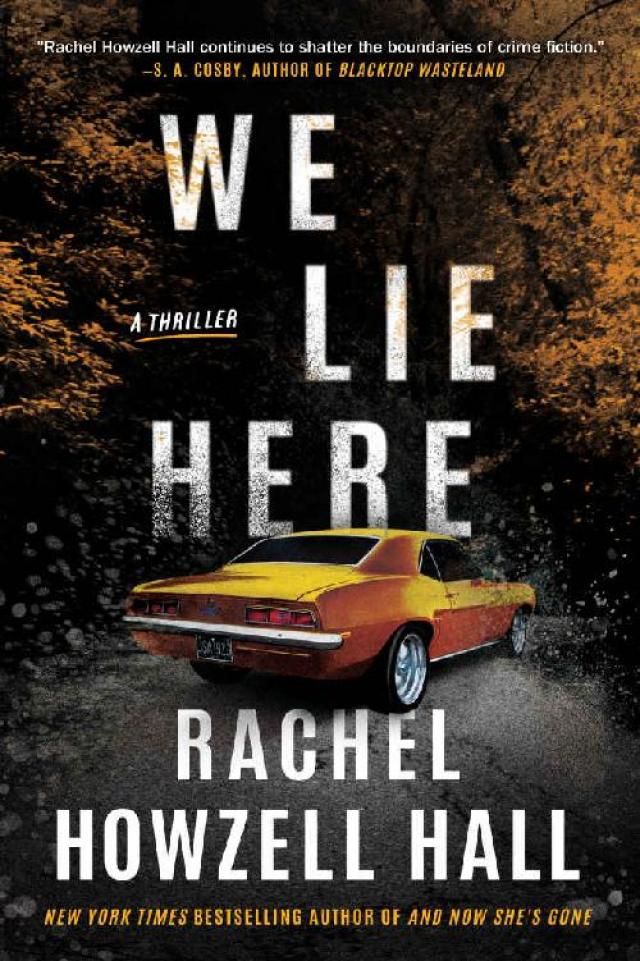
We Lie Here: A Thriller, page 31


Only one person would know.
Elizabeth Marsh wasn’t the stalker. And Dad didn’t kill Elizabeth Marsh.
Mom—Barbara McGuire—stalked and killed Elizabeth Marsh.
And somehow, she got me to write that confession . . . that is, if she didn’t write it herself.
I know she’s the one who forged that letter to the parents.
“Yara.” Mom—no, Barbara—looms in my bedroom doorway. She holds my newest rescue inhaler in one hand and a revolver in the other. The revolver . . . the one I left behind in the Camaro, the one with the red mark on the barrel I’ve seen in my dreams.
I scramble to grab the hunting knife from beneath the mattress.
Her eyes narrow as she takes in the knife. “Where did you get that answering machine?”
My face crumples. “Does it matter? You did all of that because she was prettier than you? Because some people liked her more than they liked you? Because you wanted Dad?”
She snorts. “Your father ended up being just like that Camaro out there. Actually, he’s more disappointing than the Camaro.”
I shake my head. “You forced me to write that confession, and you’ve held on to it all these years.”
“Forced?” She rolls her eyes. “You loved handwriting exercises. And if the police came and asked questions, well . . . better Robert than me.”
I shake my head. “But all this time, you told me that I was . . .” Dramatic, crazy, depressed, anxious, delusional. But I was none of those things. I’d witnessed the murder of my mother and had been taken into the home of the woman who’d killed her.
“Yara,” Barbara says, “I tried to love you like you were mine, and there were moments where I truly felt something like love, but then I’d remember . . . I wanted my happily ever after, and Felicia was gonna ruin it, just like she ruined high school. She really thought Liz was alive.”
“You pretended to be Liz,” I whisper. “You sent postcards, letters. Those text messages to me—you wrote those. You wrote those letters you claimed Felicia sent, didn’t you? Made everyone think that you were the victim.”
She says nothing.
“You wrote that note to Felicia on Friday night,” I say.
The paper—Dad’s legal pad. That’s why their fingerprints were on that note.
“You killed Felicia,” I whisper.
“Technically,” she says, “LaRain and I worked together on that. I promised to give her some of your trust fund after helping me with you. Poor Lala had no patience.”
“LaRain . . . She had your honeybee pendant.”
Barbara pales. “Excuse me?”
“In her hand,” I whisper. “The medical examiner found it.” I pause, then cock my head. “What trust fund?”
She stares at me, reaches for her neck, thinking. Then: “You have a choice, Yara.” Her shaky hands still reach for her missing bee pendant. “You can die from an asthma attack, which you’ve been doing slowly all week, or I’ll handle it and afterward, I’ll leave you in a spot in the forest that you used to love when you were a child. Lots of butterflies there. I picked it out for you a long time ago, that night at the cabin with Liz.”
“You shot her,” I whisper.
“You slipped out of the cabin,” she says.
“You found me,” I say, nodding.
“On the shore of the lake. You saw me and ran into the water.” She chuckles, waggles her head. “I figured you swam out into the deepest part and drowned, which would’ve been perfect.”
But I didn’t drown. I rolled onto my back to breathe, just like I’d learned in swim class, and kicked over to that little island. I didn’t freeze to death. I didn’t starve to death. I survived. And now, I try to blink away my tears, but they roll down my cheeks, hot and free. I remember now. The cold water, the rocks, the frogs . . .
Hot tears fill my eyes. “Daddy?”
She rolls her eyes. “He’d always tell me, ‘Maybe in another life,’ and excuse me? Maybe? And when I made her disappear and I helped look for her, I took care of you and made sure that Rob ate and slept, and just like I planned, he fell in love with me. This time, I won. And beautiful Liz so nicely left behind all her bank accounts and fancy, sellable things. You can thank her when you see her on the other side.”
Elizabeth Marsh had funded our lives. Her money had been used to buy this house, buy our cars . . . The Italian glass in the attic. The Chagall. The ring on Barbara’s hand was the same ring I saw in pictures at the cabin. Those bundles of cash in the Camaro . . .
“And the cabin,” I say.
“I went there that night, and I confronted her,” Barbara says. “Rob was in LA and had left you two alone. She’d begged me to let you leave—there was a condo in the Virgin Islands—but we both knew that Rob wouldn’t give up on her, not after being together since high school.”
“The tapes,” I whisper. “She recorded you coming that night. And the fight . . .”
Barbara nods. “We fought, and the neighbor heard and came over. But she left—Liz pretended that everything was okay. That was the first time she did what I asked. Guess seeing you with this”—she lifts the gun again—“pressed to your forehead convinced her to listen to me. But you surviving . . . You were worth more alive than dead. You are a treasure, Yara.”
I twitch—she’s always said this to me, and I thought she meant it out of love, not . . .
I gape at her. “You’ll kill me, your daughter, for money?”
She cocks her head. “Would it be better if I killed you for love? For God? You’re the writer. Tell me, what sounds better? And I’ve worked hard for this. All those postcards and letters and keeping Liz alive in everybody’s head? Making it look like she’d completely lost it and abandoned y’all? Scared that the cops would realize that the woman showing up at the Lost Hills Station with the statement to leave her alone wasn’t Liz, but that it was me?”
Barbara flaps her hands at her face and shivers. “I got gray hair that night. But it worked out.” She sighs and shrugs. “I’m good and I’m smart as hell, but I still haven’t figured out how to change my fingerprints to match a dead woman’s. Give me time.”
“You’re fucking evil,” I say, shaking my head.
“I’m the GOAT, my dear.”
“Greatest of all time for what?” I ask. “Murder? Fraud? Theft? Gaslighting?”
She laughs. “I hadn’t thought of gaslighting.”
“Liz wasn’t crazy.”
Her eyes go hard. “She was for baiting me.”
“Felicia wasn’t crazy.”
“Again,” Barbara says, “she got in my way.”
“And I didn’t have an overactive imagination or lose things for no reason. I needed help, but you wouldn’t get me the kind I needed. And you fought with Dad, who tried to help me.”
She grins. “What else do you want me to say, Yara?”
My tears cloud the woman before me. “Does Dominique know?”
She sighs. “Why would I tell her anything? She’ll be a very rich woman. And know this: I won’t let Ransom anywhere near her money. We’ll be very good stewards of your inheritance once you’re resting on that hill with the butterflies.”
“Barbara,” I say. “Mom. They know. It’s over. They know you killed LaRain. They know you killed Felicia. And they’ll know that you tried to kill me.”
“Tried?” She throws her head back and laughs. “You still don’t know me. There is no try. There is only do. I always win.”
I grip the knife and swallow the lump hardened in my throat. “Actually, it’s, ‘Do or do not. There is no try.’ So go ahead: do it, bitch.”
Her eyes are hard and dark as a shark’s. She lifts the gun and pulls the trigger.
Click.
Click.
Click.
Nothing.
After discovering the gun in the trunk, I emptied the chamber and slipped the bullets into my pocket.
I use my last breaths to lunge at Barbara Gibson. I knock her to the hallway carpet and hold the hunting knife to her throat. A pearl of blood pebbles on the tip of the dark blade.
Her eyes bulge, but she doesn’t beg. She smiles. “Go ahead. End it. Do something.”
I want to whip this knife across her throat and glory in the spray of blood that would spurt from her arteries.
That’s what she wants, too. And whatever Queen Bee wants, Queen Bee gets.
She always wins.
Not today.
Epilogue
July 12, 2019
There are over 2,200 mines near Palmdale—from aluminum and chromium to titanium, vanadium, and zirconium. Deputy Diego Castro has led his mine rescue team to search three of those, including the Tropico Gold Mine and Quartz Hill Mine, for the remains of Elizabeth Marsh Gibson. He hoped that either these mine searches or another dredge through Lake Paz would turn something—no, someone—up.
They haven’t.
As I wait for a meeting invite to pitch Queen of Palmdale to a producer I met two weeks ago, I sit out on the deck of the cabin at Lake Paz examining the mail I found in Elizabeth Marsh’s post office box: a bank statement with my name on it. Papers from another bank confirming my address on Edgewater Court. A letter from a lawyer “just checking in.”
As you come closer to reaching your twenty-fifth birthday and fulfilling all the requirements set forth by your mother, Elizabeth, we’ll talk more about your trust—investments, philanthropy, and retirement.
The signature on other documents attesting that I understand is not my signature. The bank account receiving allowances does not belong to me. The names on those accounts are Elizabeth Marsh and Yara Gibson, but I’ve never received any money.
Of course.
My mother left me the cabin and required that I reach adulthood to inherit the full amount. If I’d died before then, Dad would’ve inherited half of the money, and the other half would have gone to a children’s arts organization. Greedy Barbara McGuire Gibson decided to play the ultimate long game, waiting two decades to get her hands on the full amount. She probably tried to change the terms of the trust, but that would’ve required an in-person meeting with the trustee and fingerprints—Elizabeth Marsh’s fingerprints.
I finish reading final witness statements from friends and family . . . including Felicia Campbell’s.
STATEMENT FROM FELICIA CAMPBELL TO DETECTIVE MATT STALL:
I tried to tell you, but men always think women are hysterical, that we need psychiatric evaluations. I have two degrees from Caltech, and I’m working on a third. Does it look like I need psychiatric treatment?
Oh, Felicia.
You were right all along.
Dad offers me another bottle of water. His facial hair is now gray even though nearly two months have passed since Kayla arrested Barbara for the murders of Felicia Campbell and LaRain Andrepont.
Dad wept as I told him everything, as he listened to the answering machine tapes, as I showed him my coerced confession. He’d tried to leave Barbara, but then Dominique was born—just as Kayla’s parents said. Dad gave Barbara an ultimatum: “Treat me better or else.”
“She did,” he told me, “until she didn’t. I’d bring up divorce again, and she’d do better.”
“Why didn’t you just leave?” I asked.
“She would’ve never given me custody of Dom,” he explained. “And I didn’t want to separate my girls. So . . .” He swiped at the tears rolling down his cheeks.
He told me that he’d texted back and forth with Felicia on the night she died. He’d begged her for more time, said that he’d tell me everything and that he was writing it all that night, the same night I told him to write a toast for the party.
He had no idea that Barbara had killed Liz. “Why would I think that?” he asked me last night. “Especially knowing that Liz was struggling for so long after the accident. And then, when she started sending postcards and emails . . . To me, she was alive. And Felicia and I tried to find her—a body for Felicia, a living woman for me.”
He shook his head. “I didn’t cheat on Liz—with Barbara, with anyone. I really thought Liz left me. I mean . . . I hated her for going, but I’m not stupid: She was too good for me. She was Old Black Hollywood royalty, and I was an ex–football captain who tore his ACL on the third day at Raiders training camp. I never deserved her, but she loved me, too. I didn’t think Barbara would’ve . . . How could she be so . . . evil?”
Held without bond, Barbara has nothing to say. For the first time in her life, she’s gone mute. We will not allow her to use the money she stole from Elizabeth Marsh to pay for an attorney. There’s a rumor that the DA won’t seek the death penalty for the two murders if she tells us where she left Elizabeth Marsh so many years ago.
My phone rings.
It’s Lukas, our contractor. “Hey, Miss Gibson. I hate bothering you again, but can you drive down right now? We got a problem.”
Is it a news station wanting exterior shots of our house being torn down again?
Is it Dominique throwing herself in front of a bulldozer for the third time? She hasn’t spoken to me these past weeks. She refuses to accept that Dad wants to rebuild and not sleep in a bedroom or roam a hallway that he shared with a murderer. She refuses to believe that her mother killed mine.
On the Saturday morning of the anniversary party, I canceled and forfeited all my money to the golf club. I spent hours texting friends and family, and my phone shuddered from all the texts of why and everything okay and tell me how I can help and who’s paying for my hotel cancellation fee.
Lake Paz shimmers blue as the sky above us. Trees dance in the breeze and rain down dried leaves and needles. Once fire season starts, some of this will burn. For years, our lives have been ablaze and we didn’t even know it.
Dad climbs into the Camaro’s passenger seat. He just finished showering, but he still looks dusty and worn. He’s always wanted to lose a few pounds, but not like this.
“Rib eyes for dinner?” I ask, revving the engine.
“Sounds good to me.”
He’s now renting a one-bedroom apartment four miles away from the house. I offered to let him stay at the cabin since it belongs to me, but he doesn’t want to leave Palmdale. He doesn’t want to leave his football team.
The farther we drive from the lake, the closer to the sun we get. By the time we reach the house on Edgewater Court, the thermostat on my watch hits 111 degrees. The main house, except for one wall, is gone. Little colored flags that mean different things—gas line, electric wiring—dot the ground. The contractor and his crew have started demolishing the rear garage, and now, they crowd around the spot where the Camaro used to sit.
Lukas, a man with a weathered face as square and red as a brick, shakes hands with Dad.
“What’s up?” I ask.
“Sweet car,” he says, nodding to the gold muscle car.
“It was my mother’s,” I say.
Lukas beckons us to follow him.
Last time, there’d been issues with the blueprints. Cha-ching. Another time, there’d been a suspected crack in the foundation. We had to pay for a structural engineer. Cha-ching. I hold my breath again as I parkour across the remains of my childhood home.
“We stopped cuz we found this.” Lukas points to the spaces between chunks of concrete.
I lean in close. “What is it?”
Dad says, “What am I looking at?”
This is not concrete. It’s too round and perfectly shaped to be concrete.
I turn on my phone’s flashlight and move the light lower.
It’s a skull.
Something gleams beneath the jaw cavity.
A lightning bolt.
And a gold nameplate.
Liz.
She’s been with us this entire time.
I don’t remember driving back to Lake Paz.
I don’t remember falling into Shane’s embrace on the cabin’s porch.
I don’t remember trudging to the bedroom that overlooks the lake.
My eyes open to a dusky room with shards of sunlight flickering across my hands.
Dominique slips in bed beside me.
I wipe away the tears rolling along the bridge of her nose.
Dominique does the same for me.
Without saying a word, we pinkie-shake.
She tucks her head beneath my chin and slowly lets out her breath.
And together we lie there, silent as secrets, as the sun dips beneath that forever-deep lake.
ACKNOWLEDGMENTS
I will never get tired of thanking those who continue to support this dream of mine. Thank you especially to those who choose to pick up my stories and attend events and buy books and engage and encourage me and my writing friends. Y’all are the best readers ever!
Jill Marsal, you’ve been my dream agent for almost ten years now—and somehow, I still feel like I’m your only client. Thank you for always looking out for me.
Thank you to my incredible team at Thomas and Mercer. Jessica Tribble, you are a dream editor, and I’m thrilled that we’re working together, that you’re so supportive and excited about the words I slap against the page. Clarence Haynes, you are still the best developmental editor in the world, and the more we work together, the stronger my stories become. Excelsior! Grace Doyle, Brittany Russell, Sarah Shaw, Nicole Burns-Ascue, all of editorial, all of production, all of marketing, Brilliance . . . Thank you so much for throwing your backs into it. I’ve never felt so supported in my publishing career—thank you for making me feel like I deserve any of this.
Thank you to my incredible team at BookSparks. Crystal Patriarche and Taylor Brightwell, I appreciate everything you do. I had some big hits this past year, and I have you to thank for that. Let’s get some more!
Thank you, writing friends—too many to name. You continue to be sources of inspiration and writer envy. (How do some of y’all do those tricks?!) Thank you, especially, to Jess Lourey and Lee Goldberg for showing me around my new publishing home. The writing life is scary, and I’m blessed to have guides like you holding my hand.
Thank you to my family. These past pandemic years have meant fewer road trips to hang out, but the little time we’ve been able to spend means so much to me. Mom, you’ve always believed in me, in this dream of mine, and here I am. Gretchen, Jason, and Terry, your texts and our Sunday Zoom calls bring me joy . . . and great ideas. I love y’all.