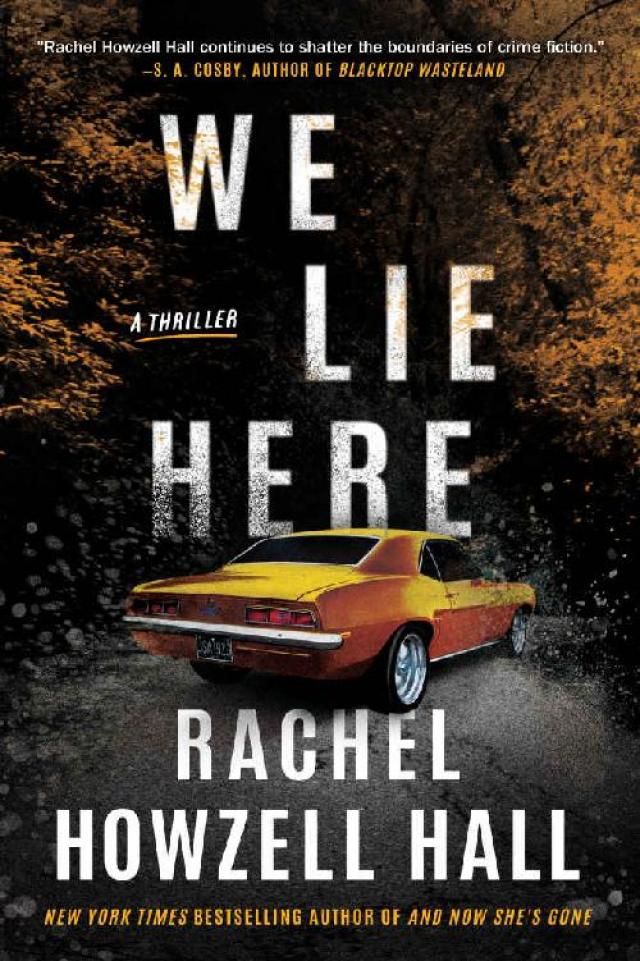
We Lie Here: A Thriller, page 20


I follow even as one of my flip-flops twists in the fence’s diamond-shaped wires.
I’m quick.
The prowler is quicker.
“Yara!” Dad shouts from somewhere behind me.
The prowler runs toward the foothills, incentivized not to get caught.
I’m wielding a machete, and I’ve suffered mini–asthma attacks since Friday. After three minutes of running, I stop and try to catch my breath. I rest my hands on my knees.
Someone grabs my arm.
I spin away.
It’s Mom. Her eyes are wild as a mustang’s. “Are you crazy running outside like that?”
I try to catch my breath. “Is Daddy okay?” I ask between gasps.
She grabs my chin. “Don’t ever do that again. Do you understand me?”
“Is Daddy okay?”
She gazes toward the desert. “He’s fine. Come on.”
We walk back to the house. Dominique, wide-eyed, walks from the kitchen to the den with a pen and pad in her hands.
“So?” Mom asks, pulling her into a hug.
“TV is here, computers and phones are here.” She shrugs. “Nothing’s missing.”
“You okay?” Mom asks her, smoothing her braids.
Dominique nods, then catches my eye. “Is Yara—”
Mom glances back at me. “She’ll be fine.”
Sure.
Minutes later, a sheriff’s deputy stands before us and scribbles into his tiny pad.
Our house is now filled with the sounds of police radio chatter and the heavy boots of four men wearing khaki and green. Edgewater Court glows with red and blue lights from the squad cars. Our neighbors stand on the sidewalk in clumps of two and three.
“Description?” Deputy Gordon asks me.
“He’s—”
“A male, then.”
I swallow. “I’m assuming.”
“You didn’t see a face?”
I shake my head. “The person wore a hoodie. Lean. About three inches taller than me.”
He blinks at me, then writes in the pad.
“Black Air Jordans, black jeans, black hoodie,” I add.
“You’re describing everybody in AV,” Dominique snarks.
“Dom,” Dad says.
“She’s right,” Mom says.
“What about identifying marks?” Deputy Gordon asks. “Tattoos, scars . . .”
“It was dark,” I say, “and my contact lenses weren’t in, and I wasn’t wearing my glasses.”
The deputy stares at me, then closes his notepad. “We don’t have a lot to go on, and if we did, the fact that your sight . . .”
My stomach twists, and I avoid the gaze of Deputy Gordon, who isn’t so blurry that I can’t see exasperation in his face.
He and his partner leave.
A few neighbors are holding up their phones to record. Some clumps have merged into one megaclump, and they throw suspicious glances at the only Black family on the block.
Dad closes the front door behind him.
Dominique paces the den.
I sit on the ottoman and pull my knees to my chest.
Mom settles at the dining room table. She lights a cigarette, blows smoke to the ceiling.
Dad sits beside me and wraps his arm around my shoulders. “You’re shaking.”
Because the intruder wore a hoodie. Just like the person who slashed my tires. Just like the monster who forced Felicia to walk into Lake Palmdale.
“I don’t feel safe,” I whisper.
Dad squeezes my upper arm, kisses my forehead.
I close my eyes. “What if it’s the person who was with Felicia that night? The person who sent that postcard, keyed my car, or slashed my—”
I gasp, then point to the fireplace mantel, to the family portrait there, broken glass, one face scratched out. My face scratched out.
“What the hell . . . ?” Dad asks, wide-eyed.
Mom stands and squints at me. “What aren’t you telling us, Yara? Who’s so angry at you that they’re breaking into our house?”
The world fizzes at its edges, and I shout, “There’s nothing to tell. I don’t know who this is, or what I’ve done. I don’t know who came into our house or who did that!” I point to the shattered picture frame again.
Dad and Mom hold each other’s gazes. Something passes between them. “Need to go to the hospital?” Dad asks, his attention back to me. “Can you breathe?”
Mom draws cigarette smoke into her lungs. “She’s fine, Robert. You’re fine, Yara. No one’s hurt and that’s what matters.”
She’s now smoking and pacing, just as tense and scared as me, but she’s releasing her fear by smoking and pacing. She sees that I’m watching her. Smiling, she kneels before me and takes my hand. “Sweetie, there’s no reason for you to feel unsafe. No one’s gonna hurt you, not anymore. Whoever it was? They’re not coming back. Okay? It’s all gonna be okay.”
I don’t think I believe her.
This isn’t Felicia—Felicia is dead.
Yep, she’s gone.
WHERE IS LIZ???
I’m back. From outer space. Run bitch, run!
Surrender.
37.
I can’t sleep.
The buzz of anxiety keeps me from closing my eyes, from catching my breath, from falling back asleep. Downstairs, the lights burn bright in the kitchen. The music of opening cupboards and the clip-clop of slippers assure me that everything’s all right.
Mom is flipping through her tea bag collection.
“Hey,” I say.
“I knew you were gonna come down.” She tosses me a smile. “How about chamomile peppermint? That’ll calm us a little.”
“Sounds good.” I settle in the breakfast nook and place my cheek against the table.
Mom’s phone vibrates from the countertop.
“Who’s up this late?” I ask.
“LaRain heard about the deputies coming.” She hums as she fills the teakettle with water, then sets it on the burner. Click-click-click. Whoosh. Fire licks at the bottom of the pot.
The phone vibrates again.
Mom reads the message and rolls her eyes. “Anyway . . .” She reaches into her robe pocket and pulls out my glasses. “Look what I found.”
“Where were they?” I slip them on. “I can see!”
Mom pats my head. “They were on the dining room table. You probably left them there after you got in from the hobby store.”
I don’t remember that.
Soon, the teakettle whistles, and the air smells of steam. Mom pours water into our mugs, sets the honey bear on the counter, then slides into the nook.
As we prepare our tea, Mom’s eyes burn through me.
“What?” I ask.
She places her hands flat against the countertop. “What’s going on with you?”
I search her face for a clue. “Nothing’s going on with me.”
She pours honey into her cup, giving time for words to form in her mind. Finally: “You seem stressed. A little on edge. More anxious than normal. You taking your meds like you should?”
I swallow too-hot tea, scalding my mouth and throat.
“You’re scattered, Yara. Losing things, forgetting where you are. Something’s on your mind, weighing you down.” She squeezes my wrist. “Instead of writing everything down in your little journal, talk to people. Just spit it out so we can face it. Together.”
I chew my bottom lip, then blurt, “I don’t think I left my glasses on the dining room table.” There. I said it.
Mom tilts her head. “You think the phantom prowler tried to steal your glasses?”
“That.” I point at her. “That’s my problem. You don’t believe anyone was in the house.”
She drops her eyes to the cup. “I don’t know, Yaya. I didn’t see this person.” She pauses, then adds, “And you didn’t see this person, either.”
My stomach drops and my head pops back. “So who vandalized the picture? Who was I chasing in the desert?”
She holds up her hand. “Stop. You left your glasses on the table. That’s where I found them. As for the picture . . . who’s to say? You sleepwalk and you could’ve—”
“No!” I shout. “That’s ridiculous—”
“You’ve done things like that before,” Mom whispers, “back when you were a child. It’s okay if you don’t remember. I’m not sure if I want you to remember how . . . destructive you can become when you’re . . . not doing well. And I also know that all of this screws with your need to be perfect.”
I snort. “I don’t need to be perfect. Something strange is happening here and I . . .”
“You don’t think you sleepwalk?” Mom asks.
I hesitate, just for a moment. “I guess I do.”
“Do you forget where you put things? Do you lose your train of thought sometimes?”
I chew the inside of my cheek, then nod.
Mom grunts, then lifts her cup to her lips.
I sink in the seat. “What’s wrong now?”
She shakes her head and drinks her tea, and her hard eyes glare at the honey bear.
I know what this look means: this ungrateful heifer.
The kitchen feels small, and I try to look anywhere but at my mother. My eyes find the light fixtures in the ceiling and the shadows of dead fly carcasses trapped there.
I clear my throat and say, “Thank you for finding my glasses.”
She looks me in the eye and grunts again.
“And thanks for the tea.” I slide out from the nook. “I just need rest. I just . . . I’m gonna take my wonderful hot beverage upstairs and try to go to sleep.” I kiss the top of her head and shuffle out of the kitchen, not expecting her to say good night but still hoping that she does.
My mother offers nothing but silence as I leave.
124 was spiteful.
The first sentence in Beloved.
Earlier today, I’d read up to only page 20. One cannot read Beloved like one reads The Da Vinci Code. You must peel it like soft baby onions, handle it gently like the brattiest soufflé. Reading it will help me fall asleep.
But Beloved isn’t on my nightstand.
I open the top drawer and paw past my underwear. It’s not there, either. I open the second drawer and paw past my T-shirts.
“What’s wrong?” Mom stands in the doorway.
“I . . .” I paw through my socks and bras again.
“Your book?”
“Yeah.” My tongue feels like rubber on cheap sneakers, and it pushes at the film of scalded gums in the roof of my mouth.
“I saw it in the den last night,” Mom says.
“That’s right.” I do remember reading after taking a shower. “Thank you, Mom.” I zip past her and hurry down the steps. Now it makes sense that my glasses were on the dining room table.
She was right. I am being dramatic.
There’s Entertainment Weekly. There’s Popular Science, Sports Illustrated. There’s nothing by Toni Morrison.
I search beneath the couch, then the chaise longue.
“Don’t tell me you lost the book,” Mom says from the staircase.
“You said you saw it . . . ?”
“Right there on the coffee table.”
I check the credenza, the windowsill, and in between the couch cushions.
Mom searches with me, moving the couch, throwing cushions to the ground, sighing as she searches but still searching.
“Maybe the prowler took it,” I say.
Mom gapes at me. “You serious?”
Wide-eyed, I nod. My eyes skip around the den, from the chaise longue and couch to the television and coffee table. Pillows lay scattered across the carpet. Cushions push against each other like toppling gravestones. The broken picture frame and vandalized picture no longer sit on the fireplace mantel.
Mom smiles. “We have over sixty pieces of good shit to steal in this house, but a crackhead takes a book no one understands?”
“It was signed.” I sound manic, even to me.
Mom’s mirth dies. “Yara, sweetheart.” She runs a hand over her face, then shakes her head. “I’m gonna eventually find out what happened to the book. So you might as well—”
I yank my hair, confused. “I don’t understand . . . Might as well what?”
Mom perches on the couch and pats a cushion for me to sit beside her.
But I don’t sit. I pace and pluck my rubber band because I want to smoke.
“When you were a child,” Mom says, then pauses.
When she doesn’t continue, I say, “When I was a child, what?”
“Whenever you broke something or lost something, you always told us that some girl did it. Where’s your coat, Yara? This girl took it. You always described her as tall with freckles. One time, we went up to the school to talk to the principal because this tall, freckled girl stole your calculator. We demanded that this girl be suspended.”
I blink at her.
“You don’t remember this?” Mom asks.
Glimpses of calculators and the girls’ bathroom and torn shirts and tight lungs clutter my mind. I shake my head.
“Everything okay?” Dad now stands at the base of the staircase.
“Yara can’t find the book I gave her,” Mom explains. “And I was just reminding her about the mystery girl she always blamed for taking and breaking her stuff.”
Dad chuckles. “Oh yeah. The tall girl with the freckles.”
“Well, something would happen,” Mom continues, eyes on me again, “and you couldn’t handle it anymore. Not the original crime of you losing or breaking something, nor the lie you told me about this girl.”
“And you wrote these confessions,” Dad adds.
A flare pops in my head. “What? No.”
Dad nods. “Oh yeah. I still have one. I’ll go get it.” He darts up the steps.
While he’s gone, Mom tugs at her earlobe, nervous now. “It’s gonna be okay, baby. It’s anxiety, and we know now how to control your anxiety.”
My legs give, and I plop on the ottoman. “But I don’t remember any of this.”
“I know. You never do.”
I try to chuckle. “This is crazy.”
Dad returns to the den with his wallet. He pulls a folded piece of yellowed pink paper from the billfold.
Mom says, “Wow, Rob. You kept one?”
“Yeah.” He unfolds the note and shows it to me. “From you. Fifth grade.”
A child’s wobbly penciled cursive fills the page.
“Read it, Yaya,” Mom says.
With a trembling hand, I take the paper.
Dear Mommy and Daddy. I am sorry that I told you that the girl stole my inhaler. I am lying. I sold my inhaler because I wanted more money for the book fair. Please forgive me. Your daughter, love forever, Yara Marie Gibson.
My eyes cloud with hot tears, and I can no longer see my writing. My mind fuzzes, and I try to call up the memory of the book fair and ten-year-old me composing this confession, but this happened so long ago, and I’m so tired, and . . .
“You okay?” Mom squeezes my shoulder.
I pinch the bridge of my nose. My head . . . it’s filled with mucus, and my memory is trapped in it like dinosaurs in tar. Beloved, the book Mom kept for me since forever, is lost now. Fat tears roll down my cheeks. “Mom, I’m so sorry. I’ll find the book, okay?”
And I will take my pills. I’ve been raw-dogging life without my antianxiety medication and experiencing negative results.
Mom takes my hands and holds them to her chest. “I got you, Yara,” she whispers.
I can’t remember.
I’m doing that thing that I’ve feared for so long.
I’m losing my mind.
38.
East Palmdale
5:11 a.m.
I’m losing control.
The hunter can’t lose control. The hunter can’t zigzag here. Ping-pong there. Break shit. Make carnival-level noise.
Losing control means the prey escapes.
Just like tonight.
Losing control means the hunter bleeds.
Just like tonight.
Losing control means pink water swirling in the bathroom sink, carrying blood and dirt down into the drain. From getting cut after pounding that picture frame. From running and falling in the desert and slate and dirt scraping skin that now needs to be hidden.
Eyes, heart, throat—they all burn.
I’m losing control.
The plan was supposed to work.
Enter the house. Find the photo. Scratch out her face. Leave as quietly as I came.
But the stupid frame with those stupid metal teeth to hold the backboard . . .
Punching the picture like it stole something meant the glass was gonna break.
Stick to the plan next time
Well, fuck you. Nothing always goes right, plan or no plan.
Why do I have to do all the hard work?
Are you doing the hard work, though?
Sure. Okay. Whatever. The so-called mastermind gets to sit back and be slick. Sit back and judge. Sit back and stay clean.
The water rolling off the hand injury runs clear now. The bleeding has stopped.
Back to the tiny stupid bedroom with its cheap tan carpet and thin walls, rattling windows, and lumpy mattress wedged into a stupid, cheap, wannabe Italian headboard . . .
I hate this place.
All this hard work demands better carpet, better windows, a headboard from Macy’s, not some strip-mall furniture store with neon SALE tags hanging in the windows.
Patience, the mastermind texts. Only a matter of time.
I’m gonna be blamed.
Swallow it. Like I always do. But don’t choke.
And come up with a new plan.
39.
It’s been a long night. I find snatches of sleep here and there, claiming it like a bird hopping from worm to worm. The bed linens scratch against my skin, and the air that I breathe wears spurs and sickles. But I don’t reach for my inhaler because there are only seventy puffs left. The hunting knife now lives beneath my mattress. Someone was here. I couldn’t have imagined that, right . . . ?
I haven’t completed a straight line of thinking since arriving in Palmdale, but then again, I was forgetting and losing things before leaving Los Angeles County. Maybe it was the anticipation of coming here that shorted my brain. Or maybe my genetics are taking over, and the madness is setting in like pointy ears or thick eyebrows, also inherited from your parents. This is bad, though, and I’m only twenty-four. How bad will it be ten years from now?
I’m quick.
The prowler is quicker.
“Yara!” Dad shouts from somewhere behind me.
The prowler runs toward the foothills, incentivized not to get caught.
I’m wielding a machete, and I’ve suffered mini–asthma attacks since Friday. After three minutes of running, I stop and try to catch my breath. I rest my hands on my knees.
Someone grabs my arm.
I spin away.
It’s Mom. Her eyes are wild as a mustang’s. “Are you crazy running outside like that?”
I try to catch my breath. “Is Daddy okay?” I ask between gasps.
She grabs my chin. “Don’t ever do that again. Do you understand me?”
“Is Daddy okay?”
She gazes toward the desert. “He’s fine. Come on.”
We walk back to the house. Dominique, wide-eyed, walks from the kitchen to the den with a pen and pad in her hands.
“So?” Mom asks, pulling her into a hug.
“TV is here, computers and phones are here.” She shrugs. “Nothing’s missing.”
“You okay?” Mom asks her, smoothing her braids.
Dominique nods, then catches my eye. “Is Yara—”
Mom glances back at me. “She’ll be fine.”
Sure.
Minutes later, a sheriff’s deputy stands before us and scribbles into his tiny pad.
Our house is now filled with the sounds of police radio chatter and the heavy boots of four men wearing khaki and green. Edgewater Court glows with red and blue lights from the squad cars. Our neighbors stand on the sidewalk in clumps of two and three.
“Description?” Deputy Gordon asks me.
“He’s—”
“A male, then.”
I swallow. “I’m assuming.”
“You didn’t see a face?”
I shake my head. “The person wore a hoodie. Lean. About three inches taller than me.”
He blinks at me, then writes in the pad.
“Black Air Jordans, black jeans, black hoodie,” I add.
“You’re describing everybody in AV,” Dominique snarks.
“Dom,” Dad says.
“She’s right,” Mom says.
“What about identifying marks?” Deputy Gordon asks. “Tattoos, scars . . .”
“It was dark,” I say, “and my contact lenses weren’t in, and I wasn’t wearing my glasses.”
The deputy stares at me, then closes his notepad. “We don’t have a lot to go on, and if we did, the fact that your sight . . .”
My stomach twists, and I avoid the gaze of Deputy Gordon, who isn’t so blurry that I can’t see exasperation in his face.
He and his partner leave.
A few neighbors are holding up their phones to record. Some clumps have merged into one megaclump, and they throw suspicious glances at the only Black family on the block.
Dad closes the front door behind him.
Dominique paces the den.
I sit on the ottoman and pull my knees to my chest.
Mom settles at the dining room table. She lights a cigarette, blows smoke to the ceiling.
Dad sits beside me and wraps his arm around my shoulders. “You’re shaking.”
Because the intruder wore a hoodie. Just like the person who slashed my tires. Just like the monster who forced Felicia to walk into Lake Palmdale.
“I don’t feel safe,” I whisper.
Dad squeezes my upper arm, kisses my forehead.
I close my eyes. “What if it’s the person who was with Felicia that night? The person who sent that postcard, keyed my car, or slashed my—”
I gasp, then point to the fireplace mantel, to the family portrait there, broken glass, one face scratched out. My face scratched out.
“What the hell . . . ?” Dad asks, wide-eyed.
Mom stands and squints at me. “What aren’t you telling us, Yara? Who’s so angry at you that they’re breaking into our house?”
The world fizzes at its edges, and I shout, “There’s nothing to tell. I don’t know who this is, or what I’ve done. I don’t know who came into our house or who did that!” I point to the shattered picture frame again.
Dad and Mom hold each other’s gazes. Something passes between them. “Need to go to the hospital?” Dad asks, his attention back to me. “Can you breathe?”
Mom draws cigarette smoke into her lungs. “She’s fine, Robert. You’re fine, Yara. No one’s hurt and that’s what matters.”
She’s now smoking and pacing, just as tense and scared as me, but she’s releasing her fear by smoking and pacing. She sees that I’m watching her. Smiling, she kneels before me and takes my hand. “Sweetie, there’s no reason for you to feel unsafe. No one’s gonna hurt you, not anymore. Whoever it was? They’re not coming back. Okay? It’s all gonna be okay.”
I don’t think I believe her.
This isn’t Felicia—Felicia is dead.
Yep, she’s gone.
WHERE IS LIZ???
I’m back. From outer space. Run bitch, run!
Surrender.
37.
I can’t sleep.
The buzz of anxiety keeps me from closing my eyes, from catching my breath, from falling back asleep. Downstairs, the lights burn bright in the kitchen. The music of opening cupboards and the clip-clop of slippers assure me that everything’s all right.
Mom is flipping through her tea bag collection.
“Hey,” I say.
“I knew you were gonna come down.” She tosses me a smile. “How about chamomile peppermint? That’ll calm us a little.”
“Sounds good.” I settle in the breakfast nook and place my cheek against the table.
Mom’s phone vibrates from the countertop.
“Who’s up this late?” I ask.
“LaRain heard about the deputies coming.” She hums as she fills the teakettle with water, then sets it on the burner. Click-click-click. Whoosh. Fire licks at the bottom of the pot.
The phone vibrates again.
Mom reads the message and rolls her eyes. “Anyway . . .” She reaches into her robe pocket and pulls out my glasses. “Look what I found.”
“Where were they?” I slip them on. “I can see!”
Mom pats my head. “They were on the dining room table. You probably left them there after you got in from the hobby store.”
I don’t remember that.
Soon, the teakettle whistles, and the air smells of steam. Mom pours water into our mugs, sets the honey bear on the counter, then slides into the nook.
As we prepare our tea, Mom’s eyes burn through me.
“What?” I ask.
She places her hands flat against the countertop. “What’s going on with you?”
I search her face for a clue. “Nothing’s going on with me.”
She pours honey into her cup, giving time for words to form in her mind. Finally: “You seem stressed. A little on edge. More anxious than normal. You taking your meds like you should?”
I swallow too-hot tea, scalding my mouth and throat.
“You’re scattered, Yara. Losing things, forgetting where you are. Something’s on your mind, weighing you down.” She squeezes my wrist. “Instead of writing everything down in your little journal, talk to people. Just spit it out so we can face it. Together.”
I chew my bottom lip, then blurt, “I don’t think I left my glasses on the dining room table.” There. I said it.
Mom tilts her head. “You think the phantom prowler tried to steal your glasses?”
“That.” I point at her. “That’s my problem. You don’t believe anyone was in the house.”
She drops her eyes to the cup. “I don’t know, Yaya. I didn’t see this person.” She pauses, then adds, “And you didn’t see this person, either.”
My stomach drops and my head pops back. “So who vandalized the picture? Who was I chasing in the desert?”
She holds up her hand. “Stop. You left your glasses on the table. That’s where I found them. As for the picture . . . who’s to say? You sleepwalk and you could’ve—”
“No!” I shout. “That’s ridiculous—”
“You’ve done things like that before,” Mom whispers, “back when you were a child. It’s okay if you don’t remember. I’m not sure if I want you to remember how . . . destructive you can become when you’re . . . not doing well. And I also know that all of this screws with your need to be perfect.”
I snort. “I don’t need to be perfect. Something strange is happening here and I . . .”
“You don’t think you sleepwalk?” Mom asks.
I hesitate, just for a moment. “I guess I do.”
“Do you forget where you put things? Do you lose your train of thought sometimes?”
I chew the inside of my cheek, then nod.
Mom grunts, then lifts her cup to her lips.
I sink in the seat. “What’s wrong now?”
She shakes her head and drinks her tea, and her hard eyes glare at the honey bear.
I know what this look means: this ungrateful heifer.
The kitchen feels small, and I try to look anywhere but at my mother. My eyes find the light fixtures in the ceiling and the shadows of dead fly carcasses trapped there.
I clear my throat and say, “Thank you for finding my glasses.”
She looks me in the eye and grunts again.
“And thanks for the tea.” I slide out from the nook. “I just need rest. I just . . . I’m gonna take my wonderful hot beverage upstairs and try to go to sleep.” I kiss the top of her head and shuffle out of the kitchen, not expecting her to say good night but still hoping that she does.
My mother offers nothing but silence as I leave.
124 was spiteful.
The first sentence in Beloved.
Earlier today, I’d read up to only page 20. One cannot read Beloved like one reads The Da Vinci Code. You must peel it like soft baby onions, handle it gently like the brattiest soufflé. Reading it will help me fall asleep.
But Beloved isn’t on my nightstand.
I open the top drawer and paw past my underwear. It’s not there, either. I open the second drawer and paw past my T-shirts.
“What’s wrong?” Mom stands in the doorway.
“I . . .” I paw through my socks and bras again.
“Your book?”
“Yeah.” My tongue feels like rubber on cheap sneakers, and it pushes at the film of scalded gums in the roof of my mouth.
“I saw it in the den last night,” Mom says.
“That’s right.” I do remember reading after taking a shower. “Thank you, Mom.” I zip past her and hurry down the steps. Now it makes sense that my glasses were on the dining room table.
She was right. I am being dramatic.
There’s Entertainment Weekly. There’s Popular Science, Sports Illustrated. There’s nothing by Toni Morrison.
I search beneath the couch, then the chaise longue.
“Don’t tell me you lost the book,” Mom says from the staircase.
“You said you saw it . . . ?”
“Right there on the coffee table.”
I check the credenza, the windowsill, and in between the couch cushions.
Mom searches with me, moving the couch, throwing cushions to the ground, sighing as she searches but still searching.
“Maybe the prowler took it,” I say.
Mom gapes at me. “You serious?”
Wide-eyed, I nod. My eyes skip around the den, from the chaise longue and couch to the television and coffee table. Pillows lay scattered across the carpet. Cushions push against each other like toppling gravestones. The broken picture frame and vandalized picture no longer sit on the fireplace mantel.
Mom smiles. “We have over sixty pieces of good shit to steal in this house, but a crackhead takes a book no one understands?”
“It was signed.” I sound manic, even to me.
Mom’s mirth dies. “Yara, sweetheart.” She runs a hand over her face, then shakes her head. “I’m gonna eventually find out what happened to the book. So you might as well—”
I yank my hair, confused. “I don’t understand . . . Might as well what?”
Mom perches on the couch and pats a cushion for me to sit beside her.
But I don’t sit. I pace and pluck my rubber band because I want to smoke.
“When you were a child,” Mom says, then pauses.
When she doesn’t continue, I say, “When I was a child, what?”
“Whenever you broke something or lost something, you always told us that some girl did it. Where’s your coat, Yara? This girl took it. You always described her as tall with freckles. One time, we went up to the school to talk to the principal because this tall, freckled girl stole your calculator. We demanded that this girl be suspended.”
I blink at her.
“You don’t remember this?” Mom asks.
Glimpses of calculators and the girls’ bathroom and torn shirts and tight lungs clutter my mind. I shake my head.
“Everything okay?” Dad now stands at the base of the staircase.
“Yara can’t find the book I gave her,” Mom explains. “And I was just reminding her about the mystery girl she always blamed for taking and breaking her stuff.”
Dad chuckles. “Oh yeah. The tall girl with the freckles.”
“Well, something would happen,” Mom continues, eyes on me again, “and you couldn’t handle it anymore. Not the original crime of you losing or breaking something, nor the lie you told me about this girl.”
“And you wrote these confessions,” Dad adds.
A flare pops in my head. “What? No.”
Dad nods. “Oh yeah. I still have one. I’ll go get it.” He darts up the steps.
While he’s gone, Mom tugs at her earlobe, nervous now. “It’s gonna be okay, baby. It’s anxiety, and we know now how to control your anxiety.”
My legs give, and I plop on the ottoman. “But I don’t remember any of this.”
“I know. You never do.”
I try to chuckle. “This is crazy.”
Dad returns to the den with his wallet. He pulls a folded piece of yellowed pink paper from the billfold.
Mom says, “Wow, Rob. You kept one?”
“Yeah.” He unfolds the note and shows it to me. “From you. Fifth grade.”
A child’s wobbly penciled cursive fills the page.
“Read it, Yaya,” Mom says.
With a trembling hand, I take the paper.
Dear Mommy and Daddy. I am sorry that I told you that the girl stole my inhaler. I am lying. I sold my inhaler because I wanted more money for the book fair. Please forgive me. Your daughter, love forever, Yara Marie Gibson.
My eyes cloud with hot tears, and I can no longer see my writing. My mind fuzzes, and I try to call up the memory of the book fair and ten-year-old me composing this confession, but this happened so long ago, and I’m so tired, and . . .
“You okay?” Mom squeezes my shoulder.
I pinch the bridge of my nose. My head . . . it’s filled with mucus, and my memory is trapped in it like dinosaurs in tar. Beloved, the book Mom kept for me since forever, is lost now. Fat tears roll down my cheeks. “Mom, I’m so sorry. I’ll find the book, okay?”
And I will take my pills. I’ve been raw-dogging life without my antianxiety medication and experiencing negative results.
Mom takes my hands and holds them to her chest. “I got you, Yara,” she whispers.
I can’t remember.
I’m doing that thing that I’ve feared for so long.
I’m losing my mind.
38.
East Palmdale
5:11 a.m.
I’m losing control.
The hunter can’t lose control. The hunter can’t zigzag here. Ping-pong there. Break shit. Make carnival-level noise.
Losing control means the prey escapes.
Just like tonight.
Losing control means the hunter bleeds.
Just like tonight.
Losing control means pink water swirling in the bathroom sink, carrying blood and dirt down into the drain. From getting cut after pounding that picture frame. From running and falling in the desert and slate and dirt scraping skin that now needs to be hidden.
Eyes, heart, throat—they all burn.
I’m losing control.
The plan was supposed to work.
Enter the house. Find the photo. Scratch out her face. Leave as quietly as I came.
But the stupid frame with those stupid metal teeth to hold the backboard . . .
Punching the picture like it stole something meant the glass was gonna break.
Stick to the plan next time
Well, fuck you. Nothing always goes right, plan or no plan.
Why do I have to do all the hard work?
Are you doing the hard work, though?
Sure. Okay. Whatever. The so-called mastermind gets to sit back and be slick. Sit back and judge. Sit back and stay clean.
The water rolling off the hand injury runs clear now. The bleeding has stopped.
Back to the tiny stupid bedroom with its cheap tan carpet and thin walls, rattling windows, and lumpy mattress wedged into a stupid, cheap, wannabe Italian headboard . . .
I hate this place.
All this hard work demands better carpet, better windows, a headboard from Macy’s, not some strip-mall furniture store with neon SALE tags hanging in the windows.
Patience, the mastermind texts. Only a matter of time.
I’m gonna be blamed.
Swallow it. Like I always do. But don’t choke.
And come up with a new plan.
39.
It’s been a long night. I find snatches of sleep here and there, claiming it like a bird hopping from worm to worm. The bed linens scratch against my skin, and the air that I breathe wears spurs and sickles. But I don’t reach for my inhaler because there are only seventy puffs left. The hunting knife now lives beneath my mattress. Someone was here. I couldn’t have imagined that, right . . . ?
I haven’t completed a straight line of thinking since arriving in Palmdale, but then again, I was forgetting and losing things before leaving Los Angeles County. Maybe it was the anticipation of coming here that shorted my brain. Or maybe my genetics are taking over, and the madness is setting in like pointy ears or thick eyebrows, also inherited from your parents. This is bad, though, and I’m only twenty-four. How bad will it be ten years from now?