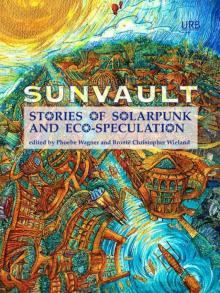
Fighting for the Future, page 1
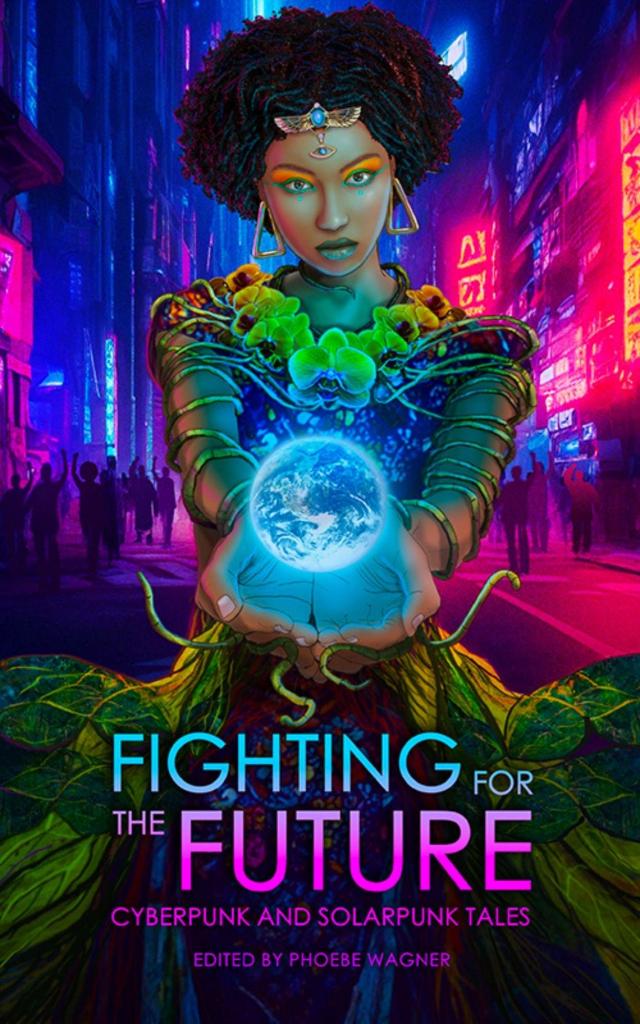


Fighting for the Future
Cyberpunk and Solarpunk Tales
Edited by Phoebe Wagner
Android Press
Cover Art © 2023 by Hal Hefner
"Introduction" © 2023 by Andrew Sage
“Nano-Vibration” © 2023 by Brent Lambert
“Property of PAUSE Ltd.” © 2023 by Ai Jiang
“The Galaxy's Cube” © 2023 by Jeremy Szal
“Do Anarchists Dream of Collective Sheep?” © 2023 by Izzy Wasserstein
“Tomorrow Is Another Day” © 2023 by Louis Evans
“The Promise” © 2023 by Rona Fernandez
“Root Cause” © 2023 by Lauren C. Teffeau
“Broken Threads” © 2023 by Kevin Wabaunsee
“The Robot Whisperer” © 2023 by Holly Schofield
“The Strength of the Willow” © 2023 by Commando Jugendstil and Tales from the EV Studio
“Solarpunks” © 2023 by J.D. Harlock
“Materiality” © 2019 by Cory Doctorow
“The Scent of Green” © 2023 by Ana Sun
“Cloud 9” © 2023 by Christopher R. Muscato
“The Holiness of Light” © 2023 by Cynthia Zhang
Compilation © 2023 by Phoebe Wagner
Published by Android Press
Eugene, Oregon
www.android-press.com
ISBN 978-1958121313 (paperback)
ISBN: 978-1958121320 (epub)
All rights reserved. No part of this book may be reproduced in any manner whatsoever without written permission of Android Press, except in the case of brief quotations embodied in critical articles and reviews. Please respect the rights of the author and the hard work they’ve put into writing and editing the stories in this book. Do not copy or distribute, and do not post or share online. If you like the book and want to share it with friends, please consider buying additional copies.
Contents
Editor's Note
Introduction
I. Cyberpunk Tales
Nano-Vibration Brent Lambert
Property of PAUSE Ltd. Ai Jiang
The Galaxy’s Cube Jeremy Szal
Do Anarchists Dream of Collective Sheep? Izzy Wasserstein
Tomorrow Is Another Day Louis Evans
II. Transitionary Tales
The Promise Rona Fernandez
Root Cause Lauren C. Teffeau
Broken Threads Kevin Wabaunsee
The Robot Whisperer Holly Schofield
III. Solarpunk Tales
The Strength of the Willow Commando Jugendstil and Tales from the EV Studio
Solarpunks J.D. Harlock
Materiality Cory Doctorow
The Scent of Green Ana Sun
Cloud 9 Christopher R. Muscato
The Holiness of Light Cynthia Zhang
Author Biographies
Editor's Note
Since its inception, solarpunk and cyberpunk have been in conversation together. Cyberpunk’s intense dedication and love of technology in an environmental wasteland is reimagined in solarpunk’s right-tool-for-the-right-job usage of technology in a damaged but healing, living world. Cyberpunk’s individualism is balanced with solarpunk’s communalism. Even cyberpunk’s neon is juxtaposed with solarpunk’s solar panels.
This ancestry always felt like the right fit to me since my earliest attraction to solarpunk. With this network in mind, I hoped to jumpstart the next -punk subgenre. While some people argue that -punk gets slapped on any word too quickly, solarpunk felt like the next utterance of a conversation we never finished having with cyberpunk.
When I set out to co-edit Sunvault: Stories of Solarpunk and Eco-Speculation (2017), the goal was to create a general anthology of fiction, poetry, and art so those interested in solarpunk could have a starting point. The goal when co-editing Almanac for the Anthropocene: A Compendium of Solarpunk Futures (2022) was similar: the first general nonfiction collection of solarpunk in hopes of jumping the genre from idea to action. In this collection, I set out to satisfy my desire to see the cyberpunk roots of solarpunk flourish and restart the conversation I’ve always felt whispering between these genres.
Indeed, the cyberpunk stories are reaching for the future that the solarpunk stories are wrestling with. Similar themes emerge, such as the beginnings and consequences of revolutionary action in “Nano-Vibration” by Brent Lambert, “Do Anarchists Dream of Collective Sheep?” by Izzy Wasserstein, and “Tomorrow Is Another Day” by Louis Evans. In the second half of the book, those revolutions may have been successful, but people—both human and nonhuman—must recover from the destruction wrought by capitalism, social injustice, and environmental degradation, which creates plenty of problems, such as in “The Scent of Green” by Ana Sun and “The Holiness of Light” by Cynthia Zhang.
In the middle of this spectrum, these stories imagine how communities shift, rebuild, destroy oppressive systems, and reimagine what it means to be in community with the rest of the living world, such as in “Broken Threads” by Kevin Wabaunsee, “The Robot Whisperer” by Holly Schofield, and “The Strength of the Willow” by Commando Jugendstil and Tales from the EV Studio. Importantly, though, these stories do not shy away from critique, even of desirable societies as often found in solarpunk stories, such as in “Root Cause” by Lauren C. Teffeau, “The Promise” by Rona Fernandez, and “Solarpunks” by J. D. Harlock. Among these stories, the authors consider how technology has been used to hurt people and the living world, but also how technology can be used to build communities and expand our notions of personhood, such as in “Property of PAUSE Ltd.” by Ai Jiang, “The Galaxy’s Cube” by Jeremy Szal, “Materiality” by Cory Doctorow, and “Cloud 9” by Christopher R. Muscato.
While I leave it to Andrew Sage to explain the history and deeper connections between cyberpunk and solarpunk, I will say the reason this anthology matters is because neither vision of the future is certain. These stories show we have the tools to revolt and organize against a cyberpunk future, but let’s not forget those lessons in our hopes to achieve a solarpunk reality.
How to read this book:
Putting together an anthology never goes as expected. I’m always blown away by the submissions, and the writers end up changing my vision for the book. Initially, I imagined this anthology would have section breaks separating the cyberpunk, transitional, and solarpunk stories, but as I worked on organizing the book, I realized that was impossible. Of course, it wouldn’t be—couldn’t be—that delineated. The stories had their own sense of flow with no clear breaks, though there certainly is a sense of change from beginning to end.
As the editor, my recommendation would be to start at the beginning and read to the end. While many anthologies don’t function in such a linear way, reading cover to cover will demonstrate the greatest sense of change as imagined by these amazing writers. If you are more interested in the cyberpunk stories, then I’d read from “Nano-Vibration” by Brent Lambert to “The Promise” by Rona Fernandez. If you are more interested in the transitional stories, I’d start with “Root Cause” by Lauren C. Teffeau and read through “The Strength of the Willow” by Commando Jugendstil and Tales from the EV Studio.
If you are all about the solarpunk stories, then I’d start with Kevin Wabaunsee’s “Broken Threads” and read through the final story, “The Holiness of Light” by Cynthia Zhang. As you can see, there is overlap, and only a handful of stories clearly fit into their specific genre—but that is what makes this anthology important. We are currently living through tipping points, moments of great change, so we must imagine how to shape these moments and the futures they create.
Regardless, read this book in the way that works for you. I hope it inspires you to make your own stories and better your community!
Hope through action,
Phoebe Wagner, 2022
Introduction
Andrew Sage
When it comes to popular visions of the future, the dialectic of utopia and dystopia has thoroughly captivated our collective imaginations. These genres of speculative science fiction have introduced us to vibrant new worlds that nonetheless echo our own. The concept of utopia arose first, deriving from Greek meaning both “good place” and “no place.” Fittingly, utopia is perceived as a picturesque society of inaccessible perfection. Dystopia followed shortly in response, from the Greek for “bad place.” Dystopian worlds are terribly grim sites of totalitarian injustice and suffering. Utopia and dystopia have been compared, contrasted, and combined to explore what we desire and what we fear in our societies. The many manifestations of this dichotomy present us with an opportunity as a human community to observe our circumstances and determine our trajectory.
The utopic visions of solarpunk and dystopic horrors of cyberpunk have arisen to present and explore these possibilities. Cyberpunk societies are dominated by violence on all levels, much like our own, from the most interpersonal to the most impersonal and systemic, due to the corrupt heights of capitalism and unregulated technology. Conversely, solarpunk staunchly rejects the seeming inevitability of capitalist dystopia, even through the compounding consequences of climate crisis. Instead, solarpunk worlds explore the alternative possibilities of true social justice, tempered technological development, and sustainability through ecological harmony, presenting the real possibility of fantasy made manifest through bold anarchic praxis and flourishing communities.
Solarpunk and cyberpunk, as distinct yet interrelated manifestations of the subversive punk ethos, inevitably con
The global rise of industrial capitalism has left an indisputable scar on the face of our planet. Worse yet, it seems as if humanity has resigned itself to the destructive tendencies of this political and economic system as inevitable, with no real, viable alternatives. Yet the continental proportions of capitalism’s devastation can no longer be ignored. The climate crisis is climbing to its peak, with no end in sight.
Cyberpunk stories take this brutality to its extreme but natural conclusion. These worlds are high-tech and low-life. Faceless, totalitarian, multinational mega conglomerates dominate the people of this troubled future, even assuming the role of governments due to their monopoly over political, economic, and even military power. Societal decay is reflected in the nihilistic depiction of human connections, often transactional or coercive. Our protagonists typically struggle to navigate this calloused world or seek to rebel against it, reflecting the inhumane nature of capitalism’s logic. Yet cyberpunk protagonists are typically unable to transform or even escape the reach of the system. The dystopic messaging is clear: imagine a boot stamping on a human face—forever.
Solarpunk stories, on the other hand, typically critique capitalism indirectly, portraying a world attempting to heal from the wounds it has left on its people and its landscape. The genre optimistically argues that it is not too late to reverse our course and work to repair the harms caused by capitalism through ecological restoration, ethical technological integration, and diverse, egalitarian human collaboration. But we must reject capitalism to achieve this better world. We must, in fact, reject all systems of domination in order to establish a free and equitable society. Solarpunk works, though not necessarily utopian, explore this alternative to the pessimistic view of cyberpunk dystopias. Characters in these worlds demonstrate what it would look like if we fought back against the alienating status quo and built something new. Solarpunk embodies the crucial recognition that utopia is the never-ending process of making a better world.
The harms of industrialisation under capitalism have exposed the volatile relationship between technology and nature. How can we justify our use of technology if the consequences have been as dire as the Great Pacific Garbage Patch, irreversible oil spills, the acidification and eutrophication of our oceans, the toxic runoff of rare earth mineral mining sites, the deforestation of our old growth forests, the loss of our topsoil, the unmitigated release of greenhouse gases, and the Holocene extinction? Depictions of nature are practically absent in most cyberpunk fiction. Instead, these sterile, man-made worlds are filled with sprawling, dense, and all-consuming urban hell. Concrete, glass, neon, and steel cover buildings and streets, with nary a tree or shrub to be found. Even food takes on an increasingly artificial composition. Nature has been stifled and forgotten or obscured by the smog of metropolis. On the other hand, technological innovations are as advanced as one can imagine. Advanced prosthetics, holographics, cryogenics, nanotechnologies, artificial intelligences, digitised consciousnesses, and more dominate the day-to-day lives of cyberpunk urbanites. How these technologies have become so widespread on a planet with limited resources or how these technologies even work may not be clear, but what is clear in cyberpunk settings is that human technological advancement excludes and exists beyond the natural world.
Solarpunk, on the other hand, is concerned with the development and application of technology in human societies, as well as how such technologies impact our environments. Although some fanciful interpretations of solarpunk have embraced fictional high-tech solutions, most practical understandings of solarpunk embrace low-tech ways of living sustainably with permaculture principles, DIY ethics, right to repair, modular and multipurpose tools and components, the abolition of planned obsolescence, vernacular material use, decentralised infrastructure, urban walkability, and the broad application of biophilic design. There have been critics of solarpunk’s emphasis on solar panels, which currently require the use of rare earth minerals mined in exploitative conditions, but the wielding of solar energy need not be limited to conventional solar panels. Solarpunk fiction also embraces practices of ecological restoration, such as rewilding and soil regeneration. Ultimately, solarpunk seeks to find and maintain a balance between technology use and natural sustainability.
Several different bodies of philosophical thought have confronted the relationship between the individual and their society. Society does not exist independently of the individual and the individual cannot exist without society. We’ve evolved as social animals, almost like cells in a larger social body. In a cyberpunk society, this body is deeply ill. Its cells are alienated from each other, attacking and maligning its misfits, malcontents, and marginalised. Corporations have commodified every dimension of social and personal life, while hyperindividualism has totally eroded any conception of community, leaving a permeating sense of desolation and despair. Cyberpunk protagonists, though nonconformist and self-expressive, are just as isolated as the rest of their society is from their humanity. Solarpunk societies, on the other hand, demonstrate a social body in the process of recovery. Individuals are embedded in social networks that exist to uplift each piece, and not just the sum of its parts. Individuals in solarpunk fiction have been unshackled from the restraints of capitalist relations to life and labour, allowing them to exercise, and so develop, their abilities to the fullest. The free association of all the people in community involves them in the process of thinking, planning, coordinating, and implementing the decisions that affect them in their society, rather than being alienated from power as in a cyberpunk world. The health, creativity, and talent of the whole social organism is able to blossom and flourish, unrestrained.
The tension between solarpunk and cyberpunk is reflective of ongoing tensions in the real world that have yet to be resolved. The tension between hope and nihilism. Should we invest our time and energy into fighting to survive and thrive when it could all be for nought? Should we even try when failure seems not only possible but likely? How do we overcome centuries of destruction, centuries of authoritarianism, centuries of propaganda? Can we avert total apocalypse? We face a fork in the road. Unless we act now, our choice will be made for us. The stories presented in this anthology explore just a sliver of our many possibilities.
Utopia or dystopia?
You decide.
Nano-Vibration
Brent Lambert
Quazin threw his head back after sniffing the line and rolled his shoulders. The last part had nothing to do with getting the drug into his system, but it was a ritual he followed nonetheless. He looked at Dru and gave her a big smile.
This was her third time partying with him and the rest of the crew. Quazin wasn’t sure if she was a good fit just yet, but sometimes it took a while. She was sweet and there seemed to be a spark of adventure lying beneath the surface.
“You want me to get a line ready for you?” Quazin asked. He usually did one first to make the newbies ease up. Yadis did it for him all those years ago.
Dru thought about it for a moment and shrugged. “Yeah sure, why not. It’s been a long fucking week at work anyway.”
Quazin smiled and unscrewed the small vial he carried with him most days. He tapped a small rock out from it and onto the counter. With one of his old metro cards, he broke the rock up into another line for him and one for her.
She did it and shook her whole body afterwards. “Whew! That one was good.”