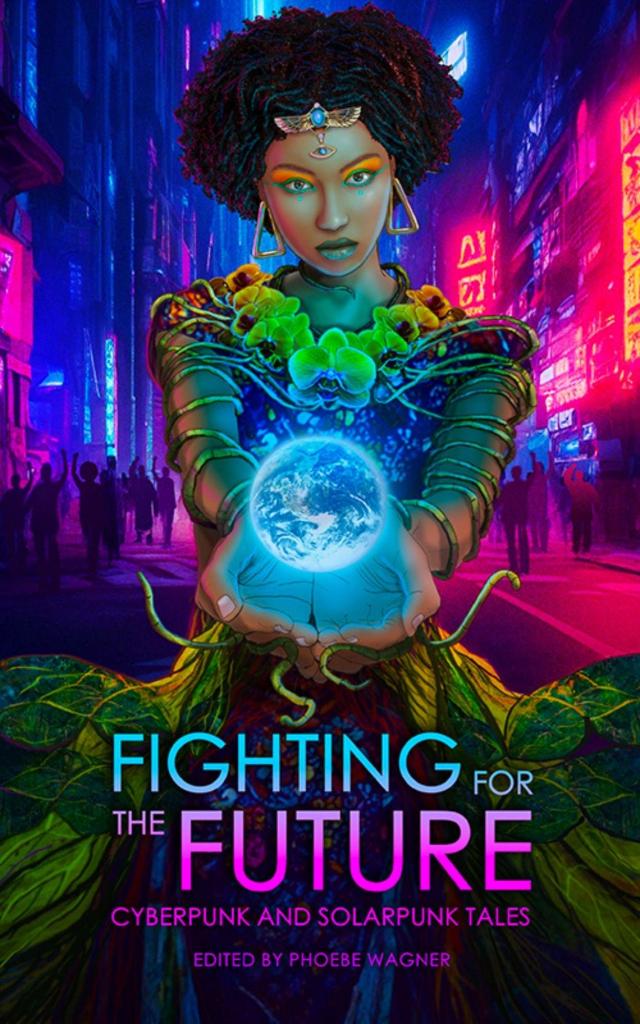
Fighting for the Future, page 22


“You two were close, weren’t you?”
Jean shrugs, the softness dissipating back into somber sobriety. “I thought we were, up until they went and got themselves killed. Which—it’s not like I didn’t know it was fire season or that they’d helped with smaller wildfires before. But they never even mentioned they were going. That’s the thing that gets me the most—maybe if I’d known, then I would have been prepared for it in some way. Not for them to die, maybe, but for something at least. And then I start going through their things and I find a will, of all fucking things, as if they’d been prepared all along—”
Hesitantly, Aileen winds an arm around Jean’s shaking shoulders. When Jean doesn’t move away, she pulls her closer, letting Jean’s head fall on her shoulder as she soundlessly cries.
When the letter first arrived at her office, Aileen hadn’t believed it was real at first. Thought it must have been a mistake, some cruel prank from a malicious stranger intent on digging up her past. Like almost everyone she knew, she left La Paz after high school, packed up for the first college to offer her a scholarship and never looked back. Why would she? A quarter of the town had burned down during the last fires, and yet the disaster had barely made it beyond local news. The state wasn’t going to give them enough money to rebuild the lost houses and businesses; anyone with the means to do so was moving out, searching for new jobs in places where their work and dreams could be something more than waiting tinder.
But Haru had stayed. Long after even the last nuns left for retirement homes or died of old age, Haru stayed, so devoted to Harmonious Resonance that Aileen eventually could not think of one without the other. Just as certain kami were tied to particular stones or ponds, Haru and the temple seemed as inexorably bound as a shadow and its object. Even now, Aileen expects to see them walking around the corner, eyes bright as they rush forward with a handful of wild onions or a new story to share.
It’s strange, Aileen thinks as she rubs circles against Jean’s back. All these years, and she had never doubted her choice to leave. La Paz was an ordinary small town with all the prejudices and problems of a small town, and besides the occasional longings for frozen Yakult or sweet strong Cuban coffee, she had never felt any nostalgia for the place. For the people, yes, and the person she had once been, but never La Paz itself.
Yet now, sitting on the creaky porch of the temple where she had once met her best friend, Aileen wonders whether she could have stayed.
Jean slowly untangles herself from Aileen, furtively wiping her eyes on her sleeves.
“Haroun and Alec should be back soon,” she says. Her voice is scratchy, but surprisingly steady. “I know we’ve just met, but if you wanted, after dinner you could drive over to our place and crash on the couch. People here are decent for the most part, but it’s still probably better that you don’t stay alone. Single woman, all alone in the middle of nowhere, you know how it goes.”
“Dani gets along well enough.”
“Dani’s got Luna and her hell pack of goats to protect her. Demonic little creatures—last time I visited, they almost ate my favorite jacket. Seriously, though. If you change your mind, our place is open to you.”
“Thank you,” Aileen says, “but I’ll only be here for a night or two. I’ll be okay.”
Despite her assurances to Jean, sleep comes uneasily to Aileen. More so than the fear of coyotes or unfriendly strangers, the act of sleeping in Haru’s bed leaves Aileen tense and her dreams erratic, too many ghosts threatening to invade every time she opens her eyes to an unfamiliar ceiling.
After the fourth time she lurches awake, Aileen gives up on a good night’s rest. It’s a little before down dawn, the sun not yet up but the sky beginning to lighten, the blackness of night giving up to lighter gray. Outside the main gate, Aileen reaches in her pocket for a cigarette. It’s a terrible habit, one she knows she should quit, but it soothes her nonetheless.
Smoke fills her lungs, the familiar fuzziness of nicotine softening the edges of world. Aileen lets herself drift, thinking not of the boxes to finish sorting through or the return flight tickets she still needs to buy, but simply holding herself in the coolness of the pre-dawn day.
Behind her, something rustles in the grasses.
Aileen turns, heart pounding and muscles gearing to run, only to find that the intruder is not a coyote or an axe murderer but a small golden fox, sitting neatly on its back paws by the gate.
“Oh,” Aileen says, the tension rushing out of her so quickly it makes her dizzy. Slowly, she crouches down, careful not to startle the creature. “Hello there.”
The fox watches her, its eyes large and gold. Outside of a few childhood visits to zoos, Aileen has never been this close to a wild animal, and never without a fence separating them. Logically, she knows she should be afraid—a fox wandering this close to humans might simply be a former pet, but it could just as easily be rabid or worse. But there’s something in the fox’s gaze, an intelligence in its tawny eyes that makes Aileen set aside her caution.
Traditionally, Inari’s messengers are white-pelted, but the kami is well-known for shifting appearance according to the believer. Maybe this little messenger is a Californian variant, gold for a golden state.
The fox turns, trots a few steps towards the temple before stopping to look back at her, its message clear. Curious, Aileen follows.
They end up in the shed, standing next to dark shapes that are just identifiable as hoes and bags of soil. The fox noses at a spot at the ground, then expectantly looks up at Aileen.
“Yeah?” Aileen asks, leaning down to examine the floorboards. “Do you smell something nice under there? Some mice, maybe?”
Her fingers brush over something hard. It’s a hinge, hidden under layers of dust. She looks to the fox, who only blinks in response. Turning on her phone reveals the outline of a trapdoor, hidden among the lines of the floorboards.
It takes a minute or two of scrabbling through the dust, but eventually Aileen pries the door open, revealing a set of rough-hewn stairs leading into the dark. She turns to consult the fox again, but it is already bounding down the stairs, paws scuttling softly as it disappears out of sight.
As she descends, Aileen thinks of the movies she and Haru used to watch in her parents’ basement, old sci-fi and adventure flicks where wandering protagonists discovered secret fortresses and magical worlds hidden underground. In Miyazaki movies, falling through thickets meant finding the lairs of friendly Totoros or hidden root systems quietly purifying the toxic world above.
When Aileen shines her phone over the walls of the small space, she finds no hidden civilizations or glowing magical crystals. But there are shelves are carved into the walls, each holding used tofu boxes full of mushrooms: enoki and oyster and portobello, growing pale and bright out of coffee grounds and tea leaves. Sealed jars of jam and fermenting vegetables sit next to a basket of eggs covered in mud and straw—century eggs, Aileen realizes, a pungent dish she had never cared for but which Haru had adored whenever they stayed at her house.
In a crate on the ground, Aileen finds several glass bottles filled with golden liquid—D. wine, their labels read, and Aileen knows exactly which novel inspired Haru to brew dandelion wine.
On a small table in the corner sit two solar lamps. When tested, they have just enough charge to dimly light the small space. Beyond them, there are no networks of glowing wires, no humming machines to suck in carbon emissions or convert islands of garbage into clean earth. Objectively, the cellar is a small, humble space, the kind that any enthusiastic DIYer with a knack for home renovation could make. But looking around, what Aileen sees is quintessentially Haru: a collection of small kindnesses, little luxuries to lighten the lives of those around them.
A shrine could be anything, Haru told her once, hands covered in dirt from planting tulip bulbs in rain-softened ground. A few stones in a garden, a spray of wildflowers laid in front of a photograph—it did not have to be wine or incense, what mattered was the act of offering itself. A temple’s glory was not its opulence, its golden Buddhas and polished floors, but the care it was given and gave in return. A patch of ground, given water twice a day, could grow into a sacred space as well, roots spreading underground and branches above filling with oranges like golden sun.
At her feet, the fox yawns, tail swishing slowly against the dirt floor. On one of the higher shelves, Aileen finds an unopened bag of dried sardines. She shakes out a few for the fox, who regards her solemnly before delicately picking up a piece. A humble offering, but still acceptable, it seems.
Watching the fox eat, face scrunching with pleasure as it chews, Aileen thinks she can stay another day or two. Until community dinner, at least. And then, after that—well. It’s six months until her current contract runs out, six months until she has to scramble for another grant or fellowship to fund her apartment in a flooding city. La Paz has the opposite problem of New York, too hot and dry instead of wet, but perhaps there is some middle ground she could find between them, someplace where light can convert into cool air and hard rains to soft grass.
Licking up the last of the fish, the fox gazes up at Aileen. In the dim light, its eyes shine like twin coins, warmed in the light of a golden sun.
Author Biographies
EDITOR
Phoebe Wagner
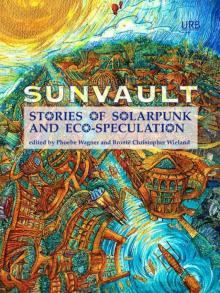
Phoebe Wagner is a writer, academic, and editor of solarpunk anthologies, including Sunvault: Stories of Solarpunk & Eco-Speculation. She holds a PhD in literature and is an assistant professor of creative writing at Lycoming College. Follow her at phoebe-wagner.com or on Twitter as @pheebs_w.
AUTHORS
Cory Doctorow
Cory Doctorow (craphound.com) is a science fiction author, activist and journalist. He is the author of many books, most recently Radicalized and Walkaway, science fiction for adults; How to Destroy Surveillance Capitalism, nonfiction about monopoly and conspiracy; In Real Life, a graphic novel; and the picture book Poesy the Monster Slayer. His latest book is Attack Surface, a standalone adult sequel to Little Brother; his next nonfiction book is Chokepoint Capitalism, with Rebecca Giblin, about monopoly, monopsony and fairness in the creative arts labor market, (Beacon Press, 2022). In 2020, he was inducted into the Canadian Science Fiction and Fantasy Hall of Fame.
Louis Evans
[OPEN FILE B:/LOUIS_EVANS.EXE/README.TXT]: Louis Evans is a bespoke executable running on a conventionally growprammed hominid wetware frame. Notable Evans outputs have been printed in Nature: Futures, Analog Science Fiction & Fact, Interzone, etc. Further Evans file access is available at https://www.evanslouis.com/; intermittent logging is provided at https://twitter.com/louisevanswrite.
Rona Fernandez
Rona Fernandez is a Filipina-American writer, dancer and activist-fundraiser in the San Francisco Bay Area. Her essays and stories have appeared in The Rumpus, Apparition Lit, The Colored Lens, Devilfish Review and The Masters Review. She is currently working on RED DETLA JOLT, a climate fiction novel set in a near-future Northern California. An alumna of the VONA/Voices and Tin House novel workshops, when Rona is not writing she coordinates a mutual aid network for BIPOC intentional communities, and is a fundraising consultant for racial and climate justice movement groups. You can find her on Twitter @ronagirl.
J. D. Harlock
J.D. Harlock is a Lebanese Syrian Palestinian writer based in Beirut. He is the Poetry Editor at Orion’s Belt and Solarpunk Magazine. You can find him on Twitter @JD_Harlock.
Ai Jiang
Ai Jiang is a Chinese-Canadian writer and an immigrant from Fujian. She is a member of HWA, SFWA, and Codex. Her work has appeared or is forthcoming in F&SF, The Dark, Uncanny, The Puritan, Prairie Fire, The Masters Review, and her debut novella Linghun (April 2023) is forthcoming with Dark Matter INK. Find her on Twitter (@AiJiang_) and online (http://aijiang.ca).
Commando Jugendstil
Commando Jugendstil is a solarpunk creative collective. Their projects conjugate technology and art with the idea of transforming the city in its sustainable version, while focusing on co-designing solutions with local communities, to stimulate a just transition that can spark from the ground up. They believe imagination is a transformative force, so they also write and illustrate stories and other works of fiction that can help people envision their sustainable future: if you can imagine it, then you can do it. Their short stories and illustrations appeared in anthologies and publications on the web and all around the globe: USA, Australia, UK, Spain, and recently Italy. They also held workshops and lectures on solarpunk and speculative design in the Universities of Cambridge and Moscow, and they proudly coordinated and contributed in projects and festivals in Milano (Italy), Reading (UK), and Bruxelles (Belgium), always with the idea of helping create a solarpunk world.
Tales from the EV
Tales from the EV is also a small collective of storytellers. They started out with archanepunk and alternate history, but fell in love with solarpunk while helping the Commando write Midsummer Night's Heist. Their collaboration has been going strong ever since. Members of TftEV are involved in climate justice activism with Earth Strike UK and the Green New Deal for Europe campaign.
Brent Lambert
Brent Lambert is a Black, queer man who heavily believes in the transformative power of speculative fiction across media formats. He resides in San Diego but spent a lot of time moving around as a military brat. His family roots are in the Cajun country of Louisiana. Currently, he manages the social media for FIYAH Literary Magazine and just had an anthology produced with Tor.com titled Breathe FIYAH. He has work published with FIYAH, Anathema Magazine, Cotton Xenomorph, Baffling Magazine and upcoming with Beneath Ceaseless Skies. He can be found on Twitter @brentclambert talking about the weird and the fantastic. Ask him his favorite members of the X-Men and you’ll get different answers every time.
Christopher R. Muscato
Christopher R. Muscato is a writer from Colorado. He is the former writer-in-residence for the High Plains Library District, fellow of the Terra.do climate community, and a winner of the XR Wordsmith Solarpunk Storytelling Showcase. He is also the father of twins toddlers, who provide good motivation to imagine a brighter future for us all.
Andrew Sage
Andrew Sage is an Afro-Trinbagonian writer, artist, and YouTuber, best known for his conversational approaches to various cultural, historical, and sociopolitical topics. From solarpunk to decolonisation to youth liberation to Black anarchism, Andrew seeks to learn and explore as much as possible. You can find him on his YouTube channel @Andrewism or on his Twitter @_saintdrew.
Holly Schofield
Holly Schofield’s stories have appeared in Lightspeed, Analog, Glass and Gardens: Solarpunk Winters, Glass and Gardens: Solarpunk Summers, and many other publications throughout the world. She is a Fiction co-Editor at Solarpunk Magazine. You can find her at hollyschofield.wordpress.com.
Ana Sun
Ana Sun writes from the edge of an ancient town along the River Ouse in the south-east of England. She spent her childhood in Malaysian Borneo, and has subsequently lived on two other islands prior to moving to the UK.
Jeremy Szal
Jeremy Szal was born in 1995 and was raised by wild dingoes, which should explain a lot. He spent his childhood exploring beaches, bookstores, and the limits of people’s patience. He’s the author of over forty science-fiction short stories. His debut novel, Stormblood, is a dark space opera from Gollancz in June 2020, and is the first of a trilogy. He was the editor for the Hugo-winning StarShipSofa until 2020 and has a BA in Film Studies and Creative Writing from UNSW. He carves out a living in Sydney, Australia with his family. He loves watching weird movies, collecting boutique gins, exploring cities, cold weather, and dark humour. Find him at https://jeremyszal.com/ or @JeremySzal.
Lauren C. Teffeau
Lauren C. Teffeau is a speculative fiction writer based in New Mexico. “Root Cause” is set in the world of her novel Implanted (Angry Robot), mashing up cyberpunk, solarpunk, adventure, and romance. The book was shortlisted for the 2019 Compton Crook award for best first SF/F/H novel and recently named a definitive work of climate fiction by Grist.org. Her short fiction can be found in a number of speculative fiction magazines and anthologies, most recently DreamForge Magazine, Flame Tree Press, The Dread Machine, and Chromophobia: A Strangehouse Anthology by Women in Horror. She holds a master’s degree in Mass Communication and spent a few years toiling as a researcher in academia. Now she writes to cope with her ordinary existence.
Kevin Wabaunsee
Kevin Wabaunsee is a speculative fiction writer and biomedical research news editor. He is the former managing editor for the Science Fiction and Fantasy Writers of America (SFWA), and currently an associate editor for Escape Pod. His fiction has been published in Strange Horizons, Escape Pod, Apex Magazine, and PseudoPod. He is a Prairie Band Potawatomi.
Izzy Wasserstein
Izzy Wasserstein is a queer and trans woman who teaches writing and literature at a university on the American Great Plains and writes poetry and fiction. Her work has appeared in Beneath Ceaseless Skies, Clarkesworld, Fantasy, and elsewhere. She shares a home with her spouse Nora E. Derrington and their animal companions. She’s an enthusiastic member of the 2017 class of Clarion West. Her debut short story collection, All the Hometowns You Can’t Stay Away From, was released with Neon Hemlock Press in 2022.
Cynthia Zhang
Cynthia Zhang is a part-time writer, occasional academic, and full-time dog lover currently based in Los Angeles. Her novel, After the Dragons, was published with Stelliform Press in 2021, and was shortlisted for the 2022 Ursula K. Le Guin Award in Fiction as well as the 2022 Utopia Awards in the category of Utopian Novella. Her work has appeared or is forthcoming in Solarpunk Magazine, Xenocultivars: Stories of Queer Growth, Kaleidotrope, On Spec, Phantom Drift, and other venues. She is on the web at czscribbles.wixsite.com and cz_writes on Twitter.