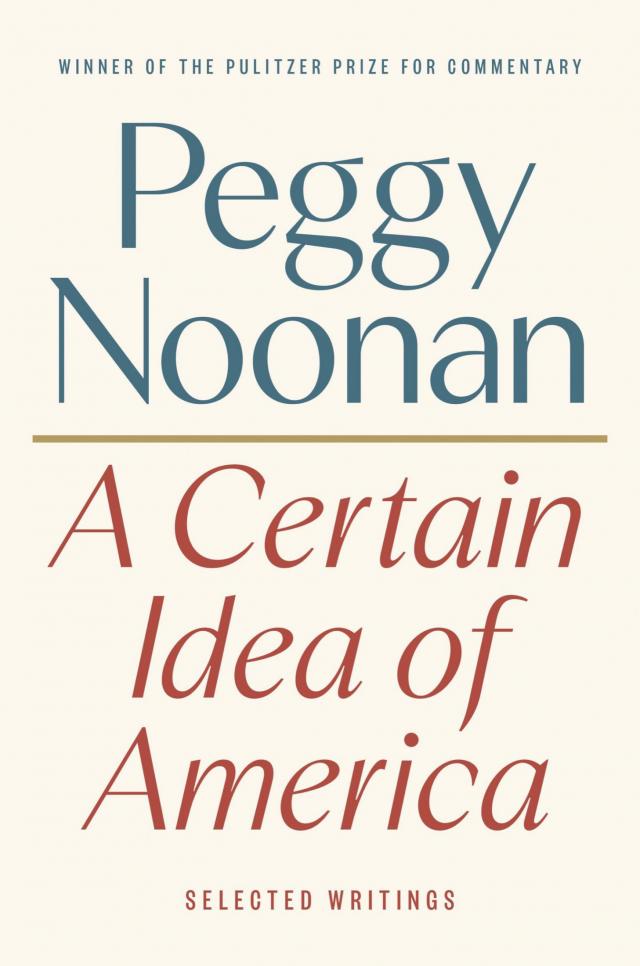
A Certain Idea of America, page 1


Portfolio / Penguin
An imprint of Penguin Random House LLC
penguinrandomhouse.com
Copyright © 2024 by Peggy Noonan
Penguin Random House values and supports copyright. Copyright fuels creativity, encourages diverse voices, promotes free speech, and creates a vibrant culture. Thank you for buying an authorized edition of this book and for complying with copyright laws by not reproducing, scanning, or distributing any part of it in any form without permission. You are supporting writers and allowing Penguin Random House to continue to publish books for every reader. Please note that no part of this book may be used or reproduced in any manner for the purpose of training artificial intelligence technologies or systems.
All columns first published in The Wall Street Journal and have been edited slightly for clarity.
Cover design: Brian Lemus
Cover photograph: Erin Patrice O’Brien
Book design by Alissa Rose Theodor, adapted for ebook by Estelle Malmed
Library of Congress Cataloging-in-Publication Data
Names: Noonan, Peggy, 1950– author.
Title: A certain idea of America : selected columns / Peggy Noonan.
Description: [New York] : Portfolio ; Penguin, 2024.
Identifiers: LCCN 2024037311 (print) | LCCN 2024037312 (ebook) | ISBN 9780593854778 (hardcover) | ISBN 9780593854785 (ebook)
Subjects: LCSH: United States—Politics and government. | United States—Civilization.
Classification: LCC E183 .N66 2024 (print) | LCC E183 (ebook) | DDC 973—dc23/eng/20240926
LC record available at https://lccn.loc.gov/2024037311
LC ebook record available at https://lccn.loc.gov/2024037312
Ebook ISBN 9780593854785
pid_prh_7.0_9001707_c0_r0
CONTENTS
Dedication
Foreword
1 | LET US NOW PRAISE FAMOUS MEN
Billy Graham, the Ecumenical Evangelist
The Wisdom of Oscar Hammerstein
The Mystery and Grace of Paul Simon
Hats Off to Tom Wolfe
Thoughts on Theodore Roosevelt and John Hay after the Russian Invasion of Ukraine
These Generals Were the Closest of Enemies
History Gives George H. W. Bush His Due
On Margaret Chase Smith
Richard Nixon’s Example of Sanity in Washington
On the Death of a Queen
A Great Man Got Arrested as President
Bob Dylan, a Genius Among Us
2 | I DON’T MIND BEING STERN
The Senator’s Shorts and America’s Decline
Life Isn’t Merde
Get Ready for the Struggle Session
The Left Is Overplaying Its Hand
America Needs More Gentlemen
Reflections on Impeachment, Twenty Years Later
The Uvalde Police Scandal
America Has Lost the Thread
The Half-Madness of Prince Harry
The Sexual-Harassment Racket Is Over
Kids, Don’t Become Success Robots
What Were Robespierre’s Pronouns?
Scenes from the Class Struggle in Lockdown
Bring ’Em to Justice
Psychos in the C-Suite
America’s Universities Are Self-Destructing
Democracy Is Not Your Plaything
The Media Can’t Keep Their Heads
Where Did the Adults Go?
3 | TRY A LITTLE TENDERNESS
My Summer with Leo Tolstoy
The Lonely Office Is Bad for America
A Genius for Friendship
America’s Most Tumultuous Holy Week
Think Like an Artist
Out of the Ashes of Notre Dame
On Uvalde: Let Not Our Hearts Grow Numb
Coronavirus Will Change Everything
Our New Coronavirus Reality
What Comes After the Coronavirus Storm?
Give Thanks for Taylor Swift
4 | ON AMERICA
What’s Become of the American Dream?
A Continuing Miracle
On Keeping Our Composure
Wisdom of a Non-Idiot Billionaire
“Which Way to Pointe du Hoc?”
An American Song, an American Crisis
A Week in the Life of a Worried Land
“Home Again, and Home Again, America for Me”
Spirits in the Skies of Summer
The Pilgrims Take Manhattan
We Need a Farsighted Conservatism
Against the Tear-It-Down Movement
Joe Biden Can’t Resist the “River of Power”
A Tabloid Legend on Jeffrey Epstein’s Death
Why the Titanic Keeps Drawing Us In
The Protected Versus the Unprotected
5 | IT APPEARS HE DIDN’T TAKE MY ADVICE
If Biden Runs, They’ll Tear Him Up
Imagine a Sane Donald Trump
6 | WATCH OUT
What I Wish Oppenheimer Had Said
The Ukraine Crisis: Handle with Care
It’s the Unthinkable. We Must Think About It.
The October Horror Is Something New
The Rape of the Israeli Women
AI Is the Y2K Crisis, Only This Time It’s Real
We’re Putting Humanity’s Future into Silicon Valley’s Hands
Artificial Intelligence in the Garden of Eden
What Might Have Been at Tora Bora
7 | WE CAN HANDLE IT
Roe v. Wade Distorted Our Politics and Roiled Our Culture
What Pro-Lifers Should Learn from Kansas
John Paul II’s Prescient 1995 Letter to Women
Mrs. Smith’s Tips for New Lawmakers
Mind Your Manners, Says Edith Wharton
The San Francisco Rebellion
The Kids Are Not All Right
Save Capitalism!
The President Has a Presentation Problem
What Comes After Acheson’s Creation?
American Institutions Are Frailer Than We Know
The Century of the Postheroic Presidency
Acknowledgments
About the Author
_9001707_
For Will and Alice in an auspicious year
FOREWORD
This is not a book about the day to day of our national political life. It is simply about loving America and enjoying thinking aloud about it.
The columns gathered here are varied in terms of subject matter. They are about the things that endure, and things that deserve to be encouraged. A number of them are about spectacular human beings. As my editor and I read through the past few years of Wall Street Journal columns, if I said, “I really enjoyed writing that,” or she said, “I loved this,” or I said, “This was important to me,” it was in. If not, out. We chose about eighty from more than four hundred. We found ourselves most attracted to themes of history and its pleasures.
The book is divided into seven parts.
“Let Us Now Praise Famous Men” is mostly about great figures and artists of the twentieth century, from Billy Graham to Oscar Hammerstein, from Queen Elizabeth II to Senator Margaret Chase Smith of the state of Maine, and from Tom Wolfe to Bob Dylan, with some side trips to the nineteenth century and the generals of the American Civil War. Looking back on a career of now fifty years, I see that from the beginning what I have loved most, what has most moved me, is writing honest praise.
“I Don’t Mind Being Stern,” on the other hand, is about having fun, as a public writer, taking as big a stick as you can to people and things you are certain deserve it. The U.S. Senate changing its dress code to accommodate a senator who enjoys dressing like a child? Get the stick. Vengeful Prince Harry? Ditto. We were certain a recent Broadway production of Cabaret deserved our stern attention, in a piece whose last line is its summation: “Life Isn’t Merde.” We castigate men who aren’t gentlemen, and admonish parents who, as their personal vanity product, wind kids up to become mindless status robots. Also receiving fire are woke academics who speak garbage thoughts with garbage words. (I am sorry to use the word “woke,” which is boring and sounds merely sarcastic, but the thing is that when you say it, everyone pretty much knows what you mean.) I believe we were the first to compare contemporary social justice warriors with the practitioners of the struggle sessions of the Chinese Cultural Revolution. We enjoyed pointing out that the leaders of the French Revolution were, largely, sociopaths. There’s a piece written in the hours after January 6, 2021.
In “Try a Little Tenderness” we turn to love, which we posit as a very good thing. We call for artists to enter politics. We meditate, after the fire that swept the Cathedral of Notre Dame, in Paris, on the enduring presence and power of religious faith. We unabashedly love, we swoon over and wish to marry, Leo Tolstoy and War and Peace. We mourn for Uvalde, Texas. We talk about the endless drama of men and women, and instruct America that more happens every day in the office than business. Also we declare Taylor Swift an American phenomenon, and if you don’t like it you can just shake it off.
“It Appears He Didn’t Take My Advice” is two columns long. The first,
“On America” is about the foibles, troubles, and triumphs of our country. It includes the story of my great-aunt Jane Jane, and how, as an Irish immigrant, she came to love her new country. I’d say the general theme of this section is about keeping your poise under pressure. It includes recent college graduates, the Normandy invasion, and the spirited, against-the-grain testimony of an old-fashioned capitalist. Also included, a portrait of the dynamics that produced a political sea change: “The Protected Versus the Unprotected.”
“Watch Out” contains columns about the worries that preoccupy my mind: the dark potentials of AI, skepticism as to the character and motives of its inventors; the possible use of nuclear weapons, and the ongoing dramas in Ukraine and the Mideast.
“We Can Handle It” is about working our way, as a nation, through things that roil us, from the #MeToo movement to the abortion wars, from the creation of a sane foreign policy, to the low state of the American presidency.
* * *
—
This collection draws its title from the famous first sentence of Charles de Gaulle’s “War Memoirs,” most happily translated as “All my life I have had a certain idea of France.” It struck me when I read it many years ago and stayed with me because all my life I have had a certain idea of America, and from the beginning it shaped my thinking and drove my work.
What is that idea? That she is good. That she has value. That from birth she was something new in the history of man, a step forward, an advancement. Its founders were engaged in the highest form of human achievement, stating assumptions and creating arrangements whereby life could be made more: just. In the workings of its history I saw something fabled. The genius cluster of the Founders, for instance—how did it happen that those particular people came together at that particular moment with exactly the right (different but complementary) gifts? Long ago I asked the historian David McCullough if he ever wondered about this. He said yes, and the only explanation he could come up with was: “Providence.” That is where my mind settles, too.
De Gaulle said his thoughts on France were driven as much by emotion as reason, and the same for me. A piece in here dated July 3, 2019, speaks of both:
I’m not really big on purple mountain majesties. I’d love America if it were a hole in the ground, though yes, it’s beautiful. I don’t love it only because it’s “an idea,” as we all say now. That strikes me as a little bloodless. Baseball didn’t come from an idea, it came from us—a long cool game punctuated by moments of high excellence and utter heartbreak, a team sport in which each player operates on his own. The great movie about America’s pastime isn’t called Field of Ideas, it’s called Field of Dreams. And the scene that makes every grown-up weep is when the dark-haired young catcher steps out of the cornfield and walks toward Kevin Costner, who suddenly realizes, That’s my father.
He asks if they can play catch, and they do, into the night.
The great question comes from the father: “Is this Heaven?” The great answer: “It’s Iowa.”
Which gets me closer to my feelings on patriotism. We are a people that has experienced something epic together. We were given this brilliant, beautiful thing, this new arrangement, a political invention based on the astounding assumption that we are all equal, and that where you start doesn’t dictate where you’ll wind up. We’ve kept it going, father to son, mother to daughter, down the generations, inspired by the excellence and in spite of the heartbreak. Whatever was happening, depression or war, we held high the meaning and forged forward. We’ve respected and protected the Constitution.
And in the forging through and holding high we’ve created a history, traditions, a way of existing together.
We’ve been doing this for 243 years now, since the first Fourth of July and in spite of all the changes that have swept the world.
It’s all a miracle. I love America because it’s where the miracle is.
I would say of the above, welcome to my deepest heart.
You’ll see some of the U.S. Civil War here. It has been a lifelong preoccupation and followed my interest in Abraham Lincoln, whose life has gripped me since childhood. He is the only American president who was both a political and literary genius—literally, genius—and about him clung an air of the mystical. He was completely human (homely ways, off-color jokes, depressions, a writer of angry letters) and yet there was something almost supernatural in his ability to be fair, to be just, to be merciful toward his tormentors (the angry letters were thrown in a drawer). What a figure. Tolstoy thought him the greatest man in history.
Religious faith is a constant subtext here because it’s my constant subtext.
Anyway, America. With all her harrowing flaws (we have always been a violent country, for instance) she deserves from us a feeling of profound protectiveness. Our great job as citizens is to shine it up a little, make it better, and hand it on, safely, to the generation that follows, and ask them to shine it up and hand it on. I think that is often what I was trying to do. When you see this I will have been a weekly columnist in The Wall Street Journal for just shy of a quarter century. I am grateful I haven’t run out of opinions.
* * *
—
All of these columns have appeared in The Wall Street Journal. The titles of some have been changed though not the dates, and some words and references have been added or replaced to enhance clarity but not alter meaning.
CHAPTER 1
LET US NOW PRAISE FAMOUS MEN
On great figures and artists, most, but not all, of the twentieth century.
BILLY GRAHAM, THE ECUMENICAL EVANGELIST
February 22, 2018
You know the miraculous life of Louis Zamperini, whose story was told in Laura Hillenbrand’s epic, lovely book, Unbroken. Louis was the delinquent, knockabout son of Italian immigrants in Torrance, California, who went on to run for America in the 1936 Berlin Olympics, then joined the Army Air Corps before Pearl Harbor. He crashed in the Pacific, drifted in a raft on open sea for forty-seven days, came near death—shark attacks, storms, strafing by Japanese bombers—and survived, only to be captured by enemy troops. He spent two years in Japanese prison camps—beaten, tortured, brutalized as much as a person can be and still live.
He came back a hero, shocked to be alive. But his life went from rise to descent—rage, alcoholism, destruction. He couldn’t focus enough to make a living, couldn’t stop the downhill slide. His wife, Cynthia, announced she was leaving. One day a neighbor told them of something going on in town, in L.A. An evangelist named Billy Graham had set up a tent and invited the public. Cynthia grabbed at the straw, but Louie refused. He wasn’t going to watch some con man screaming. Cynthia argued for days and finally fibbed. Billy Graham, she said, talks a lot about science. Louie liked science. So he went, grudgingly, and they sat in the back. The following quotes are from Unbroken.
This is what Billy Graham looked like: “His remarkably tall blond hair fluttered on the summit of a remarkably tall head, which in turn topped a remarkably tall body. He had a direct gaze” and “a southern sway in his voice.” Studio chiefs saw a leading man and offered him a movie contract. Graham laughed and said he wouldn’t do it for a million a month. He was thirty-one and had been traveling the world for years.
This is what he hid: He was wearing out. “For many hours a day, seven days a week, he preached to vast throngs, and each sermon was a workout, delivered in a booming voice, punctuated with broad gestures of the hands, arms, body. He got up as early as five, and he stayed in the tent late into the night, counseling troubled souls.” His weight dropped and there were circles under his eyes. “At times he felt that if he stopped moving his legs would buckle, so he took to pacing his pulpit to keep himself from keeling over.”
It cost him to be Billy Graham. He wanted to end his crusades, but their success convinced him “Providence had other wishes.”