A Certain Idea of America, page 32


Be able to see your work soberly. Keep notes so history will know what happened. “Our efforts for the most part left conditions better than we found them,” Acheson says. Especially in Europe, which was dying and went on to live.
Cheer up. Good things can come of bad times, great things from fiercely imperfect individuals.
Even though you’ll wind up disappointed. All diplomats in the end feel frustrated over missed opportunities and achievements that slipped away. “Alas, that is life. We cannot live our dreams.”
Still to be answered: What is America’s strategy now—our overarching vision, our big theme and intent? What are the priorities? How, now, to navigate the world?
That soldier needs an answer to his question: What do you need from us? What’s the plan?
AMERICAN INSTITUTIONS ARE FRAILER THAN WE KNOW
May 31, 2018
I have been thinking about trust. All the polls show and have for some time what you already know: America’s trust in its leaders and institutions has been falling for four decades. Trust in the federal government has never been lower. In 1958 Pew Research found that 73 percent trusted the government to do what is right “always” or “most of the time.” That sounds healthy. As of 2017 that number was 18 percent. That’s not.
Other institutions have suffered too—the church, the press, the professions. That’s disturbing because those institutions often bolster our national life in highly personal ways. When government or law turns bad, they provide a place, a platform from which to stand, to make a case, to correct.
A problem that has so many parts and so much history—from Vietnam to Twitter bots—will not easily be solved. But there are things we can do individually to help America be more at peace with itself.
First, realize this isn’t merely a problem but a crisis. When you say you believe in and trust democratic institutions, you are saying you believe in and trust democracy itself. When you don’t, you don’t. When a nation tells pollsters it’s unable to trust its constituent parts it’s telling pollsters it doesn’t trust itself.
It’s time to see our mighty institutions with their noble facades—the grand marble courthouses, the soaring cathedral—for what they are: secretly frail and in constant need of saving.
When you’re young and starting out you imagine institutions are monoliths—big, impervious to your presence. Later, having spent time within, you know how human and flawed it all is, and how it’s saved each day by the wisdom and patience—the quiet heroism—of a few. Be one of the few.
If you’re young it would be good at this point to enter your profession with a premature sense of the frailty of everything.
Six years ago I was invited to speak to a small West Point class. Polls had come out showing that the U.S. military still retained the trust of the people, and this was much on my mind. I wondered if the cadets knew how much was riding on them.
I told them the institution they’re about to enter was among the last standing, and one of their great jobs will be to keep it trustworthy.
Naturally maintaining their institution’s moral stature was not the main focus of their minds. So I told them a story of a great army of the West, admired by all, that did something wrong, and then a series of things, and by the end, when it came out, as such things do, it broke that army’s reputation in a way from which it never quite recovered. I was speaking of France and the Dreyfus affair. They had not heard of it.
There should be a course in it.
I urged them to conduct themselves so that such a thing could never happen in the U.S. Army. I don’t think I left them rushing to download Émile Zola on their iPads. I do think they were hearing for the first time how much America depends on them not only for military expertise but to keep up the national morale.
In many ways we’re too national in our thinking. Don’t always be thinking up there. Be thinking here, where life takes place. In building trust think close to home. If your teenager judges an institution called Business in America by the billionaire hedge funder spouting inane thoughts on cable TV with a look on his face that says “See how original I am!” then capitalism is doomed. You can’t make your teenager admire slippery, rapacious tech gods in Silicon Valley. But if your children understand business in America as modeled by you—as honorable men and women engaged in an honorable pursuit—then they will have respect for the institution of business. If for no other reason be honest in your dealings, be compassionate, and provide excellence.
Realize there’s a difference between skepticism and cynicism, that one is constructive and the other childish.
Skepticism involves an intellectual exercise: You look at the grand surface knowing it may not reflect the inner reality. It implies action: If it doesn’t, try to make it better. Cynicism is a dodge: Everything’s crud, you’d be a fool to try and make it better, it’s all irredeemable and unchangeable.
Be skeptical of our institutions, not cynical toward them.
For those who operate on any level of our public life, hear this: Some of our problems can be resolved or made less dramatic and assaultive by an old-fashioned concept that used to exist in American public life. It is called tact. We are in an epidemic of tactlessness, which is an absence of respect for the other side, for whoever is on that side. It is an utter lack of generosity and sensitivity.
“Bake my cake” is, among other things, a stunning example of lack of tact. You’re supposed to win graciously, not rub the loser’s face in it.
If you are, say, in the U.S. Congress, where both parties failed for a quarter-century to regulate our borders effectively, and those forced to live with the results of that derogation rise up and demand action, the correct response is not to imply they are nativist racist bigots.
You listen to people, you don’t label them insultingly.
A tactful response? “We take your point—we haven’t succeeded and we’ll try to get it right. In the meantime, since we’re all imperfect human beings, please don’t let your anger turn into something small, biased, and narrow. While you investigate your heart, we will get to work.”
You lose nothing when you hear and respect criticism. You gain trust.
Finally, we ask so much of government, which is not, we know, the most competent of institutions. When we ask too much and multiply its tasks, it’s likely to fail, and when it does we become angry—and trust goes down again.
Our Founders were skeptical of concentrated power. The power of government, arrayed against the individual, could crush him. They devised checks, balances, enumerated rights. Those who believe in their wisdom should speak of it more persuasively.
To this day many Republicans speak of what they call “limited government.” This is an unfortunate and unpersuasive phrase. Usage changes. To most people “limited” means insufficient, not up to the task. “He had the heart of a quarterback but was limited by his small stature.” Americans know they have limited government. They’ve been to the DMV. What they’d like is a government that acknowledges its limits and understands itself as one of many players in the democratic drama—not the central player but a present and competent one. A realistic government, a humble government, at the very least a more collegial one.
President Trump cannot help. Increasing public trust is not his declared mission, and what it would take is not in his toolbox. He tends in his statements to undermine trust: His own government is embarked on a deep-state witch-hunt conspiracy, his agencies are incompetent, the press is fake-news liars.
What can be handled by us, should be. We can’t go forward this way.
THE CENTURY OF THE POSTHEROIC PRESIDENCY
December 26, 2019
When we think about current history we tend to be expecting or predicting something as opposed to experiencing something. But what we need to understand now is that the twenty-first century isn’t new. It still feels new, but it isn’t. We are entering its third decade. We have been waiting for the century to take its shape and fully become itself, but it’s already doing that.
The twentieth century was shaped by the events of 1914–19, the Great War, and Versailles. The past two decades have been shaping the twenty-first.
If we limit ourselves to domestic politics it’s been a time of big change with big implications.
Both parties have been overthrowing the elites and establishments that reigned for at least half a century. In doing so, both parties are changing their essential natures. In both cases the rebellion is driven largely by a bottom-line bitterness: You didn’t care about us, and now you will be gone.
Among Democrats it is the rising left, the progressives, kicking away from the old Clintonian moderates, from old party ways and identifications. They hate Clintonism almost more than they hate conservatism. And they are hated back. In a recent conversation with a politician who was a high official in the Clinton administration, I asked, When you go talk to progressives about your differences, how does that conversation go? “I don’t speak to them,” he shot back. The new New Left—we have to find a better name—is closer to socialism or proudly socialistic. What they feel for the old party establishment: “Thanks for standing up for the little guy while your trade deals made you and your friends rich.” “Thanks for creating a tax system in which you guys become billionaires while everyone else sank.”
The left-wing millennials will rise because the young always do. It’s tempting to compare the rise of the left in the party now with the 1970s and the rise of the old New Left. Boomer leftists then were mad at America over the war, and some of them had read Marx for the first time. But they loved America, and they went on to show that love as the workhorses they were—the first to put the lights on in the office or the institution in the morning, the last to put them off at night.
The rising millennial left seems to love high abstractions—economic justice, global movements for change. But they weren’t raised in a patriotic age, they weren’t taught what in America is admirable, even noble. Do they love America? Do they love this thing we have and are part of in the same, moist-eyed way Americans have in the past? It’s unclear. But if they don’t, when they triumph we’re in trouble.
On the Republican side the rise of Donald Trump revealed the new party to itself. It is a big-government, antiwar, populist party that is conservative-leaning in its social policy. Any card-carrying Trump supporter will immediately say, after lauding the economy, that he has delivered on the courts and has aligned his administration, for all his personal New Yorkiness and indifference to social issues, with those who think conservatively.
Republicans in 2016 were to the right of party leaders, elders, and professionals on essential issues—immigration, political correctness, the LGBTQ regime and the arguments it spurred in the town council about bathroom policies, and in schools over such questions as “Are we still allowed in sports to have a girls’ team composed of biological girls and a boys’ team composed of biological boys? Will we be sued?”
They knew that on these questions and others the party’s establishments didn’t really care about their views or share them.
When Republicans rebel against the status quo, it’s a powerful thing. They produced in their 2016 rebellion something new: They changed the nature of the presidency itself. The pushing back against elites entailed a pushing against standards. It’s always possible a coming presidential election will look like a snapback to the old days, a senator versus a governor, one experienced political professional against another. But we will never really go back to the old days. Anyone can become president now, anyone big and colorful and in line with prevailing public sentiment.
We have entered the age of the postheroic presidency. Certain low ways are forgiven, certain rough ways now established. Americans once asked a lot of their presidents. They had to be people not only of high competence and solid, sober backgrounds, but high character. In modern presidencies you can trace a line from, say, Harry S. Truman, who had it in abundance, to Gerald Ford and Ronald Reagan, who also did.
But the heroic conception of the presidency is over. Bill Clinton and his embarrassments damaged it. Two unwon wars and the great recession killed it. “If you like your doctor you can keep your doctor” buried it. When you deliberately lie like that, you are declaring you have no respect for the people. And the people noticed.
They would like to have someone admirable in the job, someone whose virtues move them, but they’ve decided it’s not necessary. They think, Just keep the economy growing, don’t start any new wars, and push back against the social-issues maximalists if you can.
In the last cycle we spoke of shy Trump voters—those who didn’t want to get in an argument over supporting him. I suspect this cycle we’ll call them closeted Trump voters—those who don’t want to be associated with the postheroic moment, who disapprove of it, but see no realistic alternative.
In time we’ll see you lose something when you go postheroic. Colorful characters will make things more divided, not less. They’ll entertain but not ennoble. And the world will think less of us—America has become a clownish, unserious country with clownish, unserious leaders—which will have an impact on our ability to influence events.
I close with another entity of American life that should be worried about seeming like it doesn’t care about its own country. It is what used to be called big business.
America has always been in love with the idea of success. It’s rewarded the creation of wealth, made household saints of the richest men in the world. We were proud they lived here.
But big business, especially Big Tech executives and bankers, should be thinking: In this century they’re coming at you left and right.
The left used to say, “You didn’t build that,” while the right said, “You did.” But now there’s a convergence, with both sides starting to think, This country made you. It made the roads you traveled; it made the expensive peace in which your imagination flourished; it created the whole world of arrangements that let you become rich.
You owe us something for that. You owe us your loyalty. And if you allow us to discern—and in this century you have been busy allowing us!—that you do not really care about America, that your first loyalty isn’t to us but to “the world” or “global markets,” then we will come down on you hard.
It isn’t only parties that can be broken up in this century, the one that isn’t coming but is here.
Acknowledgments
Great thanks to Bria Sandford, my editor at Portfolio, who conceived this book and made it possible. She is a dream. The writer Ian Tuttle helped me editorially and in terms of research and organization. He is superb. Publisher Adrian Zackheim was our quiet enthusiast and thoughtfully pondered all. The copy editor, Jane Hardwick, was careful and thorough. Editorial assistant Leila Sandlin kept everything afloat, nailing down every title, date, and space break. God bless her. With such a group it’s hardly necessary to point out that any mistakes made in this book are mine, but it’s true. The publicist Amanda Lang has kept me from any worry with her good judgment, and Brian Lemus, the cover designer, is a genial and charming individual who did an excellent job.
For many years I have been grateful for the counsel and friendship of the great Bob Barnett. Those to whom he’s given his wisdom and commitment could form a very big club, and a happy one, too.
At The Wall Street Journal I thank as always Robert Thomson, Paul Gigot, and James Taranto. Matt Hennessey, Megan Jacobson, and Nicole Ault deserve gratitude for their help over the years, as do Kate LaVoie and Khanh Lao, who see to it the columns are illustrated with photos and drawings. A particular bow to the artists Chad Crowe, Barbara Kelley, and Martin Kozlowski, who make my work look better.
The same little group has cheered me on personally through most all of my books, and did so with this one. Great thanks to Joan, Diane, Lesley, and Marie, who came together more or less by accident thirty years ago and became for me the deepest of friends. And to Ernie, and the memories of Pete, Mike, and Aaron, too.
About the Author
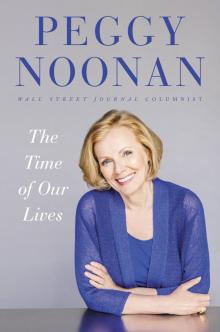
Peggy Noonan is a Pulitzer Prize-winning opinion columnist for The Wall Street Journal. She is the author of ten books on American history and culture, including the political classic What I Saw at the Revolution. She was a special assistant and speechwriter to President Ronald Reagan.
What’s next on
your reading list?
Discover your next
great read!
Get personalized book picks and up-to-date news about this author.
Sign up now.
_9001707_
Peggy Noonan, A Certain Idea of America