The Sword in the Stone-Dead, page 8
part #1 of Great Vicari Mystery Series


“And what shall I call you, Mister—?”
“Malloy will do fine.”
“Mr. Malloy it is then.”
“Just Malloy.” He wiped his hands on what had once been a white handkerchief. Malloy was trying to keep his injured jaw turned away from Vickery.
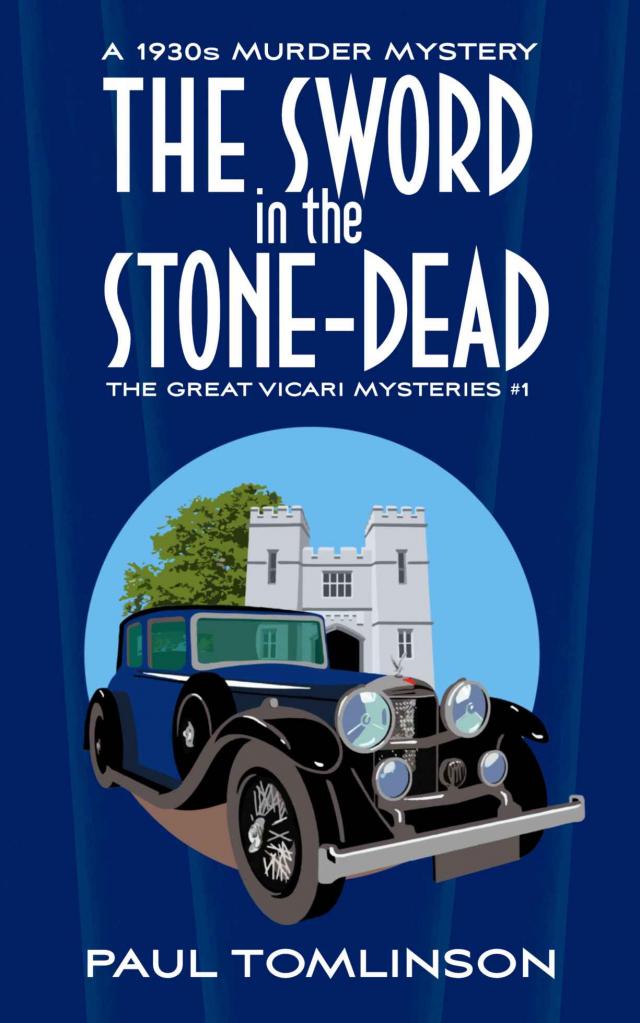
They were standing in a paddock out of sight of the keep, where the cars had been parked so as not to spoil Fulbright’s image of a medieval idyll. Malloy had the bonnet open on a car with gleaming navy and black paintwork and shining chrome.
“This your car?” He asked.
“Do you approve of my choice?” Vickery was watching his face closely.
“Alvis Speed 20. They say it’s a ‘dignified’ fast car. Up to seventy-five miles an hour, it probably is. At ninety, possibly less so.” Malloy smiled.
“I had the feeling that you were trying to avoid me this weekend,” Vickery said.
“I was.”
“I would not have given away your secret.”
“I know that.”
“The bruise is colouring up nicely,” Vickery said.
“Bit of an accident. Clumsy of me.”
“To run into Fulbright’s fist? Or rather, a backhanded slap.”
Malloy looked at him directly for the first time.
“Leo Fulbright wears a signet ring,” Vickery said. “Margot has a scar on her jaw in exactly the same place.”
“I ought to know not to try and deceive you,” Malloy said.
“I should hope that you wouldn’t feel the need.”
“You saved me from the hangman’s rope: I’m still not sure why.”
“Because it was the right thing to do.”
“But what I did...”
“Was done for the right reason. I was sure then: I still am.”
“You are a remarkable man, Mr. Vickery.”
“As are you, Mr. Malloy.”
“It’s just Malloy.”
“So you would have people believe.”
“Aren’t you going to ask me what I was doing to your car?” Malloy asked.
“You came out here so as to avoid the company of Mr. Fulbright. And you were also checking to see if any of the cars had been used last night. You discovered that none of them had been moved, and that none of them could have been, because a vital component has been taken from the engine of each.”
“You took the—”
“Not I,” Vickery said. “I would not know which parts to take. But had I taken them, I would have hidden them, perhaps wrapped in oilskin, submerged close to the edge of the pond at the front of the house.”
“Not at the edge of the lake to the rear?”
“A possibility, but a greater danger of footprints giving away the hiding place.”
“Should I retrieve them?”
“You are free to act as you see fit,” Vickery said. “Myself, I would determine the exact hiding place, and then leave them there until they were needed.”
“Why remove them in the first place?”
“To prevent any of our little assemblage making an early departure. It would seem that we are all expected to stay and see how this little drama plays out.”
“Do you have any idea who is behind it?”
“Too many ideas, unfortunately. I shall need more information if I am to exclude those who are innocent, and uncover the identity of the guilty.”
“Am I a suspect?” Malloy asked.
“I shall be keeping an eye on you,” Vickery said, smiling. “This morning, when the latest poison pen letter was discovered, were you present?”
“No, I was in the next room. I heard Fulbright shout.”
“Did you see him open the envelope?”
Malloy shook his head. “He was holding it when I went in, he’d already opened it.”
“Do you recall of how many pages the letter consisted?”
Malloy paused, recalling the image to his mind’s eye. “There were two sheets. I’m fairly sure.”
“I think you are correct. Fulbright hides the second, and only shows us the first.”
“Then he has something to hide,” Malloy said. “The second sheet holds some clue as to why Fulbright is being targeted. He is guilty of something.”
Vickery nodded. “That is a reasonable supposition. I would very much like to see the second sheet, but I fear that Fulbright will have destroyed it.”
“I should have been there when it was delivered,” Malloy said.
“Had you been at Fulbright’s door, the letter would not have been delivered. At least, not then. Whoever it was would have waited until a time and place where there was no danger of their being observed. You could not have done more than you did.”
“I’m sure Fulbright doesn’t think so.”
“I do not think we need be too concerned about what he thinks. As long as we stay out of arm’s reach.”
Malloy rubbed his swollen jaw and smiled. Vickery turned to leave.
“Should you ever decide to be undignified,” Malloy said, “I hope you will consider making me your accomplice.”
Vickery turned back, frowning. Then he smiled. “The Alvis Speed 20. I would definitely want you at the wheel, Mr. Malloy.”
* * *
“Hello, Auntie Margot!”
Margot spun round, her face struggling to express neither surprise nor revulsion.
“Timothy!” She said, her smile a rictus.
The boy was about five or six, dressed in flannel shorts, shirt and grey sweater, and socks that seemed to have lost their elastic. He ran to Margot and wrapped his arms around her. She patted him on the head and then pushed him away, just as Vickery entered.
“Ah, Benjamin, may I introduce you to Timothy, Geoffrey’s nephew. Timothy, this is Mr. Vickery: he’s a magician!”
If Margot had been hoping that Timothy would show a typical youthful interest in magic, allowing her to slip away unnoticed, she was disappointed.
“There is no such thing as magic,” Timothy asserted. “It’s all nonsense designed to fool gullible people. I had a magic set for Christmas, it was rubbish.”
“Have you come down with your uncle?” Margot asked quickly.
“No I drove myself down. Of course I’m here with Uncle Geoffrey. He’s in the library talking to the butler, Creepy.”
“Crawley,” Margot corrected.
“Have you ever made an elephant disappear?” Timothy asked Vickery.
“No, I’ve never managed to eat a whole one,” Vickery said.
The boy rolled his eyes. “I hope you’re not the only entertainment we have this weekend!”
“Why don’t you go upstairs. I’m sure I heard your sister calling you,” Margot said.
“I doubt that. Eleanor thinks I’m an annoying brat. She said I should go out and climb one of the apple trees, as high as I can. Then jump.”
“That sounds great fun. What are you waiting for?” Vickery asked.
“If I wanted to break my neck,” Timothy said, “I’d ask to be in one of your magic tricks.” He turned and trotted away, leaving Vickery standing white-faced and mute.
“Benjamin, I’m so sorry,” Margot said, touching his arm. “He’s just a child, he didn’t know...”
Vickery recovered slightly and looked at her. “It’s fine, Margot, really. I have heard much worse said.”
“I will speak to Geoffrey. That sort of behaviour should not go unpunished.”
Vickery held up his hand to stop her. “I would much rather you didn’t,” he said. “It is nothing. He rather caught me by surprise is all. I forget sometimes that parts of my story are known to all.”
“You are somewhat infamous,” Margot said. “I know people who would kill for that kind of notoriety.”
“I did,” Vickery said.
Margot stood aghast, mortified by her own insensitivity—until he winked at her.
Chapter 7
“Mr. Vickery, may I introduce my uncle, Sir Geoffrey Atterbury,” Eleanor Trenton said, showing Vickery into the library.
Sir Geoffrey’s handshake was firm and dry. His hair and moustache had once been red, but were now only slightly foxed. His eyes were a watery blue, and his lips dark, the colour of uncooked liver.
“Sir Geoffrey, thank you for sharing your keep with us this weekend, it’s a remarkable place,” Vickery said.
“It is, rather, isn’t it? My late wife hated the place, but I couldn’t bear to let it go. An Englishman’s castle and all that.”
“If you don’t mind, I’m going to rest a while before dinner,” Eleanor said.
“Of course, my dear, you run along. Mr. Vickery and I will have a nice chat over a cigar.”
“Your brother’s daughter?” Vickery asked, after Eleanor had closed the door behind her.
“My elder sister’s, god rest her.”
“Her mother died—”
“—in an accident, yes. Swimming. A villa on the coast—Rhodes I think it was. She’d taken a drink, perhaps more than one, and then gone for an evening swim. Her sot of a husband wasn’t there to save her, of course. Must have been awful for the poor girl.”
“Eleanor found her own mother?”
“Floating face down in the water, she said, a cloud—a cloud of blood blossoming around her head. It was a most awful thing. My sister was a wonderful woman. Eleanor has grown to be so much like her—sometimes I find it difficult looking at her. There’s a portrait of my sister here somewhere, in one of the upstairs bedrooms, you should take a look at it. Remarkable likeness, you’ll see.”
“And her father?”
“Oh, she looks nothing like him, thank goodness.”
“I meant, what became of him?”
“Nothing ever became of him, Vickery. Hopeless sort. He’s around somewhere, I’m sure. But he and Eleanor are estranged. I’ve been more of a father to them than he was, to Eleanor and her brother.”
“Timothy?”
“You’ve met him? He’s a card isn’t he?”
“Indeed, though I’m not sure if he was dealt from the top of the deck or the bottom.”
“Eh?”
“Was Eleanor’s mother an actress?” Vickery asked.
“Heavens, no! In school perhaps, we all do that. My sister was a wife and a mother, that was all she ever needed, I think. That’s enough isn’t it?”
“That is something every woman must decide for herself, I would say,” Vickery said.
“I suppose so, yes.”
“And Eleanor has decided that she wishes to act, in front of the camera.”
“Apparently so, yes. It will be strange that there will be images of her that never age. We’ve always had portraits, and photographs now, of course, but these pictures will move. It will be like a ghost.”
“I hadn’t considered that,” Vickery said.
Sir Geoffrey looked at him. “Hadn’t you?”
“And you will be investing in this motion picture, for the sake of your niece?”
“Yes. Well, not in the film itself. I was too late for that, Fulbright already had all the funding in place. But he plans to have his own studio, based here at the keep, at least initially, we think. I shall be a silent partner, but it looks good to have someone with a title on the letterhead. Or so Fulbright believes: I’m never sure.”
“And your money will be of some assistance?”
“Oh, yes—at first, at any rate—until Arthur and Guinevere is released. Films are a medium-term investment, apparently: two or three years before you see any real return.”
“You are much better informed than I,” Vickery said.
“Not really. Only what Fulbright has told me. He seems to know what he’s about. I’m happy to trust his judgment.”
“With advice from your solicitor and accountant, of course.”
“Well, naturally. Though this is more in the way of a gentleman’s agreement.”
“Which is perfectly fine; providing that both men are gentlemen.”
“Well, yes. But times are changing, Vickery. The old money is disappearing: look what happened in the States when the markets—well, you know what happened—I don’t pretend to understand it. And there’s taxes, we all understand them! There’ll be hardly anything left for Timothy to inherit. It won’t do for us to be sniffy about new money. People like Fulbright might well be this country’s future.”
“If he lives long enough,” Vickery muttered.
“What was that?”
“Does Timothy live with you now?” Vickery asked.
“Well, he’s away at school mostly, but yes, he calls the old hall home now. He’s a bright boy, that one.”
“That’s certainly one possible description. Does he excel academically?”
“Not really. But then, neither did I. Didn’t need to. He seems to understand money well enough. Better than I do. But other than that—” Sir Geoffrey shrugged. “His will be the last generation that can get by, I suppose. That’s why I want to invest in this thing with Fulbright, give Timothy something to fall back on, just in case.”
“Do you really think there is money to be made in moving pictures?” Vickery asked.
“Why shouldn’t we be able to emulate the success they have been having in—where is it, California? With British acting talent and engineering, I don’t see how we can fail.”
“Unless the British talent heads for America?”
“Like old Charles Laughton? He was always good value. Larger than life. Saw him as Prospero at the Old Vic. That’s the sort of talent we produce. And Fulbright, of course. America will never produce their like. They haven’t the theatrical heritage we have. Take Shakespeare—English! Wrote his plays before there was a United States, and we’re still watching them. All it needs is the right sort of imagination. And investment.”
“I’m sure you’re right,” Vickery said.
“That Hungarian fellow has just built a studio down near the aerodrome. If that’s not looking to the future of British motion pictures, I don’t know what is. Shall I ring for some tea? All of this talking must be making you terribly dry.”
“Tea would be lovely,” Vickery said.
Sir Geoffrey got up and rang the bell: his butler appeared almost instantly.
“I saw your niece talking with Edward Kimball earlier. Have they known each other a long time?” Vickery asked.
“They are on speaking terms again, are they? I suppose that’s a good thing. Not sure I like Eleanor keeping company with him though.”
“Because he’s an actor?”
“Because he’s a drunkard. I don’t mind that a man takes a drink, so long as he doesn’t make a fool of himself. Brawling in the street—grown men. It’s not done, Vickery.”
“Who was he fighting with, do you know?”
“No idea. Wasn’t there. But I heard all about it. I just hope he’s cleaned up his act, like he promised.”
“Was he ever violent towards your niece?”
“Heavens, no! I wouldn’t have allowed that kind of behaviour. I’m very protective of her, you know. He’d have been out on his ear, with my boot behind him.”
“Eleanor would have confided in you if there had been...?”
“He never touched her, Vickery. I’m not so out of touch that I wouldn’t have known—or found out about it. I have my own methods for keeping an eye out for my niece’s well-being.”
“I didn’t mean to suggest anything. I hope I have not caused any offence.”
“I don’t offend easily, Vickery. Thick skin, especially after what happened. You seem like a decent enough fellow. I like that. You remind me of my cousin Raymond—he was a poofter too—but a good man all the same.”
Vicary laughed. “You really do have your spies out there, don’t you?”
“As I said, I’m not out of touch. I know a thing or two about everyone who’s here this weekend, and most of what I know need go no further. You can rely on my discretion, I assure you.”
“Then like cousin Raymond, I am in your debt.”
“Eh?”
“Ah, here’s the tea.”
* * *
“What were you thinking?” Eleanor demanded.
“I was thinking that I needed to look out for you, because you don’t seem capable of doing it yourself,” Fulbright said. He was clearly uncomfortable being confronted directly.
“I am quite capable of taking care of myself. I don’t need some arrogant Victorian patriarch to control my life. I am not your mentally unstable sister!”
“If I hadn’t had that photographer follow him, you would never have known what sort of a man he is,” Fulbright said.
“I know exactly what sort of man he is: I’ve been around men like him all my life.”
“Then you ought to know better than to shack up with another one.”
“It is not for you to decide who I should or should not become involved with.” Eleanor’s lips were pale and her eyes were glaring. “I will make my own decisions.”
“Eleanor, please, you must understand that I have only your best interests at heart—”
“Do you think I am so feeble-minded as to believe that, Leo? You are only ever concerned with one person’s interests.”
“You are becoming hysterical—”
“Don’t you dare!”
“I don’t understand why you are so concerned with what happens to Ted Kimball,” Fulbright said, changing tack. “You said you didn’t love him. Have you changed your mind? Again?”
“No—I—How I feel about Teddy has nothing to do with this. It is your behaviour that concerns me,” she said. “You have no right to—”
“Eleanor, I am disappointed with your—”
“Don’t try and make me feel guilty. I have every right to be angry with you. What you did was unforgivable.”
“I’m not going to apologise for doing what I thought was the right thing,” Fulbright said.
“Then don’t. But do not fool yourself into thinking you did it because it was the right thing for me. It wasn’t. You were acting purely out of self-interest.
“You ungrateful—!”
“What am I meant to express gratitude for, Leo? All the sacrifices you have made on my behalf? Is that why you’re going to give my part to your witch-wife?”
“Malloy will do fine.”
“Mr. Malloy it is then.”
“Just Malloy.” He wiped his hands on what had once been a white handkerchief. Malloy was trying to keep his injured jaw turned away from Vickery.
They were standing in a paddock out of sight of the keep, where the cars had been parked so as not to spoil Fulbright’s image of a medieval idyll. Malloy had the bonnet open on a car with gleaming navy and black paintwork and shining chrome.
“This your car?” He asked.
“Do you approve of my choice?” Vickery was watching his face closely.
“Alvis Speed 20. They say it’s a ‘dignified’ fast car. Up to seventy-five miles an hour, it probably is. At ninety, possibly less so.” Malloy smiled.
“I had the feeling that you were trying to avoid me this weekend,” Vickery said.
“I was.”
“I would not have given away your secret.”
“I know that.”
“The bruise is colouring up nicely,” Vickery said.
“Bit of an accident. Clumsy of me.”
“To run into Fulbright’s fist? Or rather, a backhanded slap.”
Malloy looked at him directly for the first time.
“Leo Fulbright wears a signet ring,” Vickery said. “Margot has a scar on her jaw in exactly the same place.”
“I ought to know not to try and deceive you,” Malloy said.
“I should hope that you wouldn’t feel the need.”
“You saved me from the hangman’s rope: I’m still not sure why.”
“Because it was the right thing to do.”
“But what I did...”
“Was done for the right reason. I was sure then: I still am.”
“You are a remarkable man, Mr. Vickery.”
“As are you, Mr. Malloy.”
“It’s just Malloy.”
“So you would have people believe.”
“Aren’t you going to ask me what I was doing to your car?” Malloy asked.
“You came out here so as to avoid the company of Mr. Fulbright. And you were also checking to see if any of the cars had been used last night. You discovered that none of them had been moved, and that none of them could have been, because a vital component has been taken from the engine of each.”
“You took the—”
“Not I,” Vickery said. “I would not know which parts to take. But had I taken them, I would have hidden them, perhaps wrapped in oilskin, submerged close to the edge of the pond at the front of the house.”
“Not at the edge of the lake to the rear?”
“A possibility, but a greater danger of footprints giving away the hiding place.”
“Should I retrieve them?”
“You are free to act as you see fit,” Vickery said. “Myself, I would determine the exact hiding place, and then leave them there until they were needed.”
“Why remove them in the first place?”
“To prevent any of our little assemblage making an early departure. It would seem that we are all expected to stay and see how this little drama plays out.”
“Do you have any idea who is behind it?”
“Too many ideas, unfortunately. I shall need more information if I am to exclude those who are innocent, and uncover the identity of the guilty.”
“Am I a suspect?” Malloy asked.
“I shall be keeping an eye on you,” Vickery said, smiling. “This morning, when the latest poison pen letter was discovered, were you present?”
“No, I was in the next room. I heard Fulbright shout.”
“Did you see him open the envelope?”
Malloy shook his head. “He was holding it when I went in, he’d already opened it.”
“Do you recall of how many pages the letter consisted?”
Malloy paused, recalling the image to his mind’s eye. “There were two sheets. I’m fairly sure.”
“I think you are correct. Fulbright hides the second, and only shows us the first.”
“Then he has something to hide,” Malloy said. “The second sheet holds some clue as to why Fulbright is being targeted. He is guilty of something.”
Vickery nodded. “That is a reasonable supposition. I would very much like to see the second sheet, but I fear that Fulbright will have destroyed it.”
“I should have been there when it was delivered,” Malloy said.
“Had you been at Fulbright’s door, the letter would not have been delivered. At least, not then. Whoever it was would have waited until a time and place where there was no danger of their being observed. You could not have done more than you did.”
“I’m sure Fulbright doesn’t think so.”
“I do not think we need be too concerned about what he thinks. As long as we stay out of arm’s reach.”
Malloy rubbed his swollen jaw and smiled. Vickery turned to leave.
“Should you ever decide to be undignified,” Malloy said, “I hope you will consider making me your accomplice.”
Vickery turned back, frowning. Then he smiled. “The Alvis Speed 20. I would definitely want you at the wheel, Mr. Malloy.”
* * *
“Hello, Auntie Margot!”
Margot spun round, her face struggling to express neither surprise nor revulsion.
“Timothy!” She said, her smile a rictus.
The boy was about five or six, dressed in flannel shorts, shirt and grey sweater, and socks that seemed to have lost their elastic. He ran to Margot and wrapped his arms around her. She patted him on the head and then pushed him away, just as Vickery entered.
“Ah, Benjamin, may I introduce you to Timothy, Geoffrey’s nephew. Timothy, this is Mr. Vickery: he’s a magician!”
If Margot had been hoping that Timothy would show a typical youthful interest in magic, allowing her to slip away unnoticed, she was disappointed.
“There is no such thing as magic,” Timothy asserted. “It’s all nonsense designed to fool gullible people. I had a magic set for Christmas, it was rubbish.”
“Have you come down with your uncle?” Margot asked quickly.
“No I drove myself down. Of course I’m here with Uncle Geoffrey. He’s in the library talking to the butler, Creepy.”
“Crawley,” Margot corrected.
“Have you ever made an elephant disappear?” Timothy asked Vickery.
“No, I’ve never managed to eat a whole one,” Vickery said.
The boy rolled his eyes. “I hope you’re not the only entertainment we have this weekend!”
“Why don’t you go upstairs. I’m sure I heard your sister calling you,” Margot said.
“I doubt that. Eleanor thinks I’m an annoying brat. She said I should go out and climb one of the apple trees, as high as I can. Then jump.”
“That sounds great fun. What are you waiting for?” Vickery asked.
“If I wanted to break my neck,” Timothy said, “I’d ask to be in one of your magic tricks.” He turned and trotted away, leaving Vickery standing white-faced and mute.
“Benjamin, I’m so sorry,” Margot said, touching his arm. “He’s just a child, he didn’t know...”
Vickery recovered slightly and looked at her. “It’s fine, Margot, really. I have heard much worse said.”
“I will speak to Geoffrey. That sort of behaviour should not go unpunished.”
Vickery held up his hand to stop her. “I would much rather you didn’t,” he said. “It is nothing. He rather caught me by surprise is all. I forget sometimes that parts of my story are known to all.”
“You are somewhat infamous,” Margot said. “I know people who would kill for that kind of notoriety.”
“I did,” Vickery said.
Margot stood aghast, mortified by her own insensitivity—until he winked at her.
Chapter 7
“Mr. Vickery, may I introduce my uncle, Sir Geoffrey Atterbury,” Eleanor Trenton said, showing Vickery into the library.
Sir Geoffrey’s handshake was firm and dry. His hair and moustache had once been red, but were now only slightly foxed. His eyes were a watery blue, and his lips dark, the colour of uncooked liver.
“Sir Geoffrey, thank you for sharing your keep with us this weekend, it’s a remarkable place,” Vickery said.
“It is, rather, isn’t it? My late wife hated the place, but I couldn’t bear to let it go. An Englishman’s castle and all that.”
“If you don’t mind, I’m going to rest a while before dinner,” Eleanor said.
“Of course, my dear, you run along. Mr. Vickery and I will have a nice chat over a cigar.”
“Your brother’s daughter?” Vickery asked, after Eleanor had closed the door behind her.
“My elder sister’s, god rest her.”
“Her mother died—”
“—in an accident, yes. Swimming. A villa on the coast—Rhodes I think it was. She’d taken a drink, perhaps more than one, and then gone for an evening swim. Her sot of a husband wasn’t there to save her, of course. Must have been awful for the poor girl.”
“Eleanor found her own mother?”
“Floating face down in the water, she said, a cloud—a cloud of blood blossoming around her head. It was a most awful thing. My sister was a wonderful woman. Eleanor has grown to be so much like her—sometimes I find it difficult looking at her. There’s a portrait of my sister here somewhere, in one of the upstairs bedrooms, you should take a look at it. Remarkable likeness, you’ll see.”
“And her father?”
“Oh, she looks nothing like him, thank goodness.”
“I meant, what became of him?”
“Nothing ever became of him, Vickery. Hopeless sort. He’s around somewhere, I’m sure. But he and Eleanor are estranged. I’ve been more of a father to them than he was, to Eleanor and her brother.”
“Timothy?”
“You’ve met him? He’s a card isn’t he?”
“Indeed, though I’m not sure if he was dealt from the top of the deck or the bottom.”
“Eh?”
“Was Eleanor’s mother an actress?” Vickery asked.
“Heavens, no! In school perhaps, we all do that. My sister was a wife and a mother, that was all she ever needed, I think. That’s enough isn’t it?”
“That is something every woman must decide for herself, I would say,” Vickery said.
“I suppose so, yes.”
“And Eleanor has decided that she wishes to act, in front of the camera.”
“Apparently so, yes. It will be strange that there will be images of her that never age. We’ve always had portraits, and photographs now, of course, but these pictures will move. It will be like a ghost.”
“I hadn’t considered that,” Vickery said.
Sir Geoffrey looked at him. “Hadn’t you?”
“And you will be investing in this motion picture, for the sake of your niece?”
“Yes. Well, not in the film itself. I was too late for that, Fulbright already had all the funding in place. But he plans to have his own studio, based here at the keep, at least initially, we think. I shall be a silent partner, but it looks good to have someone with a title on the letterhead. Or so Fulbright believes: I’m never sure.”
“And your money will be of some assistance?”
“Oh, yes—at first, at any rate—until Arthur and Guinevere is released. Films are a medium-term investment, apparently: two or three years before you see any real return.”
“You are much better informed than I,” Vickery said.
“Not really. Only what Fulbright has told me. He seems to know what he’s about. I’m happy to trust his judgment.”
“With advice from your solicitor and accountant, of course.”
“Well, naturally. Though this is more in the way of a gentleman’s agreement.”
“Which is perfectly fine; providing that both men are gentlemen.”
“Well, yes. But times are changing, Vickery. The old money is disappearing: look what happened in the States when the markets—well, you know what happened—I don’t pretend to understand it. And there’s taxes, we all understand them! There’ll be hardly anything left for Timothy to inherit. It won’t do for us to be sniffy about new money. People like Fulbright might well be this country’s future.”
“If he lives long enough,” Vickery muttered.
“What was that?”
“Does Timothy live with you now?” Vickery asked.
“Well, he’s away at school mostly, but yes, he calls the old hall home now. He’s a bright boy, that one.”
“That’s certainly one possible description. Does he excel academically?”
“Not really. But then, neither did I. Didn’t need to. He seems to understand money well enough. Better than I do. But other than that—” Sir Geoffrey shrugged. “His will be the last generation that can get by, I suppose. That’s why I want to invest in this thing with Fulbright, give Timothy something to fall back on, just in case.”
“Do you really think there is money to be made in moving pictures?” Vickery asked.
“Why shouldn’t we be able to emulate the success they have been having in—where is it, California? With British acting talent and engineering, I don’t see how we can fail.”
“Unless the British talent heads for America?”
“Like old Charles Laughton? He was always good value. Larger than life. Saw him as Prospero at the Old Vic. That’s the sort of talent we produce. And Fulbright, of course. America will never produce their like. They haven’t the theatrical heritage we have. Take Shakespeare—English! Wrote his plays before there was a United States, and we’re still watching them. All it needs is the right sort of imagination. And investment.”
“I’m sure you’re right,” Vickery said.
“That Hungarian fellow has just built a studio down near the aerodrome. If that’s not looking to the future of British motion pictures, I don’t know what is. Shall I ring for some tea? All of this talking must be making you terribly dry.”
“Tea would be lovely,” Vickery said.
Sir Geoffrey got up and rang the bell: his butler appeared almost instantly.
“I saw your niece talking with Edward Kimball earlier. Have they known each other a long time?” Vickery asked.
“They are on speaking terms again, are they? I suppose that’s a good thing. Not sure I like Eleanor keeping company with him though.”
“Because he’s an actor?”
“Because he’s a drunkard. I don’t mind that a man takes a drink, so long as he doesn’t make a fool of himself. Brawling in the street—grown men. It’s not done, Vickery.”
“Who was he fighting with, do you know?”
“No idea. Wasn’t there. But I heard all about it. I just hope he’s cleaned up his act, like he promised.”
“Was he ever violent towards your niece?”
“Heavens, no! I wouldn’t have allowed that kind of behaviour. I’m very protective of her, you know. He’d have been out on his ear, with my boot behind him.”
“Eleanor would have confided in you if there had been...?”
“He never touched her, Vickery. I’m not so out of touch that I wouldn’t have known—or found out about it. I have my own methods for keeping an eye out for my niece’s well-being.”
“I didn’t mean to suggest anything. I hope I have not caused any offence.”
“I don’t offend easily, Vickery. Thick skin, especially after what happened. You seem like a decent enough fellow. I like that. You remind me of my cousin Raymond—he was a poofter too—but a good man all the same.”
Vicary laughed. “You really do have your spies out there, don’t you?”
“As I said, I’m not out of touch. I know a thing or two about everyone who’s here this weekend, and most of what I know need go no further. You can rely on my discretion, I assure you.”
“Then like cousin Raymond, I am in your debt.”
“Eh?”
“Ah, here’s the tea.”
* * *
“What were you thinking?” Eleanor demanded.
“I was thinking that I needed to look out for you, because you don’t seem capable of doing it yourself,” Fulbright said. He was clearly uncomfortable being confronted directly.
“I am quite capable of taking care of myself. I don’t need some arrogant Victorian patriarch to control my life. I am not your mentally unstable sister!”
“If I hadn’t had that photographer follow him, you would never have known what sort of a man he is,” Fulbright said.
“I know exactly what sort of man he is: I’ve been around men like him all my life.”
“Then you ought to know better than to shack up with another one.”
“It is not for you to decide who I should or should not become involved with.” Eleanor’s lips were pale and her eyes were glaring. “I will make my own decisions.”
“Eleanor, please, you must understand that I have only your best interests at heart—”
“Do you think I am so feeble-minded as to believe that, Leo? You are only ever concerned with one person’s interests.”
“You are becoming hysterical—”
“Don’t you dare!”
“I don’t understand why you are so concerned with what happens to Ted Kimball,” Fulbright said, changing tack. “You said you didn’t love him. Have you changed your mind? Again?”
“No—I—How I feel about Teddy has nothing to do with this. It is your behaviour that concerns me,” she said. “You have no right to—”
“Eleanor, I am disappointed with your—”
“Don’t try and make me feel guilty. I have every right to be angry with you. What you did was unforgivable.”
“I’m not going to apologise for doing what I thought was the right thing,” Fulbright said.
“Then don’t. But do not fool yourself into thinking you did it because it was the right thing for me. It wasn’t. You were acting purely out of self-interest.
“You ungrateful—!”
“What am I meant to express gratitude for, Leo? All the sacrifices you have made on my behalf? Is that why you’re going to give my part to your witch-wife?”