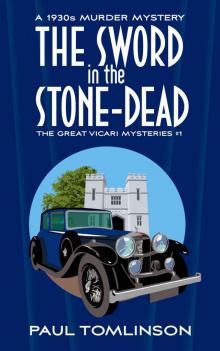
The Sword in the Stone-Dead, page 23
part #1 of Great Vicari Mystery Series


“That’s not how it was,” Fulbright said. “She came to me and asked for my advice. She had an audition, and wanted me to help her prepare.”
“Do you honestly expect me to believe that?” Margot asked.
“He’s telling the truth,” Kimball said. “She went to him. Mr. Vickery was right, Eleanor knew how to get what she wanted from men. Especially older men.” He glanced towards Sir Geoffrey.
“Mr. Kimball,” the Inspector said, “I should warn you at this point that you do not need to say anything more. And that anything you do say may be set down in evidence to be used against you.”
“I want to finish this,” Kimball said firmly, glancing towards Vickery. Vickery thought about this for a moment, and then nodded his assent.
“You think that Eleanor used you, and then moved on?” Vickery asked Kimball.
“It was even worse than that,” Kimball said. “She found that she had no use for me. Not then.”
“Eleanor left you because Leo Fulbright offered a better prospect. What did you do?”
“I did what I always do. I got drunk. And then I went to see Margot.”
“And you discovered that she had no use for you either?”
“That’s when I found out that she had just used me before, to try and get even with Leo.”
“Teddy, I’m sorry,” Margot said, “I never meant to—”
Kimball shook his head, not wanting to hear.
“You wanted to hurt Margot?” Vickery asked. “And Leo?”
“I thought if Margot got hurt, Leo would go running back to her, filled with guilt and contrition, like he always did. And then Eleanor and I would stand some chance of—” He shrugged. “Hopelessly naïve.”
“When Artie Delancey found out what you had done, what happened?” Vickery asked.
“Margot was in the hospital, nobody knew how badly she’d been hurt. Artie was afraid that she would die. I didn’t care what happened to me, but Artie did. He really was my friend, probably my only real friend. He put the costume back in the theatre wardrobe, and he promised he would never tell anyone what I’d done.”
“Were you afraid that Artie might try and blackmail you?” Vickery asked.
“Artie? He would never have done that. He loved me. He would do anything for me.”
“And you exploited that fact, didn’t you?” Vickery said. “When you murdered Eleanor Trenton?”
“I never meant for Artie to get hurt,” Kimball said. “No matter what else you think about me, I want you to know that I did care about him. He was like my little brother.”
“I think Artie knew that,” Vickery said.
“You said there was a question you’d forgotten to ask,” Kimball said. “You meant the photographer?”
“I did,” Vickery said. “It occurred to me on Friday when I first heard the story, but then other things got in the way.”
“What about the photographer?” Fulbright asked.
“On the night that Artie took Mr. Kimball to the Pink Gardenia, there were two photographers waiting outside.”
“So?” Fulbright asked.
“Who sent the second one?” Vickery said. “Everyone assumed that you sent them both, but why would you send two photographers?”
“I didn’t,” Fulbright said. “I sent Garvin. He’d been hanging around the set trying to take pictures: I didn’t know at the time he was also trying to take my daughter.”
“Leo.” Margot laid a hand on his arm again, as if to stem the rising of his blood pressure.
“Who sent the second photographer?” Vickery repeated. “No one in this room.”
He looked round. People looked questioningly at each other, then back at Vickery.
“It was Eleanor,” Kimball said. “She was spying on me. I thought at first that he had put her up to it,” he nodded towards Fulbright. “But I think he got the idea from her.”
“Why was she having you followed?” Vickery asked.
“I had been right about Leo going back to Margot after the accident. And I went back to Eleanor. I thought things were good between us. But I think she just wanted to keep her options open, in case Leo didn’t come back to her when Margot recovered. She was stringing me along, and I was too stupid to see it. After about a year, I had become a habit with her, something she was used to.
“I had asked her to marry me, more than once. She had turned me down. I want to think that she was seriously considering my latest proposal, she hadn’t said no straight away this time. You’ve already heard about her father: she didn’t want to spend her life with another drunk. She wanted me to stop drinking. To prove that I wasn’t like her father. And I was going to do it: I wanted to be with her so much, I would have done anything.”
“You didn’t make a very good job of it,” Fulbright said. “A drunken brawl in the street outside a poofter bar.”
“It was a mistake,” Kimball acknowledged. “I wanted to go out on one final all-night drinking spree. And then the next day I was due to check into the clinic Artie had booked me into. With their help, I’d be cured. I’d never touch a drop again.”
“But the photographers were waiting for you outside the bar,” Vickery said.
“Seeing him standing there with that camera, with the big reflector thing, like a huge eye that missed nothing, captured everything. Winking at me and telling me that I had failed. Showing me that Eleanor didn’t trust me. I was angry with myself, but it was easier to hit him.
“Perhaps if I hadn’t attacked the photographer, Eleanor might have forgiven me. Given me another chance. But once she heard what I’d done, to her, I was just like her father. He hadn’t been able to change, and she thought I couldn’t either. I’d like to take a drink now, if I may?”
Vickery nodded to Malloy, who went to the sideboard and poured whisky into a glass. He handed it to Kimball.
“And so we come, finally, to what really happened on the night of the murder,” Vickery said. “Would you like to explain it, Inspector?”
“Er—I think that you would tell the story far better than a mere policeman,” Debney said.
“If you’re sure?” Vickery said.
“Just get on with it, Vickery,” Fulbright said. “We all know who solved this thing.”
“On the night that Eleanor Trenton was murdered, a scream was heard and something that sounded like a person falling into the pond. We know this happened just after midnight, and so we believed this to be the time of the murder.”
“You don’t need to be Sherlock Holmes to figure that out: it’s obvious!” Fulbright said.
“Perhaps it is too obvious,” Vickery said.
“Don’t talk in riddles, man,” Fulbright said.
“We assume that the time of Eleanor Trenton’s death was the time when the scream was heard.”
“She certainly didn’t scream after she was dead, did she?” Fulbright said.
“There I think you are wrong,” Vickery said.
“But the doctor confirmed the time of death,” Linette said. “Didn’t he?”
“Not exactly. He said that his findings were consistent with the murder having occurred at midnight. But there is a margin of error in such a calculation, particularly when the body has been submerged in cold water. Miss Trenton could have been killed at any time between ten o’clock and midnight.”
“But the scream?” Linette said.
“Proves only that someone screamed just after midnight. We have nothing to prove that it was Eleanor Trenton,” Inspector Debney said.
“Then who?” Linette asked.
“Eleanor couldn’t have been killed at ten o’clock, or even eleven o’clock: we all saw her at the top of the stairs well after eleven,” Bannister said.
“Did you speak to her?” Inspector Debney asked.
“Perhaps it was her ghost?” Kimball said: the whiskey seemed to have had an immediate effect.
“Don’t be a bloody fool. She was still alive then, she was killed at midnight. There’s no other explanation,” Fulbright said.
“That is what the murderer wished us to believe.” Vickery glanced towards Kimball, who raised his glass in salute. “The person people saw at the top of the stairs in the red dress was Artie Delancey.”
“Ridiculous!” Fulbright said.
“Is it?” Vickery said. “Wasn’t he of similar build to Miss Trenton, enough for him to be able to substitute for her in the horse-riding scenes in your motion picture?”
“Yes, but—”
“Artie did look good in a dress,” Bannister said.
“The dresses!” Malloy said. “We wondered why Artie had more than one: he brought several colours because he didn’t know which one Eleanor would be wearing that night.”
“Correct,” Vickery said. “And after the murder, Artie hid the red dress he had worn in Eleanor’s wardrobe to throw us off the scent. He couldn’t leave the shoes, because his were several sizes larger than Eleanor’s, which we might have noticed.”
“But Artie couldn’t have stabbed her,” Bannister insisted.
“He didn’t,” Vickery said. “Ted Kimball did, soon after dinner. He put her body in the pond. It was dark and he knew no one would find it there. Until he was ready.”
“It was Artie who screamed at midnight!” Linette said.
“What about the sound of the body falling in the water at midnight?” Margot asked.
“The sack Mr. Malloy found in the pond,” Vickery said. “It had been filled with blocks of ice, from the caterers the previous evening. Artie tossed it in the pond to make the sound.”
“By the time I found the sack, the ice had melted,” Malloy said.
“The red button was from Artie’s dress,” Fulbright said. “I thought it was Eleanor’s, I was going to keep it...”
“I do not believe Mr. Kimball intended to kill Artie as well, at least not at first. But when it became apparent that Artie wasn’t going to be able to handle the situation calmly...”
“Poor Artie,” Bannister said. “He deserved better than that.”
“So did Eleanor Trenton,” Ted Kimball said bitterly. “I killed her because I didn’t have the guts to murder Leo Fulbright. I wanted him to suffer for taking her away from me. I wanted everyone to think he had done it. I wanted to see the police take him away in handcuffs.”
“They will be taking you away in a few minutes,” Fulbright gloated. “Off to dance for the hangman.”
“I’m afraid I’m going to have to disappoint you again,” Kimball said. “I’ll be gone before they get the handcuffs on.”
“You’re not going anywhere,” Fulbright said.
“Always with the literal mind, Leo. No poetry in your soul,” Kimball said.
“What is he wittering on about?” Fulbright asked.
“Mr. Kimball has, I believe, taken a fatal dose of barbiturates with his whisky,” Vickery said.
“You let him kill himself?” Inspector Debney asked, shocked.
“I did not prevent it,” Vickery said.
“But you knew?” The Inspector insisted.
“I suspected, but I had no proof.”
Kimball slumped. Malloy, poised ready, caught him. Garvin and Linette rose so that Malloy could lay Kimball on the chesterfield.
“Three dead,” Vickery said, “quite the weekend party, Mr. Fulbright.”
“How the world will mourn the loss,” Fulbright said, “two second-rate actors and a sexual deviant.”
Malloy bounded across the room and swung a right-hook at Fulbright. It knocked the older man off his feet: he landed on his buttocks on the carpet with a startled oof!
Recovering himself, his face turning purple-red, Fulbright shouted up at Malloy, spittle flying.
“That was the biggest mistake of your life, boy! Hitting me in front of witnesses.” Fulbright looked around the room, triumphant in is expectation of support.
Vickery turned his back on Fulbright and walked from the room. Dickie Bannister followed his example. Then Sir Geoffrey. Veronica Fulbright looked down at her brother, shook her head, turned and exited. Oliver Garvin took Linette’s hand, and the two of them hurried out, not looking at Fulbright. The police constables and Inspector Debney also left the room. Malloy looked down at Fulbright, tugged his forelock, and followed the others out.
Only Margot McCrae remained.
“You might have done something,” Fulbright said.
“I did: I’m here, aren’t I?”
Chapter 24
Malloy came down the stairs carrying Vickery’s suitcase. Vickery was standing in the entrance hall talking to Inspector Debney. Debney looked like a man who had just been handed a rotten fish.
“I took the liberty of packing for you, sir,” Malloy said, interrupting whatever the Inspector had been saying. “Shall I bring the car round?”
“Thank you, Malloy. I think we are finished here, aren’t we Inspector?”
With the greatest of reluctance, Inspector Debney nodded. He closed his notebook and wandered over to where Doctor Cole was standing, having examined his third corpse of the weekend.
“Are all the cars now in running order?” Vickery asked, as they stepped out from the shadow of the gatehouse onto the drive. They paused for a moment and looked in the direction of the pond.
“They’re all working again, with the exception of Garvin’s MG,” Malloy said. “That needs a magician rather than a mechanic.”
“Don’t look at me, I’m retired,” Vickery said. “I gave Garvin the keys to Ted Kimball’s car.”
“And he gave them to you in exchange for a lethal dose of barbiturates.” Malloy said. It wasn’t a question. “Did you get the pills from the doctor?”
“No, I’ve been carrying them with me for some time. But I recently found that I had no desire to keep them. I’m glad they did not go to waste.”
“There’s still one thing I don’t understand,” Malloy said.
“Only one?” Vickery said.
“Why did Kimball fire the crossbow at Fulbright the other night?”
“He didn’t.”
“Then who did?”
“Fulbright’s sister, Veronica.”
Malloy laughed. “Leo Fulbright had better watch out in future! Do you think he knows?”
“I am sure he suspects.”
“And the police?” Malloy asked.
“I did not tell the Inspector. It is not in Miss Fulbright’s interest that the police are aware of her second attempt on her brother’s life. If someone asks, Dickie Bannister has agreed to accept the blame for it. But I doubt anyone will even mention it.” Vickery nodded towards Malloy’s swollen right hand. “Do you need ice for that?”
“I’m rather enjoying the pain.” Malloy grinned.
“You shouldn’t have hit him. But I’m rather glad you did.”
“I felt sure Leo Fulbright would be the one killed this weekend,” Malloy said.
“But then we would have had a dozen murderers, all lined up with their daggers, n’est-ce pas, mon ami?” Vickery said, curling an imaginary Belgian moustache.
“Which reminds me, when I asked you about your accent—”
“I told you I was born in Grimsby.”
“You said Halifax,” Malloy said.
“Grimsby is a small town near Halifax.”
“When you say near...?”
“It didn’t seem far when I took t’train.”
“Was that a Yorkshire accent? Or Welsh? I thought detectives were supposed to be masters of disguise.”
“Being who I am is disguise enough,” Vickery said.
“Then why the accent?”
“I might ask you the same question.”
“I’m Irish.”
“Since when? It takes more than a couple of glasses of stout.”
“I have an Irish birth certificate,” Malloy insisted.
“And I have a tin sheriff’s badge, but that doesn’t mean I’ll be chasing after Robin Hood any time soon.”
“Douglas Fairbanks not your type then?”
“I much prefer a man in trousers rather than stockings.”
“I shall restock my wardrobe accordingly.”
Malloy loaded Vickery’s case into the boot of the car.
“What will you do now?” Vickery asked.
“Time for a new position,” Malloy said.
“Are you likely to punch your new employer?”
“That depends on how he behaves.”
“I shall bear that in mind,” Vickery said. He handed Malloy the keys to the Alvis. “We are not going to be undignified. At least not today.”
Malloy opened the rear door of the car and stood straight, saluting. Vickery climbed into the back seat.
Malloy started the car, and with a last look back at Silberman’s Keep, they headed off down the drive.
Author’s Afterword: ‘How to Not Write a Whodunit’
I didn’t intend to write a whodunit, it sort of happened by accident. I wrote The Sword in the Stone-Dead in January, February and March of 2015: from first idea to complete 65,000-word draft in a little under twelve weeks. I had never written a novel-length story in such a short space of time, and those twelve weeks had included a couple of substantial rewrites. And it was all done in my spare time, because I had a full-time job at that point. I’m not saying ‘look how wonderful I am,’ I’m saying that sometimes a writer gets lucky, and the muse pays a visit; everything comes together and magical things happen.
Actually, I’m not saying that at all. I don’t believe in the muse, in luck, or in magic. What really happened in those early months of 2015 was that I was prepared to write a novel, I’d figured out how to do it, and I sat down to prove to myself that I really could do it.
Up to that point, I’d written ten novel-length manuscripts and a couple of feature-length screenplays, and they were all rubbish. No matter how many times I rewrote them and polished them, I knew—in my heart of hearts—that they didn’t really work. There was something missing. There were some good ideas in there, some humour, some decent dialogue, but each whole added up to less than the sum of its parts. I sent some of them out to agents and publishers, but none of them really satisfied me, so it was no surprise when they were returned with a ‘thanks, but no thanks.’