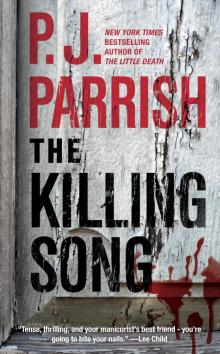
The Killing Song, page 32


“We better get going,” Cameron said.
“Yeah,” I said. I stuffed the jeans in the duffel and zipped it. “But we need to make a quick stop first.”
Maybe I should have been surprised to see that El Melocotón was crowded on a Sunday morning, but I wasn’t. The place was packed with young men, just as it had been on both my other visits. But as I walked in, I sensed something had changed.
Faces turned toward me, talking ceased. As I made my way through the bar to the beat of Duke Ellington’s “Caravan,” the wall of bodies gave way.
Pierre was sitting at his table in the back. His dark eyes were expressionless when he looked up at me.
“Would you take a drink with me?” he asked.
Cameron was waiting in the car; I had only minutes to spare, and I was still pissed at Pierre for leaving us in the tunnels. I sat down across from him and he poured out two glasses of his Basque liqueur. When I didn’t take a drink, Pierre set his glass down.
I pulled the silver chain from my pocket and set it on the table. “I thought you’d want this back,” I said.
Pierre looked at the chain but didn’t pick it up. Then he reached into his pants pocket and set something on the table next to it.
It was the Deux Coeurs necklace.
I stared at it in shock. Then it clicked, and I looked up at Pierre.
“It was you,” I said.
Pierre didn’t blink. I could feel the weight of the young men’s eyes on me. I leaned back in the chair and shook my head slowly.
“How did you do it?” I asked.
“Do what?” Pierre said.
“He was there. I killed him. And then he wasn’t there. You’re the only person who knew about Two Hearts, knew he was down there.”
“That is true,” he said.
“There was another way in?”
“There are always other ways.”
“And you got there before the cops?”
“We always do.”
“You took the cartridges?”
Pierre nodded. “We were on our way, coming back to help you, and heard the echoing of the shots. We arrived in Deux Coeurs just after you left. We took the cartridges and the bullets we found in the walls.”
I just sat there, stunned. “And you left the end pin,” I said. “Why?”
“It needed to be found.”
I shook my head slowly. “But why?” I asked. “Why did you do this for me?”
Pierre picked up the silver chain and fingered the small key. “I gave this to you for luck, but also because I no longer deserved it. I needed a reason to wear it again. So it was not just for you, Monsieur Owens.”
Pierre slipped the chain over his head and tucked the key into his shirt. He picked up his glass.
“Will you take a drink with me now?” he asked.
The music had stopped. I turned around and looked at the young men. They raised their glasses subtly in my direction, then turned away.
I picked up my glass and took a drink.
There was only one question left.
“Where is he?” I asked.
“You have nothing to worry about,” Pierre said.
I leaned forward. “But I need to know—”
“He is in the darkest place. That is all anyone needs to know.”
I looked at my watch. If I didn’t leave right now, I would have no time left to say good-bye to Eve and Juliette at the airport. I rose, putting the Two Hearts necklace in my pocket.
“Dieu soit avec vous, Monsieur Owens,” Pierre said.
We shared drinks together at the airport. Cameron had a beer, Juliette a Coke, and Eve ordered one of those pink drinks. Kirs, they were called, a mix of dry white wine and black-currant-flavored liqueur called crème de cassis. I didn’t know if Nora was familiar with the drink, but I planned on introducing it to her.
I wasn’t sure why. Maybe I just wanted to share with Nora a memory of Paris. Maybe I sincerely believed she would like them. That alone was enough to make me want to try.
My eyes drifted to the departure board, then around the cocktail table. All the small talk about jobs, family and inept airport security had been exhausted.
I knew our jobs were safe. My editor Darcy had asked me last night on the phone if I would write of my adventures in France, maybe even consider a book she could edit. I had told her no.
There were things I wanted to write about that I had never considered before. I just wasn’t sure yet exactly what they were. But I did know they didn’t concern Mandy or Laurent Demarais. And I knew it had nothing to do with that stillborn novel in my drawer.
Eve’s job was saved by Cameron’s now internationally syndicated stories. Commandant Boutin couldn’t fire a legend. He hadn’t even admitted publicly that the body of the “international serial killer” had mysteriously disappeared. That would be admitting that Demarais still might be out there stalking the streets of Paris and beyond, and there was no way the police were going to admit that.
During our few minutes at the airport café, I opened up and told Eve, Juliette and Cameron a little about Mandy and my parents. Juliette was fascinated by the Civil War and asked me questions I couldn’t answer. Overall, I must have painted her a pretty nice picture of my home, because she asked me if she could visit me one day in North Carolina and eat grits. I told her my folks, especially my mother, would like that very much.
By eleven, it was time for me to head through security, and there was only one thing left to say. And one person to say it to.
I asked Cameron and Juliette to excuse us and I took Eve a short ways down the concourse.
We stopped at a window that overlooked the runway. I took Eve’s crutches and helped her down onto a bench. The smell of baking bread and strong coffee drifted from somewhere. A soothing babble of French floated around us. They were smells and sounds I would always have in me now.
When I sat down next to Eve, her eyes were expectant. I took her hand and turned it palm up. Then I reached into my pocket and withdrew the Two Hearts necklace. I laid it in her hand.
“I didn’t lie to you,” I said. “I killed him and I left him lying there on the floor. Pierre led a group down there after we got out. I don’t know what they did with the body. He wouldn’t tell me.”
The stunned expression on Eve’s face almost made me wish I had not dropped this on her now. But she had to know the truth, and it occurred to me in that moment exactly why.
“I couldn’t leave here letting you think he was still out there, Eve, letting you go on looking for him,” I said. “I couldn’t do that to Juliette.”
“Juliette?” Eve said.
“She really needs you to let him go,” I said.
Eve’s eyes teared.
“We both need to let it go,” I said.
She hesitated, then nodded. I heard an announcement in French for a Delta flight, then it was repeated in English.
“That’s my flight,” I said.
We went back to the café and gathered my duffel and computer bag. Cameron, Juliette and Eve walked me to the security barrier. I held back tears as each of them embraced me, but they flowed when I felt Eve’s arms around me.
“Be happy, Matt,” she whispered.
“I will,” I said.
I didn’t trust myself to look back as I went through security and down the corridor to my gate. I was in my seat on the plane before I even allowed myself to think about the things and people I was leaving behind in Paris.
But there were things I needed to do at home. I had looked away for just a moment and my mother and father were gone. I had looked away for just a moment and Nora was gone. I had looked away for too many years, and in that long, long moment, I had lost everything that mattered.
The stewardess was coming down the aisle telling people to turn off their electronic devices.
There was still time.
I flipped open my cell and punched in Nora’s number. As I listened to the ringing go on, I realized it was only six in the morning in Miami. I let it ring anyway.
Finally, I heard her voice, hoarse with sleep.
“Nora, it’s Matt.”
A long pause. But at least it wasn’t “Matt who?”
“Where are you?” she said finally.
“On the plane. I’m coming home.”
Another long pause. The stewardess was hovering over me, insisting I turn off the phone.
“Nora, are you there?”
“Yes, I’m here.”
“Will you pick me up at the airport?”
The pause was so long this time I closed my eyes.
But then, when she finally spoke, it was as if she were right next to me.
“I’ll be there for you,” she said.
Turn the page for a look at P. J. Parrish’s
riveting suspense novel,
THE LITTLE DEATH
featuring Detective Louis Kincaid
available now from Pocket Books
The top was down on the Mustang, and the road ahead was empty. Louis Kincaid was not sure exactly where he was going.
He had never driven this road before. On all of his trips over to the east coast, he had taken Alligator Alley, which cut a straight, expedient slash across the Everglades from Naples to Fort Lauderdale. Always in the past, he had arrived quickly, done his job, and headed straight back home.
But this time, an impulse he did not understand had led him to the back roads.
The map told him he had to stay on US-80, but the highway had changed names several times already, narrowing to meander through cattle pastures and tomato farms, offering up a red-planked barbecue joint, a sunburnt nursery, or a psychic’s bungalow. Three times, the speed limit dropped, and US-80 became Main Street, passing Alva’s white-steepled church, La Belle’s old courthouse, and Clewiston’s strip malls. From there, the towns fell away, leaving only the vast flat expanse of the sugarcane fields, broken by a row of high power lines, marching like giant alien soldiers to the horizon.
The wind was hot on Louis’s face and the scenery was a blur of color—the high green curtain of the cane and the denim of the December sky. The sun was behind him, and he had a strong urge to turn the car around and head back home. But he had made a promise and had to see this thing through.
Soon he reached the sprawling suburbs of West Palm Beach. The fast-food joints and gas stations grew denser the farther east the car went, ending in the pastel warren of old downtown West Palm Beach.
At the Intracoastal, Louis steered the Mustang onto a low-slung bridge that connected the mainland to the barrier island. He had the thought that the bridge looked nothing like the one that led from Fort Myers over to his island home on the Gulf. The Sanibel–Captiva causeway was a plain concrete expanse that leapfrogged across rocky beaches dotted with kids and wading fishermen.
This one looked like the drawbridge to a Mediterranean castle, complete with two ornamental guard towers.
The bridge emptied onto a broad boulevard lined with majestic royal palms and fortresslike buildings that looked like banks. There was no welcome sign, no signs anywhere. He guessed he was in Palm Beach now.
“Mel, wake up,” he said.
No sound or movement from the passenger seat.
Louis reached over and jabbed the lump. “Mel! Wake up!”
“What?”
“We’re here. Where do I go?”
Mel Landeta sat up with a grunt, adjusted his sunglasses, and looked around.
“Take a right on South County Road,” he said.
“Where? There’s no street signs.”
“I don’t know. I haven’t been here in a long time. The island’s only fourteen miles long and a mile wide. If you hit the ocean, you’ve gone too far.”
Louis spotted the street name painted on the curb and hung a right. The financial citadels of the boulevard gave way to boutiques and restaurants.
“Where we meeting this guy?” Louis asked.
“Some place called Ta-boo. Two more blocks and hang a right onto Worth Avenue. You can’t miss it, believe me.”
In the three years Louis had been in Florida—despite the fact his PI cases had taken him from Tallahassee to Miami—he had never made it over to Palm Beach. But he knew what Worth Avenue was: the Rodeo Drive of the South, minus the movie stars. He slowed the Mustang to a crawl, looking for a parking spot. Some of the store names he recognized—Armani, Gucci, Dior, Cartier—but most didn’t register. What did register was the almost creepy cleanliness of the street. From the blinding white of the pavement to the gleaming metal of the Jaguars and Bentleys at curbside, Worth Avenue had the antiseptic look of an operating room.
He pulled the Mustang in behind a black and gold Corniche. Mel sniffed the air like a dog. “Ah, the sweet smell of money.”
The only thing Louis could smell was perfume. It took him a moment to realize it was wafting out on an arctic stream of air-conditioning from the open door of the Chanel boutique. A security guard, dressed in blue suit and tie, was stationed just inside the door.
Mel got out and stretched. He pulled his black sports coat from the backseat and slipped it on, then looked at Louis.
“Did you bring a jacket?” he asked.
Louis stared at him.
“A sports coat,” Mel said. “I told you to pack one.”
“It’s eighty degrees,” Louis said.
“Get it,” Mel said.
Stifling a sigh, Louis popped the trunk and shook out his blue blazer. The Chanel guard had come out to stand just outside the door and was watching him.
“Hey, buddy,” Mel called out. “Which way is Ta-boo?”
The guard’s eyes swung to Mel, giving him the once-over before he spoke. “Two blocks back,” he said.
They headed east down the wide sidewalk, pausing at a corner for a Mercedes to turn. Louis’s gaze traveled up the imposing coral stone façade of the Tiffany & Co. building to the statue of Atlas balancing a clock. It was one-forty. They were late.
“You still haven’t told me how you know this guy,” Louis said as they started across the street.
“I knew him when I was with Miami PD,” Mel said. “I helped him out once when he got in a jam.”
This was certainly more than a jam, Louis thought. Reggie Kent was the prime suspect in a murder. A murder gruesome enough to have made the papers over in Fort Myers. A decapitated body had been found in the fields on the westernmost fringe of Palm Beach County. The head had not been found, but the mutilated corpse was identified as a Palm Beach man named Mark Durand.
The sheriff’s department had connected the dots, and they had led sixty miles east and across the bridge, right to Reggie Kent’s island doorstep.
That was all he knew, Mel had said. Other than Reggie Kent was scared shitless. And that he was innocent, of course.
“This must be the place,” Mel said.
The restaurant’s large open window framed two blond women sitting at a table sipping drinks. Inside, it was as cool and dark as a tomb, the long, narrow room dominated by a sleek bar. Beyond, through a latticed entrance, Louis could see a main dining room.
Louis knew that Mel probably couldn’t see well. His retinitis pigmentosa allowed him to see blurred images if the light was bright, but at night or in the dimness of a bar, he needed help. Not that Mel would ask.
“What’s this Reggie guy look like?” Louis asked.
“I haven’t seen him in ten years. Blond, stocky. Nice-looking guy, I guess.”
The bar was packed, mainly with more blondes, who had given them a quick, dismissive once-over. There was a man sitting at the far end, waving a hand. Louis led Mel through a sea of silk and tanned legs.
The guy who had signaled them slid off his zebra-print bar stool. “Mel,” he said, “My God, you haven’t changed a bit.”
“Neither have you, Reggie,” Mel said, sticking out his hand.
Louis knew Mel couldn’t see the guy well, but the lie brought a smile to Reggie Kent’s face as he shook Mel’s hand. In the blue reflected light of the saltwater aquarium behind the bar, Louis could see Reggie’s face clearly. He was probably about fifty, but his round, pale face had an oddly juvenile look. His skin was pink and shiny, almost like the slick skin of a burn victim. Wisps of blond hair hung over wide blue eyes. He wore a pink oxford shirt beneath a light blue linen blazer and white slacks.
As Reggie Kent hefted himself back onto the bar stool he revealed a glimpse of bare pink ankle above soft navy loafers. The whole effect made Louis think of a giant Kewpie doll.
“You’ve saved my life,” Reggie Kent said.
“Let’s not get ahead of ourselves,” Mel said.
“Yes, yes, of course.” Reggie ran a hand over his brow. The bar was frigid, but Louis could see a sheen of sweat on the man’s face.
“This is Louis Kincaid, the guy I told you about,” Mel said, nodding.
Reggie focused on Louis. “You’re the private investigator.”
His voice had dropped to a whisper, and his blue eyes honed in on Louis with intense curiosity before darting away. “You need a drink. How rude of me. Yuba!”
The bartender appeared, a tall woman with long, sleek black hair and almond-colored skin, wearing a white shirt and a black vest.
“You need a refill?” she said in a softly accented voice.
“Yes, another Rodnik gimlet. And whatever my friends are having. Just put it on my tab.”
The woman hesitated.
“What?” Reggie asked.
“Don says I can’t run a tab for you anymore,” she said quietly. “I’m sorry, Reggie.”
Even in the dim light, Louis could see the red creep into Reggie’s face. Louis pulled out his wallet and tossed a twenty onto the bar. “Bring us two Heinekens and the gimlet,” he said.
The bartender nodded and left.
Reggie was staring at something beyond Louis’s shoulder. Louis turned and saw two women looking at Reggie and whispering.
The bartender brought the drinks and eyed the twenty. “That’s fifty-six dollars, sir.”
“What?” Louis said.
Mel laughed.
Louis dug out two more twenties. “Keep the change.”