Dark Harvest, page 5
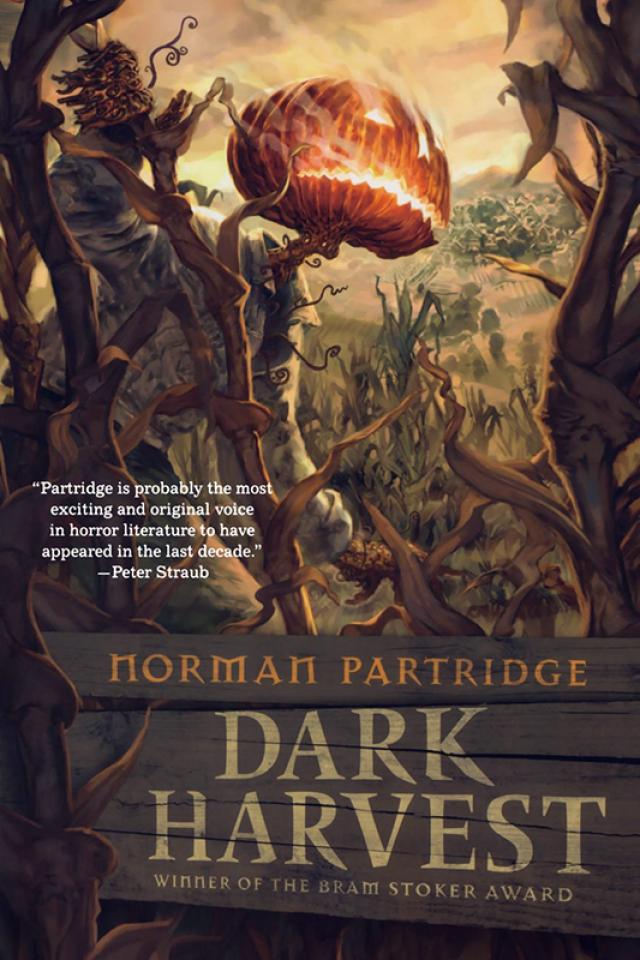


Just ask Mitch Crenshaw if you’ve got any doubt about that. Because the October Boy’s stalking toward him now, and there’s a mutant fire glowing behind his eyes that looks like it could melt the lead lining off a bomb shelter door. That fire…it’s bottled-up Hiroshima…it’s 150-proof Nagasaki…and there’s so much more to it than what it is, or what Mitch believes it to be, that he can barely stand to look at it.
Mitch closes his eyes for just a second. He tries to move, but can’t. He hears the October Boy’s whiskbroom footsteps, and for him that’s the only sound in the world. There’s nothing else out there in the night. Bud is gone. Charlie’s dead at the side of the road; he’ll never make another sound.
Those last two realizations get Mitch moving. He grabs the pitchfork handle and yanks. The spike exits foot and leg in an electric jolt of pain. If he can use the fork to stand up, that’s a start. The Chrysler’s right behind him. If he makes it onto his feet, he can lean against the hood, maybe balance that way, maybe even manage to defend himself and—
The October Boy tears the pitchfork out of Mitch’s hands. He cracks the pommel of the butcher knife against Mitch’s jaw. Again, Crenshaw goes down hard, his spine ratcheting against the Chrysler’s front bumper as his ass finds its blacktop destination. The Boy squats in front of him, his eyes still blazing with that mutant fire Mitch can’t even comprehend, and the blade of the butcher knife comes up and fills the space between their faces, and the October Boy’s carved mouth chews over a single word.
“Keys.”
It takes a second for the word to register in Mitch’s brain, and then he digs his car keys out of his pocket and hands them over. The October Boy’s fingers vine around them like they’re a fistful of sunshine, and he stands and walks around the side of the Chrysler, and the driver’s door creaks open.
“You’d better move,” the October Boy says. “You’re in my way.”
The car door slams. The engine starts. The front bumper rattles Mitch’s backbone. Jesus Christ, but Mitch moves then, away from that thresher of a bumper, out of the path of those brutal Firestones.
He’s crawling across blacktop as the October Boy hits the gas. The stink of burning rubber fills the air. Mitch rolls down the embankment into the muddy ditch at the side of the road. An exhaust cloud follows him, settling low to the ground. Mitch lies there in the darkness. He doesn’t look up. The Chrysler growls in the night. A wind rises, sowing through the corn as if chasing the big black machine, digging its way down the drainage ditch. Hamburger wrappers churn under its breath, but it doesn’t last long.
And then it’s quiet.
The stars shine down. The wind doesn’t even whisper.
For a time. For a little while.
And then somewhere further down the ditch, a frog starts up. It’s the first frog Mitch has heard all night. He’s forgotten that there are frogs out here. And then another joins in…and another…and another…and it turns out Mitch isn’t alone in the darkness. There are frogs all around him in that muddy old ditch. They were right here all along, clinging to the shadows like a silent audience—dozens of them, maybe even a hundred—and Mitch didn’t know they were here at all, because they were smart enough to be quiet…smart enough to keep their little yaps shut when a two-legged legend came walking down the road…
Mitch buries his face in his hands, listening to those frogs work over the silence. Yeah…they’re sure talking now, he thinks, and then he laughs, because it really is kind of funny.
They don’t waste any time running their mouths once their little green asses are safe.
Not when they’ve got something to talk about.
Not when they’re telling a story…
PART TWO
Lies
Of course, the story told by Mitch Crenshaw’s amphibian friends is one the October Boy won’t hear. He’s already blown a couple miles down the black road, and he’s concentrating hard, because driving isn’t easy for him. His viny fingers cling too tightly to the steering wheel, and his severed-root feet are spongy on the gas and the brake. But he does all right, and in a few minutes he crosses the Line into town.
Kids are everywhere, running in packs with bows and arrows, and axe handles, and scythes sharpened for a single night’s work. They’re waiting for his grand arrival in the most obvious places, shadowing the city limits for the first sign of a thing that doesn’t move like a man. So he jams the Chrysler’s horn and guns through the first bunch of teenagers just as he hits Main Street, and they get out of his way double-quick because there’s not much more they can do when a couple tons of steel growls at them like a king-size tomcat that’s seriously pissed off.
Sure they move, but they don’t scare easy. The October Boy’s about fifty feet down Main when a rock hits the Chrysler’s trunk. “Screw you, Crenshaw!” some guy shouts. “Get your chickenshit ass out of that car and onto the street!” And the Boy’s carved grin stretches wide as he hears those words, because they mean things are going to work out better than he ever could have imagined. No way he could have crossed the Line this easily if he’d come into town on his own two legs. But no one recognizes him in Crenshaw’s car, and that means he’s got a chance of running his game all the way to the finish line.
How much of a chance, he’s not exactly sure. There’s a lot more to winning this game than just crossing the Line. And sure, his final destination is in sight—there’s the old brick church, dead ahead. That’s the place that spells ollie ollie oxen free for the October Boy, and if he gets there before midnight the game will end differently than it ever has before. But getting there won’t be easy, because this is definitely one case where the shortest distance between two points isn’t a straight line.
Seen in the bright light of an autumn afternoon, the brick church is the color of faded roses, but by moonlight those bricks are as ugly as old scars. Already, a few young men have gathered on the lawn beneath the narrow arched windows, and at least five guys are sitting on the steps leading up to the church door. They’re playing a different set of odds than the guys running the streets. They’re counting on the October Boy making it all the way to the church in one piece. After all, the church is the Boy’s only predictable destination.
And that bet makes one thing a sure deal—the October Boy won’t try to make it just yet. Right now, that would be suicide, and the Boy knows it…just as he knows he’s going to have to find a safe place to think things over and come up with a plan. So he hangs a left turn and heads down a side street, flicking his lights on to high beam so it’ll be tougher for anyone facing the Chrysler head-on to spot a pumpkin-headed driver sitting behind the wheel—
“Goddamn! It’s Mitch Crenshaw’s heap! Get outta the way!”
A dozen kids scatter as the Chrysler approaches. The guys in the first group wear dime-store monster masks. The ones in the second don’t need masks at all—their pale, washed-out faces are scary enough, five days of hunger etched in the hollow spaces along with just enough chiseled insanity to send a shiver up the October Boy’s gnarled spine.
Both gangs disappear into the shadows as the Chrysler blows by. It’s no surprise that this kid Crenshaw has a hell of a rep. So does his car. That’s just fine with the October Boy. If Crenshaw’s rod is the steel equivalent of his own personal monster mask, he’ll be happy to let it scare anyone who gets in his way.
He makes a couple more turns, working his way east, following back streets to the edge of the downtown section. Then he hangs a left on Oak Street and heads north, cruising by the market. The ham-fisted butcher stands guard out front, armed with a shotgun. That’s the way it is all over town, any place that has food. The diner, the truck stop, the liquor store out by the highway—they all have guards posted. The powers-that-be want that five-day hunger scrabbling around inside every young man who’s out for the Run. The only way anyone’s eating tonight is if they spill the candy locked up in the October Boy’s guts.
The Chrysler passes the market. There’s one last streetlight on the corner ahead. Then another turn, and the October Boy’s into the neighborhoods, where the streets are darker and oak branches climb high over the road, cutting off the moon and the stars.
No porch lights shine from the doorsteps of those houses. Not the electric kind, anyway. But light spills across some of those yards nonetheless—a bumper crop of carved pumpkins sit on those porches, their rough-hewn eyes trained on the streets as if watching the night’s action—somebody’s idea of a joke.
A lot of those Jack o’ Lanterns are mashed. Hey, you remember that. It’s a tradition—pass a house, bash a pumpkin. Get your blood pumping while you think about splattering the real deal. So it’s easy to understand why many of the homes are already cloaked in darkness—Jack o’ Lanterns splattered, candles out.
As he drives, the October Boy thinks about the people who live in those houses—the ones who’ve turned their children onto the streets. And he thinks about the houses themselves, and the quiet little rooms where nothing much ever happens, and the things that do happen that are never spoken of. But in the end it’s not the houses themselves that matter. It’s the people inside who count. So his thoughts return to those people, sitting boxed-up in their little rooms, and he thinks about the things they say and the things they keep locked up inside, and he wonders if you can still feel those people when their voices fall silent and their shadows disappear.
When those rooms are empty.
When those people are gone.
He clocks one block, and then another. A scream cuts through the night as he makes another turn. Just ahead there’s a clot of silhouette on someone’s front lawn, and a figure on the ground. There’s another scream from the prone figure—gotta be it’s a girl—and then one of those silhouettes rears back and kicks her, and laughter eclipses the sound of her pain.
The October Boy almost hits the brakes. Almost. Because girls don’t make the Run…and if one of them is on the street tonight, God knows what will happen to her.
But the Boy ignores the impulse. He doesn’t have time to be anyone’s hero. That’s not his role tonight.
So he forgets about the brakes.
He hits the gas instead.
Pete’s running down the street, following the sound of the girl’s screams when that same busted-up Chrysler speeds toward him, its front end cleaving the black ocean of night like the prow of Captain Nemo’s Nautilus in that Disney movie.
This time Pete barely gives the car a second thought. Once he jukes to the sidewalk and gets out of its way, that is. His attention is focused elsewhere—on that scream, on the yard that it’s coming from, on two guys looming over a lone girl who’s flat-backed on a neatly manicured front lawn.
There’s not much light on that subject. Three carved pumpkins sit on a small porch that skirts the front of the house, their wild yellow leers rippling across clipped grass. It’s not exactly a spotlight, but it’s revealing enough for Pete to recognize Marty Weston and Riley Blake. They’re football players, beer-gut lineman, and they’ve both got brakeman’s clubs because their fathers are railroad men. Between them, they’ve also got about three hundred and fifty pounds on the busted-up redhead at their feet.
“What’s wrong, sweetie?” Riley asks. “No backtalk this time?”
The redhead barely manages a groan.
“Sounds like this skinny little hunk of nothing finally learned her lesson, Marty. Could be she’s finally ready to shut up and get her ass indoors, where she belongs.”
Weston nods in agreement. “The little bitch can scream some. I’ll give her that. She wails like a Siamese cat tossed in a deep fryer.”
“Uh-huh. It’s damn sure better than listening to her talk, though. At least I understand what she means when she screams.”
“You don’t understand anything, idiot.” The girl’s voice is shaky, but there’s some steel in it, too. “If you were smart, you wouldn’t even be on the streets tonight. You’d be safe out back of your little Hicksville homes, yanking your peckers in the outhouse.”
“Jesus…listen to that.”
“See what I mean? Happens every time she talks. That’s why I’d rather hear her scream.”
Riley hauls back with a booted foot. Pete watches it happen in slow motion. And then he’s all done watching. Without a word, he crosses the lawn, moving in on Riley fast, cracking the pistol butt against the bigger kid’s skull just as Riley’s foot digs into the girl’s ribs.
Riley drops his brakeman’s club and Pete whacks him again, and the football player nearly goes flat on his ass as he trips over the girl. But all those tire drills on the practice field have been good for something, and Riley catches his balance at the last second. He rips around, facing Pete now, shaking his big head like it’s a four-slice toaster some moron jammed with a fork.
“McCormick?” Riley says, because even in the dark he recognizes the guy who clubbed him. “Pete McCormick? Oh, you just picked one hell of a time to grow some guts, you little shit. I’m gonna bust you up but good.”
“Uh-uh.” Pete chambers a round and raises the .45. “I don’t think you’re gonna do that, Riley.”
Riley stumbles back a step. “Hey! This asshole’s got a gun!”
“Yeah,” Weston says. “I can see that.”
Weston’s standing off to the side, and his brakeman’s club is already in motion as the words exit his mouth. It’s whistling towards Pete’s head, and Weston’s stepping in behind it, following the club’s arc with his weight. As Pete ducks under it he sees Weston shifting his stance, already setting his feet and cocking the club for another swing while his idiot buddy’s standing there slack-jawed like he’s watching the whole thing on television, and Pete whirls to the side and points the gun at Weston just as the big lineman lets loose his second swing—
—and the brakeman’s club nails Weston hard, cracking the football player’s kneecap like a china plate. It’s not the club Weston’s holding, of course. It’s the club Riley dropped. The redhead has it now, and Weston screams as she cracks him a second time, and he drops his club and goes down so hard and so fast that it seems someone should have yelled timber.
The girl’s on her feet, at Pete’s side in a second, the brakeman’s club still in her grasp.
“Thanks,” he says.
“Thanks yourself. I owed you one.”
And Riley Blake’s still standing there with his mouth hanging open, all two hundred and thirty pounds of him. The skinny little chick has his club. His buddy’s on the ground, howling over a busted kneecap. Worse than that, a sawed-off misfit who never lets him copy the answers off algebra exams is staring straight at him with a fucking .45 in his hand, a gun he already used to dig a couple of divots in Riley’s oversize skull, and Riley has the clear impression that the little bastard is picturing a bull’s-eye right there on his oversize shirt.
“I don’t believe this shit,” Riley says, doubly stunned. “There ain’t supposed to be any girls on the Run. And I never heard of anybody hitting the streets with a gun—”
“You’re talking like there are rules to this game,” Pete says, cutting him off. “There aren’t any rules, Riley. Tonight there are only winners and losers, and you can figure out which one you are.”
“But it’s not right. She’s a girl. And that’s a gun.”
“And this is a club.” The girl steps in and cracks Riley Blake upside the head, and he topples like beef on the hoof whacked with a slaughterhouse hammer.
“How about that, asshole?” the girl asks, looming over him. “Is that right enough for you?”
Riley looks up at her, but he knows better than to say another word. The girl’s bruises are painted with stark white moonlight. She’s just waiting for an excuse to give it to him again. The way Pete figures it, it wouldn’t take much. But Pete doesn’t want that to happen, though he can’t say exactly why. He grabs the girl by the shoulder and pulls her back. He’s ready to tell her to lay off. But she twists around, and their eyes meet, and his words don’t make it past his lips.
It’s no surprise that there are tears in her eyes, but in this unguarded moment Pete sees straight through them. There’s something behind those tears—something buried in the midnight black of her pupils that runs deep and strong—but Pete looks away from it, because it’s like catching a glimpse of some stranger’s naked heart, and his gut tells him it’s something he shouldn’t see until she wants him to.
“Let’s get out of here,” he says.
The girl doesn’t say a word.
But when Pete moves, she follows.
Of course, Pete recognizes the girl. There are no strangers in this town.
Her name is Kelly Haines, and she’s in Pete’s biology class. Pete knows that much, but it’s not like they’ve ever talked or anything. Like Pete, she mostly keeps to herself. As far as he knows, she’s the only new girl to hit town in his lifetime.
Kelly’s father was the only guy who ever managed to jump the Line. He was drafted during World War II, and—unlike every other G.I. from around here—he never returned to town when the fighting was over. Instead, he brought a war bride stateside and settled far from home. Probably never spoke a single word to his wife about the place where he was born. Probably never said a word to his daughter, either.
Kelly’s parents were killed in a car accident last summer. Social Services in her hometown backtracked her father’s war records and found her only living relatives smack-dab here. Just that fast she’s living with an uncle and an aunt she never met, in a place that’s got plenty of nothing unless you’re crazy about corn and quiet.
That’s Kelly’s story.
At least, that’s the way Pete heard it…
So Pete and Kelly leave a pair of busted-up football players behind them. They head toward the heart of town, where there are bound to be more kids roaming the streets. That means they’ve got to be careful. Handling Riley Blake and Marty Weston was dicey enough—Pete doesn’t want to replay that encounter with a larger roster of opposing idiots. Even with the .45, he wants to steer clear of trouble, and he knows he’ll get it with a capital T if anyone catches a girl outside on the night of the Run.