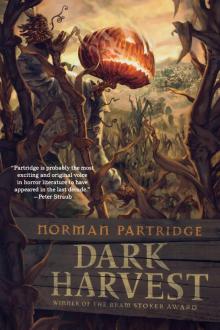
Dark Harvest, page 2
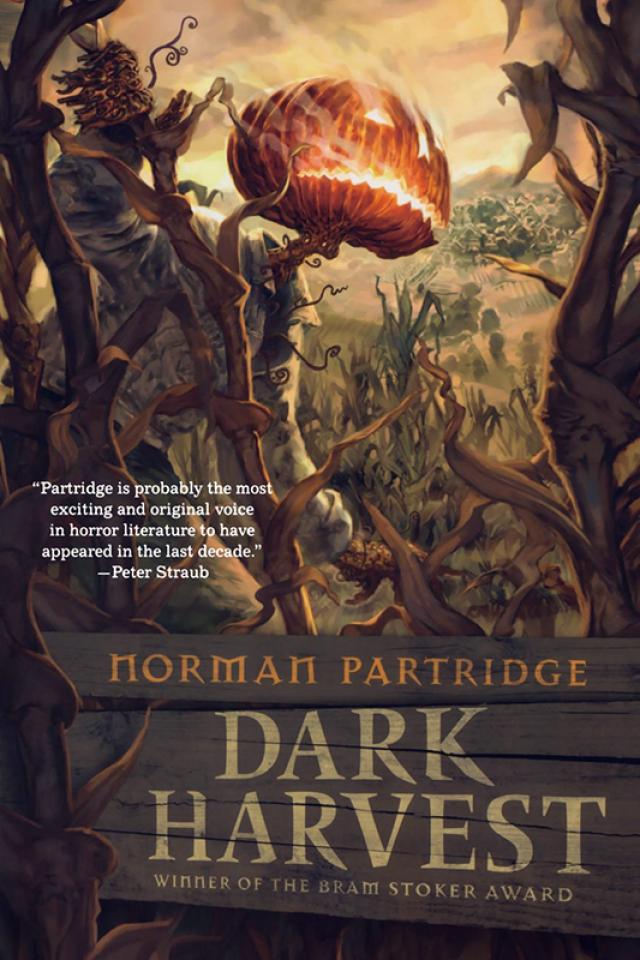


This unsettles the man, for there is no candle within the Boy’s hollow head. Still, the light is there, and so is the wet crackle of flame tasting fibrous yellow strands. These things the man recognizes clearly, though he cannot explain them.
So best not to think about it, the man tells himself.
No point in thinking, because there’s no explaining any of it.
Tonight, everything’s just the way it is.
Tonight, everything’s chiseled in stone.
Yes. The man with the knife could not possibly see this night any other way. For a long moment, he stares into the pair of flickering sockets where the Boy’s eyes should be. The man does not blink; the October Boy can’t. The Boy draws another tentative breath, and his exhalation carries the rich scents of scorched cinnamon and gunpowder and melting wax. Somehow, the mingled smells steady the man, and he raises the knife once more and sets about finishing the work he has begun.
Twin rows of jagged teeth appear below the arrowhead gap of the nose. Yellow light flickers across the man’s hand as the Boy inhales through his spiked mouth. His breaths are still shallow, still weak. But the light from his eyes paints harsh triangles on the man’s face as he carves, and the man works faster now, cutting twin ends into a wicked smile that cleaves cheekbones and just misses stabbing the October Boy’s eyes.
The man’s knife hand drops to his side; his other hand releases the stem attached to the pumpkin’s crown. The Boy’s head bobs low—by rights it should fall off his shoulders, for in truth he has no neck to support it. But this changes quickly as green creepers climb the twisted vine, which leads to the stem, twining as they go, growing thicker and darker as they angle toward the base of the pumpkin. They raise the Boy’s head on a strong, braided neck that drives barbed tendrils into the gourd itself.
That corded neck turns from green to brown as it roots in the heavy globe. Fresh growth scabs over with dark, rough bark. Vines and leaves rustle within the Boy’s coat as he takes his first deep breath. The Boy raises his head as the cool evening air fills him. He holds that breath for a long moment, and then it leaves him in a spiced exhalation.
A feeble tongue of flame follows it…and what most certainly is a word.
But the man with the knife will not acknowledge a word from the thing that stands before him. He has not come to listen to words. No. He has come to do a job that must be done, and that is what he will do. No more, no less. So he turns away with the knife still in his hands, and he walks to the road. The October Boy’s scrabbled footfalls follow the man’s even steps as he crosses the cornfield. But the man does not turn around, and it is only when he hears the rhythm of his own boot heels on hard pavement that his mind returns to the next task this night requires.
The man’s car is barely a year old. It’s black and sleek—not at all like the other cars you see around here. He sets the butcher knife on the hood and opens the door. There’s a grocery bag on the front seat, waiting there on expensive upholstery. The bag is heavy with candy. The man grabs a couple Big Hunks and stuffs them into one of the Boy’s coat pockets. He digs deep in the grocery bag and fills the other pocket with Clark bars. Next he unfastens the front button of the October Boy’s coat, and he shoves candy through those ropes of vines. Oh Henry!s; Hershey’s bars; Abba-Zaba’s.
Handfuls of Candy Corn nestle between leaves like secrets wedged into green envelopes. Red Vines and Bit-O-Honeys fill the gaps. The October Boy staggers a bit, for the man’s hand is as cold as the coming night, and the load is heavier than one might think.
And so he totters, but he will not fall. The Boy is not made that way. His severed-root feet scrape as he backpedals a few steps across the black road, and he leans against the car for support. The man closes on him and shoves one last fistful of candy against the gnarled vine of his backbone, and the Boy’s sawtoothed smile becomes a grimace. Perhaps another word waits within, in his mouth, ready to travel another tongue of flame. But before either thing can leave him, the man who has given him a face fills the Boy’s sliced grin with a handful of Atomic Fireballs, and then another, and another.
The light grows dimmer in the October Boy’s mouth.
The light grows brighter behind his eyes.
Soon the grocery bag is empty. The man balls it up and tosses it into the field. Now there is only one thing left to do. He retrieves the knife from the hood of the car. It only takes a second to do this, but in that second the man stares at the dead field and the indigo blanket of sky that has now grown very dark, and he sees the cold stars glimmering above him and the bright empty dome of the rising moon, and as he turns his gaze travels from the things that hang in the sky to the ribbon of asphalt that waits at his feet—the black road that carves a midnight path toward the cold white glow marking the town.
The man stares at the October Boy. He does not say a word. His actions speak for him. He extends the butcher knife. Thick tendril fingers vine around the hilt as the Boy takes it. And now the man’s hand is empty, and his white fingers stiffen as they stretch through the darkness, tracing the path of the road.
Every finger but one curls into a fist.
The man points toward the town.
The Boy with the knife starts toward it.
Pete hears them in the street. He turns out the bedroom light and parts the threadbare drapes so he can see what’s going on out there. Yeah. It’s just like everyone said. The town’s teenage male population is on the move. They’re running in packs, like dogs turned loose for the hunt.
The old oak in Pete’s front yard chokes off the moonlight, but he recognizes three guys from his gym class as they pass beneath the dull glow cast by the streetlight on the corner. They’re loping down the middle of the street, hooting at shadows as if calling down a dare. One of them has a baseball bat, another a ball-peen hammer, the last a two-by-four bristling with nails—
A car horn blares behind them as a rust-pocked heap runs a stop sign and makes the corner. The boys scatter, and the gap between two of them is just wide enough to accommodate a beat-up Chrysler hardtop with a pair of headlights that blaze like a Gorgon’s eyeballs. At least that’s the way those headlights seem to Pete, and he freezes behind his bedroom window as the twin beams hit the glass.
For a brief moment, the headlights frame him like a portrait nailed to a wall. The Chrysler completes its turn and roars up the street. Just that fast it’s gone, and Pete’s standing there all alone in the darkness. Outside, two of the guys from his gym class peel their skinny asses off the asphalt and dust themselves off while their buddy needles them from Pete’s front yard. “Crenshaw and his rattletrap,” the guy laughs. “Your sweet little asses nearly got chopped, girls. You almost greased that shitheap’s gearbox but good.”
The guy goes on like that for a while. He’s got a mouth on him, all right. His chatter seems pretty funny, considering, and Pete almost laughs until the other guys bark down the Mouth with a few choice insults of their own.
Those guys pick up the things they dropped when they scattered—that ball-peen hammer, and that two-by-four studded with nails. And then there’s nothing left to laugh about. Suddenly, it’s like that car was never there at all. The two kids take a few cuts at the shadows and move on, and their friend the Mouth silently cocks his baseball bat over his shoulder and follows them PDQ, as if the last thing he wants in the world is to be left alone.
Seeing the last kid do that, Pete feels a hole open up inside him. Not that he needed anyone to paint him a picture, but that little incident just did the job, because there’s no way he can ignore the score when it comes to this game. Pete’s alone right now, locked up in his room, and he’s going to be alone when he hits the streets. No friends, no car, no backup. And that’s not a feeling with a whole lot of good in it, even if you’re used to going solo. Fact is, Pete’s pretty sure that he’d be hiding under his bed right now if he had any sense at all.
But Pete knows he’d never turn chicken like that. Not as long as he has a reason to stand on his own two feet. He might not be able to put a name to that reason, but he knows he’s got it. It’s somewhere down deep inside him, in a quiet place his father could never understand…or maybe it’s somewhere just down the hall, behind another bedroom door marked with a little girl’s handprint in pink paint. And just as he’s thinking that, his bedroom door swings open. A hard slab of light fills the space, and a dull yellow carpet stitched by a single Westinghouse bulb stretches from the doorway to his bed.
His old man stands there in the hallway. Pete can’t see him clearly with the exposed bulb dangling behind his father’s head, but he can see enough. The old man’s hardly weaving at all, but Pete knows that he’s drunk. And when his father follows his shadow into the room, Pete notices that the old man’s got something in his hand.
Pete can’t see what it is yet. Neither can he see his father’s face. And then the old man turns on the bedroom light, and right off Pete sees everything real clearly. All the broken things that lie buried behind the old man’s eyes, and the honed thing gripped in his fist.
The old man hands the machete to his son.
“This saw me through the Run when I was your age. I figure it’ll do the same for you tonight.”
Pete runs his thumb over the oiled blade. Maybe he should keep his mouth shut. Maybe. But after five days locked up in this shoebox of a room, he just can’t do it.
“Looks like this thing could do some damage if a guy had the guts to put it to work.”
Pete speaks those words evenly. His tone is matter-of-fact. But those words are bait tossed in the water, and Pete knows it, and so does his old man.
“You have something to say to me, son?”
“I just did.”
“Listen, I know what you’re thinking—”
“No you don’t, so don’t pretend that you do.”
“Pete, I know how you feel. But it’s one night, and you’ll get through it. And tomorrow I’ll get to work on things. I mean it. I’ll call Joe Grant down at the elevator, and maybe I can patch things up and get my job back—”
“It’s too late for that, Dad. I’m tired of listening to you tell me how things are going to change when I know they won’t. You lost your chance to do that when you crawled inside a bottle.”
“Wait a second, boy. Hear me out—”
“No. Our backs are to the wall. There’s only one way out, so I’m going to take it. I’m going out there tonight, and I’m going to change things. I’m gonna win the Run, and I’m not gonna do it with words.”
His old man grabs Pete then. It’s exactly the wrong thing to do. Pete pushes his father away, harder than he should, and he snatches his frayed denim jacket off the bed, and he heads for the doorway.
Outside, some guy screams in the street, but Pete doesn’t jump. Up the block, an axe handle rattles across a gap-toothed picket fence, but Pete doesn’t twitch. He starts down the hallway, leaving his bedroom behind without a backward glance.
The old man’s calling after him. Pete hears the words, but they don’t matter now that he’s said his piece. So he buries those words under his footsteps, and he leaves them behind. He only cares about what’s up ahead, ready to charge his ass like a rusty Chrysler with a pair of Gorgon headlights. And he walks down the shitty little hallway with its lone lightbulb and nicotine-stained paint, and he passes his kid sister’s bedroom, but not fast enough to escape the muffled sobs behind the eight-year-old’s painted handprint on the door. Kim shouts his name as another pack of guys scream by in the street, but Pete doesn’t slow a step.
He can’t afford to. That thing up ahead is suddenly real, and it’s pulling at him. The October Boy. It’s all he’s heard about for the last two months. The story’s been drilled into him and spackled over. He knows what it is, and what it means.
If Pete’s got the guts, he can grab it.
If he’s got the smarts, it’s all his.
So his lips stay buttoned as he opens the front door. His father’s footsteps are dogging him now, and his little sister’s still calling his name in a voice that’s burning a hole straight through his heart, but he’s through that door in a second, and he hits the street with his father’s machete clutched tightly in his hand.
He runs into the night. His Chuck Taylors don’t make a sound. But somehow, no matter how fast he humps it, that beat-up look in his father’s eyes keeps the pace. Pete can outrun his father’s words, but he can’t outrun that look. It’s welded to his spine like a shiny key stuck in the back of some cheap Japanese toy, and with every click-clack twist it winds his bones and muscles tighter, so when that key spins free he runs like the devil himself is cranking his gears.
And that’s the way it is for our buddy Pete, all the way from his front door to the alley behind a rundown bungalow that faces North Harvest Street.
Pete’s tennis shoes skid over gravel as he comes to a stop by the back fence. He cools his jets for a second, takes a quick look up the alley. There’s no one else around. So he tosses the machete over the fence, then jumps the sucker himself.
He comes down on a weed-choked lawn that died about two months ago. The backyard’s as empty as the alley. There’s not even a dog, but that’s no surprise. Because this house belongs to a cop named Jerry Ricks, and a brutal son of a bitch like Ricks sure wouldn’t figure he’d need a dog to scare anyone in this town.
But Pete isn’t scared. He’s sure Ricks won’t be anywhere close to home tonight—not with the Run kicking into gear. He also knows that the cop lives alone. So the house is dark. No lights on outside or in. Pete picks up the machete and crosses the lawn, dead grass crunching underfoot. There’s a hose by the back stairs, and he turns it on and has a quick drink. The water tastes like rubber, but at least it’s cold.
Pete sits down on the back steps and catches his breath. There’s an overhang covering a cracked cement patio, but it doesn’t look like the kind of place anyone would pick for a summertime cook-out or anything. Hanging from one thick beam in the center of the overhang is a heavy bag—the kind boxers use. For a second Pete remembers the job Ricks did on him with that nightstick. For another second he pictures the cop out here, working on that bag, pummeling hard-packed canvas with his fists the same way he jammed Pete’s kidneys with that nightstick, grinning like an ape while he works up a real good sweat.
That’s enough to get Pete moving again. He tries the back door, but even Jerry Ricks doesn’t trust his reputation that far—the door is locked. So Pete goes around to the side of the house, finds a window set low enough in the wall that he can work on without hunting for a ladder.
It’s a double-hung job—the easiest kind. Pete works the machete blade between the stool and the bottom rail, levering the steel sharply. This time luck’s on his side. The lower sash rises, which means the window wasn’t even locked.
Pete reaches inside and drops the machete to the floor. He slips over the sill and closes the window behind him. It’s dark inside the house, but he doesn’t turn on a light. Instead he waits for his eyes to adjust, and it doesn’t take long.
There’s the machete, lying on the floor. Pete snatches it up. If things go the way he’s planned, he won’t need it much longer. The way Pete’s got things figured, a twenty-year-old machete isn’t going to cut it when it comes to the job that needs doing tonight. It might have been good enough for his father all those years ago, but Pete’s all through fooling himself about what kind of guy his dad is. What did the machete get his old man, anyway? Twenty years stuck in this town. Twenty years spinning his wheels, so he could crawl inside a bottle when things got tough.
No way Pete’s going to end up like that. That’s why he’s here, taking a chance no other kid has even contemplated. Any other night, breaking into a house owned by the town’s leading hard-ass would earn you a one-way ticket to the graveyard. But not tonight. If Pete gets out of here without getting caught, and if things go the way he plans out there on the streets, well, no one will care how many laws he broke in this stinking little crackerbox as long as he ends up grabbing the brass ring before the bell in the old church steeple tolls midnight.
That’s a whole lot of ifs to swallow, but there’s no other way Pete can see this night going. Either he’ll end up a winner, or he’ll end up dead. As far as he’s concerned, it’s a one way or the other proposition. Forget settling. Forget compromise. Tonight he left all that behind in his father’s house, and—
Hell, Pete doesn’t have time to stand here jerking himself off with words. That’s his father’s game. First things first is the way he sees it. That means he’s going to worry about his belly instead of his brain, because he’s got a five-day hunger to kill if he wants to run full-out tonight.
He steps around the counter separating the dining room from the kitchen. Man, it’s rank in there. A garbage can’s jammed in the corner by the back door. A couple of empty TV-dinner trays that have done double-duty as ashtrays stick up over the rim, and shoved to one side is a nest of hamburger wrappers occupied by greasy fries that look like they’re ready to start crawling.
The sight doesn’t exactly whet the appetite, but Pete’s so hungry it doesn’t much matter. He sets the machete on the sidebar, opens the fridge, and takes a quick inventory. There’s a carton of eggs, a jar of pickles, and a couple of apples that are on the far side of withered.
“Oh, man,” he whispers, but he keeps looking. A couple of sixes of Burgie, bottles of mustard and mayo and ketchup, and—here comes the clincher—a quart bottle of orange juice.
That’s it.
“Just my goddamn luck,” Pete whispers, because OJ’s the only thing he’s had in the last five days. Still, he grabs the bottle and twists off the top, taking a long swallow as he steps over to the cupboards above the sink. Gotta be something better in there. Pete opens the door, but all he sees is a box of oatmeal, some pancake mix, and—
Behind him, the doorbell rings.
Pete freezes. Standing right there in Jerry Ricks’s kitchen, with a bottle of OJ in his hand. He glances over the counter. He’s got a straight view from the kitchen, through the dining room, to the attached living room. The drapes are wide open in there, and the front window is only a couple of feet from the door. All the doorbell ringer has to do is take a couple steps to the left and they’ll be sure to spot Pete standing in front of the moonlit kitchen window.