

Jacket Weather, page 16


Lou says “Mike, ya gotta realize. These guys are up against it, some of them. What if it was you, living like this? Where’s your rachmanis?”
•
Sunday I’m reading on the bed. In our neighbor’s window the water towers are stacked in a lemongrey sky. All day the light doesn’t change. All day a teakettle wind is whistling in the vents and the white slow plumes of steam are rising. All day I’m here reading—how many of these days do you get in a year? In a lifetime? Late in the afternoon the sun comes out. And then the light gets dialed down and dialed down until, in a deep-blue sky, only a few silver rooftop pipes are still gleaming. Dialed down until there’s one white water tower bobbing on a sea of night that’s poured into the streets below, and those rooftop pipes are the gold of smoked sable.
•
I woke to the sound of a shovel scraping the sidewalk below. Last night, I walked her to the subway in a blizzard, which was also the year’s first snowfall. Snowswirl. It snowed upward, it spiraled down the side streets, hit you broadside at the intersections. Someone was laughing but you couldn’t look up. Then she was laughing, standing in a drift. She stopped walking and just let it go, like we were standing in a rowboat that was going down in three feet of water and it was the funniest thing ever. She was able to laugh at herself. And in that laughter I heard all of life, why we live, even though we suffer and even though we die, why it’s still worth it. Headlights floated by. A tall young guy fell in step with us. He was holding the remains of an umbrella over his head. He looked like he’d walked out of a Roadrunner cartoon. He asked where we were going. When we crossed the road to drop off a movie I said “You’re on your own!” We heard him through the snow, looking for a new friend. He didn’t seem to have seen snow before. She said “He must be from California.” I missed her even with her at my side. She’d turned me inside out. Or I’d done it for her. I felt as though my heart was on the outside, beating. There was never enough of her. I could never get close enough, never possess her completely enough. As though there were some measure of completeness beyond complete, something beyond now, something in the realm of the imagination, some essence. I felt as though maybe cannibalism was the answer. To kill and eat her right there in the snow. She claimed to feel exactly the same, but it’s hard to know. I kissed her at the subway, she was just a nose and a smile encircled by a snowy hood. I told her to hold the rail and watched her down.
The walk home was desolate. Outside my hood was near silence. Except for a plastic tarp on a motorcycle snapping in the wind. By the time I made it to my building, my coat and scarf were white. I waited for the elevator with the snow melting off me, missing her something terrible. Inside my apartment, I locked the door, as though protecting what remained of her presence there. The screens were clotted with snow and there were five inches of it on the outside sill. I hung my scarf and coat and gloves in the shower, dried my hair with a towel, and went to bed listening to the radiator, with the room cast in orange snowlight.
And this morning I lay there listening to that shovel scrape the sidewalk, and then silence. My heart was still on the outside, beating, waiting.
•
Through two jogging sets of smeary windows: a woman in a white ski jacket, far end of the next car, which swung out to one side, ahead us on the curve. Her face was turned away. The lights went out and then back on.
•
Monday I walked past Lou at his locker.
“I didn’t see you this weekend,” he said. “You were here?”
“I was here yesterday. Night we stayed home.”
“You cooked?”
“I made pasta with garlic and oil.”
“What’d you do?”
I went back to him. I said “My friend Tammy gave me a truffle slicer. I used it for the garlic. Red pepper flakes.”
“Parsley?” he said.
“Yeah, parsley, at the end, with lemon.”
“Romano?”
“I used Parmesan last night. What about you?” I said.
“Same thing. I made pasta with garlic and oil. I ate the whole pound.”
“You ate a pound of linguine?”
“I used the vermicelli.”
“I haven’t had that in a long time. De Cecco?”
“Ronzoni,” he said. “It was on sale, three pounds for two dollars.”
Now Painter Joe was there. He was unwinding his wraps and hanging them in his locker. Yesterday he told us about the Lanzetti brothers, from South Philly: six brothers, five named after popes. All gangsters. Pius, Leo, Teo, Lucien, Ignatius, and Willie—all mob guys.
He said “You gotta reserve a cup of the pasta water.”
Lou said “How about linguine fini? Ever use that?”
“I made it the other night,” I said.
“Garlic and oil?”
“Yeah. And breadcrumbs, I made.”
This opened a discussion of different techniques for linguine with garlic and oil. Painter Joe, in a jockstrap, said he uses a couple of anchovies. A man drying his balls down the aisle said he adds a squeeze of lemon. Lou tucked his shirt in and squatted to settle into his pants. He doesn’t sauté his garlic, he throws it in fresh at the end.
“There’s always something else,” I said. “You’re never done, with pasta.”
“A continuing fascination,” Lou said. He was combing his hair in the mirror. “You’re never done.”
•
By the time I got on the treadmill, the sun had shot below the clouds and raised every ridge and bump on 14th Street, each with its own shadow, including a tall slant beside the Salvation Army sign. She’d been living at Jane’s for a few months, but she still couldn’t see her way clear to saying what she wanted, and my head was still full of the stuff I came to the Y to outrun. The past, the future. The guys she’d been with and what was going to be with us.
With the iPod on shuffle I was going pretty good when up chimed an acoustic guitar, a twelve-string, ringing and droning around me as though I were inside the instrument. Whoever it was took two deliberate, formal passes at a theme, and then played that same theme at a clip. First the shadow, then the sun. Perfect simple thing. I looked at the device: Leo Kottke, “In Christ There Is No East or West.” Still running, I played it again. First the ceremony, then the dance. All the same tune. In our circle there’s no east or west or north or south. No future or past, no yours or mine, no me or you. There’s only us and only now. And if we can stay here, it’ll always be now, and if it’s always now, we can stay.
And then it’s the Allmans playing “Jessica” and I’m still running, happy and suddenly free, opening it up like they do, with a blind cloud of sunlight at the windows. Nothing in front of me and nothing behind. Tomorrow’s just another today. And I don’t have to undo the knots and unfasten the locks and retrace the routes and mazes that led me to a moment’s peace yesterday. All I have to do is accept today’s joy.
Once in a while you see through “time.”
And then it was pavement grey out there again. Behind the pebbled glass, someone stopped to light a cigarette in cupped hands and the red strobe of an ambulance moving panel to panel threw his shadow on the glass.
I was out of the shower by 8:25, drying off. She was meeting me at 8:30. All I had to do was get dressed and she’d be there, on the other side of this moment, like the other side of a door.
I went upstairs. Outside, a few snowflakes were in the air, small ones. Schoolkids were shrieking all around me. A voice told me Look around. You won’t be here again.
June was crossing Sixth Avenue. She was coming past the newsstand. It seemed there was barely time left for us. And then she was right in front of me. To me, she looked like she did when she was 27. Maybe to her, I did too. That’s the thing about being with someone who knew you when you were young: she’ll always see you that way.
She was standing close. As close as people do in the movies. Her green eyes were studying mine. She must have seen something.
“Don’t say anything,” she said.
Another ambulance was going by. I was looking at her hair.
I turned up her collar.
“Zip up,” I said.
Acknowledgments
Yuka Igarashi is the reason you’re reading this: she brought this book in from the cold. In the happy event the publication of Jacket Weather comes to seem as if it was inevitable, I’ll know otherwise. That it should have found her seems a miracle to me, even if it’s one with an easy explanation: Steve Levine and Chris Kraus, to both of whom I’m forever grateful. Max Blagg and Danielle Leone kept the wind in my sails. Sally DeCapite has done that for nearly six decades. Wah-Ming Chang prepared the text for print with incredible care and precision, and Michael Salu gave me the perfect cover. Really, it’s been a too-brief pleasure to work with everyone I’ve met at Soft Skull. And each of the following people helped in some way: Sanjay Agnihotri, Cindy Barber, Ted Barron, Sheelagh Bevan, Laura Blackburn, Vince Bruner, Suzanne DeGaetano, Maggie Dubris, Jane Friedman, Robert Gordon, Rebecca Gowen, Philly Grossman, BG Hacker, Ray Halliday, Richard Hell, Clinton Heylin, Greg Jiritano, Mimi Lipson, Tony Maimone, Greg Masters, Brian S. McGrath, Joel Murach, Elinor Nauen, Will Patton, Heather Price-Wright, Rosa Ransom, Kelly Reichardt, Luc Sante, Joe Santore, Mark Satlof, Tere Saylor, Pete Simonelli, Anna van der Meulen, and Jocko Weyland. I’m very happy to thank Nile Butta, who reintroduced me to June. And above all June, my feelings for whom I’ve spent an entire novel trying to encompass, and now I’ve run out of room.
© Ted Barron
Under the banner of Sparkle Street Books, MIKE DECAPITE has published the novel Through the Windshield, the chapbook Creamsicle Blue, and the short-prose collection Radiant Fog. Cuz Editions published his story “Sitting Pretty,” later anthologized in The Italian American Reader. DeCapite lives in New York City.
This is a work of fiction. All of the characters, organizations, and events portrayed in this novel are either products of the author’s imagination or are used fictitiously.
Copyright © 2021 by Mike DeCapite
All rights reserved
First Soft Skull edition: 2021
The author wishes to thank the editors of the following publications, where excerpts of Jacket Weather have appeared in slightly different form: Local Knowledge, No Tokens, Poetrybay, and Vanitas.
The author gratefully acknowledges reprinting lyrics from the following songs:
“Breakin’ in My Heart” © 1978 by Tom Verlaine
“Rama Lama Ding Dong” © 1958 by George “Wydell” Jones Jr. and Jimbo Publishing
“Cry Baby” © 1994 by the Waldos and Walter Lure
Library of Congress Cataloging-in-Publication Data
Names: DeCapite, Michael, 1962– author.
Title: Jacket weather : a novel / Mike DeCapite.
Description: First Soft Skull edition. | New York : Soft Skull Press, 2021.
Identifiers: LCCN 2020057121 | ISBN 9781593766931 (paperback) | ISBN 9781593766948 (ebook)
Subjects: LCSH: Middle-aged persons—Fiction. | Music trade—Fiction. | New York (N.Y.)—Fiction. | GSAFD: Love stories.
Classification: LCC PS3554.E17746 J33 2021 | DDC 813/.54—dc23
LC record available at https://lccn.loc.gov/2020057121
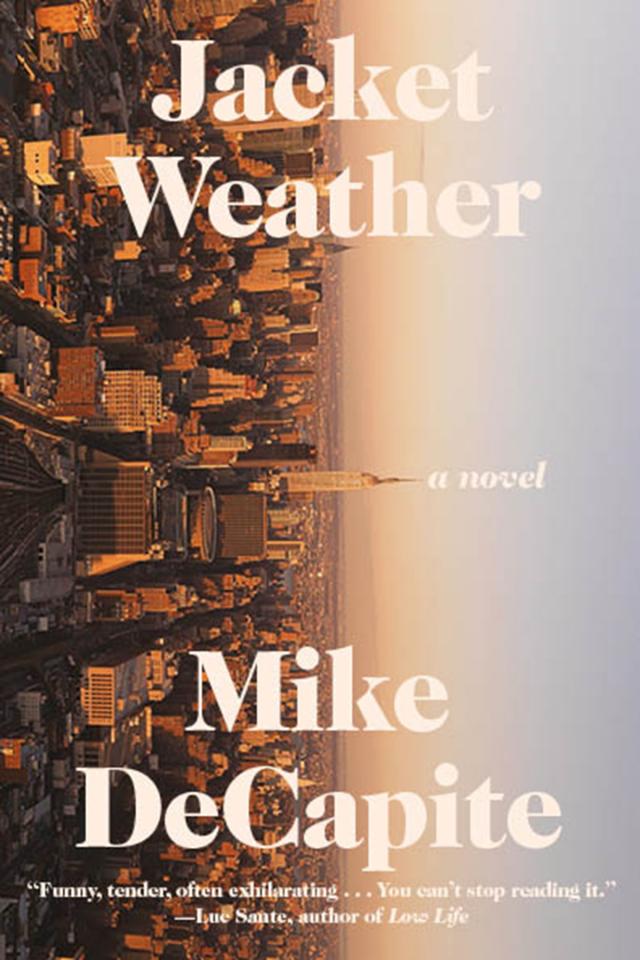
Cover design & Soft Skull art direction by www.houseofthought.io
Book design by Wah-Ming Chang
Published by Soft Skull Press
1140 Broadway, Suite 706
New York, NY 10001
www.softskull.com
Mike DeCapite, Jacket Weather


