

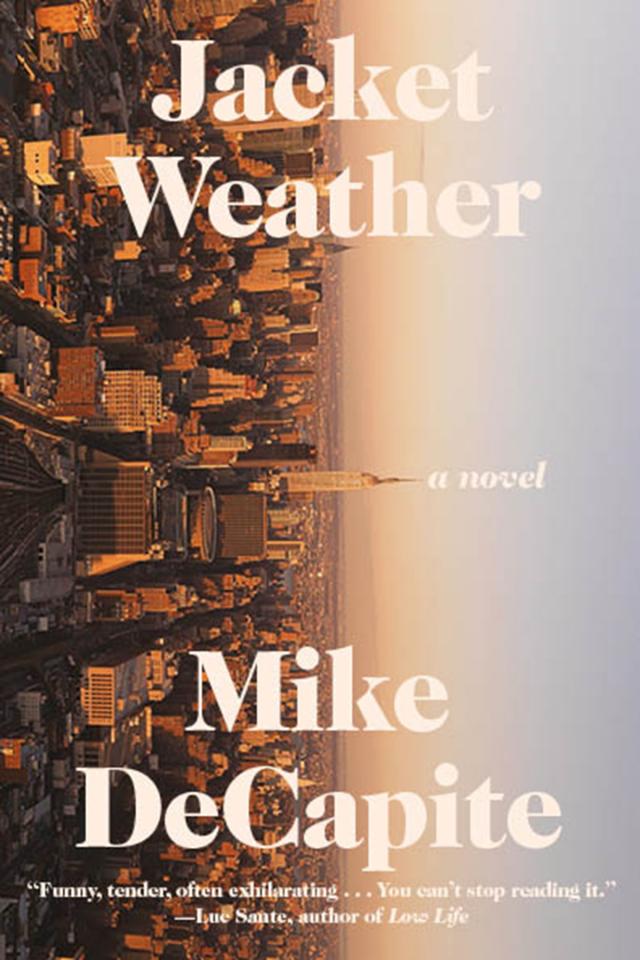
Jacket Weather, page 12


There’s no one in the whole store, row after row—except for the row I’m looking for. Right now there’s one guy, and it’s Nicky Raven—later Nikki Raven in the eighties after he moved to LA—comparing the forty types of adult diapers. Probably back in town taking care of someone. And he’s hypnotized by choice, like anyone would be. Beltless? Extra absorbency? With aloe? How long’s he been floating around in here? I haven’t thought about him in thirty years. At least thirty years. I was new on the scene when he was playing the bars with the last version of his band Ravens Laughter. He was mysterious because he’d opened for the Dolls and put out a single. Plus he was from an older generation—glam or shock metal. He was from a generation that still believed in stars and expected to get signed. He never really made the transition to punk, but he’d be at a show now and then, and he had an air about him. He was a rock star except for the fame. He left town way back when and faded into legend in LA, and now here he is in the fluorescent light with his one-thousandth black dye job and last faded pair of black snakeskin jeans and a serviceable pair of pointy children-of-the-night bondage shoes in the diaper aisle. Family gets you in the end. He’s a little haggard, carrying more weight. Still kind of unapproachable. And he sees me and we acknowledge each other—he’s trying to place me—we nod.
I woke up later my father was in the doorway, naked. Just his presence woke me, the eeriness of it. He glows in the dark. What’s he want? He steps out from behind your ideas of him—he’s in his life, not yours, and suddenly at the end of it, in this white body, his oldest companion. I jumped across the room and took his arm. “Pa, what are you doing?” I was naked too. So there we were. He looked at me like I could explain it. He was different in the night, part of a different realm. And his consciousness was more porous lately. He had vivid dreams. One night he was chased by a lion and woke up hollering. I was touched by how elemental the danger. Another night he cracked his head open on the dresser throwing himself out of bed to catch a fly ball.
“Pa, where you going?” I asked him, as he moved past me toward the couch and lifted the sheet. Maybe he was looking for my mother. I felt as though he was moving toward some ancient place where we all slept together, right after I was born, or where all families slept together for warmth and safety, in caves.
“Pa, you can’t sleep here,” I told him.
“I can’t?” he said.
“You can, but this is where I’m sleeping. Ma’s in the hospital. Don’t you want to sleep in your own bed?”
“Where is that?”
“Come on,” I said, and I walked him through the apartment, holding him by the arm as he took his determined compliant baby steps. “How’d you get here?” I asked him.
“Well,” he said. “I just . . . followed along.”
The next day was business as usual. There was nothing on TV, so I told him I was going to the library to get a movie to break up the afternoon.
“Anything you’re in the mood for?”
“Gangsters,” he said.
October washed in with the rain. Now the clouds are tearing themselves open on the uplit Empire State Building like a scene from some 1930s dirigible-captain serial and she’s through the door in a raincoat and short dress and tall black boots, with her purse and the mail and a brown shopping bag, crashing in on a wave of her own anticipation because I’ve been in a mood and she’s carrying a bouquet of sunflowers, and she says “These are for you!”—a burst of yellow sunflowers in brown paper—but it’s nothing compared to that smile, I mean just the biggest irresistible smile as she comes through the door with her nose wrinkled, laughing already at having this done for me, the excitement and deliciousness of it, the sheer luck of our being together right here and now.
•
“What news on the Rialto, Bubbie?”
“D’ja see Jackie?”
“Why, what’s with Jackie?”
“He had the other knee, he’s at Village Care.”
“For how long?”
“Till tomorrow or Friday.”
“I’ll go tomorrow.”
•
first leaf stains on pavement
•
One minute I’m walking home from school kicking through leaves with half a headache and sunlight prismatic in my eyebrows and the next, I’m driving my mother’s car through a park with the sun at that same after-school angle after I’ve moved her into assisted living, gotten rid of her furniture and most of her clothes and sent the photo albums down the chute. Getting back to New York, I feel like I finished writing a novel: I just want to stare out the window. These are the days of endless afternoons. Banging from a construction site. The kind of days you’ll remember forever and forget by tomorrow—these are the days. A steel ventilator in a blue sky.
•
REGISTERED
NO. 6240876
STATE OF NEW YORK
MOTOR VEHICLE
REPAIR SHOP
•
Subway doors open on two people under the stairs in a nest of blankets. She’s asleep, he’s propped on an elbow, having a smoke. Laundry draped on the enclosing rail.
•
Way back in that first autumn, with June living at Jane’s and a river between us, we still spent most of our nights apart and snatched what time we could on the weekends. June carried a lime-green canvas overnight bag, which is sitting above our heads on a luggage rack on a dark October morning as we sail out of the Lincoln Tunnel on a Trailways bus, Catskill-bound.
“I could live in Weehawken,” I announce, looking out the window.
“No.”
“No?”
“What would you do there?”
“I’d . . . become active in Weehawken politics. I’d use the Fountain Motel—”
“Stop it.”
“—as a place for accepting bribes and kickbacks on shady development deals.”
“Would you be rich?”
“I’d be perceived as rich. But my ambitions and lifestyle would always outstrip my resources.”
•
“D’ja go up and see Lester?”
“Yes, I went yesterday.”
“I went, but he wasn’t in his room. He look good?”
“He did. He’s tired, but the surgery went well.”
“He sounded good when I called. Who’s picking him up?”
“I’m not sure. He’ll be discharged Monday or Tuesday.”
“I’ll stop there tomorrow.”
•
Woman with a broomstick yoke of recycling outside Duane Reade. Shirtless guy pushing a shopping cart lashed with bags of cans and bottles. A line of these prairie schooners in the parking lane.
•
“I went once, Tere. There’s a brown awning on 11th Street, in the urn district, where everybody goes. Tony recommended a woman there and I made an appointment. I told her what was going on and she seemed to think it had something to do with my father’s death, which didn’t ring true for me.
“Also? By that point I hadn’t had a cigarette in a week and I was feeling different anyway. So I didn’t go back.”
•
“Yeah, Mike: Lou. I got your message—Jeez, you got the thing this fast? I just dropped it off! I was gonna call you and tell you about it. But anyway: what it is basically—I received this from a doctor from Spain. If you notice, there’s not one word in English on the whole thing, it’s really from Spain. It’s ah, it’s basically it’s made from ah—pigs that they only feed them acorns. It’s the same acorn-fed pig that they get the Iberico ham—that famous ham? Now, the ham comes from the leg: this comes from the back. So—this is like a capocol’. You can make a sandwich with it, you can serve it like hors d’oeuvres, y’know, on a platter, before you eat. But I wasn’t impressed with it! If you notice I opened it, because I wanted to try it, so I could tell him, and I made a sandwich with it, I cut some pieces off. It was kinda chewy! It wasn’t tender. So I want you to eat it and tell me what you think of it. But it’s uh . . . one of the finest uh— To me, it reminds me of capocol’! But capocol’ is better than that. And uh, it’s a fine product . . . Maybe I should just have it plain. And just chew it. I dunno, but in a sandwich? It didn’t bite off! The whole piece pulled. So I wasn’t crazy about it. Aright, so I hope you enjoy it: slice it up, have it with uh, y’know, with breadsticks or whatever, I dunno, make a sandwich with mustard—like that. Aright I hope you enjoy it: it’s uh, it’s like, it’s a gourmet kind of a cold cut, y’know, it’s a—salumi. Aright, I’ll talk to you later.”
•
We’d just smoked some hash. “Station to Station” came on. Gradually, it came on. You know, the steam, the platform. We became very involved with the train sound at the beginning. It went on forever. From Berlin to Cologne, it went on. And then the guitar, wailing.
“How great is that?” I said.
“Wow.”
“See?”
“See what?”
“Have you ever heard this?”
“It’s David Bowie, ‘Thin White Duke.’”
That cracked me up. Because I knew it wasn’t her thing. But she could pull this silly phrase from forty years’ deep storage, even though she didn’t care about Bowie. There was something about our age or parallel history.
I said “What’s not to like about this?”
“I never understood David Bowie, it’s like science fiction.”
I keeled over to one side laughing.
“What’s not to understand about this? Listen to the sound of that. That’s all you gotta know.”
But now Bowie came on, intoning. Doing his Nazi vampire cokehead bit.
“I want to know what’s going on, Michael. I want to know what’s happening.”
I was doubled over. I couldn’t breathe. She meant What does he want? You know. What’s he want from me? She’s immune to pretension. She wants music that’s unequivocal. Music that’s on the make. I fell through a wormhole of adoration and laughter.
A Suicide song came on. June said “He asked for my number once, Alan Vega. I was so embarrassed.”
“Why embarrassed?”
“I was young then. I didn’t—speak up for myself. I didn’t have any moxie yet.”
I had a revelation. There was nowhere else I wanted to be. Including alone. With June I was where I wanted to be. It registered like the sound of a gong. I never suspected this was a possibility. Always, in the past, whoever I was with, I secretly wished I were elsewhere. Even if it was off by myself, typing and drinking or whatever. I just thought that’s how it is. Who knew it could be this way?
“I’m really high,” she said.
I thought about that.
Then I said: “I feel like high is not the right word for this.”
“What?”
“I feel like high is not the right word for this. It sounds like you’re high above where you usually are. You know what I mean? Separate from it. But this is not separate from who I am, this is who I am. This stuff brings me back to who I am. Like this is who I’m supposed to be. Like this is who I’d always be if I were paying attention.”
“What else?” she said.
Back down the wormhole I went.
“What else, honey?”
We’d been there for another hour when the phone rang. It was her mother.
When she hung up, our attention went back to the music.
Half an hour later, she said “My mother had a comment for everything. Then she asked me what we were doing and I said ‘Listening to records.’” June passed a hand in front of her face: “Nothing! Total silence. She had nothing to say to that. Probably thought How crazy is that?”
“‘We’re burning the coffee table,’” I said.
Our laughter increased.
“You should tell her something different every time she calls.”
She was waving me away, laughing.
“‘Us? We’re taking the stuffing out of the pillows.’”
She kept waving me to stop.
“‘We’re turning the vases over.’”
Laura Nyro came up on shuffle.
We listened.
I said “She seems like the kind of person people say ‘She’s very talented!’”
She started laughing.
“Right?” I said. “Like she’s hearing that her whole life. ‘She’s very talented!’”
Another Laura Nyro song came on. She seemed to be playing the chord changes as they arrived in her head.
After a while it was like we had a situation on our hands.
“I put this record on every couple of years,” I said. “But after about fifteen minutes I feel like I’m losing my mind or she is, so one of us has to go.”
This time, it was me. We left the apartment. Laura Nyro drove us out. I was locking the door behind us. The song was still playing. Laura Nyro was singing her heart out.
I said “That to me is the sound of neurosis.”
She nodded.
I said “In fact, if I had to choose one word to describe what Laura Nyro sounds like, that would be the word: neurosis.”
“Yeah, she’s crazy,” June said easily.
I stopped to look at her.
“Simply put, yes.”
We started laughing.
We were laughing uncontrollably.
We stopped.
“Michael,” she said, putting a period on it.
•
“It’s been two weeks now, Tere. Turns out I didn’t need therapy. I just needed to quit smoking. Soon as I quit, I lost all that agita, tsuris, fear and trembling. Looked around for it, it wasn’t there.
“Which is not why I quit—I’ve tried a million times to quit smoking, but maybe I’m finally able to do it because if I’m asking someone to stick around and have a future with me, I have to do what I can to be there.
“I still see those clips of her with other guys, but I don’t sit and watch them on repeat. I think the same thoughts. But without cigarettes I can’t make an activity out of thinking them. I feel what I feel, I don’t have to act it out, as well. Without a prop for my anxiety, I don’t turn it into an opera.
“It’s hard to make more of anything than it is.
“Which I have to admit is the one thing I miss. Without alcohol and now without cigarettes, I have no way anymore to settle into a moment or to hang on to it, I have to let it pass. Life just keeps on happening.”
•
One night after work I stood at the corner of 50th and Sixth looking at the Radio City sign on a night without June. Maybe she was working or maybe it was that first autumn, after she sold her place and moved over to Jane’s. Anyway, the list of what there was to do without her ran through my fingers like the end of a film. I wandered down to Grand Central, which inescapably stands for the world. Even has its own sky. The first time I moved to New York I got off the train here with a manual typewriter and bag of books. Including a dictionary! I tried to watch myself through that kid’s eyes as I moved with the crowd, but it didn’t give me a lift, and neither did the boards for the Harlem Line, Hudson Line, and New Haven Line, or the skylit catwalks, or the seagreen zodiac firmament. You can’t always get it up, imaginationwise. So I got on the train to 14th. Some mariachis came on the L and played for two stops before passing the hat. I walked up Marcy and let myself into the apartment and didn’t bother turning on a light, just climbed into bed. But the bed without her was zero comfort. Like sleeping at a bus stop.
•
And there she is in a white bathrobe with her hair in clips, busy at whatever she does in the kitchen in the morning. Putting the dishes away, setting up the coffee. Whatever it is, she’s got a whole system going on. Just under my sternum, a right whale breaches.
•
I lie awake in the precancerous dark listening to the sound of space at the windows. A field of sound: the base sound of the city, the humming of the world’s dynamo. An active sound of nothing in particular. I get up to take a leak.
“What’s happening?” she says, from sleep. “Everything okay?”
•
Sunday evening at Elephant & Castle, a woman doing the Times crossword with a glass of wine, a salad, and a half order of shoestring fries.
•
It was only about six in the morning, June was at the table reading something online. She’d been getting hot flashes. Feeling other changes. She was reading for a long time. Then she closed out and shut the computer down. She sat there looking out the window.
Finally she said “I’m gonna look older.” She turned and looked at me, to gauge my understanding of that.
I nodded.
It was just getting light, and there was a new crane on the skyline.
•
She put her head on my chest, I put my face in her hair, and she slept while we fell through space.
•
sirens
•
THE JUNE AND JANE SHOW
JUNE: Jane, what kind of cake do you have at home?
JANE: Donuts.
JUNE: Tell me what kind of cake.
JANE: Jelly donuts. Chocolate glazed—
JUNE: What kind of cake?
JANE: It’s a banana cake with nuts—
JUNE: No I don’t like it.
JANE: Sort of a cashew cream—
JUNE: No I don’t like it.
JANE: With a hint of hazelnut—


