Stronger: A Super Human Clash, page 5
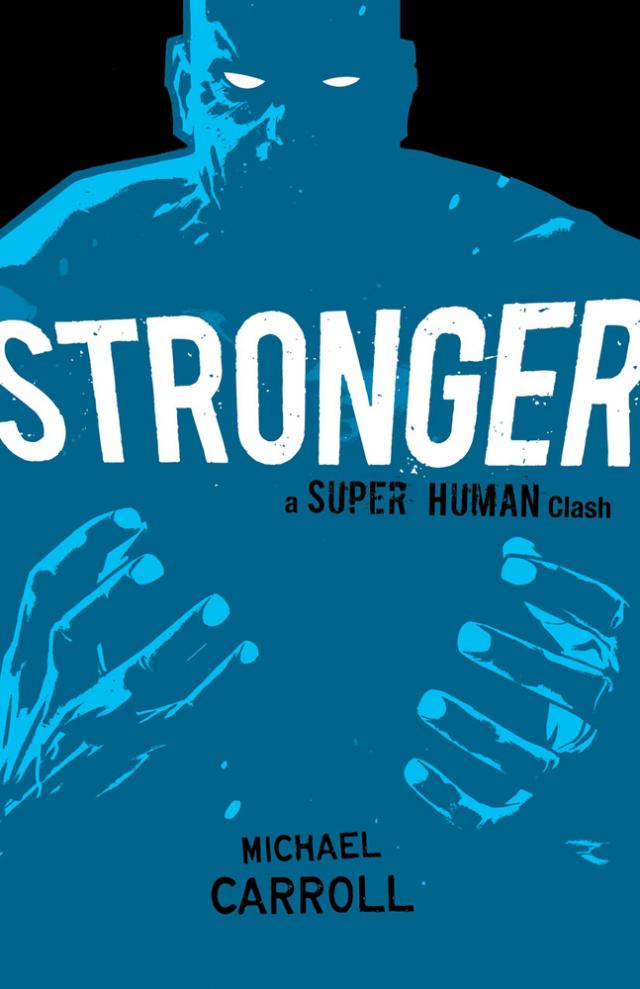


“And tell him what, Doctor? That there’s a secret base somewhere—you don’t know where we are, do you?—in which we are keeping prisoner a four-meter-tall blue-skinned boy? Do you think he’d believe you?” She squared her shoulders and glared at him. “You will teach him to talk. And you will not leave this compound until you’ve achieved that. Understood? We want to know why and how this happened to him.”
“Isn’t it obvious? He’s a superhuman!”
“That’s not obvious at all, no.”
“Don’t you follow the reports? He is not the only one! Maxwell Edwin Dalton, sixteen years old, able to read minds. A young woman who can control any form of energy. A young man who can fly under his own power. Another who can move so fast, the rest of the human race might as well be marble statues. And I know for a fact that your people have recruited a seventeen-year-old boy who’s been gifted with intelligence that’s completely off the charts.” Tremont turned away from her, came right up to the glass, and placed his hand on it, looking in at me. “There are even stories of a shape-shifter, did you know that? A man who—at will—can change into another person. Right down to the fingerprints.” He paused for a second, then looked back at Harmony. “Is that how you found out your blue prisoner’s identity? His fingerprints?”
“No. His DNA.”
“You’re telling me that he still has the same DNA?”
“Yes. And to save you the trouble of asking, it’s human. Completely human. Nothing to indicate how this change occurred. The same with Dalton and the young genius you mentioned. They’re all human.” Harmony walked up to the glass and stood next to him. “But they’re not just human. They’re more than that. And we have to know why.”
After that, Dr. Tremont came to see me every day, morning and afternoon, at least two hours each time.
He always called me by my first name, always treated me like a person, not an animal. He conducted dozens of tests on me. Simple ones at first, like giving me a series of cards with words on them. He’d say a word and I’d hold up the correct card. Then spelling: He gave me a pile of wooden blocks with letters on them—the same blocks you’d give to a preschool kid. I did pretty well on that one too until he got to phrases like pseudo-mnemonics that I’d never actually heard before, let alone learned to spell.
After a few weeks, he arranged for an oversized computer keyboard to be installed in my cell. It was connected to a screen that he could read, and for the first time since that day in church, I was able to properly communicate with the world.
“I want to go home.” They were the first words I typed.
“I’m sorry, Gethin,” he said. “They won’t allow that. It’s out of my hands.”
“How long have I been here?”
“Almost six months, I think.”
“They have no right to keep me. I haven’t done anything wrong!”
He shrugged. “It seems that they require neither right nor reason. I’m a prisoner here too—they won’t let me leave until I can get you to speak again. Or until it’s been proven that you’ll never speak again. But I don’t think that’ll be the case. Tomorrow we’ll begin working on basic phonemes. They’re the sounds that make—”
He stopped when I started typing again: “They don’t care if I can speak. That’s an excuse. They could have brought one of these machines in months ago.”
The doctor nodded. “That thought has crossed my mind. Gethin. Listen for a few minutes, please?”
“OK.”
“Human babies learn to speak by a sort of trial-and-error system. Have you ever heard a child learning to talk? They might know the word dog, and they’ll say that when they see one. Their parents encourage them. Positive reinforcement. Then they might see a cat but not yet know the name for it. But they will recognize that it has similar attributes to a dog: It’s a quadruped, it has a tail, it’s covered in fur. So they’ll say ‘dog’ and their mother or father will correct them, tell them that the word for that particular animal is cat. Are you following this, Gethin?”
I typed, “Sure.”
“Good. Now, when you think about it, by the time children are, say, two years old, they have learned hundreds of words, and most of the time will get them right. They are able to subconsciously identify some very subtle differences. For example, my sister has twin six-year-old girls and a one-year-old boy. The girls are identical. I mean, I can’t tell them apart—they’ve played some clever tricks on me, I must say—but their brother always knows who is who.”
I sat back and watched him for a moment, wondering where this was going.
“The human brain is a remarkable machine, Gethin. Think about that. My one-year-old nephew, who has practically no experience of anything other than eating and crying, and who still gets confused about which way up a spoon should go, is better at something than I am.”
I typed, “He’s had more practice.”
Dr. Tremont laughed. “Yes, of course. That’s the point I’m steering toward…. When we’re toddlers we’re constantly learning. Testing, retesting, experimenting, guessing, and so on. That process of repetition effectively carves pathways into our brain. As we grow, we develop shortcuts. If I ask you to multiply ten and five, you know the answer is fifty. You don’t need to calculate it every time.”
“But that’s just what we call memory,” I typed.
“Right. That’s how memory works, to a degree. In the brain’s language centers we store millions of these shortcuts. I say the word tiger and you know exactly what that means. The word brings up a picture of a tiger in your brain, maybe with sound. Or even smell, if you’ve ever had the good fortune to encounter one up close. And it works the other way. When you want to communicate the word tiger to me, you don’t have to think about how to make the right sounds. That’s already hardwired into your brain. The correct word just comes out.”
I nodded, then typed, “And that’s the part of me that’s gone wrong?”
“I think so, yes. Our tests have shown me that everything else is still working—and working rather well—inside your head. But when you speak, the wrong sounds come out. Now, I mentioned phonemes…. They’re the basic parts of human speech. What we’re going to have to do is work on them one at a time so that when you attempt to make a particular sound, that’s the sound we get. We’re going to reprogram your brain.”
“Will that work?”
The doctor was silent for a moment, then gave me a tight-lipped half smile and shrugged. “I’m … hopeful. It’s got to be worth a try.”
Dr. Tremont and I worked nonstop over the following two months. It was exhausting at first: For the entire first week I had to say “ah” over and over, with the doctor constantly correcting me, until something kicked in and suddenly the “ah” sound was coming out whenever I used a word that required it.
After that, my rate of progress increased, and by the end of the two months I was able to speak whole sentences without a single growl, grunt, or snarl.
I quickly learned that Dr. Gordon Tremont was not the world’s foremost expert in linguistics. He admitted that he was good, but not the best. It turned out that he’d been chosen because his psychological profile was very close to Harmony Yuan’s, and it was hoped that—like her—he wouldn’t suffer the same reaction to me that most people did.
They were right about that, at least. Whoever “they” were. The doctor and I got along very well. He worked hard, but he was usually happy enough to chat rather than lecture.
On the last morning of the doctor’s stay, he approached my cell rather slowly. He just looked at me for a few moments, then cleared his throat. “Good luck, Gethin. I hope … I hope they see sense one day.”
“Can you do me a favor? Tell my parents I’m still alive.”
“I … Yeah. Sure. I’ll do that.”
But I could tell from his expression that he was lying. And he knew that I could tell. My captors were monitoring us, and I had no doubt that if he did try to contact my parents, the penalties would be severe.
Nevertheless, I nodded. “Thanks. For everything.”
He gave me a thin-lipped smile, then turned away.
After that, it was back to the old routine: Harmony spending hours each day just watching me.
Despite the situation I had to admire her patience and self-control, because she never seemed to be bothered by the fact that now that I’d relearned to speak, I didn’t stop talking. I told her thousands of times in the first couple of days that I wanted to go home.
She barely responded, of course. Now and then she would just shake her head, or say, “When we’ve found out everything we need from you, we’ll see what can be done.”
Eventually, I gave in. “How are you supposed to find out what you want to know if you don’t ask me anything?”
“We have a way to go yet. Your cell is rigged with sensors that monitor your heart rate, perspiration, and stress levels. If there was anyone else in there, we’d have begun the interro gation immediately because those sensors act as a very accurate lie detector. But your physiology is so much different from a normal person’s, they’re practically useless.”
“But I won’t lie. I want to get out of here. I’ll tell you whatever you need to hear.”
“That’s my point, Gethin. Someone in your situation is liable to lie without realizing they’re doing so if—”
“That’s the first time you’ve ever used my name.”
She stopped, and pursed her lips in thought. “So?”
“So maybe you’re finally starting to think of me as a person, not a monster.”
Her only response to that was “Hmph.”
“Tell me something…. When you’re talking about me to your bosses, what do you call me? Gethin? The boy? The prisoner? Or maybe it’s the monster?”
“The subject,” she said.
“Oh. So you’re saying that I’m not a prisoner?”
But she knew I was just trying to throw her off guard, and she had a lot more experience at that sort of thing than I had. She said, “Want to guess how the guards refer to you? They call you Brawn. You know that word?”
“Yeah. It means ‘strength.’ As in, ‘All brawn and no brains.’”
Harmony nodded. “That’s right.”
“That’s not very fair. I’m not an idiot. I’ve got brains.”
“Yes, but they don’t see that. They look at you and their immediate reaction is to run away. We’re still trying to isolate the reason for that—and the reason that it doesn’t affect people like myself and Dr. Tremont—but there’s a strong indication that it might be an olfactory reaction. Smell, in other words.”
“But I wash every day! Well, most days.”
“I know that. Gethin, smell is a much more powerful sense than most humans realize. A sudden whiff of a particular scent can trigger immediate and overwhelming emotional responses.”
“So I smell?”
“Not as such. Some scents act only on the subconscious. It’s not like you smell of strawberries, or manure, or peanut butter. But whatever it is, it seems to trigger the fight-or-flight reaction in most people. As long as you’re like this, you’re not going to be making a lot of friends.”
“How long will I be like this?”
She shrugged.
“When can I go home?”
“You can’t. I’m sorry, but that won’t be permitted.”
“Then I’ll get myself out.”
Harmony smiled at that. “I really don’t think you will, Gethin. No one has ever escaped from this facility. You have to accept that you’ll be here for as long as we want you here.”
That was one thing she was wrong about.
CHAPTER 7
TWO AND A HALF MONTHS after the first anniversary of my imprisonment, I escaped.
It was surprisingly simple, in the end, and I was annoyed at myself for not thinking of it sooner. It was merely a matter of living up to the beliefs my captors already had about me: I allowed myself to become a monster.
When the two guys let me out of my cell to give it its monthly cleaning, I grabbed hold of both of them. I locked my hands around their little heads and roared at the guards, “You let me go or I’ll kill these two men right here and now!”
All of the guard’s rifles were instantly raised to shoulder height, aimed at my head. One of them shouted, “Let them go! This is your only warning!”
“No!” I roared back. “You listen—”
Immediately a high-pitched, deafening siren began to wail. Then a thick white mist came squirting through the ventilators—the two guys immediately went limp, unconscious—and the guards decided not to waste time trying to negotiate with me: They started shooting. I threw the two unconscious guys back behind the glass wall of the cell—I didn’t want them to get hit—and took a run at the guards.
A hail of bullets ripped into me, but that didn’t slow me down. I grabbed the nearest guard and threw him at his friends like a bowling ball. Took hold of another and used him as a battering ram to force my way to the end of the corridor, where a massive steel door had slammed down.
It took me almost a minute to punch a hole in the door and then tear the hole wide enough for me to climb through.
Another long corridor, this one absolutely packed with soldiers. All wearing white protective gear, all aiming their guns at me.
I paused for a moment, wondering whether it was worth the effort. I was pretty sure I’d survive whatever they threw at me, but I was already in a lot of pain: My entire body was covered in bullet holes, my clothes almost torn to shreds.
And then I thought, They can’t open fire—they’d hit the guys behind me!
They opened fire.
It was like being caught in a sudden sandstorm, only with bullets instead of sand. Behind me, five or six soldiers died, shot by their own men, and I finally understood the seriousness of my situation: If they were willing to sacrifice their own people to keep me prisoner, then they were capable of anything.
I tore a large chunk off the steel door, then held it in front of me as I ran.
A crescendo of bullets ricocheted off my makeshift shield as I plowed through the soldiers, knocking them aside, no longer worried about hurting them. If they didn’t care about me or each other, why should I care about them?
I’m sure I even stepped on a few as I ran. Probably broke a lot of bones.
To my right, four soldiers rushed from an open doorway. As the doors were closing behind them, I had a quick glimpse of dozens of rows of computer terminals, all manned by scared-looking people bundled up in thick coats, gloves, and fur-lined hats.
The four soldiers immediately opened fire at me, but I was moving fast and protected by my shield. One of them was struck by a ricochet from his own gun, which served him right, but his colleagues didn’t try to help him: They just kept shooting.
At the end of this second corridor was another set of steel doors, but as I approached them, they opened, showing me daylight for the first time in a year.
Outside. The air was almost achingly cold, and breathing was already difficult with a hundred bullet wounds in my chest and arms, but the first deep breaths I took were heavenly.
I looked around, saw that I was on the edge of a large flat, open area surrounded by a high ridge, like the inside of a crater. It was maybe a couple of hundred yards across, with the doors at one side and a shallow ramp on the opposite side. Off to the left, three large white half-track trucks were lined up. The ridge and the ground were dazzlingly white from the sunlight, almost blinding, but I refused to let that stop me.
Behind me, there was a deep rumble as the doors began to close once more, and my first thought was that they had decided it was safer to let me go…. And then I saw the massive white-painted anti-aircraft guns fixed to the ridge that encircled the compound. Three of them, all with their barrels turning in my direction.
All three of the anti-aircraft guns fired simultaneously—and uselessly. Maybe it was the frustration of being locked up for so long, or maybe my strength and speed had grown, but I saw the missiles coming, homing in on me as I ran, and at the last second I jumped up and sailed over them so that they detonated against the doors behind me.
At the apex of the jump—which had to be thirty feet at least—I flung my crude shield at the nearest gun. It spun through the air like a giant misshapen Frisbee and crashed into the gun with enough force to shatter it into useless fragments that showered the area, raining down on the two soldiers who’d jumped out of the gun just in time.
The moment I landed, the remaining two guns fired again. I dodged the first shell, but the second slammed into the ground at my feet. The explosion sent me hurtling backward, tumbling head over heels. I crashed face-first into the back of one of the half-track trucks and kept going, straight through the truck’s cab.
I landed heavily on my back, the wind knocked out of me.
But I was on my feet again in seconds, running back to the ruined truck.
In the cell I’d read about Vikings going on a berserker rage, where they got so worked up before a battle that practically nothing could stop them…. That was what was happening to me: I was getting free and I didn’t care what it took.
I honestly believe that if I’d had to kill some of the soldiers, I would have done it without pause.
When I reached the truck, I skidded to a stop, crouched down beside it, and took hold of the chassis. It took very little effort to raise the entire truck over my head and throw it at another of the anti-aircraft guns.
The truck flipped as it arced through the air, coming down roof-first on top of the gun. But I didn’t stop to admire what a great shot that had been. I was already running for the third of the guns, racing up the steep embankment.
The guys working the gun had time to fire six shots before they panicked and ran. I dodged the first two shells, leaped over the third, ducked under the fourth. I swatted the fifth shell aside. I caught the sixth in my left hand, and then my face was only inches away from the barrel. On either side, the two soldiers were running like crazy.