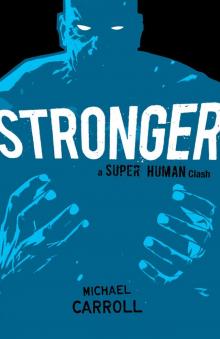
Stronger: A Super Human Clash, page 2
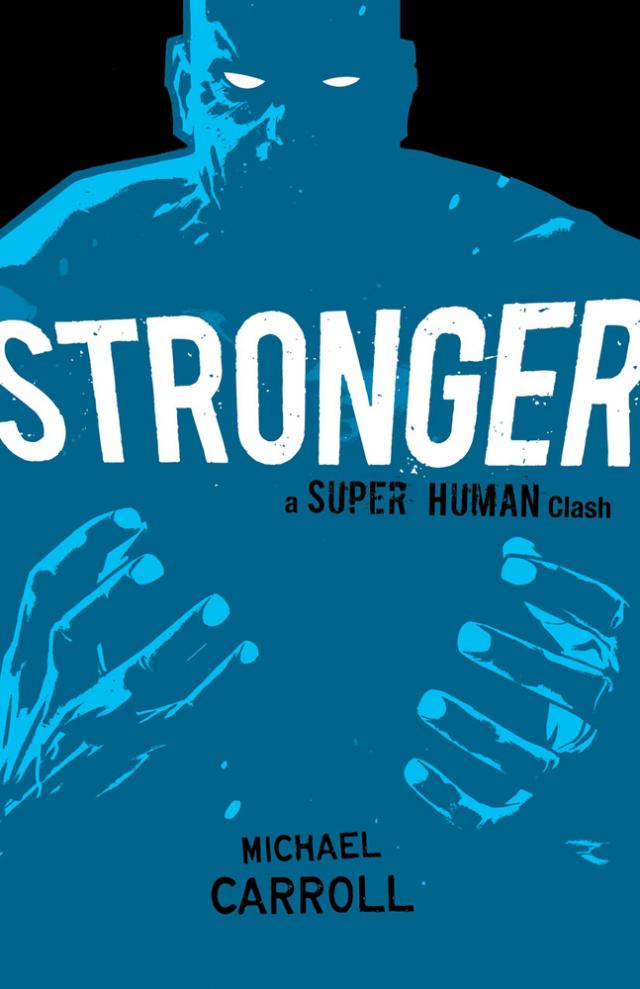


Back in the day, I could have grabbed him, crushed him into a ball, and thrown him straight through the dome. But although I was still much stronger than an ordinary man, the old days were long gone.
Hazlegrove stalked away without looking at me for my reaction, because he knew me. He knew I was beaten. I’ve been a beaten man ever since I was first dumped in this place.
For the first few months after I arrived, I worked with some of the other prisoners on a dozen escape plans. And one time three of us almost made it out. But the guards … Well, it’s fair to say they weren’t chosen for their kindness and understanding. They caught us in the act, and shot Diego and Catharina right in front of me. Then they shot me, square in the back of my head. But I was a lot luckier than the others in one way: My skin is tough. It’s not quite bulletproof, but it’s strong enough that even at point-blank range the bullets don’t usually penetrate more than a half inch.
So they shot me again, and again. Maybe two dozen times in total, until I collapsed. They gave me a few days to recover—left me chained up in one of the work sheds—and then it was back to work. As punishment, my shift was expanded from twelve hours a day to sixteen.
That was before Hazlegrove came to the mine, of course, when his predecessor DaLemacio was in charge. DaLemacio died a couple of years later when a crossbeam supporting the crushers snapped. One of the steel cables whipped back and caught him in the side of his head, which cracked open like a soft-boiled egg hit with a spoon. That was the closest thing we’d ever had to a vacation.
Hazlegrove was given the job on the grounds that he would cut costs. And he lived up to that promise: He reduced our rations and installed rain barrels to catch the runoff of rainwater from the dome. Rainwater is much cheaper than pumping the water from the river three miles away, and who cares if it’s stagnant and filthy? We were prisoners. We didn’t deserve clean water.
But those were only minor cuts compared with Hazlegrove’s greatest achievement. He’d concluded that the kids were a drain on the mine’s resources: They consumed food but didn’t give anything back. Hazlegrove’s plan was simple: Any children under the age of five had to share their parents’ rations. Any kids older than that would receive their own rations—as long as they worked.
The younger kids swept up, dragged buckets of platinum ore to the crushers, and ran messages across the compound from one guard to another. If they didn’t work, or if they dropped a bucket once too often, they were beaten. Oh, the guards showed some kindness by beating the kids only with their hands and not their truncheons, but the first time I saw it happen … I lost control.
I grabbed hold of the guard—a fat man called Vamos—and punched him in the face. That one punch broke his nose and all of his teeth, shattered his jaw, and fractured his skull. Sadly, he lived, but at least he quit the mine soon afterward.
Hazlegrove punished me again for that. He cut my rations by three quarters, and I’m a big guy; I need to eat a lot. When after a few weeks it was clear that starvation hadn’t curbed my anger, he picked three of my friends and had the guards beat them within an inch of their lives.
Now, as Hazlegrove walked away from me, I had to suppress the urge to leap up and come down on his head, and keep jumping on him until every one of his bones turned to jelly.
Keegan saw the look on my face, and she reached up and put her hand on my arm. “We’ll get them out,” she said with a forced smile.
A couple of the others approached. “What’s the plan?” Cosmo asked. In the outside world, Cosmo would never have survived. His weak muscles gave him just about enough strength to stand upright. Unable to dig or carry anything, Cosmo had been assigned the task of operating one of the crushers, and he couldn’t even do that for very long: He was barely strong enough to pull the machine’s levers.
“I don’t have a plan,” I said, and then added, “yet.” I sat down cross-legged and shrugged. “Maybe we can dig a side tunnel through from D?”
Keegan nodded. “Yeah, that might work. If the blockage isn’t too heavy, there’s a good chance some of Jakob’s team is still alive. So we pick a spot about seventy, eighty yards in—that should be past the blockage—and we bore through. The shafts are about twenty yards apart at that depth. It’ll take a couple of days, and that’s only if we don’t hit any bedrock.”
Cosmo said, “No, look, here’s what we should do…. Instead of digging a full-size tunnel from D, we just dig a bore-hole. Wide enough for me. That’ll be a lot faster. I can go through, see if there’s anyone alive in there.”
“Good thinking,” Keegan said, and Cosmo beamed at that. He’d had a crush on Keegan since the first day they met. She continued, “If there is anyone alive, you can bring them food and water while we work on widening the tunnel.”
By now, there were two dozen workers gathered around us. And they were looking at me to give them the go-ahead. They saw me as their leader. They always had. Not because I’m smarter than anyone else—which I’m definitely not—or because I’ve been here so long. It’s because I’m bigger and stronger.
I don’t like being a leader. I’ve never liked that. I’m much happier following other people’s instructions. Actually, I’m happiest when I’m completely on my own, but it’s been a very long time since I was able to indulge in that luxury.
Keegan reached up to my shoulder and casually brushed the dust and tiny flakes of rock from my blue skin. “What do you say, Brawn?”
I nodded. “All right. Let’s get to work.”
CHAPTER 2
TWENTY-SEVEN
YEARS AGO
I WAS TWELVE YEARS OLD when my world ended. Not the world, of course. Just my world.
It was Sunday morning, and I was in church, in the choir. Not by my own choice, mind you. My mother had made me join a year earlier. I came home from school one day, and when I opened the door, she was waiting for me with Pastor Cullen. “Here’s my little darling now, Pastor! Isn’t he adorable? Voice like an angel! Go on, sweetheart, sing something for the pastor!”
“Ma, no!” I pleaded.
“No, petal. You have to. Sing ‘Always on My Mind’—you love that one!”
That was embarrassing, and made even worse because my best friends Adrian and Jaz were right behind me.
I turned bright red and then Jaz nudged me in the back. “Go ahead, Elvis,” he said. “We don’t mind waiting.”
I spent the next year trying to live that one down. It didn’t help that I actually was able to sing. Pretty soon Pastor Cullen was giving me solos.
I didn’t want to do it, but I couldn’t say no to Ma. Well, I could have said no, but it wouldn’t have made any difference: When she set her mind on something, that was it.
Pastor Cullen was the same: No matter how much you protested, he did things his own way. That was why everyone in the choir had to dress up in a long white vestment. An alb, it’s called. Goes from your neck right down to your ankles. Not so embarrassing to be seen in when you’re with nineteen other choristers, but it’s horrible when you’re doing a solo and all your friends come along and sit in the front row just so they can make faces at you and try to get you to crack up, and then they rib you about it for ages. “Dude, how come you’re not wearing your dress today?”
The only concession Ma made was to allow me to wear my sweatpants and a T-shirt under my alb: It was bad enough to have to wear that thing without having to have a suit on under it.
But when I was twelve … It was the last Sunday in September. I was with the rest of the choir, and feeling a little nervous because I had to sing “God’s Glory Be the Highest” and wasn’t completely confident of the middle eight.
Pastor Cullen was at the pulpit in the middle of his sermon. He was about sixty years old, white haired, red faced, and jowly. He had far too much nose hair and ear hair for one man, and he always smelled of stale sweat and laundry detergent.
The church was an old building, constructed back in the day when it was fashionable to decorate them with all the oak, marble, and gold paint the builders could get their hands on. I was standing off to the side, right next to the marble pulpit, which was a prized spot among the choir because the pastor didn’t allow us to have chairs—we had to stand for the whole service—and on really sweltering days we could rest against the pulpit and cool ourselves down a little.
That day Pastor Cullen was on a particularly long and rambling rant. “The spirit of the community is that of its individuals. The Lord tells us, ‘Thou shalt love thy neighbor as thyself.’ If one person is unhappy, that brings us all down, so we must strive to bolster our community by enhancing the lives of those around us. ‘Do unto others as you would have them do unto you.’ This is not purely a Christian concept. Hindus, Sikhs, Buddhists, and followers of many other faiths—even some that predate Christianity—subscribe to the idea of karma: You will be repaid in kind for the manner in which you treat others. ‘Whatsoever a man soweth, that shall he also reap.’ That is as true for matters of the spirit as it is for matters of the community. Good and evil, selfishness and altruism, kindness and greed … These are within all of us. We choose the nature of our character, and that choice affects everything we do and infects those around us. We cannot choose our neighbors, but we can choose how we treat them.”
I knew what was coming next. We all did. Pastor Cullen had been stuck on the same topic for months: “To strengthen our town, we need solidarity. Unity. Faith in our community as a whole and in its individual members. Buy your groceries and gas locally. Instead of going to West Peyton to buy a new car, save money and buy a good-quality used car from a dealer right here in town.”
I looked out over the sea of mildly irritated faces. No one had the guts to stand up and tell the pastor to give it a rest: His cousin owned the only secondhand-car dealership in town.
The pastor didn’t seem to be getting anywhere near the main point of the sermon—unless the point was “I want to talk and you’d all better listen”—so I found myself growing more and more agitated.
I had to sing as soon as he stepped away from the pulpit, and it was always nervewracking. The longer he talked, the more nervous I became, especially because he didn’t always build up to a dramatic ending that we could see coming: Sometimes he just trailed away like he was giving up.
I realized that I was clenching and unclenching my fists, so I forced myself to stop. A thin trickle of sweat ran down my back, even though it wasn’t a particularly warm day.
The guy beside me, Chad Farnham, whispered, “You OK?” Chad was in his twenties, but only a couple of inches taller than me. He’d been the number-one soloist until I joined the choir, so he was always looking out for me: If I got sick, he’d have to take my place, and he didn’t want to be there any more than I did.
“Just wish he’d get on with it,” I whispered back. Anyone who sings in a choir that’s led by a gasbag like Pastor Cullen pretty quickly learns the ancient art of ventriloquism.
“Well, just don’t mess it up this time,” Chad said.
“Once!” I muttered. “One time I got the verses mixed up!”
“He kept us all back for extra practice, dude. We all suffered.”
“Let it go, Chad.”
The pastor was still talking, going all over the place like a blind man trying to mow a football field in a hurricane. Then he started on another of his favorite topics, the fact that the community always donated much more to the local hockey team’s fund-raisers than to the church.
I felt my stomach churn like there was a massive belch brewing, the kind you get after downing a whole can of soda in one go, but I hadn’t yet had anything to eat or drink that day.
“You look like you’re gonna barf. You sure you’re OK?” Chad whispered out of the corner of his mouth.
“I will be. Back in a minute.” Where I was standing I was mostly hidden from the congregation, and the pastor couldn’t see me from that angle, so it was easy enough to slip back into the vestry without causing much of a disturbance.
The vestry was small, plainly decorated, and only just big enough for the whole choir to assemble. There was a desk, a single chair, and two other doors, one leading out into the church’s rear parking lot and the other to the toilet.
I pushed open the second door and knelt before the bowl. My stomach suddenly spasmed as though I was about to throw up, and at the same time my skin started to itch and sting like the worst case of sunburn ever. My arms and legs began quivering, and I had to clutch the sides of the toilet bowl to steady myself. My brain started pounding, Boom, boom, boom … Over and over like a bunch of angry villagers trying to smash through the castle gates with a massive battering ram.
For a second, against the bowl’s white porcelain, my hands looked almost blue, but even as I tried to focus on them, the nausea and the headache faded. I took a few deep breaths, then pushed myself to my feet.
OK, I told myself. You’re all right. You’re not going to throw up.
I felt fine, as though nothing had happened. In fact, better than that: There was a sense of clarity that reminded me of the way my ears would sometimes pop a few hours after I went swimming and I’d realize that until then I hadn’t been able to hear properly.
I returned to the vestry and quietly opened the door to the church. Pastor Cullen was coming to the end of his sermon—accusing the people of loving hockey more than they loved God—and I was about to squeeze past the rear-most members of the choir and return to my place when it happened.
Something exploded out of me—that’s the only way I can think of to describe it: It felt like every square inch of my skin just erupted.
For a while—seconds, maybe minutes—all I knew was the pain. But it began to fade, and I became aware of the screaming, a deep bellowing roar that seemed to vibrate through the floorboards and shake the church’s walls.
When I was finally able to open my eyes, when the convulsions and retching eased, all I could see was what looked like a cobweb, black against a white background.
It took me a moment to realize that I was lying on my back, looking up at the church’s ceiling, its white plaster now shot through with fresh cracks. The cracks were spreading, growing sporadically as the ceiling shook and shuddered in response to the ongoing screams.
And the screams were coming from me.
CHAPTER 3
I SLAPPED MY HAND over my mouth and missed, hitting myself hard in the cheek instead. Had it not been for the pain still coursing through my body, I might have laughed at that.
But the pain was easing by the second, the all-encompassing cramps and nausea receding like the lake behind a shattered dam, leaving behind clusters of twitching nerves that hopped under my skin like suffocating fish.
I forced my mouth closed—that much at least I was able to do—and tried to sit up, but my arms and legs felt wrong. Too bulky, awkward, and unmanageable, like when you wake up with your arm tucked behind your head and it’s gone all numb.
Particles of plaster dropped from the cracks in the ceiling, and I instinctively raised my arms to shield my eyes, then al most yelped when I saw two massive blue-skinned hands racing toward me.
So I lay there for I don’t know how long, looking up at my oversized blue hands, clenching them into fists, waggling my fingers, rubbing them together. I would have thought that maybe I was somehow now wearing large rubber gloves if not for the sensation: When I poked the skin, it felt real. I could even feel the pulse in my left wrist.
I raised my head and looked down the length of my body: Powerful-looking blue legs protruded from the shredded remains of my vestments, and all I could think about was how lucky I was to be wearing my sweatpants. They were stretched almost to the limit around my muscular legs, but at least I wasn’t naked in church.
My skin was blue. It was hard to get that concept to fit inside my head. Blue, and hairless: Even the tiny little hairs on my arms were gone.
I ran one hand over my head and felt my hair fall away from my scalp.
A tiny part of my brain was signaling for attention, like a niggling reminder that I’d forgotten something, and then I realized what it was: No one was saying anything.
I raised my head and looked around. I was next to the pulpit, right in the middle of where the choir should have been, but I was alone.
More able to control my limbs now, I hoisted myself up onto my elbows.
The church was deserted, the doors at the back wide open, some of the pews overturned, open hymnbooks scattered everywhere like a flock of rectangular birds that had all just dropped from the sky at the same time.
I rolled onto my stomach and pushed myself upright, and discovered that the church had shrunk: I could easily have reached up and brushed my hand against the cracked ceiling.
Crouched on the floor, half hidden behind the altar, was Pastor Cullen. He had his head down and was rapidly muttering prayers, his trembling hands gripping his dust-smeared copy of the Bible.
I took a step toward him and my bare left foot collided with the edge of the marble pulpit. I stumbled forward and grabbed the top of the pulpit to steady myself—and it shattered into fist-sized fragments.
Pastor Cullen looked up at me and shrank away, whimpering, then curled himself into a shivering ball, clutching the Good Book to his chest.
Then I was right beside him, looking down, trying to understand. He was either very small or very far away, but I couldn’t tell. I reached my hand down to him, and stopped. With my fingers spread, my left hand was large enough to cover his head.
“Please don’t kill me!” he screamed, and I jerked my hand back.
“What do you mean?” I asked. Or, at least, I tried to ask—but I couldn’t speak. All that came out was a series of deep, rumbling growls.
“Not me, not me … Take the boys instead!” He whimpered again—he sounded like an injured dog—and I took a step back.