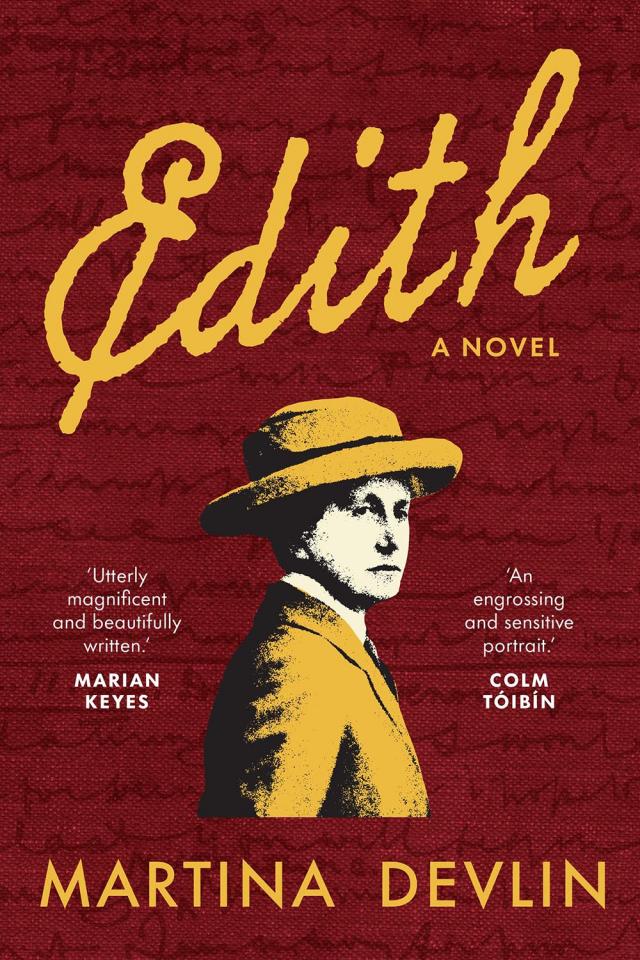
Edith, page 28


‘They’re in Wandsworth Jail now.There’ll be a trial, the law will run its course. Ex-soldiers, they are. Fought in the trenches. One of them lost a leg at Ypres. That’s why they didn’t get away. He fell, his pal doubled back for him, and they were surrounded. Poor beggars.They weren’t the ones pulling the strings. Mark my words, there’s others behind this hit.’
So, they’ll hang. At least Denis escaped the noose. Edith wonders if they might be the two men with tilly lamps in the warehouse. She realizes she’s been holding her breath, and lets it escape. ‘Where will it all end?’
Sergeant Maguire clears his throat. ‘Maybe that’s what them’uns who ordered the killing want. For none of it to end. For the fighting to go on. And on.Why do you think Mick Collins shelled the Four Courts, the week after the field marshal met his maker? Pressure was put on him to sort things out, if you ask me.You do it, Sonny Jim, or we’ll do it for you.’
Edith leans her forehead against the windowpane. ‘Such a waste. Boys, all of them.’
‘Aye, but they caused a mountain of trouble. After the field marshal went west, the English said the Treaty was broken. That’s what tumbled us back to war. And war agin our own kind, this time. Mick Collins made a choice to stand over the Treaty. It was either fight the empire again, a long, drawn out handlin’, or fight ourselves – and hope for a swift finish.’
‘Will it be? A swift finish, I mean?’
‘Aye, I dare say. Ireland’s had enough of revolution.’
Guard Tomelty returns, notebook in hand. A look snakes between him and his senior officer.The guard nods. Edith’s story has been validated.
Sir Henry Wilson didn’t approve of the Anglo-Irish Treaty, Edith recalls. A shameful and cowardly surrender to the gun, he called it. ‘Is it true the field marshal drew his sabre and ran at them when he saw their weapons?’ she asks.
‘So the newspapers say. I wasn’t there,’ says the sergeant.
‘Odd, to survive that slaughterhouse of a European war and end up felled on your own doorstep.’ Guilt jabs at Edith again. She should have gone to the London police with her suspicions that he was a target. But that Camel creature terrified her. She shudders. ‘At least Sir Henry was wearing his uniform. A man like that would hate to die in his nightshirt.’
‘Up to his neck in blood, he was,’ says the young guard.
‘That’ll do, Tomelty. Speak no ill of the dead.’
The sergeant’s tone of reproof causes a blush, pink-tipped like a daisy, to creep over Guard Tomelty’s cheeks.
Suddenly, Edith wants these functionaries of the new Irish state gone from Drishane. Their presence reminds her she ought to have contacted the authorities, scared or not. ‘Now that I’ve solved the mystery for you, sergeant, is there anything else I can help you with?’
The tilt of his chin shows his resentment at being dismissed. ‘Not at present. I’ll bid you good day.’
Guard Tomelty gathers up the boots and jams them into the pillowslip. Irrationally, she feels an aversion to the idea of Denis’s boots being taken away, and perhaps used as exhibits in a trial.‘Do you need to keep them, sergeant? I should prefer to have them, if that’s at all possible.’
‘May be required for evidence, Miss Somerville. If not, they’ll be returned to you.’
—
Edith and Cameron are sitting on the lawn by a sundial, which claims I onlie count the sunnie houres. Pinker dozes on Edith’s lap while Cameron updates her on the news from Skibbereen. She only half-listens, distracted by a cloud of bluer-than-blue butterflies rioting among the glossy leaves of magnolia bushes, and the hum of industrious bees settling and rising from one flower to the next.
‘Shall we have a game of backgammon after dinner?’ suggests Cameron.
‘If you like.’
‘Here’s Philomena now with the drinks.’
Philomena deposits the tray with gin decanter, soda siphon and glasses on a wrought-iron table. ‘Faith, but the Lord God himself would look down and pity me this day, Miss Edith.’
‘Your eczema?’
‘Exactly.The pair of yiz look as broody as hens on a clutch of eggs on them low chairs. Personally, if I sat into one of them there deckchairs I wouldn’t be fit to stand up again.’ She lowers her voice, although it is still perfectly audible.‘Have you told the master about them boyos calling to the house, asking questions to beat the band?’
‘Indeed I have, Philomena. He’s sorry to have missed them, aren’t you Cameron?’
‘I wish I knew what happened to those boots I left in the seaman’s chest,’ says Cameron.‘They’d have been jolly useful for the investigation.’
‘Thank you, Philomena, that will be all,’ says Edith. She waits until they are alone. ‘But they have the men who shot Sir Henry. They have visual evidence – they don’t need circumstantial proof.’ She accepts a glass from her brother. Idly, she tries to separate out the swallow’s sweet twitter from the wren’s piercing note. Over by the rhododendron walk, her peripheral vision catches a figure in jodhpurs, hacking jacket and riding boots. Polished ones, unlike Denis’s.
‘I seem to have pins and needles in my foot, Chimp. Won’t you excuse me? I believe I’ll take a constitutional around the garden. Here, take Pinker.’ Pinker opens her eyes and licks Edith’s hand as she passes the puppy across, then snuggles onto Cameron’s knees.‘I walked the legs off her today.’
‘Only a matter of time before it’s the other way around, Peg.’
‘There’s life in this old dog yet.’
‘Nobody doubts it.’
Flurry Knox is lounging with his back against a horse chestnut tree, one slim, horseman’s leg crossed over the other. His bowler hat is resting on his chest and a scent of hair oil rises from him.
Despite having changed for dinner, she lowers herself to the ground and settles beside him on the grass.‘Mr Fox himself.’
‘None other.’
‘Flurry, do you ever wish time could run backwards?’
‘I do not. That’s a waste of a wish when there’s so much else you could be wishing for.’
‘Such as?’
‘You tell me.You’re not too old to dream up your own wishes, gerrill.’
‘Flurry’s Wedding a West End hit?’
‘Ah, what’s the West End to us here in Castletownshend? When we have heather to rest on, the thunder of swans’ wings in flight to listen to, and the great vault of the sky above us?’
‘You’ve turned lyrical since I saw you last. Anyone would think you’d fallen in love.’
‘I have. With a long-backed hunter that’s within the black of my thumbnail off sixteen hands. Which reminds me, I can’t lie round here gabbing. I need to push off and seal the deal.’
A puff of laughter billows from her.
He scrambles to his feet and, by way of farewell, makes her a mock bow from the waist. ‘There’s a stench off the past and that’s the truth of it. The future’s where you want to point your nose, Edith Somerville.’
Author’s Note
In 1925, three years after the end of this novel, The Big House of Inver was published. It proved to be Edith Somerville’s most successful solo novel – although she still insisted on using the dual Somerville-and-Ross signature.
She never did get Flurry’s Wedding staged, despite revising it repeatedly over a seventeen-year period. But the Somervilles held on to Drishane House, largely thanks to her efforts, and the family continues to live there.
Acknowledgments
Thanks are due to:
Dr Carlo Gébler, Dr Paul Delaney, Dr Philip Coleman and Dr Kevin Power of Trinity College Dublin, who read early drafts and gave endless encouragement, as did my nephew Justin Blanchard.
Trinity’s librarians for whom no request was too much trouble. Also Queen’s University Belfast for sharing its extensive Somerville and Ross archive; the staff in Special Collections were a joy to deal with, especially Roísín Scullion.
The family of Professor Fitzroy Pyle for awarding me the Fitzroy Pyle Postgraduate Bursary during the course of this work at Trinity’s Oscar Wilde Centre, where it formed part of a PhD in literary practice.
The Somerville family of Drishane House, Castletownshend, Co. Cork, for kindly allowing me access to their private family archive, sharing memories and anecdotes, and giving me the freedom to wander around their home and its grounds. In addition, Robert Salter-Townshend for his family stories about Edith. And the people of Castletownshend who always make me so welcome during my frequent visits.
Antony Farrell, The Lilliput Press’s publisher, who took to Edith at once. Also to the Lilliput team for their enthusiasm and hard work.
The volunteers at Shaw’s Corner, Ayot St Lawrence, with whom I spent some happy hours. Writer Lia Mills and photographer Simon Robinson shared the adventure there – what larks we had!
Writer friends Sarah Webb, Ciara Ferguson and Anne-Marie Casey with whom I discussed the novel during its genesis. Also, Lorraine Curran, Kathleen Barrington and Imelda Reynolds who were always ready to listen to my Edithing. And my neighbour Lise-Ann McLaughlin, who played Sally Knox in The Irish R.M. TV series. Such unexpected connections magnify life’s joy.
Martina Devlin, Edith