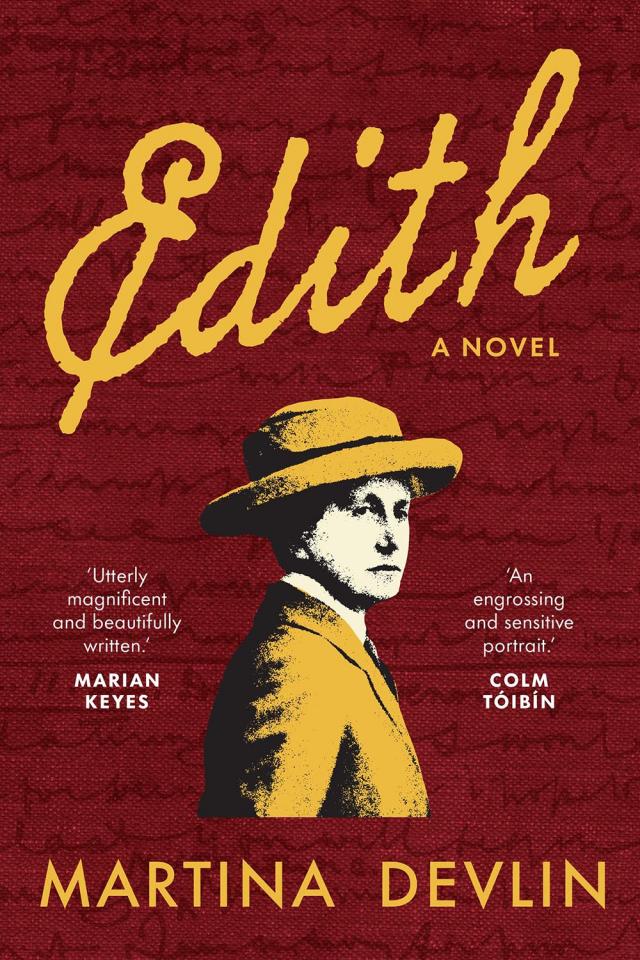
Edith, page 18


At the Irish Race Conference, Mr deValera and his friends have been disillusioned completely about the attitude of overseas Irishmen towards the Treaty.The wild idea of asking the Conference to declare against the peace settlement is not likely to be pressed now, because some of the most influential Irishmen throughout the world are in favour of it.
So, support is growing for the Anglo-Irish Treaty. Perhaps 1922 will bring stability to Ireland. Relief flows like running water through her. She pleats the newspaper, folding inwards its dateline of Friday, January 27, and returns to the waiting room.
—
The mail boat rumbles to the sound of its engines starting up. Edith leaves her cabin to go up on deck, passing a small boy at play with a peashooter. He ignores his mother’s urging to wave goodbye to Papa. Edith finds little boys more interesting than girls, whom she tends to ignore. But there are other sights to watch here, and she leans on the railings, inhaling the smells of sea salt and rot.The quay is thronged with people waving hands, handkerchiefs, hats and newspapers at friends. Their shrieks are good-humoured but indecipherable. Further along on the skyline she sees cranes, and other vessels at anchor. It’s an invigorating scene, an antidote to her weariness after a day dealing with talkative porters and uncongenial waiting rooms.
A flock of seagulls perches on the railings just along from her, the birds’ insouciance making her smile. They hitch a ride until the Hill of Howth recedes to the west, its lighthouse piercing the twilight. Smoke billows from the funnels, a foam wake churns behind. Now the seagulls rise into the air with a few lazy flaps, but instead of turning back to shore they follow the ship, letting rip with their screams.
The city lights begin to recede, the evening draws in. Edith considers going below for dinner but lingers still, enjoying the sensation of being on the move again after so long at Drishane. Men with cigars pace the deck. She takes a turn, getting her sea legs. Out of the corner of her eye, she notices one of the stewards watching her. His demeanour has an intensity which puzzles her. When he sees her spot him, he backs away, into a passageway. Just as she is about to challenge him, the boat sways and turns, and a cloud of steam is blown directly into her face.The toxic combination of machinery oil and cooking smells sends a rush of queasiness racing through her. It feels as if her stomach is being driven through her back. She staggers downstairs to her cabin. The vessel pitches and rolls all night long and she skips dinner, spending the crossing in bed with her head beneath her arm.
‘Like a sick hen hiding under its wing,’ says a voice suspiciously like Flurry’s.
But when she lifts her head the cabin is empty.
thirteen
Charlotte Shaw stands in the doorway of her Ayot St Lawrence home, arms open to embrace her cousin. ‘My dear, it’s wonderful to see your rosy cheeks again. How was the journey? Was it too, too dreadful?’
‘Not for a travel-hardened old warhorse like me, Lottie. Besides, I broke it by staying at Boyle and Mabel’s place in London last night.’
‘Come inside, you dear thing. You must go upstairs and freshen up. Then I want to hear all about home. Every little detail.’
‘You won’t like what I have to say.’
‘Won’t I?’
‘I’m afraid not. Ireland’s changed.’
Charlotte frowns and is about to speak, but Fred Day, the chauffeur, approaches with the luggage. ‘Day, leave Miss Somerville’s bags in the hall, please. Mrs Higgs will take care of them.’
Edith is ushered into a modern, red-bricked villa, a rectory before the Shaws took possession. It feels distinctly suburban and unlovely to her. She is shown upstairs to her bedroom, where she removes her hat and coat, and pats her hair into shape. En route to the drawing room, she passes a room with its door open, and catches sight of cameras, type-writers, an ancient exercise bicycle and a Bechstein piano. The house is a jumble of paraphernalia.
Charlotte has tea waiting, and she accepts a cup gladly. Knowing her cousin, it will be made from some superior blend – her cousin has always been fond of creature comforts. Edith takes in her surroundings. This room, too, is jammed with furniture and bric-a-brac. What a magpie Lottie has turned out to be. Despite the clutter, it’s an oasis of ease and warmth, cushions and footstools positioned at strategic angles and the air perfumed by hyacinths in bowls. Books, books and more books are piled, stacked and shelved everywhere the eye falls, along with magazines, pamphlets and train timetables.
‘Is George away from home?’ Anxiety underpins Edith’s question.
‘No, he’s in his writing hut in the garden. The GBS routine is sacrosanct. But he’ll take a break for a cup of chocolate at four-thirty and you can catch up then.’
Edith sets down her cup and saucer and picks her way to the window. Snowdrops flock in beds beneath the lintel, lawns lie beyond them, while at the bottom of the sloping garden a belt of conifers stands sentinel.
‘What a charming situation, Lottie.’
‘Hertfordshire doesn’t hold a candle toWest Cork, but it’s nice enough, in its way.’
‘The garden looks delightful.’
‘Our fruit trees give GBS no end of delight. He risks life and limb on wobbly ladders, picking apples and pears to squirrel away. We have a pigeon cote and beehives, too.’
‘I always thought you were a city person. After you inherited Derry you never actually lived in the house.’
‘Its upkeep costs too much. Those old houses suck your blood and grind your bones.’
‘Not if you love them, Lottie.’
Charlotte flushes at Edith’s reproof.‘I love Derry. But it makes sense to rent it out. My life is no longer in Ireland.’ She strikes a deliberately jolly tone. ‘You should see GBS and me helping Mr Higgs with the garden – sawing logs, digging, planting, whatever needs doing.’
‘Really? Both of you?’
‘Of course. Et in Arcadia ego.We love the quiet noises of the countryside.’
Edith tries and fails to imagine the man she thinks of as the Genius – not entirely admiringly – chopping wood or weeding a gravel path. She hopes Lottie handles the axe because her husband is too clumsy to be allowed near a blade.
Charlotte lifts a framed photo of two girls on horseback off the mantelpiece.‘Look at us, Edith.We never knew what freedom we had.’
‘Was that taken in Derry?’
‘Yes, long before I changed my name to Shaw. You thought nothing of riding the twelve miles to Rosscarbery, to spend all day roaming with me. How light-hearted we were.’
‘Those were the days.’
‘You always suited a riding habit.’
The Payne-Townshends had lashings of loot compared with the Somervilles – Uncle Horace made a packet on the London Stock Exchange. That girl on horseback beside Edith was known as the heiress of County Cork. Lottie and her sister Sissy had the pick of husbands, thanks to their £4000 a year apiece. She notices, not entirely kindly, that her cousin has piled on weight since their girlhood – she doesn’t so much sit down as subside into a chair, clotted cream draperies fluttering.
‘How are all your doglings, Edith?’
Now isn’t the time to tell Lottie about Dooley.‘Inconsolable at being left behind.’
Staccato footsteps announce the arrival of George Bernard Shaw. He has a salty beard, hair that clumps at his jacket collar and a shirt cuff undone.
‘Darling, it’s only three-thirty!’ says Charlotte.
‘A wise man knows when to obey rules and when to ignore them.
I left Saint Joan to her own devices and came up to say hello to Edith.’
He jerks forward to shake her hand, putting Edith in mind of a grasshopper. From behind his back, with a magician’s flourish, he produces a russet apple, bows and presents it. ‘For the lady convinced Castletownshend is the apple of some god or other’s eye.’
Edith is beguiled, while Charlotte looks indulgent.
‘Now, Edith, tell me at once, how’s this Treaty going down in Ireland?’ asks Shaw.
‘There’s a sense of bewilderment and unreality in the country.’
‘But will Ireland accept it?’
‘Not if Mr de Valera can help it. He sets my teeth on edge.’
‘Darling,’ Charlotte intervenes.‘Don’t start a cross-examination the moment you lay eyes on Edith. She hasn’t even finished her tea yet.’
‘I don’t mind, Lottie,’ says Edith. ‘I hope it’s accepted, George. But you never can tell. The people say one thing and think another. The old certainties are gone.’
‘And good riddance to them,’ says Shaw. ‘How are things on the ground?’
While Charlotte rings for his chocolate, Edith updates Shaw, who fidgets with a Staffordshire figure of Shakespeare and listens intently to her litany of landlords shot, houses burned and old county families bailing out.
‘Is Derry at risk?’ askes Charlotte.
Edith pulls a face. ‘Ancient scores are being settled. Murdering our houses is one way of doing it.Why should any of us hope for our own to be saved? Yet we do.’
‘Perhaps it’s not always murder. Maybe some of the houses are committing suicide,’ suggests Shaw.
Edith and Charlotte stare at him.
He gives a twitch. ‘The houses have been complicit in the subjugation of the people. They symbolize division.’
They continue to gape.
‘Are the people united about self-rule?’ asks Shaw.
Edith pulls herself together. ‘They are united by suffering. Ireland’s been in a state of unrest and ferment for so long now.’
‘I really can’t imagine how self-rule would work,’ says Charlotte. ‘The Irish are too excitable, and under the thumb of their priests. The Catholic farming class all wanted to send a son into the priesthood – that’s their idea of achieving respectability.’
‘Many of our neighbours have given up and left,’ says Edith. ‘If the Sinn Féiners take over, there’s a good chance they’ll do like the communists in Russia and seize everything. May as well sell up and take what we can get now, they say.’
‘Neighbours?’ Shaw has a glint in his eye.‘Do you mean the villagers?’
‘Well, no. People like …’ she hesitates. Takes a deep breath. Says it. ‘People like us, I mean. The upper classes.’
‘I was a clerk in Ireland,’ says Shaw. ‘I don’t count as us.’
‘Your people were the right sort,’ says Edith.
‘You mean opportunists?’
Charlotte begins to pat the twist of hair on the back of her head. Edith imagines she must be resigned to her husband’s behaviour.
‘You mustn’t use terms like upper and lower classes,’ continues Shaw. ‘Besides, you’re not the sacred ascendancy any longer.You’re the descendancy, incarcerated within your demesne walls.You know that, don’t you?’
‘Would you prefer the clean and dirty classes?’ says Edith.
‘Ah, now we reach the nub of it,’ says Shaw.
‘Water costs nothing.’
‘Heating it does. And washing is an effort. You don’t launder your own clothes, Edith, you might be less particular if you did. Working people are bone-weary at the end of the day.You must have faith in your community – throw in your lot with your people. And I don’t mean the gentry.Your class are pterodactyls and have outlived your age.’
‘Whatever I may be, I shall be digging in, not clearing out. The violence has to end sooner or later.’
Charlotte chips in.‘How on earth do you cope?’
‘Good manners and a sense of breeding – we try to do what our ancestors would expect. A sense of duty, I suppose you’d call it.’
‘I believe the violence isn’t all one way,’ says Shaw. ‘The Black and Tans have done dreadful things, by all accounts.’
Edith sighs. ‘There’s a wildness in the Tans. If they don’t start bad, they soon turn that way. It’s been a trial of strength between the military authorities and the IRA.’
‘But the Government condones what’s been done in Ireland,’ says Shaw. ‘With one side of its mouth, it insisted there were no reprisals. And with the other, it said what an effective deterrent they were. Anyhow, killing and terrorizing can’t be justified on the basis of “keeping the peace”.’
Edith nods. He’s put his finger on the crux of the problem.
‘English people don’t know what’s happening in their names,’ says Charlotte.
‘The people are frightened of everyone with a gun, Lottie.Whichever side they’re on,’ says Edith.
‘Fighting solves nothing,’ says Shaw. ‘Pacifism is the only solution. If you don’t know that, you know nothing about history.’
‘You may say I know nothing of history, but if I haven’t read it I’ve lived it – and I can assure you it is very unpleasant,’ says Edith.
‘Will the IRA foot soldiers fight on? Regardless of what the politicians cook up between them?’ asks Shaw.
‘If they think theTreaty is unfair, yes. They’ve paid a high price already. Surrender is unthinkable.The Roman Catholic priest in Castletownshend claims St Columcille prophesized the day would come when men would become scarce and not one would be left to saddle a horse or drive a plough. That day could be closer than we think.’
This silences her hosts. Charlotte brushes cake crumbs from her lap into her hand. ‘We can talk again at dinner. Now, why don’t I leave you two writers alone to discuss literary matters?’ She fires a meaningful look in her husband’s direction.
As soon as they are alone, they settle down to discussing her play, which he tells her has too much padding.
‘A play must be nimble, not bulky, Edith. That’s something you ink-slingers in the novel-writing game need to learn. And another thing. A play that’s heavy on Flurrying and light on reality will never do.’
She supposes he has a point.What a strange creature he is, though.
He produces her manuscript and takes her through it page by page, showing where cuts can be made. They spend more than two hours combing the work. His advice is constructive. She’s unsure how much of it she’ll actually follow – he wants an enormous amount of material cropped, and really can’t abide Flurry, who is the play’s focal point – but it’s useful to hear him talk character and staging.
‘Is Flurry your male alter ego?’ Shaw asks at one point. ‘You are inordinately forgiving of him.’
Edith is flummoxed.
‘And another thing,’ he goes on. ‘I don’t know why you’re setting the play in the 1890s. Place it in the present day. More relevance that way.’
Absolutely not, she thinks. Besides, that’s rich coming from a play-wright working on Joan of Arc, who lived in the fifteenth century.
—
Edith changes for dinner, wishing there had been time for a rest before-hand – but when Shaw was willing to work with her, she didn’t like to lose the opportunity. Back downstairs, Shaw is exactly as she left him, except he’s reading the Economic Journal. He sets it aside at once and stands up. Why, he’s still wearing his tweed jacket and knickerbockers. In small matters and in large, he does not behave comme il faut.
‘You know what you remind me of, George? My youth.’
‘How so?’
‘Enthusiasms came more easily.’
‘As we grow older, we mustn’t forget our youth. It’s a lighthouse showing us the way we once wanted to go. I’ve been thinking about your play. Tell me, is this a first effort for the stage?’
‘I’ve written for amateur productions. Fundraisers and so forth.’
‘Let me guess. Did they have elves in them?’
‘One did. A Fairy Extravaganza: In Three Acts, by Two Flappers – it raised money for prisoners of war and the hunt’s fowl fund.’
‘I see. It’s not the best apprenticeship for a career in the West End.’
Charlotte appears, dressed for dinner, and scolds her husband for not offering their guest a drink.
‘He should be a monk, Edith. No meat, no alcohol, no tobacco. Pour us both a glass of sherry, darling.’
Shaw might as well be a Presbyterian minister, thinks Edith.
‘You don’t mind a vegetarian dinner, Edith? We never serve meat. But Mrs Higgs is a marvel with her root vegetable casseroles.’
As suddenly as a pea shooting from its pod, Shaw vanishes from the room. Over his shoulder, he calls, ‘I forgot to check the scales.’
‘Piano scales?’ asks Edith.
‘Weighing. He likes to check his weight several times a day.’
‘But there isn’t a pick on him.’
‘Exactly. And he wants it to stay that way.’
Edith studies her cousin. Charlotte has an untouched look, like a new candle. She wonders at the compromises which must happen daily to make a success of this unconventional marriage.
Shaw catapults back in. ‘Still eleven stone on the nose.’
‘Marvellous,’ says Charlotte. ‘I wish I had your willpower.’
‘Have you two been gossiping about Ireland’s fuchsia-tasselled hedge-rows and featherbed boglands while I’ve been away?’
‘Of course, darling. And sharing our thrice-told tales of being the belles of West Carbery. Shall we go through?’
Shaw offers both of them his arm, jeopardizing a Sèvres shepherdess on a side table.
‘About your play, Edith,’ says Shaw. ‘Once you’ve knocked it into shape, why not send it toYeats and Lady Gregory? For the Abbey?’
‘MrYeats and Augusta have an obsession with the ancient heroic ways. I don’t want to be part of that fakery.’
A smile breaks free of his beard. It’s answer enough for Edith.
In the dining room, the table is laid with a spotless damask cloth and well-polished silver and crystal. A Victorian epergne crammed with out-of-season fruits squats in the centre. The meal is entirely without taste – parsnips, potatoes and onions stewed into a gloop. Peasant food. Wholesome, of course, Edith concedes that. At least the wine is excellent, although Shaw sticks to barley water, which he tells her is made to his specification by Mrs Higgs.