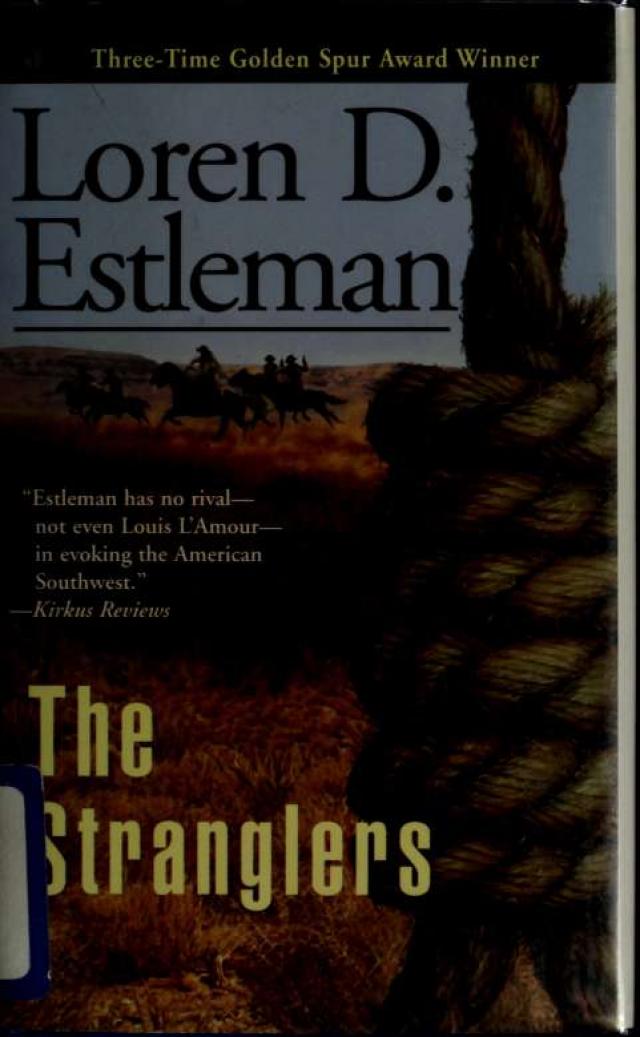
The Stranglers, page 7
part #4 of Page Murdock Series


"Before we go any further, let's get square on who makes those decisions in Helena." Blackthorne was sitting straight as a schoolmaster with his blunt-nailed fingers on the near edge of the desk. "Listen. Can you hear the voice of democracy in this room? If you say you can you're a liar, because you can't hear it this far from Washington. When I make a direct request of an employee of this court, it is not open to interpretation. Flout it for whatever reason and, believe me, you'll think that powder charge in Topeka was someone belching. Would you have that clearer?"
You had to admire the Judge's control. The town still talked about the time in court he grabbed a young Virginia attorney by his cravat, no one remembered for what infraction, and pistoned his fist into the captive's face three times before letting go and allowing him to dribble down the bench into an unconscious puddle on the floor. But that had been early in the Judge's tenure, before he had learned to harness his rage, and now there was just the thrum of iron in his tone.
He and Mercy watched each other, the latter motionless except for the play of muscles beneath the skin of his face. It had been a while since anyone had spoken hard to him; that much lay right on top where you could look at it. The last time would have ended noisy. But in that close book-lined room with the torn flag on the wall and the little chin-whiskered man behind the desk there was something like the unseen thing that forbids laughing in church. Finally the brim of Mercy's hat moved down and up slowly. "It's clear."
They were almost the same words I'd used when Colonel Hookstratton had explained the rules of Sunday's shooting contest. Something left then, and Blackthorne sat back. "We'll not waste time fetching your brothers in here. I'm in court in forty-five minutes. You'll have to fill them in later."
He indicated the chair next to mine. The marshal hesitated, then removed his hat and sat down, hanging the hat on his crossed knee. His hair was the same even black all over, though not glossy like Frank Willard's, and receding along both sides of a sharp widow's peak. There was a band of fair flesh across his forehead where his tan quit.
The Judge offered him a cigar from the humidor on his desk. Mercy accepted it and bit off the end and took it out of his mouth and found the wastebasket and got rid of the end. He let the Judge light the cigar, turning it in the flame of the match, then settled back and shot smoke at the ceiling. I took advantage of the pause to get up and crack the window. It was a small room like I said, and I don't smoke. I sat back down.
After a curt preamble from Blackthorne I told Mercy about the two men found decorating a tree during the Creel chase. The marshal listened with what looked like interest.
"We think they might have been a pair of Pinkertons that came up missing while tracking a gang of stage robbers from Wyoming," added the Judge. "There's a chance this lynching is connected with two other lawmen hanged in that same general area last month."
"Vigilantes?" suggested Mercy.
"Or just a gang of hotheads," I put in. "They don't hold us in high regard in that country."
"They get impatient waiting for justice up around there, I guess."
"They'll know justice on my gallows," Blackthorne growled. "I want you and your brothers to ride up there and ask some questions."
Mercy drew in a lungful of smoke, held it, and let it curl out under his moustache. "We will not get answers out of their like."
"Perhaps not. But it's important the questions be asked. Lynch law passed out of fashion in Montana when I accepted this appointment. I want them to know that up there, and also to know I mark the sparrow's fall in my jurisdiction."
"I was told you have men up there now."
"They're on a different manhunt. It would slow them down."
"Is that why you called us all this way? Why can't you send Murdock?" He spoke bitterly around the cigar clamped in his teeth.
"Deputy Murdock is testifying in court Wednesday."
"I didn't pin on this star to run errands."
"You pinned it on for forty a month and six cents per mile." The iron was back. "If you counted on more I'll trouble you for it."
Mercy rose, killing the cigar in the heavy brass ashtray on the desk. "When do we leave?"
"Whenever you can," said the Judge, expansively. "You'll want a packhorse and supplies, as this may take a while. See my clerk for expense chits."
"Tomorrow, then. First light."
"First light tomorrow will be fine."
"That it?"
"Unless you have something else to discuss."
"No," said Mercy, glancing from the Judge to me. "No." He left us.
"That's an unhappy man," I said.
"Indeed." Blackthorne pushed out his cheeks in a burst of air. "Did you notice toward the end how he stopped talking like a character in a novel?"
"He had plans that didn't include leaving Helena for a while."
He studied my face. "Maybe. And maybe he's just been giving orders so long that taking them doesn't fit any more." He glanced at the clock. "Mr. Springer's waiting for you in Marshal Gordon's office."
I got away from the prosecutor a little before eleven. He was due to relieve his assistant in court at the end of the noon recess and he wanted to have lunch and then confer with the Judge during the latter's walk home. While I was walking along the boardwalk breathing the sweet outdoor air, three pairs of spurs came up behind me with a noise like coins banging around inside a jar. At the end I turned sideways and nodded at the three Mercys.
"You have eaten?" Jordan inquired.
I said I hadn't. He said the Belmont served a fine free lunch and I said I knew that and he said he would like to buy me a beer and I said that sounded pretty good and the group headed that way.
The saloon was almost deserted at that time of day. We ordered four beers and four roast beef plates and retired to the curtained alcove where poker was played evenings. Joshua, true to his girth, was the most serious eater of the family. He hung his frock coat on the back of his chair, removed his cuffs, and tucked his blue-and-white-checked napkin inside his collar before digging in with his knife and fork. Young Jericho poked at his potatoes as if he expected blood to come out. He looked disappointed when it didn't. I was starting to feel about this quietest of the brothers the way I felt about Frank Willard. His face had a girlish look, his complexion like roses and milk under the superficial tan. He had very long lashes and his thick, sullen lower lip was as red as rouge. The fine black moustache looked pasted on. I didn't have a handle on him and wanted one.
Jordan sawed off a piece of beef, chewed it throroughly, and swallowed before speaking. "I see what you meant before about the Judge."
"He does his job his way." The meat tasted salty. I washed it down with beer.
"I fail to see how you put up with him," he said.
"Most of the time I don't have to."
"Yes, I thought your skin was too burned for town life. You know your way around a gun."
He waited, expecting me to return the compliment. Instead I said, "Did that surprise you?"
"Not really. You have the look. But there are a considerable number of men walking around with guns in this country who can barely remember which end the bullets come out. Josh thought you were just another dandy."
I glanced down at my town clothes. My collar was growing hair and one of my shirt buttons didn't match the rest. With his mouth full Joshua said, "I meant that iron of yours. It looks like a walking-around piece, not something you shoot." He drained off half his beer and licked foam off his walrus moustache. Grease plastered down the hairs.
"It's the second one of these I've had," I said. "I lost the first in Dakota. The cowman who brought me up willed it to me when he was dying with a Cheyenne arrowhead in his liver."
"Not much to leave a person," Jordan commented.
"He didn't have much to leave. We seem to be using up a lot of time talking about one gun."
"I guess when schoolteachers get together they talk about books just as much." Jordan touched his lips with his napkin and pushed his plate away. "We could use a man like you."
"I thought we had a man like me already."
"I mean Josh and Jer and me. While you and I were with the Judge I had them scout out the town. Helena is a rich place. You don't often see this many brick buildings where wood is so plentiful and cheap. Enough gold and silver comes through the assay office each week to fill a train you will not want to wait for at a crossing. Most places, you look at a man's clothes to learn how well he is off; here you look at his pockets. Every other miner has his overalls stuffed full with ore samples. Chicago Joe must clear a thousand a month just from the gold dust spilled in the cracks of her floor and answers to no one for it. There is so much money here they play with it the way an Indian strings double eagles around his neck because they look pretty."
"This m-morning I seen two guys b-bet f-f-five hundred b-bucks on whether a b-bird sitting on a telegraph wire would f-f-fly west or east when it lit out," volunteered Jericho.
He stared down at his plate as he spoke. I knew then why he kept silent most of the time. I said, "Which way did it fly?"
The youngest Mercy glanced at me swiftly, and something like a grin briefly turned up the corners of his moustache. "S-south."
"The point being," Jordan cut in, "that it is high time someone showed these people the value of their money."
"By taking some of it away from them," I finished.
"It is not as if we were offering them nothing in return. Security has its price."
"They pay it through licensing fees now."
"It is a poor figure for the risks we are taking. A town with this many growing concerns should not have to yield more than twenty dollars per merchant each month. It would mean a substantial income for each of us on a regular basis."
"Thanks, but I don't spend what I'm getting now."
"Then save it. When statehood comes you will have enough to buy into the governorship."
"That sounds like your dream, Mercy. It sure isn't mine."
He ran a polished nail around the thick lip of his glass, making it ring dully. "The frontier cannot last," he said. "The time is coming when men like us will no longer be needed or wanted. Where will we end up? Swinging a stick on a street corner in St. Louis or plugging peach tins in a show like Colonel Hookstratton's. Now is the time to feather our nests, while we still have strength to lift the feathers."
"Talk to Frank Willard."
"He is all hand and no head. Any fool who practices can draw a gun fast and hit what he aims at. Shooting at targets that may shoot back requires something more. You have to make your mind up before you leave the house that you are going to kill someone today, and you have to do that every day because you never know which day you will be called upon to keep that promise. It requires a man with his senses about him. I am telling you nothing new."
I slid my knife and fork onto my plate and emptied my glass. "I'm not sure I could get used to collecting taxes at gunpoint. I appreciate the beer. I haven't had to buy one since I got back to town. Everyone keeps making me offers." I rose.
Jordan leaned forward and caught my wrist. "If you will not stand with us, I hope you will not stand in front of us."
He was looking up at me with nothing but sincerity in his doe eyes. The others had stopped eating and drinking. Their hands were out of sight under the table. I removed Jordan's hand gently, nodded to his brothers, and went out through the curtains.
"I told you, I got business with Mr. Murdock."
The voice in the main room came from the batwing doors, where the bartender, a former prizefighter from Denver, blocked the way with a short solid length of pool cue in his broken-knuckled hands. "I don't care if it's with Paddy bloody Ryan. No niggers in the front door."
The old Negro who ran the livery stable caught sight of me over the bartender's side-of-beef of a shoulder. "Mr. Murdock! They said you was in here."
Call it reaction to the scene with the Mercys or plain lawman's instinct, cold iron stroked my spine to the base of my neck. I asked him what he wanted.
"I done tried to talk to the Judge, but he's in court. Cocker Flynn's horse, he done come back to the livery just now. Without Mr. Flynn. Saddle's got blood on it."
I shoved the bartender aside the way twenty-three fighters in their prime had failed to do, and outran the Negro to the stable.
TEN
I found him three miles outside town, lying alongside the same road he and the Swede and the two sheriff's deputies from Great Falls had taken two and a half days earlier on their way to find Harvey Byrd and the Indian.
At first I missed him. There was the unusual amount of tree fall cluttering the landscape after a hard winter, and in the dull browns and grays that Flynn wore on manhunt he looked like just another toppled-over stump in the tall tan grass. I passed by him with hardly a glance, but then the iron touched my back again and I turned the sorrel and there was Flynn's dented Stetson resting crown-down on top of a fresh gopher mound as if he had laid it there while he took a nap. I stepped down and knelt and placed my hand on the back of the short wide man stretched out on his stomach with crickets crawling over him. I could feel the pumping of his strong heart through his shoulder blade, straining more than ever now that there wasn't as much left to pump. I slid the hand under him to turn him over gently and felt the thick warm stickiness matting his coat and shirt to his side and bile climbed my throat, bitter as decayed lemons, but I swallowed it and got him on his back, and against the pallor of his features the startling black of his hair and eyebrows and handlebar moustache, blacker than either Willard's or Jordan Mercy's, looked like what undertakers do to corpses to make them look less dead. It never worked with them and it didn't work with Flynn. But he was breathing. You could hear it across the road if you were listening for it.
The Negro arrived with a wagon from the livery while I was stuffing a wad of grass into the hole in Flynn's side. He grunted from the pain of it, but for the most part he was somewhere I couldn't reach him. "Where's Doc Chrich-ton?" I asked the Negro when he joined me.
"Splinting a busted leg out at the Dumphrys'. Young Jake fell off'n his horse again. Mrs. Chrichton, she said he likely be back by the time we get to his office."
We got the wounded man into the back of the wagon and I covered him with a blanket the Negro had brought and I mounted up and the Negro climbed into the driver's seat and we made our way back to town at a painful pace, the Negro trying to find a road among the ruts without pitching his passenger out of the bed.
Doc Chrichton was younger than you usually found them out there where most patients paid in chickens or worthless mining stock when they paid at all. He had a lantern jaw and blue eyes and very light brown hair hanging in wings on both sides of his forehead from a natural break in the center. His wife, a tall woman four years his senior, dark-haired and hard-faced, was a nurse. They met us in front of their house just inside the city limits and the doctor helped us carry Flynn inside while his wife held open doors. We passed through a sparsely furnished but neat parlor that doubled as a waiting room and then through an office smelling of iodine and alcohol into another room containing a cot at the back of the house. When Flynn was on the cot, Mrs. Chrichton started rolling off his clothes while her husband removed his own cuffs and washed in a basin full of steaming water. I asked him what he wanted us to do.
He wiped his hands off on a clean towel. "Close the door. From the other side. If we need you we'll call you."
A glass-fronted bookcase stood in the parlor, its shelves crowded with matched sets bound in brown leather and lined up like logs in a stockade. Medical books, an encyclopedia, the usual Shakespeare, Bos well's Life of Johnson. "That there's a fine book," said the Negro while I was studying the last.
I looked at him. The skin of his face was the same shade as the leather bindings and drawn into sharp straight creases like old cloth folded away in a trunk. His short coiled hair was the color of granite and his shirt and jeans were just things to cover his thick hard body, faded and glazed with sweat and dirt to an even gray. I said, "You can read?"
He unwrapped a shy grin with six teeth in it. "A man that owned me had a sick son. He teached me to read so's I could read to the boy when he wasn't home. I read him Boswell and most of Shakespeare and some of The Decline and Fall of the Roman Empire, and then he up and died and I got sold. I never did get to find out how that fellow Attila made out."
There was a history of Rome on the bottom shelf. I tossed it to him and took Boswell for myself and we made ourselves comfortable in a pair of worn leather chairs with hollows in the seats.
I was up to Dr. Johnson's correspondence with Edward Cave when the door to the office opened and Doc Chrichton came out fastening his cuffs. He had been with the patient almost two hours.
"The bullet transfixed his left side and came out the back," he explained. "It cracked a rib on its way through, but that's minor. I flushed the wound and patched him up front and back. Which one of you plugged the entry hole with grass?"
I told him I did.
He nodded. "You greatly increased the risk of infection. But you did slow down the bleeding. Otherwise you probably wouldn't have gotten him here alive."
"Will he make it?"
"He's lost a lot of blood. He shouldn't have made it as far as he did. But he has the strongest heart of anyone of his age I've seen. Barring infection, his chances are fair to good." He paused. "He wants to see you. I said no, but he threatened to rip out my dressing. Make it fast."
On my way through the office I stepped aside for the doctor's wife coming in from the back room with a tray full of bloody instruments. She said, "Isn't there enough sickness around without you men slinging lead at one another?"
"I didn't shoot him," I said.
"You've shot others and made more work for other doctors and not a few undertakers. I saw you out there yesterday playing with guns. What's there to be proud of in being able to kill faster and better than anyone else? I hate guns."
"They're just pieces of steel. You can't hate them or love them. Hate the people that make us use them."