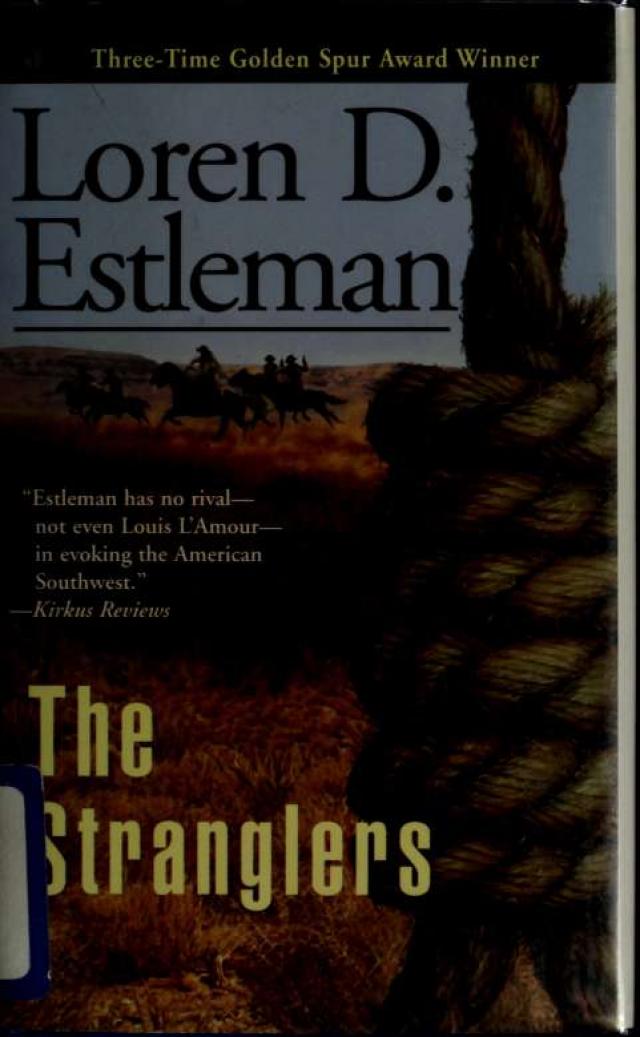
The Stranglers, page 10
part #4 of Page Murdock Series


"It's a day's ride to law from here," said the old man, smearing butter over a slice of hot bread. "I wore the bark off a limb or two in the bad times, when horse thieves was thick as grubs on a wet log. I ain't saying I wouldn't again if I thought there wasn't justice in Helena. But that fellow Blackthorne don't shy from the rope. He's got my vote for governor if we ever get to be a state, God curse the day."
"The stranglers I'm interested in don't hang horse thieves," I said. "They've been stringing up law."
He ate the bread without changing expression. "This have to do with them two you and the boy found swinging up north?"
"As like as not. Maybe you heard something."
"The boy tell you I did?"
"No," said the kid, looking at him.
The rancher used the rest of his bread to mop up the gravy from his plate. "My closest neighbor's a day off and I can't spare the day, being short one hand most of the time." He didn't look at his son. He didn't have to. "I don't hear much new till it's old."
I nodded, eating. "Well, I'd be just as happy if not everyone knew we'd been here asking about stranglers."
"I got better things to do than spread gossip. Being short one hand like I am." He called to his wife for coffee.
After supper the kid and I went to the barn to look to the horses. The kid said, "I don't know if that's the straight of it, what Pa said about not hearing nothing. I ain't around enough to know what folks is talking about."
I fired up a lantern and inspected each of the sorrel's shoes for loose nails. The kid kept talking.
"That was a mistake, asking Pa not to tell no one what we're about. He's got better things to do than spread gossip, but he spreads it anyway."
"That's what I count on." I handed the lantern to the kid, whose face screwed up for a moment in its molten light, then smoothed into something close to a smile. He bent to see to his bay's shoes.
We spent the night on feather mattresses, likely to be our last for a while, and set out again at dawn with a hot breakfast in our bellies and not so much as a good-bye from the kid's father. "He ain't long on warm," said the kid.
"That burns out soon up here," I told him.
Half an hour out we came upon the remains of Cocker Flynn's camp, the scene of the ambush. It had rained hard there recently, but the bank of rocks the deputies had started to set up for a fire that was never kindled and the mangled grass and earth where the frightened horses had plunged and wheeled during the shooting identified the spot. Here and there were brown patches darker than the bare earth, patches the rain hadn't quite been able to wash away and wouldn't for a long time. Nothing stains deeper than blood.
After a search we picked up a faint trail left by a fair number of horses and followed it to the Smith River, where we lost it. The kid crossed over and we picked our way in both directions along the squirming banks for two miles, studying the ground. We met back where we'd started.
The kid said, "Seems a long way to walk a stream bed this time of year."
"Not if you want to shake law off your spurs." We gave it up and went on to Great Falls.
The settlement was named for the roaring, steaming cataract in that knotted section of the Missouri, but it wouldn't find its way onto the maps for another two years, when the gold and silver prospectors that made up most of its population accidentally stumbled on copper, and then the smelters came in and attracted refining business from Helena and Butte. Some called the place Drewyer's Shot for the member of Lewis and Clark's party who had thus extricated himself from a situation there involving a tree and a fifteen-hundred-pound grizzly. The collection of log buildings stood on the edge of a hundred miles of trees clustered so thickly that in full leaf they looked from the mountains like an enormous lush pasture.
We attracted some attention riding down a street of ropy mud fetlock-deep. The place didn't get that many visitors, and stubble-faced men in faded flannel shirts and thready overalls swept balding buffalo robes and tattered blankets aside from the doorways to look out and see who was coming in to beat them out of their prospective claims. Many of them held big brown-barreled rifles.
None of the buildings was marked, but from my last visit I remembered which belonged to the sheriff and we dismounted and tied up in front of it. I knocked mud off my boots and led the way inside.
It was more house than office, furnished with a minimum of chairs and a crate bed with a straw mattress and a bear rug on the earth floor and a stove fashioned from a piece of locomotive boiler plate, its bent pipe escaping through a missing window pane, a greasy rag stuffed around it. A man with his hair combed forward over his scalp and a ring of dark beard like a coal-smear around his mouth was sitting at a rough table that did for a desk near the back wall. He was wearing overalls and looked like just another prospector, which he was, part-time. This was the sheriff of Great Falls. He had a shotgun cut back to pistol length pointed at our bellies.
"Throw up your hands, boys," he said quietly, in a voice webby with phlegm.
We obeyed. I said, "Page Murdock, Sheriff. We met when I came through with Sugar Jim. You remember the kid."
"Yeah." The shotgun didn't move. "I remember. You borrowed two of my best men. They're waiting for you at the saloon."
"They're all right?" asked the kid, astonished.
I told him to keep his mouth shut.
The sheriff stood. He was skinny but had a round belly like a snake digesting a hen's egg whole. "They're waiting. Let's go see them. I didn't say you could drop your hands."
The last part came out harsh. Still holding the shotgun, he told us to turn around and he came forward and lifted our guns out of our holsters and patted our chests and boots onehanded for hideouts. He straightened. "All right, hands down. Out that door and to your right, two doors down."
We walked along a rough plank that served as a boardwalk with him behind us carrying the shotgun under the close attention of the other men on the street and turned and went through the empty doorway he'd directed us to. The room was dim and stank heavily of beer and spitoons.
There were no tables in the saloon, just a bar made from another plank laid across two barrels with two more men in overalls leaning on it, watching us with glasses in their hands, and a man who was all tangled dark beard and sunken eyes and huge forearms filling a bottle from a horizontal barrel behind it. The sheriff caught his eye and he nodded once and the shotgun pushed the base of my spine and we went around the bar and through another door. That led to a back room that was actually a lean-to, containing more barrels and stacked firewood, on top of which lay an old and a young body feet to feet.
Their necks were as long as a neck could get, short of decapitation.
The kid's nostrils went white, but aside from that he showed no reaction. He had seen and done a thing or two since his first sight of hanged men. I said, "Where's the Swede?"
"If you mean that other one," said the sheriff, "we buried him where we found them. He had a hole in his chest and a cracked skull to go with the stretched neck. These two have friends here and relatives back East that might want to come read their markers someday. We didn't have horse enough to carry all three."
His mouth didn't open any wider than the shotgun muzzle to let out the words. I asked where he'd found the slain deputies.
"Just this side of the Shonkin Sag. There's trees enough to go around there."
"That's Highwood Mountain country," said the kid.
The sheriff nodded, watching me. "This Swede fellow a friend of yours?"
"He was a deputy U.S. marshal/'
"He wasn't wearing no star."
"Some killers take what they figure is handy," I said.
He considered. Then he lowered the shotgun and took a loud breath. "I reckon we're all of us losers here."
"Maybe you more than us." I accepted the return of our guns and handed the kid his Colt.
"Old Chubb Bowles there was a good lawman and a better partner." Suddenly the sheriff snorted. "Once he thought we struck the lode and rode all the way to Helena for French champagne. Didn't blink an eye when he got back and found out the gold was iron sulfide. Just knocked the necks off all the bottles and passed them around."
"Funny what being dead will do for you," I said. "I found him sour."
"That was just his way till he knew you. Town wanted him for sheriff on account of he used to be a ranger, but he said I was a better organizer and took deputy instead. That was just smoke. He knew I had a bad back and that way I could sit in the office while he done the digging and we'd still be partners." He breathed some more air. "Reckon now I got to dig and sheriff."
"Any idea which way the lynchers took?"
He shook his head. "It's mostly rock there, and we had a real gully washer night before last. If they left tracks at all they was gone hours before we got there."
"Who's we?" I pressed.
"Me and three other miners. Dutch Ike was working out that way and come back to say he found Chubb and young Tim there twisting, plus the other one."
"These other miners deputies?"
"More or less. You'll find no badges here, but hunting for gold you go a little crazy sometimes and somebody's got to keep these fellows from bashing each other's heads in."
I said, "I'd like to borrow one or two for a few days. They'll get posse pay and maybe a piece of a reward."
"For the ones that lynched Chubb and Tim?"
"Just now we're looking for someone else."
"Looking in which direction?" he asked.
"Teamstrike."
"Can't help you." He checked the abbreviated shotgun to make sure the hammer was down and slid it under his belt.
"Why not?"
"I'm just here to keep my friends from turning killer, like I said. I don't get a badge nor pay except two cents for every rat and stray dog I shoot in the vicinity and three squares a day here at the saloon. For that I don't go to no places like Teamstrike. You can talk to the others but they'll tell you the same."
"It's just a miner's town like this one," put in the kid.
The sheriff spat. "No such a thing. Maybe it started out that way, but just now it's a place to stop for all the scum in the territory on their way to Canada. Coffee's six dollars a pound there on account of them that buy it dassn't show their faces in any right town. They'd smell law coming for two miles and shoot it from one. I'd sooner overnight in hell."
He paused to measure out a long look for each of us. "If that's where you two are fixing to go," he said, "don't look for us to come in and dig you a hole."
FOURTEEN
"How many you figure?" I drew my sleeve across my JL JL mouth and corked my canteen.
The kid had just rejoined me after trotting his horse to a high mound and standing in his stirrups for the best part of five minutes, looking west. At my question he raised his eyebrows.
"You knew we were being followed?" he asked.
I slung the canteen over my saddle horn. "Ever since Great Falls. I spotted him before that, but I thought he was just a prospector. See any more than just the one?''
He shook his head. "He's riding a gray. Time to time he steps off and looks at the ground. Once he looked straight up at me, but I don't think he seen nothing. Looking down's easier than looking up, especially at this distance."
We were coming up the north slope of the Highwoods, with the ground angling sharply off behind us and the trees to our right catching fire in the lowering sun. Shadows blended the young pines in the sunken hammock of the Shonkin Sag at our backs into a dark even green like the felt on a billiard table. The channel had been carved during the last Ice Age by the stubborn Missouri when a glacier got in its way. The air up there was colder, swifter, thinner, and I could feel my cheeks and chin going numb in the wind.
We'd be sleeping with our canteens that night to keep them from icing up.
"What do we do?" asked the kid.
"About what?"
He bristled. "About our friend back there, that's about what."
"What would you suggest?"
"Well, you're the law."
"That looks like a level spot east a ways," I said, pointing with the peak of my hat brim. "We'll camp there tonight."
"And just let him come up on us while we're sleeping?"
" We don't sleep. You sleep and then I sleep. If he's one of our stranglers I can't think of a better way to make his acquaintance. But he won't be coming up here tonight."
"I'd admire to know why," he said patiently.
"Those white things you see getting in the way of the sky are called clouds. He won't have a moon to read signs by, and if he's dumb enough to try this grade in the dark he's nothing we have to worry about."
"If he was in Great Falls he knows where we're headed."
"If he felt safe enough to talk to the sheriff," I agreed. "But just like us he's got this mountain between him and Teamstrike."
"If I had a Sharps or even a Springfield I could pick him off clean from here."
I didn't say anything to that. The kid was too easy.
The level area was carpeted with sweet shoots of grass. We saved our corn by letting the horses graze and built a small fire behind a thick stand of firs for a break. The wind moaned up in the peaks and spiraled down to shiver the trees, bringing with it the metallic odor of snow that never melted. We wound ourselves in our blankets to the ears and tipped our hats forward and sat down and chewed dried meat as tough as birch bark and watched the coffee come to a boil on a flat rock next to the flames.
"You always been a deputy?" asked the kid.
"That's a damn fool question," I said. "You always been twenty?"
"I'm twenty-one. I mean, what did you do before?"
"I punched cows. Before that I punched more cows and before that I punched some more and before that I shot Rebel snipers out of trees. Between times I collected bedsores in an army hospital watching the bones in my leg knit. Anything else?"
"Just asking," he said. "I bet you was born out here. I can always spot them."
"You'd lose."
"Grew up here, then."
I nodded. ' 'In a little town you never heard of up in the Bitterroots. It's gone now. The beaver trapped out finally and wolves came in and ate the cattle. You might find a board lying around there if you looked hard."
We didn't talk again for a space. I wrapped my kerchief around one hand and plucked the smoking coffee pot up by its handle and filled our tin cups and set the pot down a little farther away from the fire and handed the kid his cup and warmed my hands around mine.
"What you figure's waiting for us in Teamstrike?" The kid blew steam off his cup.
"Mean looks, mostly. That kind generally won't bring more trouble on themselves than they've got to start with. Unless we do more than stop to buy a beer on our way through. Which is just what we're fixing to do, if the Indian is there."
"You really want the Indian, huh?"
"No more than I want the ones that shot Flynn and killed the Swede," I said.
"Well, sure, Flynn's your friend and the Swede was one of your own. But you got a thing about the Indian."
"Maybe."
"He done the same thing, though."
"No, the Indian turned."
He said, "How's that worse?"
"I don't know that it's worse." The coffee scalded my tongue. I set the cup aside to cool in the shadows beyond the firelight. "My father had a retriever, all gold with a white star on its chest. A neighbor came to visit one day when the dog and my father were in front of the house and the dog up and bit him. My father went inside and got his shotgun and loaded both barrels and came back out and blew the dog's brains apart. The neighbor said, 'Why'd you have to go and do that, Edan? It wasn't much of a bite and the dog was a good hunter.' 'Next time,' my father said, 'he might have bitten me.' "
The fire burned down to its red core. Somewhere in the darkness wings fluttered with a noise like a locomotive going wide open and something squealed and the wings beat away.
The kid said, "I never shot anyone."
"You start by watching his hands."
"I heard it was eyes."
"Eyes don't kill," I said. "Watch his hands and say to yourself you're going to kill him. Hoping it won't come to that will just slow you down and then he'll kill you. It's got nothing to do with being faster or a better shot. There's no skill to it at all. Anyone can do it."
"Sounds hard to me."
"It is. The first five times."
We finished our coffee and I laid some more wood on the fire and got up to take the first watch.
Nothing happened that night. In the dawn gray we reheated the pot and I got out the black iron skillet and greased it with bacon drippings from the can I carried in my saddlebags and paved the skillet with strips of dehydrated beef. At first the stuff coiled and twisted like surprised scorpions, but as the hot grease soaked in, the meat swelled and softened. The smell in the cold early-morning air on a wooded mountain was stomach-scraping.
"Page," said the kid.
It was the first time he'd addressed me by my Christian name. Turning the meat over in the pan with a fork, I asked him what he wanted. When he didn't reply I looked up. He was crouched on the other side of the fire with his eyes trained past my left shoulder.
I was squatting on my heels. I dropped the fork and pivoted on my right foot, throwing myself backward onto my hams as I swept the Deane-Adams out of its holster. Something metallic crunched, and suddenly the rest of my life was no longer than the barrel of a big cocked Colt staring me in the face.
"I've known warmer welcomes," said a familiar voice on the other side of the gun.
He'd maneuvered to have the sun behind him, and in the shadow of his Stetson his black bar of brow and gracefully curving moustache blended into the vague dark outline of his face, but there was no disguising that voice, flat as a piece of shale slapping the surface of a pond, or the short square solid build under the drab sturdy clothes. I said, "I gave you credit for having more brains than to pick your way up a mountain with no moon, Flynn. Or did you leave them behind at the Smith River?"