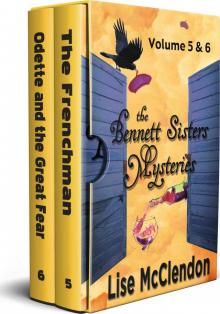
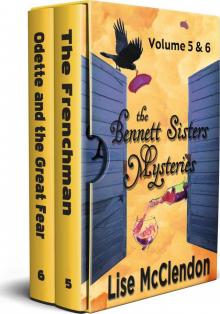
The Bennett Sisters Mysteries Box Set, page 33
part #1 of Bennett Sisters Mystery Series



Merle: I just hope nobody stabs anybody.
Francie: This cheese is so freaking awesome! Ow! Look at me! Pass the wine!
Elise: If you tell me what to do I will pout all day.
And the plus one:
Gillian: My mind is too beautiful to share.
Two days in Malcouziac resting, then they would hit the road again for three more days in a loop off to the North. The thought of it made Merle queasy. Her sisters were getting along all right, but the togetherness sometimes put a strain on things. If anybody bailed, Stasia would be livid.
Merle turned to Albert’s niece. “Have you and Tristan had fun, Valerie?” She put her hands on her son’s shoulders. Maybe this was all the hug she’d get. Her boy was sixteen now.
“Oui, madame. Nous—pardon, I am to speak English.” Valerie rolled her eyes. “It sounds terrible to me.”
“It sounds great,” Tristan said. “I love your accent.”
Valerie gave him a playful punch. “What accent?”
At fifteen the girl had already perfected the French pout, the ammunition against men for centuries. She turned up her nose, folded her arms, smirked, and burst out laughing. She was going to be a handful, if she wasn’t already.
“Thanks so much for looking after my boy, Albert,” Merle said.
“Valerie took charge of activities. I only feed the man.” Albert wagged his finger. “Not a boy any longer. So tall!”
“And handsome,” Valerie chimed in. “With big shoulders.” Her violet eyes flashed at Tristan again.
Merle tapped his big shoulders. “Come say hello to the aunties, Tris.” As he got up, Valerie did too, straightening her chic print blouse that clung to her chest and tugging down her mini-skirt.
“Oh, madame, I will love to practice my English on them!”
“Dinner at nine,” Albert called as they trailed through the back garden to the alley and through Merle’s garden gate.
The women dressed for dinner, changing into summer dresses. Merle had been able to rent her neighbors’ house as her own was too small for all of them. They had been very generous. Elise, Francie, and Gillian were staying in Yves and Suzette’s house next door. It was much more modern than Merle’s, with a full bathroom on the second level and everything very chic. It made Merle’s tiny maison de ville look medieval.
When the younger three showed up in the garden for wine before heading to Albert’s, they looked refreshed, shampooed and powdered. Elise, youngest and shortest sister, wore a flowered skirt and crisp, white blouse. Francie had on a fitted dress with the kind of low neckline she liked. Gillian had transformed herself with a short lilac dress with black lace insets better suited to New York than rural France. She’d worn it to dinner twice already, with her thick brown hair twisted artfully on her head. She took a glass of wine and stepped away without speaking, as if fascinated by the ripening pears as she tottered on four-inch heels.
“How much do you think that dress costs?” Stasia whispered in Merle’s ear.
“Whose?”
“Gillian’s. I saw it at Fashion Week. It’s couture, some Italian designer.”
“Looks expensive.”
“Pucci. That’s it.”
“Really? I thought he did all those blocky, colored things.”
“Look at you, fashionista. That’s why this dress stood out. Isn’t it divine? I checked it out at Bergdorf’s. I lusted after it.” They watched Gillian move carefully over the dirt, bending to sniff the roses. The black lace seemed to glow. The dress was kind of amazing.
As assistant managing editor at Gamine, a trendy women’s magazine, Stasia had access to all sorts of insider perks. Last winter, she’d arrived at Merle’s with an armload of sweaters and let her take her pick. “Wouldn’t Gamine give you one?”
“Are you kidding? I can’t believe she has it. Of all people.” Stasia leaned closer. “Way too pricey. Eight-thousand.”
Merle sloshed her wine. “Dollars?”
“I have a personal limit for a single item. Kinda way over.”
Merle stared at the dress. It fit Gillian like a glove. Those shoes look spendy too. Who would pay eight-thousand dollars for a dress? “She must be making some serious cash,” Merle muttered. But Stasia had moved away to talk to Elise. Their youngest sister was already on her second glass of wine. She’d twisted her ankle the first day out, not bad enough to stop walking. No one saw any swelling. But Elise took it as a sign of doom. She used to be such a sunny person before she went to law school.
Wine and Franglais flowed freely at dinner between Valerie, Albert, Tristan, the sisters, Josephine, and Gillian. Josephine wore her ever-present pearls and brought a huge terrine of cassoulet rich with duck sausage. Not a usual summer dish, she explained, but one she’d made so often she could make it with her eyes shut. They were all sated with food and wine when Gillian stood up, clinking her glass with her knife.
“Thanks for dinner. It was good.” She nodded gravely at the old people. Merle blinked, fatigue slowing her reflexes. Was Gillian making a speech? “I can’t go to that church or whatever it is you’ve cooked up for tomorrow.” She looked at Albert. “We found this little dog, hurt, by the side of the road today. He’s in a village with an old lady. I don’t trust her. I have to go get him.”
She sat down abruptly. Francie recovered first, sitting on her left. “I’ll go with you. I don’t think I can stomach another church.”
“I found him. I want to go by myself.”
She glared at Francie who blinked, confused. “I didn’t—”
“I’ll go, and Valerie can too. I love dogs,” Tristan said, carrying dirty plates.
Valerie pouted. “I am to leave tomorrow. Back to Paris.”
“Well, I can go. Can I go, Mom?”
Gillian folded her arms. “I don’t need anyone to go with me. I just need to use the rental car.” She looked up at Tristan, appraising his worthiness or manliness or something. Merle felt a shiver. Gillian squinted against the candlelight. “All right. He can go.”
Rapport de Police, Midi-Pyrénées. 18 June.
M. Jean Poutou, resident of St-Paul, Lot, called to report a stolen dog. Poutou, age 82, was confused and upset. Wailing heard in the background. Claims expensive dog used for truffle hunting was released from its pen and taken from grounds. Unsure of date of incident, possibly as long as three days ago. No explanation for why dog was unattended for such a long time. Dog belongs to grandson not currently on premises and has imbedded ID chip (dog, not grandson.) Advised that les policiers do not look for lost dogs and to call insurance agent.
Patrick Girard, Commissariat de Police, Toulouse
In the Italian Piedmont
Bettina Dellepiane arranged her silver hair in the intricate way she always did, sitting at her dressing table. She lowered her arms and sighed, peering into the mirror. The lines on her face were deeper. She hadn’t been sleeping well. Worry about the business had reached a pitch that it buzzed in her ears all day and night: Bankruptcy. La Famiglia. Land gone. Legacy lost.
She must save it. It was on her own neck that things had taken such a turn. She had mismanaged, miscalculated, or something. She had no choice. That hurt the most, that because of her actions, her grandchildren might never experience the richness of this beautiful country with its oaks and olive trees, never take their own children by the hand and trek with the dogs in the age-old treasure tradition that was ricerca del tartufo, the truffle hunt.
She stood, straightened her old back, and went to work on the accounts. The sorting sheds were silent now. The truffles would not come for several months, depending as always on the weather. What if the land was depleted? Truffles took years to mature, to acquire that unique pungency, the flavor of the woods. The inferior Chinese truffles that some tartufai mixed into their bags proved that. And the ridiculous Americans who had begun seeding oaks in that country: they made her laugh. Their great-grandchildren might benefit.
At mid-morning she sipped an espresso and stepped into the sunshine. A warm breeze blew down from the hilltop. When the telephone rang, she shook herself out of a reverie of days past, her husband young and vibrant, her boys tumbling and playing, the dogs of legend, straining leashes at the scent.
“Signora, we have bad news.”
Bettina closed her eyes. “Sì? Tell me.”
“The dog has escaped. We will find her but it will take longer. We know where she went.”
Maldestro idiota. Maybe she was the idiot to think those two olive pickers would come through. She had given them five-hundred euros that she’d never see again. She remembered the rheumy eyes on the one called Hector, the twitch in the unshaven cheek of gimpy Milo. They were difettoso—defective.
She felt her temper rise and let out a curse. “And how will you find it?”
“The microchip. It sends a signal. We must buy a gadget, what do you call? We will need money for that. We—what’s that?”
Milo, talking in the background. Curses flying.
Hector returned. “Mi dispiace, signora. The chip is gone. Milo removed it so the owners could not trace the dog.”
Bettina sat heavily on a hard chair, staring at the phone before putting it back to her ear. She had been so desperate for a good dog. She promised them five-thousand euros if they brought back an excellent truffle dog, one she heard about last year. Two days before, they had been successful. Her hopes had risen. It was not right, stealing, but for the cause of saving the estate for the grandchildren, a necessary evil. And now this. It was hard to see this as anything but the end of la famiglia.
“She can’t go far, signora. She is a little thing. Good nose, but small and skinny. A highly trained dog, the best, all the people say so. We will find her. You can count on us.”
A horn honked insistently on rue de Poitiers. Merle was upstairs, catching up on email. She frowned at the noise. Finally, she walked to the front window and opened the glass panes wide. The little blue Renault they’d rented in Bordeaux was parked on the street below. Gillian sat behind the wheel, jamming on the horn. She looked up, saw Merle, and stuck her head out the window.
“Come on. We have to get the dog to Bergerac before they close. Hurry!”
Minutes later, having scooped up her translator, Gillian flew out of Malcouziac, skidding tires on the cobblestones. Merle hung on to the Renault’s door handle as they jack-knifed onto the narrow highway, a road built for oxen. Tristan slid across the back seat with the dog in his lap.
“I’m going to get sick as this dog if you keep that up,” he said. Gillian slowed but rapped her fingers on the steering wheel nervously. The story emerged that they’d found the dog feverish and limp and felt it was their duty to rescue her from the clutches of the evil nurse. Beyond that neither Tristan nor Gillian appeared chatty so Merle just waited until they reached Bergerac. The industrial town on the plains of the Dordogne probably wasn’t listed as one of the Beautiful Villages of France, but its commerce was decent. And they had veterinarians.
It was nearly noon when they reached the office of Jules Fabien, Docteur en médecine vétérinaire, in an old building in the center of town. Much of the old town had been demolished years before, but his building looked medieval with whitewashed stone and red shutters. They double-parked and rushed inside with the dog in Tristan’s arms. An old woman with a tiny white Bichon let out a squeak and clutched her puppy to her breast.
Merle rang the bell. When the assistant showed up things went surprisingly fast. They were whisked into an exam room where the veterinarian saw them within minutes. The French did love their dogs. And their sacred lunch breaks which often lasted until three. The vet was adamant: they must leave the dog, and she must have IV antibiotics for the infection. Gillian looked distraught, hugging the animal, but agreed.
They found a café with outdoor tables three streets over in an old square and ate hearty country lunches, their appetites spurred by the morning’s drama. Salade paysanne, the enormous peasant salad with meat and eggs for Merle, plus a glass of rosé and an omelet for Gillian. Tristan made quick work of his croque monsieur and fries. By two they were back on the road. The sisters were already back from their excursion to see an enormous clock in a nearby cathedral.
Gillian parked the rental car and glanced at Merle. She seemed reluctant to trust anyone, and now she had to accept both the vet’s advice and Merle’s translation. “What did he mean that she was near death?”
“I think you got her there just in time. She had a high fever and the wound was infected. That’s why they put her on the IV.”
“It was such a small wound. Was it an accident? Could he tell?”
Merle hadn’t translated that part for her. She wasn’t sure she heard it right at the vet. But a quick check in her French/English dictionary proved she wasn’t wrong. They stepped into the street. Merle looked at Gillian sympathetically. “He thought it might be a gunshot wound.”
“What? Who would—?” Her eyes welled. She ran into the neighbor’s house, her hand over her mouth. Tough-as-nails Gillian seemed the last person to cry on this trip. Some of her sisters were well-known for tears. Tristan watched, eyes wide, as Gillian slammed the door and disappeared.
“Did she run over her dog or something?”
Merle put her hand on his shoulder. “I have no idea.”
The front door was open wide again and the sound of voices came from the garden. Someone had dusted and rearranged the chairs. A vase full of fresh flowers dressed the heavy dining table. Tristan flopped on the sofa, making it squeak, and pulled out his summer reading. Catcher in the Rye was on the agenda.
“Holden Caulfield. What a douche,” he declared.
Stasia stood in the kitchen doorway with a strange smile. “Got something for you. Come on.” She grabbed Merle’s hand and pulled her out toward the garden.
She saw the black T-shirt first and stumbled on the gravel. He had his back to her, waving his hands while talking to Francie and Annie. Francie was giving him full-on, cleavage-baring attention until she saw Merle. Then she smirked, straightening.
He turned, smiling. Pascal looked exactly the same, as if a year hadn’t passed since they were in this garden together. His black hair still curled over his collar, his jeans still fit, and his sunglasses were parked on his head, holding back that lock that always fell across his forehead.
He stepped toward her, taking her shoulders in his rough hands. “My little blackbird, you flew home.” He leaned in to kiss her cheeks, not twice, but three times. She counted.
His voice cut through her like a warm knife. She’d spoken to him a few times over the winter but the conversations were always short. He was working on a big case, she needed to be somewhere. There was never time. And what could they talk about? They hardly knew each other.
But if the physical reaction her body was sending was a clue, that didn’t matter. Oh holy Jesus. James was coming in a few days. And here was last summer’s l’aventure in all his Yves Montand, swarthy, earthy Frenchness. She couldn’t speak.
Annie came to her rescue. “Pascal was telling me and Francie about the night the thieves tried to steal your wine, Merle. You forgot a few details when you told it.”
Francie’s eyes fluttered. “Wow, Merle. You saved the day.”
“It wasn’t really—” Her voice caught.
“Yes, it was.” Pascal took her hands. “You look fantastic, Merle. Your hair has grown. I like it.”
She pulled her hands away, embarrassed. Her sisters watched like cackling vultures. “You, ah, too. Are you back in town?”
“For a few days. Annie didn’t tell you?”
Merle squinted at her oldest sister. Her wavy, graying hair was threaded with lavender blossoms like a hippie princess. She wore a white peasant blouse with cargo shorts and seemed quite pleased with herself. “She forgot to mention it.”
“What kind of wine do you have, Merle? Never mind, I’ll check.” Annie launched herself toward the house. “Francie, get glasses. Stace, do we have olives or something? Let’s celebrate. Pascal is back!”
After they disappeared inside, Pascal took Merle’s hands again, smiling. “Charlie’s angels are on the case.”
She rolled her eyes. “More like herding cats. Annie invited you?”
His lip twitched. She’d forgotten about that, a sly, endearing smile revealed in a tiny twitch. “Are you mad?”
“No, of course not.”
“But you didn’t tell me you are coming to France.”
“I’m sorry. I know.” She looked up at his face and couldn’t resist touching his chin. A three-day beard, scratchy, flecked with gray. “Things are complicated.”
“Are they?” He kissed her quickly on the mouth. “I hadn’t noticed.”
He was pulling her close for a serious kiss as Tristan’s voice broke in. “Pascal! You’re here, man!”
They spent the afternoon drinking wine and getting caught up on the legal woes of the thieves from last summer. One was in a French jail, one in a British one, one got a slap on the wrist and lost his job as mayor. That news, that the awful mayor of Malcouziac had only lost his job, that nothing could be held against him, made Merle’s blood boil. He was the sort of slippery, corrupt elitist she had way too much experience with in New York.
“Is he still around here?”
“I believe so. I’ve been on the Côte d’Azur most of the winter.” He smiled smugly. “It’s a tough life.”
“What about the sister of the vineyard owner?” Merle asked.
“She got a short sentence,” Pascal said. “I think she runs the vineyard now. She was able to hang onto it.”
“How did she manage that?”
“We are keeping an eye on her, chérie.” He patted Merle’s arm. “A strong sense of justice, this one. But all the sisters are lawyers. You are all this way?”
“She’s the worst,” Elise said. “Everything is black and white with Merle.”
“That’s not true,” Merle protested.