BAF 64 - Kai Lung Unrolls His Mat, page 1
part #64 of Ballantine Adult Fantasy Series


15-07-2024
Ernest Bramah is truly a writer for adults. He is a master of towering clouds of words that pile delicate fantasy upon fantasy—clouds shot through, however, with the lightning of satire, with the homely and charming earthiness of his people.
Rich, dry, droll, satiric, and above all, unique—these are just a few of the attributes that permeate the works of Ernest Bramah, and most particularly that body of work in which he retails the adventures of Kai Lung.
“Sly suavities, delicate evasions of language, carried to the point of fine art.”
—Clifton Fadiman
“This book, set in the never-never land of dynastic China, is a satiric, ironic commentary on the eternal veniality of human nature. Mr. Bramah has a droll, supple hand; the reader will find both the incongruity and the custom funny.”
—Mary McCarthy
“The pages of Bramah have the bouquet of the rarest tea, of a kind not imported, and drunk only by mandarins of the highest button…”
—The Bookman
BOOKS BY
ERNEST BRAMAH
ON THE BALLANTINE BOOK LIST:
Kai Lung Unrolls His Mat
Kai Lung’s Golden Hours
KAI LUNG
UNROLLS HIS MAT
Ernest Bramah
BALLANTTNE BOOKS • NEW
Copyright, 1927, 1928 by Ernest Bramah
Introduction copyright © 1974 by Lin Carter
All rights reserved.
SBN 345-23787-0-125
First Printing: February, 1974
Printed in the United States of America
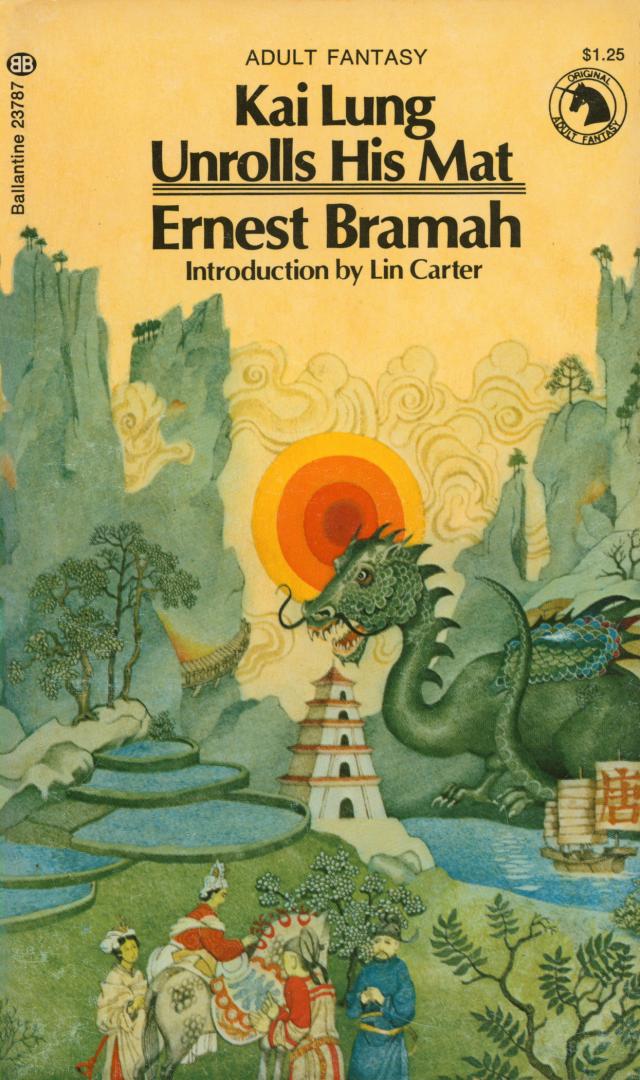
Cover art by Ian Millar
BALLANTINE BOOKS, INC.
201 E. 50th Street, New York, N.Y. 10022
Contents:-
INTRODUCTION ~ About KAI LUNG UNROLLS HIS MAT,and Ernest Bramah:
PART ONE - The Protecting Ancestors
Chapter One
Chapter Two
Chapter Three
Chapter Four
Chapter Five
Chapter Six
Chapter Seven
Chapter Eight
Chapter Nine
PART TWO - The Great Sky Lantern
Chapter Ten
PART THREE - Bringer of Good News
Chapter Eleven
About KAI LUNG UNROLLS HIS MAT,
and Ernest Bramah:
Mandarins and Magicians
In writing the introduction to the first Ernest Bramah book to appear on the Ballantine list, Kai Lung’s Golden Hours, I discussed the mystery of its author, a figure so elusive that the standard literary reference works are not certain of even the date of his birth.
Now, shy authors who shun the limelight of publicity are not rare. But it must be admitted that Bramah made a fetish of his personal privacy to an unusual degree. When the editors of Twentieth Century Authors asked him for some biographical data and, if possible, a picture, he politely but firmly declined to give them anything, answering: “I am not fond of writing about myself and only in less degree about my work. My published books are about all that I care to pass on to the reader.”
Even his publisher, Grant Richards, found him evasive and shadowy almost to the point of nonexistence. However, in his introduction to a new edition of one of Bramah’s Kai Lung books, Richards observed wryly: “I do assure his readers that such a person as Ernest Bramah does really and truly exist I have seen him and touched him [and] his portrait has been published.”
Ballantine’s reissue of Kai Lung’s Golden Hours two years ago, and my inclusion of Bramah’s superb novella, “The Transformation of Ling,” in my anthology Discoveries in Fantasy that same year, prompted a leading authority on Bramah to get in touch with me. This gentleman, Mr. William White, is an editor erf the Walt Whitman Review at Wayne State University in Detroit, Michigan, and he is, I suppose, the world’s foremost expert on our shy author and his famous and notably outspoken character, Kai Lung.
While applauding our efforts in reviving Ernest Bramah,
Mr. White tactfully corrected some of the errors I had made in that first introduction, and shared with me much of the information on Bramah that his own researches had gleaned. He was even kind enough to send me clippings and extracts of his several bibliographical articles and biographical and critical essays about the author. I can now state categorically that Ernest Bramah was indeed born, and that the event took place in the city of Manchester, England. Considerable confusion has existed over the precise date of his birth: from his autobiographical first book, you might infer it to have been in 1870; from his obituaries in the London papers, you might prefer to select the date of 1868 or 1869; or, if you happened to look him up in Chamber’s Biographical Dictionary, you might pardonably assume Bramah to have been bom in 1867. Mr. White, however, assures me that the correct date was March 20, 1868, adding, “I know this because I have seen his birth certificate.”
Bramah—his correct name was Ernest Bramah Smith—began life as a sort of gentleman farmer and wrote his first book on his personal experiences in the ars agricola. He next became a journalist, correspondent for a provincial newspaper, and eventually secretary to Jerome K. Jerome, the distinguished author of that delightful book Three Men in a Boat (to Say Nothing of the Dog). Jerome put Bramah in charge of his magazine, a periodical called To-day, and later Bramah edited another journal called The Minister.
Abandoning these quasi-literary fringe professions, Bramah became a genuine writer—officially—on July 1, 1899, when he sent Grant Richards the manuscript of The Wallet of Kai Lung. As Richards later recalled, the typescript was “sewn book-wise into a wrapper of brown paper,” an eccentricity which Bramah seems to have performed on every one of his manuscripts, or, at least, of those which Richards himself saw. The book had previously been rejected by several major publishers, including Fisher Unwin, the ancestor of the present British firm of George Allen and Unwin, the discoverer and first publisher of The Lord of the Rings.
Grant Richards found that first Kai Lung book a delight to read, and published it in 1900. No one in England seemed to agree with him on this subject, however, for the first edition took “years to sell out.” That first edition, by the way, in keeping with the traditions of British publishers, who are somewhat more modest than many of their American counterparts, consisted of only one thousand copies. A sequel, Kai Lung’s Golden Hours, was much more “immediately successful,” as William White puts it in his article, “Some Uncollected Authors: Ernest Bramah,” in The Book Collector. The implication here, which seems aesthetically valid, is that the more deeply Bramah worked his way into the ambience of his wholly imaginary and completely absurd “China,” the more his creative imagination became liberated. By the time he sat down to write the present book, Kai Lung Unrolls His Mat—first published in 1928—he was at the top of his powers and completely in control of his material and milieu.
In the present book, for example, Bramah exhibits a greater ability to weave a story than appears in the earlier books. One of the things people generally like least about the early Kai Lung books is the unfortunate fact that Kai Lung is not really a part of what is going on in the story; rather, he acts more as an outside observer, his only real function being that of a master of ceremonies who is around in order to tell one of his delicious, witty, and urbane stories at measured intervals.
In Kai Lung Unrolls His Mat, the ubiquitous teller-of-tales is up to his plump, inoffensive neck in the foreground story, the tales told in the course of the book are far fewer than we usually find in a Kai Lung volume, and the whole thing is more cohesively woven together into a single book-length narrative. I think this is what most people want to read; I know I find it considerably more enjoyable than some of the earlier, more fragmented books in the series. It must be the closest thing to a novel Bramah had written thus far in his career.
Let me hasten to add, however, that despite this major structural innovation, which is the sole point of difference between this and the early books, everything you liked in Kai Lung’s Golden Hours you will find here in the pages of Kai Lung Unrolls His Mat. The same delightfully wacky vision of a China that never really was, the same shadowy landscape of bamboo forests, quaint peak-roofed cities, soaring mountains, deep gorges, gliding rivers, sunny skies. And the same sort of characters: placid mandarins, ferocious bandits, sinister magicians, suave yet barbaric and primal dragons, mysterious apparitions, adroit enchanters, cunning rogues and sly tricksters, plucky and resourceful damsels-in-distress, and all manner of celestial and supernatural and spiritual personnages.
Above all, Bramah’s inimitable prose has lost none of its sleek burnish, its ornate witticism, its graceful and ironic language, its humor, its outrageous contradictions. The epigrams with which Bramah bejeweled his pages are still present. Few since Oscar Wilde had such a gift for the epigram, that rarest and most difficult of all the literary arts. Once exposed to Kai Lung’s grotesque drolleries, many readers will become addicted to them, as this editor did long ago. I cannot resist proving my point by quoting a few jewels from my notebook-collection of Bramahisms:
It has been said…that there are few situations in life that cannot be honorably settled, and without loss of time, either by suicide, a bag of gold, or by thrusting a despised antagonist over the edge of a precipice on a dark night.
[Of a pretty girl] After secretly observing the unstudied grace of her movements, the most celebrat
Two resolute men, acting in concord, may transform an Empire, but an ordinarily resourceful duck can escape from a dissentient rabble.
White observes that much of the charm and succinct wit of the Kai Lung books derives from the simple artifice of adapting the English language to Chinese ways of thinking and speaking. Indeed, in translating the mannered and formal Oriental speech-pattern to the English idiom, Bramah produces something far more subtle than mere farce. Character and situation blend effortlessly, smoothly, extruding a keen edge of razor-sharp satirical effect. The aplomb with which Bramah’s characters react to the most horrendous or difficult situations is in itself vastly amusing. It is not, as White points out, every inmate of a pitch-black dungeon who would protest against considerable personal indignity with such a tactful statement as: “If it is not altogether necessary for your refined convenience that you stand on this one’s face, he for his part would willingly forego the esteemed honor.”
At times, however, Bramah’s characters are so provoked that their bland imperturbability abandons them and they become ruffled. Yet the mannered Eastern diction lends a veneer of wit to even an outright insult, as when one character snarls at another, “Thou concave-eyed and mentally bed-ridden offspring of a bald-seated she-dog!”—which recalls to mind the elaborately Oriental insults in George Meredith’s The Shaving of Shagpat. At other times Bramah’s epigrams take on some of the universality of true aphorisms, as when a character states, “To regard all men as corrupt is wise, but to attempt to discriminate among the various degrees of iniquity is both foolish and discourteous”; or, “It is possible to escape from an enemy carrying a two-edged sword but not from the interference of a well-meaning woman.” This coining of aphorisms by Bramah reminds me of the greatest of all writers gifted in the perfection of that small, unusual art—another Smith—Logan Pearsall Smith, whose little books, Trivia and More Trivia, are among my treasures.
The humor implicit in adapting the Oriental mode to Western language and institutions enables Bramah to do a great many delightful, but small and subtle things. Be warned, therefore, and be on the lookout for them. When, for example, Bramah refers to a caste called the “Hereditary Confederacy of Superfluity-Removers and Abandoned Oddment-Gatherers,” he is really talking about garbage-collectors. And when he mentions the “Kochow Throng of Hechild Track-followers,” it isn’t very difficult to figure out that he means the Boy Scouts. He does this sort of thing endlessly, and with enormous sly humor.
The present book, then, affords a refreshing contrast with our first Kai Lung. When the nefarious Ming Shu carries off the beauteous Hwa-Mei, it is up to plump, placid, verbose, and amiable Kai Lung to somehow rescue the distressed damsel from the malicious mandarin. The odd assortment of rogues, vagabonds, bonzes, and charlatans he encounters on his quest makes for a light but delicious literary repast which may seem too rich to the many, but is delectable fare to the few.
A reviewer of Kai Lung Unrolls His Mat observed, when the book originally came out back in 1928, that it was “subtle, suave, and intricately satirical.” I have no quarrel with this remark, but far more interesting and to the point was the concluding observation made by this receptive early critic: “We only refrain from saying these books are the best of their kind because we know of no others that are at all like them. They are really unique.”
And so they are. And so, especially, is Kai Lung Unrolls His Mat.
—Lin Carter
Editorial Consultant:
The Ballantine Adult Fantasy Series
Hollis, Long Island, New York
PART ONE
The Protecting Ancestors
Chapter One
THE MALIGNITY OF THE DEPRAVED MING-SHU REARS ITS OFFENSIVE HEAD
As Kai Lung turned off the dusty earth road and took the woodland path that led to his small but seemly cottage on the higher slope, his exultant heart rose up in song. His quest, indeed, had not been prolific of success, and he was return* ing with a sleeve as destitute of silver taels as when he had first set out, but the peach tree about his gate would greet him with a thousand perfumed messages of welcome, and standing expectant at the door he would perchance presently espy the gracefully outlined form of Hwa-mei, once called the Golden Mouse.
“As I climb the precipitous hill-side,” [he chanted],
“My thoughts persistently dwell on the one who awaits my coming; Though her image has never been wholly absent from my mind. For our affections are as the two ends of a stretching cable—united by what divides them;
And harmony prevails.
Each sunrise renews the pearly splendour of her delicate being; And floating weed recalls her abundant hair.
In the slender willows of the Yeng-tse valley I see her silken eyelashes,
And the faint tint of the waving moon-flower tells of her jade-rivalled cheek.
Where is the exactitude of her matchless perfection—”
“There is a time to speak in hyperbole and a time to frame words to the limit of a narrow edge,” interposed a contentious voice, and Shen Hing, an elderly neighbour, appeared in the way. “What manner of man are you, Kai Lung, or does some alien Force possess you that you should reveal this instability of mind on the very threshold of misfortune?”
“Greetings, estimable woodcutter,” replied Kai Lung, who knew the other’s morose habit; “yet wherefore should despondency arise? It is true that the outcome of my venture has been concave in the extreme, but, whatever befall, the produce of a single field will serve our winter need; while now the air is filled with gladness and the song of insects, and, shortly, Hwa-mei will discern me on the homeward track and come hurriedly to meet me with a cup of water in her hand. How, then, can heaviness prevail?”
At this, Shen Hing turned half aside, under the pretext that he required to spit, but he coughed twice before he could recompose his voice.
“Whence are you, amiable Kai Lung?” he asked with unaccustomed mildness; “and have you of late had speech with none?”
“I am, last of all, from Shun, which lies among the Seven Water-heads,” was the reply. “Thinking to shorten the path of my return, I chose the pass known as the Locust’s Leap, and from this cause I have encountered few. Haply you have some gratifying tidings that you would impart—yet should not these await another’s telling, when seated around our own domestic hearth?”
“Haply,” replied Shen Hing, with the same evasive bearing, “but there is a fall no less than a rise to every tide, and is it not further said that of three words that reach our ears two will be evil?”
“Does famine then menace the province?” demanded Kai Lung uneasily.
“There is every assurance of an abundant harvest, and already the sound of many blades being whetted is not unknown to us.”
“It can scarcely be that the wells are failing our community again? Fill in the essential detail of your shadowy warning, O dubious Shen Hing, for I am eager to resume my homeward way, whatever privation threatens.”