

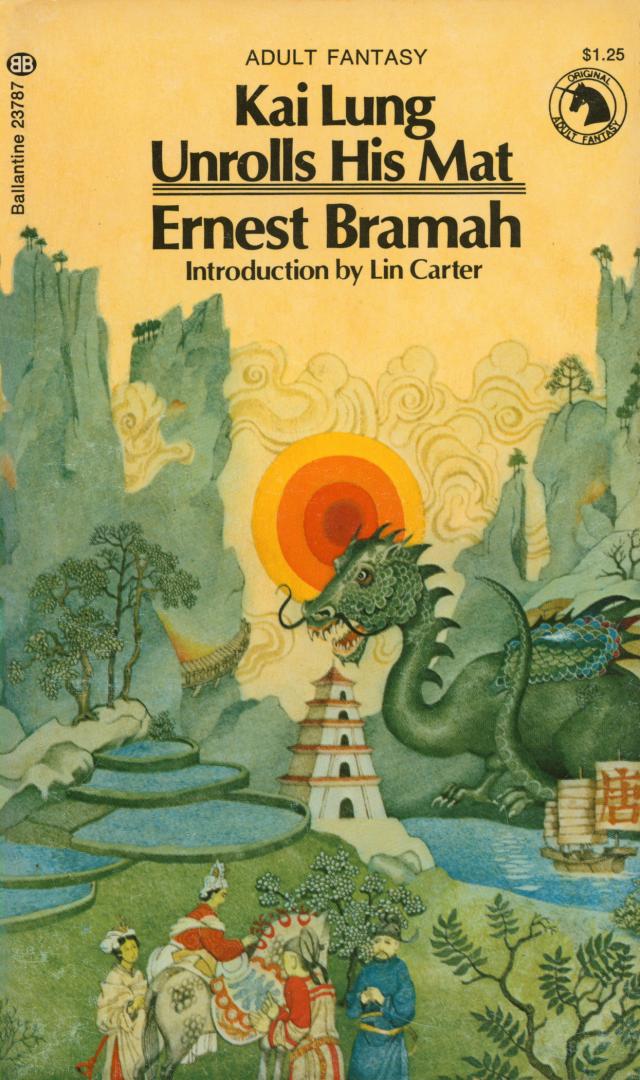
BAF 64 - Kai Lung Unrolls His Mat, page 4
part #64 of Ballantine Adult Fantasy Series


On his return from the Abode of Harmonious Ease, where the outcome of his quest has already been so insipidly described, Wan presently became aware that the chair of a person of some consequence lurked in the shadow of his decrepit door, the bearers, after the manner of their supine tribe, having composed themselves to sleep. Wan was thereby given the opportunity to enter unperceived, which he did in an attitude of introspective reverie, this enabling him to linger abstractedly for an appreciable moment at the curtain of the ceremonial hall before he disclosed his presence. In this speculative poise he was able to listen, without any loss of internal face, to the exact terms of the deplorable Hin Ching’s obscene allurement, and, slightly later, to Lan-yen’s virtuous and dignified rejoinder. Rightly assuming that there would be no further arisement likely to outweigh the disadvantages of being detected there, Wan then stepped forth.
“O perverse and double-dealing Mandarin!” he exclaimed reproachfully; “is this the way that justice is displayed about the limits of the Ia-ling Mountains? Or how shall the shepherd that assails the flock by night control his voice to sentence those who ravage it by day?”
“It is well to be reminded of my exalted office,” replied Hin Ching, recovering his composure and arrogantly displaying the insignia of his rank. “Knees such as yours were made to bend, presumptuous Wan, and the rebellious head that has grown too tall to do obeisance can be shortened,” and he indicated by a gesture that the other should prostate himself.
“When the profound Ng-tai made the remark, ‘Beneath an integritous roof all men are equal,’ he was entertaining an imitator of official seals, three sorcerers, and a celebrated viceroy. Why then should this person depart from the high principle in favour of one merely of the crystal button?”
“Four powerful reasons may be brought to bear upon the argument,” replied Hin Ching, and he moved toward the door to summon his attendants.
“They do not apply to the case as I present it,” retorted Wan, drawing his self-reliant sword and intervening its persuasive edge between the other and his purpose. “Let us confine the issue to essential points, O crafty Mandarin.” At this determined mien Hin Ching lost the usual appearance of his face somewhat, though he made a misbegotten attempt to gather reassurance by grinding his ill-arranged teeth aggressively. As Wan still persisted in an unshaken front, however, the half-stomached person facing him very soon began to retire behind himself and to raise a barrier of evasive subterfuge—first by the claim that as the undoubted thickness of his body afforded a double target he should be permitted to return two blows for each one aimed against him, and later with a demand that he should be allowed to stand upon a dais during the encounter by virtue of his high position. Whatever might have been the issue of his strategy, the conflict was definitely averted by a melodious wail of anguish from Lan-yen as she suddenly composed herself into a gracefully displayed rigidity at the impending scene of bloodshed. In the ensuement, the detestable Hin Ching imperceptibly faded out, the last indiciation of his contaminating presence being the apophthegm that there were more ways of killing a dragon than that of holding its head under water.
As the time went on, the deeper meaning of the contemptible Hin Ching’s sinister remark gradually came up to the surface. Those who in the past had not scrupled to associate with Wan now began to alienate themselves from his society, and when closely pressed spoke from behind well-guarded lips of circumspection and the submission to authority that the necessities of an increased posterity entailed. Others raised a lukewarm finger as he passed where before there had been two insistent outstretched hands, and everywhere there was a disposition to remember neglected tasks on his approach.
In other and more sombre shapes, the inauspicious shadow of this corrupt official darkened Wan’s blameless path. Merchants with whom he had been wont to traffic on the general understanding that he would requite them in a more propitious hour now disclosed a concentration of adverse circumstances that obliged them to withhold their store, so that gradually the bare necessities of the least elaborate life ceased to be within his reach. From time to time heavy rocks, moved by no apparent cause, precipitated themselves around his footsteps, hitherto reliant bridges burst asunder at the exact moment when he might be expected to be crossing them, and immutable laws governing the recurrence of a stated hazard seemed for a time to be suspended from their function. ’The egregious Hin Ching certainly does not intend to eat his words,” remarked Wan impassively as a triumphant arch which lay beyond his gate crumbled for the fourth time as he passed through.
III
Who has not proved the justice of the saying, “She who breaks the lid by noon will crack the dish ere nightfall?” Wan was already suffering from the inadequacy of a misguided father, the depravity of an unscrupulous official, and the flaccidity of a weak-kneed band of neighbours. To these must now be added a cessation of the ordinary source of nature and the intervention of the correcting gods. Under their avenging rule, a prolonged drought assailed the land, so that where fruitfulness and verdure had hitherto prevailed there was soon nothing to be found but barrenness and dust. Wan and Lan-yen began to look into each other’s eyes with a benumbing dread, and each in turn secretly replaced among their common store something from the allotted portion and strove unseen to dull the natural pangs of hunger by countless unstable wiles. The meagre strip of cultivated land they held, perforce their sole support, was ill-equipped against the universal famine, and it was with halting feet and downcast face that Wan returned each day to display his slender gain. “A few parched fruit I bring,” it might be, or, “This cup of earth-nuts must suffice,” perchance. Soon, “Naught remains now but bitter-tasting herbs,” he was compelled to say, and Lan-yen waited for the time when there would come the presage of their fate, “There now is nothing more.”
In the most distant comer of the garden there stood two shrubs of a kind then unfamiliar to the land, not tall but very sturdy in their growth. Once when they walked together in that part, Lan-yen had drawn Wan aside, and being of a thrifty and sententious mind, had pointed to them, saying:
“Here are two shrubs which neither bear fruit nor serve a useful purpose in some other way. Put out your hand, proficient one, and hew them down so that their wood may feed our scanty hearth and a more profitable herbage occupy their place.”
At this request Wan changed countenance, and although he cleared his throat repeatedly, it was some time before he could frame a suitable reply.
“There is a tradition connected with this spot,” he said at length, “which would make it extremely ill-advised to do as you suggest.”
“How then does it chance that the story has never yet reached my all-embracing ears?” inquired Lan-yen in some confusion. “What mystery is here?”
“That,” replied Wan tactfully, “is because your conversation is mainly with the ephemeral and slight. The legend was received from the lips of the most venerable dweller in this community, who had in ton acquired it from the mental storehouse of his predecessor.”
“The words of a patriarch, though generally diffuse and sometimes incoherent, are worthy of regard,” admitted Lan-yen gracefully. “Proceed to unfold your reminiscent mood.”
“Upon this spot in bygone years there lived a pious anchorite who sought to attain perfection by repeating the names of the Pure Ones an increasing number of times each day. Devoting himself wholly to this sacred undertaking, and being by nature generously equipped toward the task, he at length formed the meritorious project of continuing without intermission either by night or day, and, in this tenacious way outstripping all rival and competing anchorites, of being received finally into a higher state of total obliteration in the Ultimate Beyond than any recluse had hitherto attained. Every part of his being responded to the exalted call made on it, save only one, but in each case, just as the permanent achievement lay within his grasp, his rebellious eyelids fell from the high standard of perfection and betrayed him into sleep. All ordinary methods of correction having failed, the conscientious solitary took a knife of distinguished sharpness, and resolutely slicing off the effete members of his house, he cast them from him out into the night. The watchful Powers approved, and to mark the sacrifice a tree sprang up where each lid fell and by the contour of its leaf proclaimed the symbol of its origin.”
This incident occurred to Lan-yen’s mind when their extremity had passed all normal bounds and every kind of cultivated food had ceased. The time had now come when Wan returned an empty bowl into her waiting hands, and with mute gestures and uncertain steps had sought to go, rather than speak the message of despair. It was then that Lan-yen detained him by her gentle voice to urge a last resort.
“There still remain the two mysterious trees, whose rich and glossy leaves suggest a certain juicy nourishment. Should they happen to prove deadly in effect, then our end will only be more sharply ruled than would otherwise be the case; if, on the contrary, they are of innocuous growth, they may sustain us until some other form of succour intervenes.”
“If you are willing to embark on so doubtful an adventure, it would cover me with secret humiliation to refrain,” replied Wan acquiescently. “Give me the bowl again.”
When she heard his returning step, Lan-yen went out to meet him, and seeing his downcast look she hailed him from a distance.
“Do not despond,” she cried. “The sting of a whip indicates its end and your menial one is inspired to prophesy a very illustrious close to all our trials. Further, she has procured the flavour of an orange and a sprinkling of snuff wherewith to spice the dish.”
“In that case,” replied Wan, displaying what he had brought, “the savouring will truly be the essence of our feast.
The produce of the shrubs has at length shared the common fate,” and he made to throw away the dry and withered leaves that the bowl contained.
“Forbear!” exclaimed Lan-yen, restraining him. “‘It is no farther on than back again when the halfway house is reached.’ Who knows what hidden virtues may diffuse from so miraculous a root?”
In this agreeable spirit the accommodating person took up the task, and with such patient skill as if a banquet of ceremonial swallows had been involved, she prepared a dish of the withered leaves from the unknown shrubs. When all was ready, she set the alien fare before Wan and took her place beside the chair to serve his hand.
“Eat,” she exhorted, “and may the Compassionate Ones protect you.”
“I lean against their sympathetic understanding,” responded Wan devoutly as he looked beneath the cover. “Nevertheless,” he added graciously, “on so momentous an occasion priority shall be yours.”
“By no means,” replied Lan-yen hastily, at the same time pressing him back into the seat he would vacate. “Not until you have slaked your noble appetite shall my second-rate lips partake.”
“It is proverbial that from a hungry tiger and an affectionate woman there is no escape,” murmured Wan, and taking up a portion of the food he swallowed it.
“Your usually expressive eye has assumed a sudden glassy lustre,” exclaimed Lan-yen, who had not ceased to regard him anxiously. “What is the outstanding flavour of the dish?”
“It has no discoverable flavour of any kind,” declared Wan, speaking with considerable emotion, “but the general effect it produces is undistinguishable from suffocation. A cup of water, adored, before it is too late!”
“Alas,” admitted Lan-yen, looking round in a high-minded access of refined dismay, “none now remains! There is nothing here but the dark and austere liquor in which the herb has boiled.”
“So long as it is liquid it suffices,” replied Wan in an extremity, and seizing the proffered vessel from her misgiving hand he took a well-sustained grasp of its contents.
“The remedy would appear to be a protracted one,” remarked Lan-yen in some surprise, as Wan maintained the steady rhythm of his action. “Surely the obstruction is by now dispersed?”
“Phoenix-eyed one,” replied Wan, pausing with some reluctance; “not only is that obstruction now removed, but every other impediment to felicity is likewise brushed away. Observe this person’s sudden rise of vigour, his unexpected store of energy, the almost alarming air of general proficiency radiating from his system. It becomes plain now that from the beginning of our oppression everything has been working in an ordered scheme to lead us to an end. This is no earthly liquid, such as you might brew, but a special nectar sent down by the gods to sustain mankind in every sort of trial. From this moment our future prosperity is assured.”
As he finished speaking, there was a sudden outcry from the Way beyond, a blending of heavy steps and upraised voices; the door was thrust widely open, and with a deplorable absence of seemly ostentation the sublime Emperor of the land, accompanied by a retinue of aigitated nobles, pressed into the room.
IV
Let it be freely admitted that a really capable narrator of events would have led up to this badly arranged crisis more judiciously and in a manner less likely to distress the harmonious balance of his hearers’ feelings. Yet there is a certain fitness in the stress, however ineptly reached, for the august sovereign now involved was so rapidly outlined in all his movements that between his conception of a course and the moment when he embarked upon it there was very little opportunity for those chiefly concerned to engage in preparation. Thus steps into the record Ming Wang, last of his royal line.
When the famine had cankered the land for seven full moons, there appeared before the Palace gate a stranger clad in fur. Without deigning to reply to any man of those confronting him with words of this or that, he loftily took down the brazen trident from among the instruments that hung there and struck on it a loud, compelling note with the fingers of his open hand. At this defiant challenge, in compliance with the Ancient Usage, he was led into the presence of Ming Wang at once.
“Speak without fear,” said the sympathetic ruler affably, “for the iron law of Yu protects you.”
At the mention of this heroic name, the stranger’s expression varied in its tenor, and he drew up the covering of his face a little, although the day was warm.
“In the north and the south, on the east and the west, there is a famine in the land, for the resentful gods withhold their natural moisture,” he proclaimed; and it was afterward agreed that the sound of his voice was like the whetting of a sickle on a marble hone. “For seven moons and seven more days has this affliction been, and you who stand regently between the Upper and the Lower Worlds have suffered it to be.”
“What you say is very surprising,” replied Ming Wang, “and the more so as no appreciable scarcity has been apparent at our royal table for the time you name. Be assured that due inquiry shall be made however.”
“Let it be made forthwith and justice measured out,” said the intruder sternly, and he turned away and stood so that none might see the working of his complicated thoughts.
“When two minds are agreed, what matter which tongue speaks?” remarked the liberally endowed monarch to the scandalized officials hovering round, and with truly imperial large-handedness he ordered the immediate presence of the four chancellors of the regions named, despite the fact that they were then residing in their several distant capitals. No stronger proof of the efficiency of Ming Wang’s vigorous rule need be sought, for no sooner was the command issued than four chancellors immediately appeared.
“It is obligingly reported by an unnamed well-wisher that a scarcity exists in all the comers of our boundless realm,” remarked the Illimitable, in so encouraging a voice that the four chancellors began to beat their heads upon the granite floor in an access of misgiving. “Doubtless each has a wholly adequate reply?”
“Omnipotence,” pleaded the first, “there has been a slight temporary derangement of transport in the Province of the North, with the unfortunate arisement that here and there a luxury is scarce.”
“All-seeing,” replied the next, “certain grain in a restricted area of the Province of the South has been consumed by subterranean Beings. Yet what are southern men that they should not turn from rice to millet with a cheerful face?”
“In the Province of the East, Benevolence,” declared the third, “a fiery omen shot across the sky, corroding the earth to barrenness that lay within its sphere. To judgments such as this the faithful can but bend an acquiescent neck.”
“Father of all mercies,” stammered the last, who being slow-witted had no palliation ready to his tongue, “that same blazing menace then passed onward to the Province of the West where it wrought a like disaster.”
“Nothing could be more convincing,” agreed the Mouthpiece of Wisdom heartily. “We were sure that something of the sort would be at once forthcoming. It will certainly be a fountain of consolation to your sorrowing friends, even in the most poignant moments of their grief, that your crime—despite its regrettable consequences—was purely of a technical description.”
“High Majesty?” besought the four in harmony.
“It would appear,” explained the Supreme indulgently, “that by withholding all mention of this distressing state of things (doubtless to spare our too warm-hearted ears) you have each inadvertently come within the Code of Yaou and Shun, under the Section: ‘Conduct in an official whereby disaffection of the Outer Lands may be engendered.’ In that imperishable Statute every phase of misdoing is crystallized with unfailing legal skill into this shining principle of universal justice: one crime, one responsible official. That firmly grasped, the administration of an otherwise complex judicial system becomes purely a matter of elementary mathematics. In this case, as there are clearly four crimes to be atoned, four responsible officials suffer the usual fatal expiation.”





