BAF 45 - Kai Lung;s Golden Hours, page 1
part #45 of Ballantine Adult Fantasy Series


08-07-2024
What an enchantment it is to rediscover the work of a writer like Ernest Bramah! No one today is writing with the studied, elegant wit, the adroit humor, and above all, the superbly controlled English that this lesser-known writer of the early ’twenties used with such obvious pleasure. But it is hardly fair to imply that his talent was commonplace. On the contrary, like Cabell, he was a gifted man who developed, disciplined, and then used his talent with joyous mastery.
The mannered, polished irony of Bramah’s style is as unique as the fictitious creation of a remarkable mind—for certainly no “China” remotely like Bramah’s existed outside his imagination. Yet his work is spiced with wry humor and studded with earthy realities. The ultimate test of adult fantasy is that it speaks to us of ourselves. And this Ernest Bramah does through the delicious medium of his anti-hero, Kai Lung.
For Ballantine Books
Lin Carter has written:
Tolkien: A Look Behind “The Lord of the Rings”
Lovecraft: A Look Behind “The Cthulhu Mythos”
And has edited these anthologies & collections:
At the Edge of the World I Beyond the Fields We Know I Discoveries in Fantasy I The Doom That Came to Samath I Dragons, Elves, and Heroes I The Dream-Quest of Unknown Kadath I Golden Cities, Far I Hyperborea I New Worlds for Old I The Spawn of Cthulhu I Xiccarph I The Young Magicians I Zothique
KAI LUNG’S
GOLDEN HOURS
Ernest Bramah
Introduction by
Lin Carter
BALLANTINE BOOKS • NEW YORK
An lntext Publisher
Introduction copyright © 1972 by Lin Carter
All rights reserved.
SBN 345-02574-1-125
First Printing: April, 1972
Printed in the United States of America
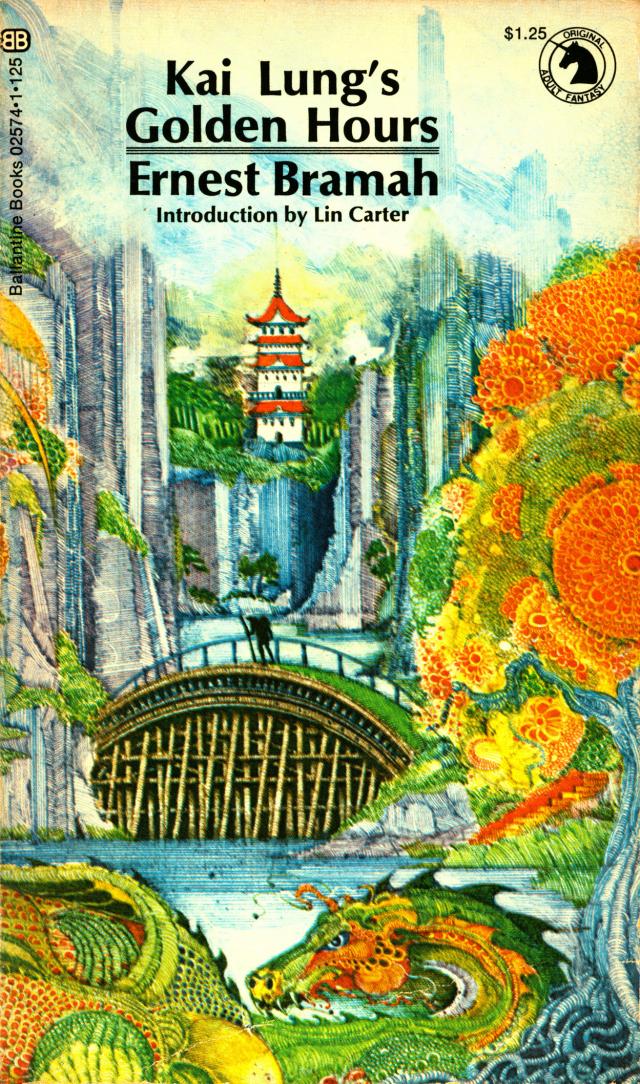
Cover art by Ian Miller
BALLANTINE BOOKS, INC.
101 Fifth Avenue, New York, N.Y. 10003
Contents
KAI LUNG’S GOLDEN HOURS
Ernest Bramah
Introduction ~ About Kai Lung’s Golden Hours and Ernest Bramah:
Chapter 1 - The Encountering of Six Within a Wood
Chapter 2 - The Inexorable Justice of the Mandarin Shan Tien
Chapter 3 - The Degraded Persistence of the Effete Ming-shu
Chapter 4 - The Inopportune Behaviour of the Covetous Li-Loe
Chapter 5 - The Timely Intervention of the Mandarin Shan Tien’s Lucky Day
Chapter 6 - The High-Minded Strategy of the Amiable Hwa-mei
Chapter 7 - Not Concerned with Any Particular Attribute of Those Who Are Involved
Chapter 8 - The Timely Disputation Among Those of an Inner Chamber of Yu’ping
Chapter 9 - The Propitious Dissension Between Two Whose General Attributes
Have Already Been Sufficiently Described
Chapter 10 - The Incredible Obtuseness of Those Who Had Opposed the Virtuous Kai Lung
Chapter 11 Of Which it Is Written: “In Shallow Water Dragons Become the
Laughing’ stock of Shrimps”
Chapter 12 - The Out-passing into a State of Assured Felicity of the Much-Enduring
Two with whom These Printed Leaves Have Chiefly Been Concerned
About Kai Lung’s Golden Hours
and Ernest Bramah:
Teller - of - Tales
Welcome to one of the most delightful worlds of recent literature; for your guide you will have Kai Lung himself; a most amusing and likable rogue. Kai Lung is a wandering storyteller who uses his quick wits and clever tongue to get himself out of the difficulties into which capricious Fate so frequently thrusts him. Ernest Bramah portrays him with loving skill: a tale-teller himself, he understands Kai Lung and loves him as much for his skills at talking his way out of tight spots as for the amiable stupidity that causes him to be forever stumbling into them.
Ernest Bramah has invented a world completely his own. Of course, he calls it China,…but never mind. Ernest Bramah neither knew nor cared anything for the real China, the China of the geography books and the history books; or if he did know, he did not bother to use that knowledge, because he has invented everything afresh.
His China is a delicious place, filled with dark forests and fine cities, and peopled with dragons, bandits and magicians. It is the sort of place where almost anything can happen, and often does.
The creator of Kai Lung is very much a man of mystery. It is the fashion right now to consider B. Traven the self-made mystery man of modem letters. But Traven cannot hold a candle to Ernest Bramah. Despite the fact that Bramah’s first book was an autobiography, we know less about him than about any other author of comparable importance in modem times.
The reason for this lack of information seems to be, simply, that Bramah was a very shy man. When the editors of a biographical encyclopedia of modem writers asked him for some personal data he smoothly turned aside their inquiries, saying: “I am not fond of writing about myself and only in less degree about my work. My published books are about all that I care to pass on to the reader.”
This is a rather unusual attitude for a writer to have. As a class, writers tend to be egotistic—writing, after all, is basically a method of getting attention. The writer generally resembles the small boy who climbs a tree and hangs by his knees from a dangerous perch, yelling “Look at me!” Bramah’s self-effacing attitude was rare. And I think it was sincere: no one could so scrupulously conceal the major facts of his existence with such tenacity if he were acting from false or assumed modesty.
We do not actually know when Ernest Bramah was bom, although evidence in his autobiography suggests it was about 1869. He was an English humorist and writer of detective stories, and his real name was E. B. Smith. Kai Lung was a secondary creation. The bulk of his fame rests on his tales of a blind detective named Max Carrados, considered by many as worthy of comparison to Sherlock Holmes. The exploits of the wise, witty, gentle, sightless investigator beguiled the readers of English magazines in the early years of this century. However, there is no novel about Carrados; Bramah did not write novels; even the Kai Lung books, which bear a superficial resemblance to novels, are actually a sequence of short stories skillfully woven together.
Although Ernest Bramah strove to avoid public notice, a few facts survive his self-imposed censorship. Grant Richards, his publisher, met him and describes the author as the kindest and most amiable of men. Richards described him as a small, bald man, with twinkling black eyes, who lived in quiet retirement far from the clamor of London’s literary circles. When he died at his country home in Somerset in 1942, his age was generally cited in the obituaries as seventy-three. The last of his books was published in 1940.
In the thirty years since his death, Ernest Bramah has faded from sight. He belongs to that generation of writers of belles lettres who rose to popularity in the 1920s; writers like Arthur Machen and Cabell, Edgar Saltus and M. P. Shiel, who were master stylists of English prose. They were products of a more leisurely age than ours, an era when cultivated readers lingered with relish over a page of well-turned prose, an epoch when one wrote for the discerning few and could ignore the many. Their time has passed, of course; but I believe there are still those readers who enjoy such sophisticated work.
Hence this revival of Kai Lung’s Golden Hours. First written in 1922, it has long been unavailable. It is not the first of the several Kai Lung books; it is simply the finest of them. I chose to reprint it first because I want you to see Kai Lung at his best, and Ernest Bramah at his peak. (The books are not really sequels to each other anyway; each volume is “more of the same,” and hence it is of no real importance in which order they are read.)
The Kai Lung books—there seem to be at least five of them—bear considerable similarity to The Arabian Nights. Therein, you will recall, Scheherazade staved off her execution through the ingenious device of telling the Caliph a story each night, and not quite finishing it, so that in order to hear the end he had to postpone her execution till the following night, at which time she would finish one yam and launch forth upon another.
Kai Lung had much the same idea. Always getting into trouble and being hauled up before the magistrate, he would illustrate his argument of innocence by narrating an entrancing tale, thus postponing the verdict from day to day. (This was merely a device for Ernest Bramah to sell an episodic collection of miscellaneous fantastic tales under the guise of a novel. It fooled no one.)
The Kai Lung stories are small, impudent masterpieces of drollery, told with sparkling polish and jewel-like precision. Bramah was a superb prose stylist. In his glittering wit and urbanity he reminds me variously of Jack Vance, or
Avram Davidson—even of James Branch Cabell. Too “literary” for a popular market, he wrote for appreciative small audiences of connoisseurs; they have long since dwindled, and, but for ours, not one of the Kai Lung books is in print today. The Kai Lung stories may originally have appealed only to the discriminating few, but they have not gone lacking for admirers. Dorothy Sayers and Hilaire Belloc have praised them, as have Christopher Morley and Sir Arthur Quiller-Couch. The New Statesman hailed them as first-rate pieces of finished irony and as elegant extravaganzas. Hilaire Belloc, who supplied a brilliant essay of introduction to the American edition of Kai Lung’s Golden Hours, was a most ardent advocate of their excellences. He praised the gemlike carving, the precision and perfection of t
It yet remains to be seen if I am correct in assuming that a readership can still be found, even in this benighted age, for polished irony and lapidary prose, for sharp-edged wit and jeweled satire. I hope I have chosen wisely: books as good as this deserve long lives. There are other Kai Lung books I would like to bring back into print by and by…
Lin Carter
Editorial Consultant:
The Ballantine Adult Fantasy Series
Hollis, Long Island, New York
Chapter 1
The Encountering of Six Within a Wood
Only at one point along the straight earth-road leading from Loo-chow to Yu-ping was there any shade, a wood of stunted growth, and here Kai Lung cast himself down in refuge from the noontide sun and slept.
When he awoke it was with the sound of discreet laughter trickling through his dreams. He sat up and looked around. Across the glade two maidens stood in poised expectancy within the shadow of a wild fig-tree, both their gaze and their attitude denoting a fixed intention to be prepared for any emergency. Not being desirous that this should tend towards their abrupt departure, Kai Lung rose guardedly to his feet, with many gestures of polite reassurance, and having bowed several times to indicate his pacific nature, he stood in an attitude of deferential admiration. At this display the elder and less attractive of the maidens fled, uttering loud and continuous cries of apprehension in order to conceal the direction of her flight. The other remained, however, and even moved a few steps nearer to Kai Lung, as though encouraged by his appearance, so that he was able to regard her varying details more appreciably. As she advanced she plucked a red blossom from a thorny bush, and from time to time she shortened the broken stalk between her jade teeth.
“Courteous loiterer,” she said, in a very pearl-like voice, when they had thus regarded one another for a few beats of time, “what is your honourable name, and who are you who tarry here, journeying neither to the east nor to the west?”
“The answer is necessarily commonplace and unworthy of your polite interest,” was the diffident reply. “My unbecoming name is Kai, to which has been added that of Lung. By profession I am an incapable relater of imagined tales, and to this end I spread my mat wherever my uplifted voice can entice together a company to listen. Should my feeble efforts be deemed worthy of reward, those who stand around may perchance contribute to my scanty store, but sometimes this is judged superfluous. For this cause I now turn my expectant feet from Loo-chow towards the untried city of Yu-ping, but the undiminished lie stretching relentlessly before me, I sought beneath these trees a refuge from the noontide sun.”
“The occupation is a dignified one, being to no great degree removed from that of the Sages who compiled The Books,” remarked the maiden, with an encouraging smile. “Are there many stories known to your retentive mind?”
“In one form or another, all that exist are within my mental grasp,” admitted Kai Lung modestly. “Thus equipped, there is no arising emergency for which I am unprepared.”
“There are other things that I would learn of your craft. What kind of story is the most favourably received, and the one whereby your collecting bowl is the least ignored?”
“That depends on the nature and condition of those who stand around, and therein lies much that is essential to the art,” replied Kai Lung, not without an element of pride. “Should the company be chiefly formed of the illiterate and the immature of both sexes, stories depicting the embarrassment of unnaturally round-bodied mandarins, the unpremeditated flight of eccentrically-garbed passers-by into vats of powdered rice, the despair of guardians of the street when assailed by showers of eggs and overripe loquats, or any other variety of humiliating pain inflicted upon the innocent and unwary, never fail to win approval. The prosperous and substantial find contentment in hearing of the unassuming virtues and frugal lives of the poor and unsuccessful. Those of humble origin, especially tea-house maidens and the like, are only really at home among stories of the exalted and quick-moving, the profusion of their robes, the magnificence of their palaces, and the general high-minded depravity of their lives. Ordinary persons require stories dealing lavishly with all the emotions, so that they may thereby have a feeling of sufficiency when contributing to the collecting bowl.”
“These things being so,” remarked the maiden, “what story would you consider most appropriate to a company composed of such as she who is now conversing with you?”
“Such a company could never be obtained,” replied Kai Lung, with conviction in his tone. “It is not credible that throughout the Empire could be found even another possessing all the engaging attributes of the one before me. But should it be my miraculous fortune to be given the opportunity, my presumptuous choice for her discriminating ears alone would be the story of the peerless Princess Taik and of the noble minstrel Ch’eng, who to regain her presence chained his wrist to a passing star and was carried into the assembly of the gods.”
“Is it,” inquired the maiden, with an agreeable glance towards the opportune recumbence of a fallen tree, “is it a narration that would lie within the passage of the sun from one branch of this willow to another?”
“Adequately set forth, the history of the Princess Taik and of the virtuous youth occupies all the energies of an agile storyteller for seven weeks,” replied Kai Lung, not entirely gladdened that she should deem him capable of offering so meagre an entertainment as that she indicated. “There is a much-flattened version which may be compressed within the narrow limits of a single day and night, but even that requires for certain of the more moving passages the accompaniment of a powerful drum or a hollow wooden fish.”
“Alas!” exclaimed the maiden, “though the time should pass like a flash of lightning beneath the allurement of your art, it is questionable if those who await this one’s returning footsteps would experience a like illusion. Even now—” With a magnanimous wave of her well-formed hand she indicated the other maiden, who, finding that the danger of pursuit was not sustained, had returned to claim her part.
“One advances along the westward road,” reported the second maiden. “Let us fly elsewhere, O allurer of mankind! It may be—”
“Doubtless in Yu-ping the sound of your uplifted voice—” But at this point a noise upon the earth-road, near at hand, impelled them both to sudden flight into the deeper recesses of the wood.