

Ferris, page 8
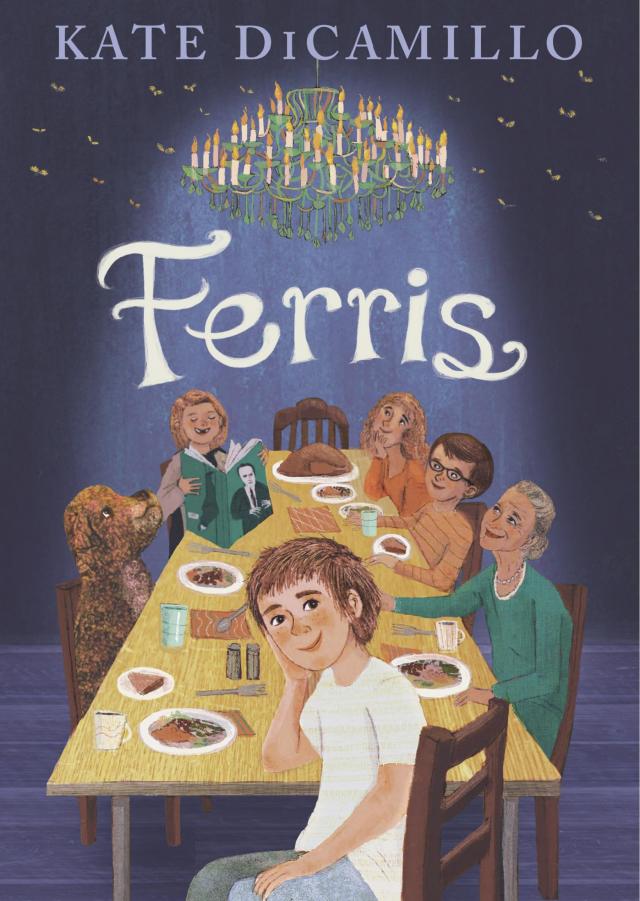


By the time Ferris made it outside, Glenn was already in his truck, and Boomer was standing in the driveway, staring at him longingly.
“Boomer!” Ferris said again.
Boomer turned and looked at her.
“Come here,” she said. Boomer sighed. He trotted over to her.
Glenn Wooley rolled down the window and said, “Ferris, right?”
“Yes, sir,” said Ferris.
“You have a way with them bees, Ferris.”
“Oh,” said Ferris.
She put her hand on top of Boomer’s head.
“You got a gift is what I’m saying,” said Glenn. “Some people just got a way about them that bees are comfortable with. See you around, Ferris. Bye now, Boomer.”
The truck drove away.
“Come on, Boomer,” said Ferris.
But Boomer sat down and stared after Glenn Wooley’s truck. He had a look of mournful disbelief on his face. He was so mournful that it hurt Ferris’s feelings, and so she went back into the house without him.
“Ferris?” said Billy Jackson when she walked through the kitchen.
“Did you close that screen door all the way?” said Ferris’s mother.
“I’ll be right back,” said Ferris.
She went through the living room and into the dining room. She stopped to look up at the chandelier, and then she climbed the stairs and went into Charisse’s room.
Charisse was sitting up in bed with the cards spread out before her, playing solitaire.
“How do you feel?” said Ferris.
“I feel fine, darling. How do you feel?”
“Fine,” said Ferris. “The exterminator just left. We don’t have raccoons. We have bees.”
“Fascinating,” said Charisse. “Your father has been hearing the ghost, I would imagine. Not a raccoon.”
Ferris thought how upsetting it would be if you were a lovelorn ghost who needed a chandelier lit and someone mistook you for a raccoon.
Charisse put the queen of diamonds down on the king of clubs.
“Also,” said Ferris, “there’s a big trunk in the attic with ‘Phineas’ written on it in gold letters.”
“A steamer trunk,” said Charisse. “It must have belonged to some traveling Phineas ancestor in days of yore.”
“What’s in it, do you think?”
“Who knows?” said Charisse. “Who knows how long it has been sitting up there? Decades? Centuries?”
Charisse put a five of clubs down on a six of diamonds.
“Boomer is in love with the exterminator,” said Ferris.
“Boomer’s in love with everybody, darling,” said Charisse. “That’s his charm.”
“But the exterminator?” said Ferris. She sat down on Charisse’s bed. “It’s like falling in love with the grim reaper.”
“Who told you about the grim reaper?” said Charisse.
“Everyone knows about the grim reaper,” said Ferris.
Boomer put his big head around the corner, and then he came creeping into the room, wagging his tail tentatively. He put his muzzle on Ferris’s leg.
Charisse reached over and scratched his ears. “I forgive you, darling,” she said.
“Me? Or Boomer?” said Ferris. “And for what?”
“Him,” said Charisse. “For loving mightily and widely. It’s what we’re here for after all.”
“But—” said Ferris.
“You are forgiven, Boomer Boy,” crooned Charisse.
Boomer closed his eyes in relief.
“Ferris!” Billy Jackson called up the stairs. “Uncle Ted has got the ladder out. Do you want to put the candles in the chandelier now?”
The chandelier! The candles!
Mightily and widely!
“Oh,” said Charisse. “The ghost will be so happy, darling. Not only will she no longer be mistaken for a raccoon, but she will see her chandelier lit at last. At last! Go on, now. I feel just fine. I do.”
Ferris went down the stairs with Boomer at her heels.
In the dining room, a ladder was set up next to the table, and Ted was standing and smiling at her. He was holding a white envelope in his hands.
He said, “Ferris, honey, before we begin the candle work, I was hoping I could impose upon you to perform an errand of mercy.”
What Ted wanted was for Ferris to hand-deliver a letter to Shirley at the salon.
As Ted talked about what a favor Ferris would be doing for him, she put her hand up to her head and touched her permed hair.
“Now, don’t worry, honey,” said Ted. “You don’t have to get your hair messed with this time. All you have to do is hand Shirley this little billet-doux.”
Billet-doux.
A love letter.
Oh no, thought Ferris.
“You just hand it to her and say, ‘I have been told to wait for a reply.’ ”
“I have been told to wait for a reply,” repeated Ferris.
“That’s right,” said Uncle Ted. He smiled so big that Ferris could see his top back teeth.
“Okay, I guess,” said Ferris.
“You just run along and do that, and when you get back, you and me and Billy Jackson will get this chandelier all cranked up and ready to shine.”
Ferris took the envelope from Ted’s outstretched hand. She walked into the kitchen. Her mother and Billy Jackson were back at the table, working on the Green Stamps.
“I have to go deliver something,” Ferris said to Billy.
“I know it,” he said. He pushed his glasses up. He smiled at her.
“Don’t let anybody make a fool out of you, Ferris,” said her mother.
Ferris touched her hair again. She felt like maybe it was too late to worry about that.
It was busy at Shirley Curl. There were three ladies waiting and reading magazines. A radio next to the reception desk was playing a song about someone’s love flying away.
“Fly away, fly away, you flew, my true . . . love,” sang a man mournfully.
It sounded like the kind of song that Boomer would sing to Glenn Wooley. If Boomer could sing.
“Ferris Wilkey!” shouted Shirley. She let out a shriek of disapproval. “What did you do to your hair?”
“What?” said Ferris. “I mean. You gave me a perm.”
“You have to work with it, honey,” said Shirley.
Shirley was able to italicize (emphasize, underscore) words better than anybody Ferris had ever known.
“You can’t just perm it and not style it,” said Shirley. “You can’t just walk around hoping that it will work without your intervention.”
Shirley, scissors in hand, walked away from the lady who was sitting in the beauty chair. She came up to Ferris and studied her more closely. She made a clucking noise that signified both dismay and disapproval.
“Here,” said Ferris. She held out the envelope.
Aunt Shirley took several fancy steps back, away from Ferris.
Shirley had very tiny feet, and everything she did on them made it seem like she was dancing.
“Is that from Ted?” asked Shirley. She pointed the scissors at the envelope as she danced farther away from Ferris.
“Yes,” said Ferris.
Shirley did some more dance steps. She opened and closed the scissors. They made a clicking, vaguely threatening noise.
“That man,” said Shirley.
“He told me to wait for a reply,” said Ferris.
“The nerve!” said Shirley. “The nerve of that man for loving me.”
Every good story, thought Ferris. Every good story is a love story.
And then she turned to see if Boomer was still outside waiting for her or if he had gone off in search of Glenn the exterminator.
The dog was there, staring in at her through the glass door. His eyes were worried, and his ears were up in the air, as if he were asking her a question.
“He wants a reply!” said Shirley. She stamped one of her tiny feet on the floor and looked around the salon. She snipped her scissors again. “He goes off to paint a history of the world. He leaves me to paint a history of the world, and he ends up painting a foot, and then he wants this child to wait for me while I reply to whatever nonsense he has put in this letter.”
Shirley danced forward and grabbed the letter out of Ferris’s hand. She used her scissors to cut the envelope open. Someone, at some point, had turned the radio off. It was very quiet inside the Shirley Curl salon.
Shirley tossed the envelope aside; it fluttered slowly to the floor while Shirley stood and silently read the letter.
Outside the salon, the sun was shining. Ferris could feel its warmth through the windows. She could feel the warmth, too, of Boomer’s gaze. Ferris held herself still in the same way she had held herself still for the swarming bees.
I am waiting for a reply, thought Ferris. I am here to wait for a reply.
And then Shirley was crying—sobbing, really—and Selma Thorpe, who was one of the ladies waiting to get her hair done, was saying, “Shirley, Shirley, whatever is the matter?”
Shirley made a fluttery motion with her hands. The scissors glinted and flashed in the sunlight.
“Aunt Shirley?” said Ferris.
Shirley took a deep, jagged breath. “Yes,” said Shirley to Ferris.
“Ma’am?” said Ferris.
“That is my answer. That is my reply. Yes.”
“That’s what I should tell Uncle Ted?”
“Yes,” said Shirley. She stood there crying, holding the letter in one hand and the scissors in the other. She said the word again and then again. “Yes. Yes.”
“Okay,” said Ferris. She turned to go.
Shirley said, “No. Come here. It is imperative that I fix your hair before you leave.”
“That’s okay,” said Ferris.
“It won’t take but a minute, honey,” said Shirley. “Come here.”
Which is how Ferris went from a bad perm to a shag.
She sat in the chair and watched as Shirley cut off most of her hair. Hunks of it fell to the ground until there was nothing left on her head but what seemed like a few curls and wisps, the downy feathers of a baby bird.
“Look at you, Emma Phineas Wilkey,” Shirley kept saying to Ferris. “Look at those eyes. Who knew you had those eyes?”
When Ferris at last stepped out of the salon, Boomer looked up at her and let out a soft, questioning woof.
“It’s me,” said Ferris. “I promise.”
To prove it, she bent over and let Boomer sniff her head.
When Ferris got back home, her mother and Uncle Ted and Billy Jackson were all together in the kitchen peeling potatoes.
“Make sure that screen door closes all the way,” said her mother.
“Where’s your hair?” said Billy Jackson.
Ferris didn’t answer him. Instead, she said to Ted, “Shirley’s reply is yes.”
“Yes?” said Uncle Ted. He turned to her. He was holding a potato in one hand and a paring knife in the other. He had an apron on over his bathrobe. “That’s what Shirley said? Yes?”
“Yes,” said Ferris.
“Oh,” said Ted. “Oh, I believe that I will sit down for just a minute.” He moved to the kitchen table and sat down while holding the knife and the potato up above his head.
“Uncle Ted?” said Ferris.
“Yes, honey?”
“Is it not the right answer?”
“It’s the right answer,” said Ted. He placed the knife on the table and then put the potato next to it. He looked up at Ferris. “ ‘My heart is gladder than all these, because my love is come to me.’ ”
“Save the poetry for later, Ted,” said Ferris’s mother, who was still peeling potatoes.
“I think I’ll make my famous mushroom gravy,” said Ted.
“We’re planning a big dinner,” Billy Jackson said to Ferris. “To eat under the chandelier. There’s going to be roast chicken and mashed potatoes.”
“Ferris,” said Ferris’s mother. “Can you explain your hair?”
“No,” said Ferris.
“Come here,” said Uncle Ted. He held out his arms, and Ferris walked into them. Ted smelled like oil paints. He squeezed her tight. “Thank you, honey,” he whispered. “Thank you for sacrificing your hair for me and my beloved.”
“You’re welcome,” said Ferris.
Ted released her. He wiped at his eyes, and then he picked up the knife and the potato and started peeling. He said, “ ‘My heart is like a singing bird . . . because my love is come to me.’ ”
“Ferris,” said her mother. “Maybe you could help with the potatoes, since this was all your idea.”
“Okay,” said Ferris.
But she walked out of the kitchen and went into the dining room. The forty candles were spread out on the table. Ferris looked up at the empty and waiting chandelier and felt a river of words flow through her.
More light and mightily and widely and dust to dust and my heart is like a singing bird and I bequeath myself to grow from the grass I love and every story is a love story and my love is come to me.
She had to see Charisse. She had to tell her, oh, everything . . . about the billet-doux and the great river of words, and also about how she had calmed the bees. She had forgotten to tell her about calming the bees.
“Come on, Boomer,” said Ferris. He followed her up the stairs and down the hallway to Charisse’s room. They both stopped at the threshold.
Pinky was sitting in the window seat.
She was reading aloud to Charisse from the library book about Houdini—Houdini, Master of Escape!
“Fascinating, darling,” Charisse said to Pinky. “Who wouldn’t want to be able to escape from a locked chest?” She then turned to Ferris and raised her eyebrows up very high.
“We’re going to put the candles in soon,” said Ferris.
“Emmaphineas,” said Charisse. “You got your hair cut. You look like a little owl.”
Pinky lowered the Houdini book and glared at Ferris. “We’re bithy.”
Ferris felt as if a small, hard stone were lodged somewhere in her chest. What was Pinky doing in her window seat? What was she doing reading to Charisse?
Boomer looked up at Ferris, and then he walked past her and went into the room and threw himself down on the floor at Pinky’s feet. He sighed a huge sigh.
“Good boy,” said Pinky. She glared at Ferris. “He’th my dog, too.”
“Okay,” said Ferris. “Charisse, I just thought you might want to know about the candles.”
“Ferris, darling,” said Charisse.
Ferris went down the stairs. She could hear Billy Jackson and her mother and Uncle Ted laughing about something in the kitchen. “Two chickens!” her mother said. And they all laughed some more. It made Ferris feel homesick even though she was already home.
She went out onto the front porch. Her father was sitting in the swing, reading the T encyclopedia.
“Ah,” he said. He lowered the book and smiled at her. “There she is. Ferris, fairest of them all. You got your hair done. Again.”
“Aunt Shirley did it,” said Ferris.
“I see,” said her father. “I must say I like this iteration better.”
Iteration was a Mielk vocabulary word. It meant version.
It was good to know so many words and their definitions; but increasingly, Ferris thought that the world didn’t make much sense, no matter how many words you knew.
It passeth understanding, thought Ferris. It passeth all understanding.
Where were those words from? Had Charisse read them to her? Had she read them to Charisse?
Her father patted the swing. “Come sit beside me, said the spider to the fly.”
Ferris sat down. She leaned up against her father. “We’re going to start putting candles in the chandelier,” she said. “And there’s going to be a big dinner, and Uncle Ted is happy because Aunt Shirley said yes to something. Pinky’s upstairs reading her stupid Houdini book to Charisse. There’s a lot going on.”
“I’ve been aware of a great hubbub throughout the house,” said her father. “Which is why I thought I would come out here and brush up on my knowledge of the world and its many wonders—as a way to prepare myself for the excitement ahead. Want me to read to you as in days of old?”
When she was very small, just a baby, Ferris’s father had read to her from the encyclopedia, and she had listened to him. At least that was the story her father always told. “You were a fussy baby,” said her father, “not fussy in the way of crying all the time, but fussy in the way of there was something you were needing to know, something no one was telling you. And one night, I thought, ‘Well, maybe this child wants to hear about the wonders of the world,’ so I read to you from the P–R encyclopedia. I read you the entry on ‘protons.’ And you listened with your eyes so wide! Your mother said, ‘You’re traumatizing the child by reading to her about protons. No baby needs to hear about protons.’ But you did. You needed to hear about protons. You stood up in your crib and held on to the bars and listened to me with your eyes all big and bright. Positive-charged protons. You were fascinated. From the beginning, you were fascinated, and that is a very good thing to be in this world.”
Ferris leaned up against her father. He smelled like soap and encyclopedias.
“Yes,” she said to him now, “read to me.”
There was a lone cricket somewhere on the porch singing a questioning song, and Ferris’s father started to read to her about tamarack trees, which were evergreens, and Ferris thought what a good word evergreen was. It was a word that promised something. It was a word that had its definition built right into it.
She fell asleep listening to her father read. She dreamed of the steamer trunk in the attic. Bees were buzzing around the trunk and flying in and out of it; and in the dream, when Ferris opened the lid and looked inside, she saw that the chest was filled to overflowing with light.
She woke up and her father was still reading, and the cricket was still singing. Billy Jackson came out onto the porch.
“Hello, Billy Jackson,” said Ferris’s father.
“Hey, Mr. Wilkey,” said Billy. “Ferris? I been thinking about Mrs. Mielk, and I have an idea about what we should do.”
Ferris sat up straight.
“Boomer!” Ferris said again.
Boomer turned and looked at her.
“Come here,” she said. Boomer sighed. He trotted over to her.
Glenn Wooley rolled down the window and said, “Ferris, right?”
“Yes, sir,” said Ferris.
“You have a way with them bees, Ferris.”
“Oh,” said Ferris.
She put her hand on top of Boomer’s head.
“You got a gift is what I’m saying,” said Glenn. “Some people just got a way about them that bees are comfortable with. See you around, Ferris. Bye now, Boomer.”
The truck drove away.
“Come on, Boomer,” said Ferris.
But Boomer sat down and stared after Glenn Wooley’s truck. He had a look of mournful disbelief on his face. He was so mournful that it hurt Ferris’s feelings, and so she went back into the house without him.
“Ferris?” said Billy Jackson when she walked through the kitchen.
“Did you close that screen door all the way?” said Ferris’s mother.
“I’ll be right back,” said Ferris.
She went through the living room and into the dining room. She stopped to look up at the chandelier, and then she climbed the stairs and went into Charisse’s room.
Charisse was sitting up in bed with the cards spread out before her, playing solitaire.
“How do you feel?” said Ferris.
“I feel fine, darling. How do you feel?”
“Fine,” said Ferris. “The exterminator just left. We don’t have raccoons. We have bees.”
“Fascinating,” said Charisse. “Your father has been hearing the ghost, I would imagine. Not a raccoon.”
Ferris thought how upsetting it would be if you were a lovelorn ghost who needed a chandelier lit and someone mistook you for a raccoon.
Charisse put the queen of diamonds down on the king of clubs.
“Also,” said Ferris, “there’s a big trunk in the attic with ‘Phineas’ written on it in gold letters.”
“A steamer trunk,” said Charisse. “It must have belonged to some traveling Phineas ancestor in days of yore.”
“What’s in it, do you think?”
“Who knows?” said Charisse. “Who knows how long it has been sitting up there? Decades? Centuries?”
Charisse put a five of clubs down on a six of diamonds.
“Boomer is in love with the exterminator,” said Ferris.
“Boomer’s in love with everybody, darling,” said Charisse. “That’s his charm.”
“But the exterminator?” said Ferris. She sat down on Charisse’s bed. “It’s like falling in love with the grim reaper.”
“Who told you about the grim reaper?” said Charisse.
“Everyone knows about the grim reaper,” said Ferris.
Boomer put his big head around the corner, and then he came creeping into the room, wagging his tail tentatively. He put his muzzle on Ferris’s leg.
Charisse reached over and scratched his ears. “I forgive you, darling,” she said.
“Me? Or Boomer?” said Ferris. “And for what?”
“Him,” said Charisse. “For loving mightily and widely. It’s what we’re here for after all.”
“But—” said Ferris.
“You are forgiven, Boomer Boy,” crooned Charisse.
Boomer closed his eyes in relief.
“Ferris!” Billy Jackson called up the stairs. “Uncle Ted has got the ladder out. Do you want to put the candles in the chandelier now?”
The chandelier! The candles!
Mightily and widely!
“Oh,” said Charisse. “The ghost will be so happy, darling. Not only will she no longer be mistaken for a raccoon, but she will see her chandelier lit at last. At last! Go on, now. I feel just fine. I do.”
Ferris went down the stairs with Boomer at her heels.
In the dining room, a ladder was set up next to the table, and Ted was standing and smiling at her. He was holding a white envelope in his hands.
He said, “Ferris, honey, before we begin the candle work, I was hoping I could impose upon you to perform an errand of mercy.”
What Ted wanted was for Ferris to hand-deliver a letter to Shirley at the salon.
As Ted talked about what a favor Ferris would be doing for him, she put her hand up to her head and touched her permed hair.
“Now, don’t worry, honey,” said Ted. “You don’t have to get your hair messed with this time. All you have to do is hand Shirley this little billet-doux.”
Billet-doux.
A love letter.
Oh no, thought Ferris.
“You just hand it to her and say, ‘I have been told to wait for a reply.’ ”
“I have been told to wait for a reply,” repeated Ferris.
“That’s right,” said Uncle Ted. He smiled so big that Ferris could see his top back teeth.
“Okay, I guess,” said Ferris.
“You just run along and do that, and when you get back, you and me and Billy Jackson will get this chandelier all cranked up and ready to shine.”
Ferris took the envelope from Ted’s outstretched hand. She walked into the kitchen. Her mother and Billy Jackson were back at the table, working on the Green Stamps.
“I have to go deliver something,” Ferris said to Billy.
“I know it,” he said. He pushed his glasses up. He smiled at her.
“Don’t let anybody make a fool out of you, Ferris,” said her mother.
Ferris touched her hair again. She felt like maybe it was too late to worry about that.
It was busy at Shirley Curl. There were three ladies waiting and reading magazines. A radio next to the reception desk was playing a song about someone’s love flying away.
“Fly away, fly away, you flew, my true . . . love,” sang a man mournfully.
It sounded like the kind of song that Boomer would sing to Glenn Wooley. If Boomer could sing.
“Ferris Wilkey!” shouted Shirley. She let out a shriek of disapproval. “What did you do to your hair?”
“What?” said Ferris. “I mean. You gave me a perm.”
“You have to work with it, honey,” said Shirley.
Shirley was able to italicize (emphasize, underscore) words better than anybody Ferris had ever known.
“You can’t just perm it and not style it,” said Shirley. “You can’t just walk around hoping that it will work without your intervention.”
Shirley, scissors in hand, walked away from the lady who was sitting in the beauty chair. She came up to Ferris and studied her more closely. She made a clucking noise that signified both dismay and disapproval.
“Here,” said Ferris. She held out the envelope.
Aunt Shirley took several fancy steps back, away from Ferris.
Shirley had very tiny feet, and everything she did on them made it seem like she was dancing.
“Is that from Ted?” asked Shirley. She pointed the scissors at the envelope as she danced farther away from Ferris.
“Yes,” said Ferris.
Shirley did some more dance steps. She opened and closed the scissors. They made a clicking, vaguely threatening noise.
“That man,” said Shirley.
“He told me to wait for a reply,” said Ferris.
“The nerve!” said Shirley. “The nerve of that man for loving me.”
Every good story, thought Ferris. Every good story is a love story.
And then she turned to see if Boomer was still outside waiting for her or if he had gone off in search of Glenn the exterminator.
The dog was there, staring in at her through the glass door. His eyes were worried, and his ears were up in the air, as if he were asking her a question.
“He wants a reply!” said Shirley. She stamped one of her tiny feet on the floor and looked around the salon. She snipped her scissors again. “He goes off to paint a history of the world. He leaves me to paint a history of the world, and he ends up painting a foot, and then he wants this child to wait for me while I reply to whatever nonsense he has put in this letter.”
Shirley danced forward and grabbed the letter out of Ferris’s hand. She used her scissors to cut the envelope open. Someone, at some point, had turned the radio off. It was very quiet inside the Shirley Curl salon.
Shirley tossed the envelope aside; it fluttered slowly to the floor while Shirley stood and silently read the letter.
Outside the salon, the sun was shining. Ferris could feel its warmth through the windows. She could feel the warmth, too, of Boomer’s gaze. Ferris held herself still in the same way she had held herself still for the swarming bees.
I am waiting for a reply, thought Ferris. I am here to wait for a reply.
And then Shirley was crying—sobbing, really—and Selma Thorpe, who was one of the ladies waiting to get her hair done, was saying, “Shirley, Shirley, whatever is the matter?”
Shirley made a fluttery motion with her hands. The scissors glinted and flashed in the sunlight.
“Aunt Shirley?” said Ferris.
Shirley took a deep, jagged breath. “Yes,” said Shirley to Ferris.
“Ma’am?” said Ferris.
“That is my answer. That is my reply. Yes.”
“That’s what I should tell Uncle Ted?”
“Yes,” said Shirley. She stood there crying, holding the letter in one hand and the scissors in the other. She said the word again and then again. “Yes. Yes.”
“Okay,” said Ferris. She turned to go.
Shirley said, “No. Come here. It is imperative that I fix your hair before you leave.”
“That’s okay,” said Ferris.
“It won’t take but a minute, honey,” said Shirley. “Come here.”
Which is how Ferris went from a bad perm to a shag.
She sat in the chair and watched as Shirley cut off most of her hair. Hunks of it fell to the ground until there was nothing left on her head but what seemed like a few curls and wisps, the downy feathers of a baby bird.
“Look at you, Emma Phineas Wilkey,” Shirley kept saying to Ferris. “Look at those eyes. Who knew you had those eyes?”
When Ferris at last stepped out of the salon, Boomer looked up at her and let out a soft, questioning woof.
“It’s me,” said Ferris. “I promise.”
To prove it, she bent over and let Boomer sniff her head.
When Ferris got back home, her mother and Uncle Ted and Billy Jackson were all together in the kitchen peeling potatoes.
“Make sure that screen door closes all the way,” said her mother.
“Where’s your hair?” said Billy Jackson.
Ferris didn’t answer him. Instead, she said to Ted, “Shirley’s reply is yes.”
“Yes?” said Uncle Ted. He turned to her. He was holding a potato in one hand and a paring knife in the other. He had an apron on over his bathrobe. “That’s what Shirley said? Yes?”
“Yes,” said Ferris.
“Oh,” said Ted. “Oh, I believe that I will sit down for just a minute.” He moved to the kitchen table and sat down while holding the knife and the potato up above his head.
“Uncle Ted?” said Ferris.
“Yes, honey?”
“Is it not the right answer?”
“It’s the right answer,” said Ted. He placed the knife on the table and then put the potato next to it. He looked up at Ferris. “ ‘My heart is gladder than all these, because my love is come to me.’ ”
“Save the poetry for later, Ted,” said Ferris’s mother, who was still peeling potatoes.
“I think I’ll make my famous mushroom gravy,” said Ted.
“We’re planning a big dinner,” Billy Jackson said to Ferris. “To eat under the chandelier. There’s going to be roast chicken and mashed potatoes.”
“Ferris,” said Ferris’s mother. “Can you explain your hair?”
“No,” said Ferris.
“Come here,” said Uncle Ted. He held out his arms, and Ferris walked into them. Ted smelled like oil paints. He squeezed her tight. “Thank you, honey,” he whispered. “Thank you for sacrificing your hair for me and my beloved.”
“You’re welcome,” said Ferris.
Ted released her. He wiped at his eyes, and then he picked up the knife and the potato and started peeling. He said, “ ‘My heart is like a singing bird . . . because my love is come to me.’ ”
“Ferris,” said her mother. “Maybe you could help with the potatoes, since this was all your idea.”
“Okay,” said Ferris.
But she walked out of the kitchen and went into the dining room. The forty candles were spread out on the table. Ferris looked up at the empty and waiting chandelier and felt a river of words flow through her.
More light and mightily and widely and dust to dust and my heart is like a singing bird and I bequeath myself to grow from the grass I love and every story is a love story and my love is come to me.
She had to see Charisse. She had to tell her, oh, everything . . . about the billet-doux and the great river of words, and also about how she had calmed the bees. She had forgotten to tell her about calming the bees.
“Come on, Boomer,” said Ferris. He followed her up the stairs and down the hallway to Charisse’s room. They both stopped at the threshold.
Pinky was sitting in the window seat.
She was reading aloud to Charisse from the library book about Houdini—Houdini, Master of Escape!
“Fascinating, darling,” Charisse said to Pinky. “Who wouldn’t want to be able to escape from a locked chest?” She then turned to Ferris and raised her eyebrows up very high.
“We’re going to put the candles in soon,” said Ferris.
“Emmaphineas,” said Charisse. “You got your hair cut. You look like a little owl.”
Pinky lowered the Houdini book and glared at Ferris. “We’re bithy.”
Ferris felt as if a small, hard stone were lodged somewhere in her chest. What was Pinky doing in her window seat? What was she doing reading to Charisse?
Boomer looked up at Ferris, and then he walked past her and went into the room and threw himself down on the floor at Pinky’s feet. He sighed a huge sigh.
“Good boy,” said Pinky. She glared at Ferris. “He’th my dog, too.”
“Okay,” said Ferris. “Charisse, I just thought you might want to know about the candles.”
“Ferris, darling,” said Charisse.
Ferris went down the stairs. She could hear Billy Jackson and her mother and Uncle Ted laughing about something in the kitchen. “Two chickens!” her mother said. And they all laughed some more. It made Ferris feel homesick even though she was already home.
She went out onto the front porch. Her father was sitting in the swing, reading the T encyclopedia.
“Ah,” he said. He lowered the book and smiled at her. “There she is. Ferris, fairest of them all. You got your hair done. Again.”
“Aunt Shirley did it,” said Ferris.
“I see,” said her father. “I must say I like this iteration better.”
Iteration was a Mielk vocabulary word. It meant version.
It was good to know so many words and their definitions; but increasingly, Ferris thought that the world didn’t make much sense, no matter how many words you knew.
It passeth understanding, thought Ferris. It passeth all understanding.
Where were those words from? Had Charisse read them to her? Had she read them to Charisse?
Her father patted the swing. “Come sit beside me, said the spider to the fly.”
Ferris sat down. She leaned up against her father. “We’re going to start putting candles in the chandelier,” she said. “And there’s going to be a big dinner, and Uncle Ted is happy because Aunt Shirley said yes to something. Pinky’s upstairs reading her stupid Houdini book to Charisse. There’s a lot going on.”
“I’ve been aware of a great hubbub throughout the house,” said her father. “Which is why I thought I would come out here and brush up on my knowledge of the world and its many wonders—as a way to prepare myself for the excitement ahead. Want me to read to you as in days of old?”
When she was very small, just a baby, Ferris’s father had read to her from the encyclopedia, and she had listened to him. At least that was the story her father always told. “You were a fussy baby,” said her father, “not fussy in the way of crying all the time, but fussy in the way of there was something you were needing to know, something no one was telling you. And one night, I thought, ‘Well, maybe this child wants to hear about the wonders of the world,’ so I read to you from the P–R encyclopedia. I read you the entry on ‘protons.’ And you listened with your eyes so wide! Your mother said, ‘You’re traumatizing the child by reading to her about protons. No baby needs to hear about protons.’ But you did. You needed to hear about protons. You stood up in your crib and held on to the bars and listened to me with your eyes all big and bright. Positive-charged protons. You were fascinated. From the beginning, you were fascinated, and that is a very good thing to be in this world.”
Ferris leaned up against her father. He smelled like soap and encyclopedias.
“Yes,” she said to him now, “read to me.”
There was a lone cricket somewhere on the porch singing a questioning song, and Ferris’s father started to read to her about tamarack trees, which were evergreens, and Ferris thought what a good word evergreen was. It was a word that promised something. It was a word that had its definition built right into it.
She fell asleep listening to her father read. She dreamed of the steamer trunk in the attic. Bees were buzzing around the trunk and flying in and out of it; and in the dream, when Ferris opened the lid and looked inside, she saw that the chest was filled to overflowing with light.
She woke up and her father was still reading, and the cricket was still singing. Billy Jackson came out onto the porch.
“Hello, Billy Jackson,” said Ferris’s father.
“Hey, Mr. Wilkey,” said Billy. “Ferris? I been thinking about Mrs. Mielk, and I have an idea about what we should do.”
Ferris sat up straight.


