

Ferris, page 11


The next thing Ferris remembered was her parents ushering her and Pinky up the stairs.
“There you go,” said her father. “Up, up, up.”
From above them came the sound of snoring. Charisse insisted that she didn’t snore, that she was too much of a lady to snore. But she was snoring.
Boomer was ahead of them on the stairs, and he kept turning and looking back to make sure that they were there, following him.
“Here we are,” Ferris said to him again and again. “We’re all here.”
The ghost did not return, but Allen Buoy came to the Wilkey house every day. He went up to Charisse’s room and played cards with her. He read to her from Whitman and the Bible, and Boomer crossed the threshold into Charisse’s room without hesitation or fear.
Autumn came.
Pinky entered first grade.
Ferris and Billy Jackson went into fifth grade.
Sometimes, Ferris saw Mrs. Mielk in the hallway of the school. Mrs. Mielk always nodded at Ferris, and Ferris nodded back. It was as if they had some great unspoken thing between them—a grave danger they had averted together.
“Do you think the ghost will ever come back?” Ferris asked Charisse one afternoon after Mr. Buoy had left.
“Why in the world would she?” said Charisse. “She has nothing to keep her here. The chandelier was lit at last. Her beloved found his way home to her.”
Later that year, in the winter, when Charisse was in the hospital, Ferris sat beside her and held her hand and asked her not to leave.
“Darling,” said Charisse.
Ferris put her head down on the hospital bed. She didn’t want Charisse to see her cry. “But if you leave,” said Ferris, “maybe you could come back?”
“Come back!” said Charisse. “There’s no need for me to come back. I have no regrets. I’ve left nothing undone. It’s been wondrous, darling. Wondrous.”
“Do you remember?” said Ferris.
“Remember what, darling?”
“Remember how you caught me when I was born?”
“How could I ever forget? Who could ever forget such a thing?”
At the funeral, Billy Jackson played “Mysterious Barricades.” Later that night, he told Ferris he didn’t think that he would ever play the song again. “It was like the music was some kind of door to somewhere, and playing it over and over again pushed open the door just enough to get to the other side of something. I don’t need to play it anymore. Does that make sense?”
“No,” said Ferris, “but I believe you.”
They were on the roof of the steakhouse, and it was cold. Still, they lay on their backs and looked up at the stars. Ferris couldn’t stop crying.
“We should light the chandelier again,” said Billy Jackson.
“Okay,” said Ferris.
“Every year at the same time, we’ll light it and have dinner underneath it. All right?”
Down below, Boomer let out a low woof. And then came the whap-whap-whap of his tail hitting the side of the building. Pinky’s head appeared at the top of the ladder. Her blond hair shone in the light of the steakhouse sign. Her face was streaked with tears.
“Pinky,” said Ferris.
“Move over,” said Pinky.
Ferris moved over, and Pinky lay down between Ferris and Billy Jackson. “I loved her, too,” said Pinky. “She was mine, too.”
The three of them cried together on the roof of Big Billy’s Steakhouse. Inside the restaurant, Bob Munson was playing the piano, and Billy Jackson’s mother was smiling at him as he played. Ferris couldn’t hear it or see it, but she knew it was happening.
Boomer whined. He barked once.
“It’s okay,” Ferris called down to him. “We’re okay.”
After Charisse died, Uncle Ted started work on his painting again.
He came to the house late in the afternoon and went down into the basement, and sometimes Ferris went and sat with him.
“Is it still going to be a history of the world?” she asked Ted.
“Patience, honey, patience.”
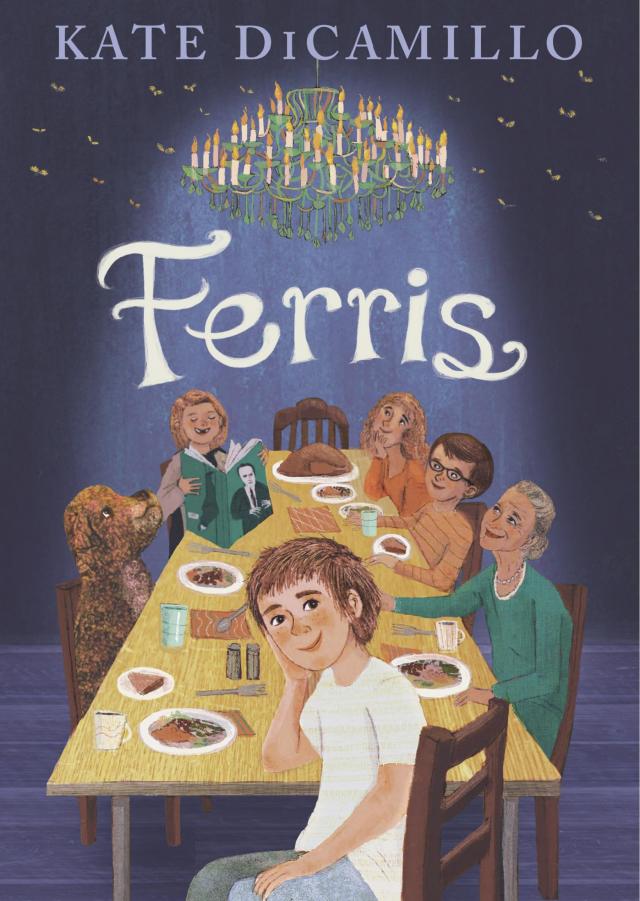
Slowly, afternoon by afternoon, a world appeared beneath Ted’s brush: there was a table and there were people sitting at the table and their faces were upturned, catching the light from above, catching the light from the candles in the chandelier. Moths flitted around the flames.
“It’s us,” said Ferris.
“It is,” said Ted.
“It’s us in the feasting hall,” said Ferris.
“That’s right,” said Ted.
When the painting was done, you could see that, way up in the far corner of the canvas, there was a small brown-feathered bird—a sparrow.
The sparrow was flying through the room. Her wings were outstretched, and she was so small and unassuming that most people didn’t even notice her.
But Ferris knew that she was there.
Ferris knew that there was a sparrow in the feasting hall.
It was spring when Uncle Ted and Aunt Shirley’s baby arrived.
Ferris and Pinky and Billy Jackson went to the hospital to see her.
The three of them leaned together over the bassinet.
“Move,” said Pinky to Ferris. “You’re taking up too much space. Let me see her.”
Ferris moved to the side. She watched Pinky make faces at the baby—sticking her thumbs in her ears and waggling her fingers, sticking out her tongue.
“Stop it,” said Ferris. “You’ll scare her.”
“No, I won’t,” said Pinky. “She likes it. I can tell.”
Billy Jackson stood staring down at the baby and smiling. He was humming.
Ferris leaned way over into the bassinet. She put her face close to the baby’s face.
“Hey, darling,” Ferris whispered.
The baby smiled at her like she knew her, recognized her.
“Babies don’t smile when they’re that young,” said Ferris’s mother. “It was probably gas.”
But Ferris knew. It was a smile.
The baby’s name was Charisse Rose Wilkey.
“Welcome,” Ferris whispered to the baby. “Welcome, darling. Here we are.”
Kate DiCamillo is the beloved author of many books for young readers, including two Newbery Medal winners: The Tale of Despereaux and Flora & Ulysses: The Illuminated Adventures. She grew up in Florida and moved to Minnesota in her twenties, where homesickness and a bitter winter led her to write her first published novel, Because of Winn-Dixie. It was named a Newbery Honor Book, and she followed it with many other award-winning novels, among them The Miraculous Journey of Edward Tulane, Raymie Nightingale, and The Beatryce Prophecy.
In addition to her novels, Kate DiCamillo has written several early-chapter-book series. The Mercy Watson and Tales from Deckawoo Drive series are both illustrated by Chris Van Dusen and feature a “porcine wonder” with a love for buttered toast and a cast of quirky characters from her neighborhood. The Bink & Gollie series, co-written with Alison McGhee and illustrated by Tony Fucile, centers on two characters who embody the tall and short of a marvelous friendship. Finally, the Orris & Timble series, illustrated by Carmen Mok, features a misanthropic rat and a naive owl. Kate DiCamillo has also written picture books, including Great Joy, illustrated by Bagram Ibatoulline, La La La: A Story of Hope, illustrated by Jaime Kim, Good Rosie, illustrated by Harry Bliss, and two picture books about Mercy Watson.
Kate DiCamillo was selected to be the National Ambassador for Young People’s Literature for 2014–2015. Of that mission, and on the power of stories, she says, “When we read together, we connect. Together, we see the world. Together, we see one another.”
Born in Philadelphia, Kate DiCamillo lives in Minneapolis, where she faithfully writes two pages a day, five days a week.
This is a work of fiction. Names, characters, places, and incidents are either products of the author’s imagination or, if real, are used fictitiously.
Copyright © 2024 by Kate DiCamillo
All rights reserved. No part of this book may be reproduced, transmitted, or stored in an information retrieval system in any form or by any means, graphic, electronic, or mechanical, including photocopying, taping, and recording, without prior written permission from the publisher.
First electronic edition 2024
Library of Congress Catalog Card Number 2023944039
Candlewick Press
99 Dover Street
Somerville, Massachusetts 02144
www.candlewick.com
Kate DiCamillo, Ferris


