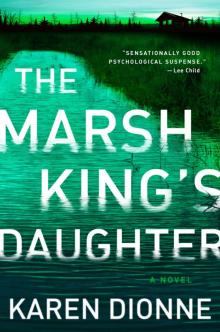
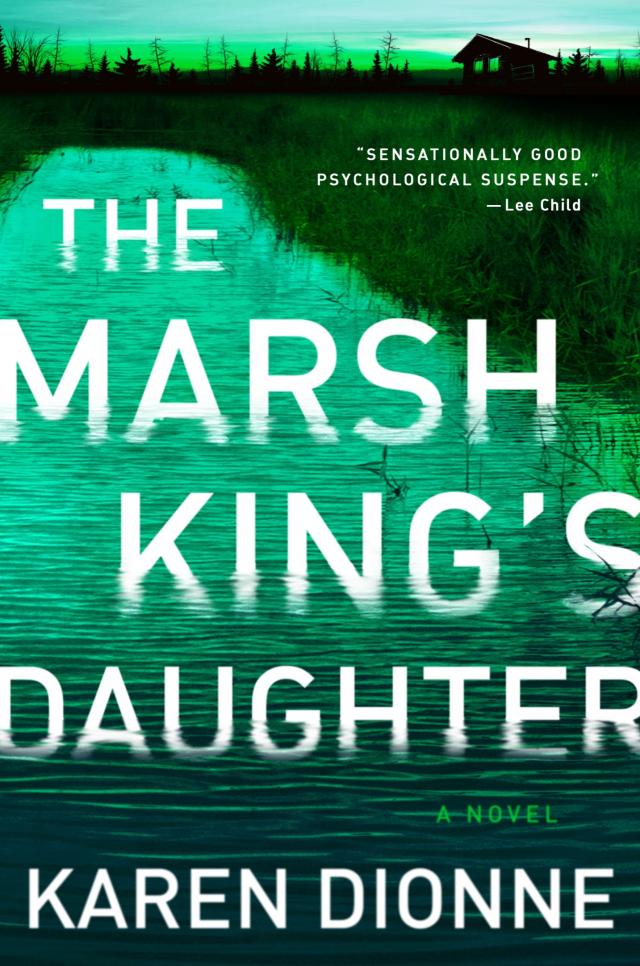
The Marsh King's Daughter, page 25


Then my father appeared in the doorway. He came over to my bed and wrapped my blanket around my shoulders and led me to the window. In the yard below, silhouetted in the moonlight, I saw a shadow.
“What is it?” I whispered.
“Gwiingwa’aage.”
Wolverine.
I clutched the blanket tighter. Wolverines are extremely ferocious, my father had often said, and would eat anything: squirrels, beavers, porcupines—sick or injured deer and moose. Perhaps even a small girl.
Gwiingwa’aage stalked into the yard. His hair was long and shaggy and black. I drew back. Gwiingwa’aage raised his head and looked up at my window and screamed.
I yelped and dashed for my bed. My father picked up my blanket and laid it over me, then stretched out beside me on top of the covers and held me in his arms while he told a funny story about Wolverine and his older brother Bear. After that, the wolverine’s scream was no longer scary.
I know now that wolverine sightings in Michigan are extremely rare. Some say the animals never lived in the state at all, never mind that Michigan is nicknamed the Wolverine State. But memories aren’t always about facts. Sometimes they’re about feelings. My father had given a name to my fear, and I was no longer afraid.
I look down at my father. I understand he’s done terrible things. He could spend a hundred lifetimes in prison and the scales of justice would never be balanced. But that night, he was just a dad, and he was mine.
“Okay,” he says. “You won. It’s over. I’ll leave now. I promise I won’t go near you or your family.”
He holds out his hands, palms up, and gets to his feet. I keep the Glock trained on his chest. I could let him go. God knows I don’t want to hurt him. I love him, despite everything he’s done. I thought when I went looking for him this morning that I wanted to return him to prison, and I do. But I also realize now that my connection to my father runs deeper than I ever imagined. Maybe the real reason I went after him was because I wanted to see him one last time before he disappeared. Now that I have, maybe that’s enough. He’s promising he’ll walk away. He says it’s over. Maybe it is.
Except that his promises mean nothing. I think about how a wendigo is never satisfied after killing and searches constantly for new victims. How every time he eats, he grows bigger, so he can never be full. How if the people hadn’t killed him, the whole village would have been destroyed.
I ease back on the trigger.
My father laughs. “You won’t shoot me, Bangii-Agawaateyaa.” He smiles, takes a step toward me.
Bangii-Agawaateyaa. Little Shadow. Reminding me of how I followed him everywhere he went. How, like his shadow, I belonged to him. How without him, I don’t exist.
He turns and walks away. Reaches behind his back and takes the second Glock from his waistband and tucks it in the front of his jeans. His walk becomes a swagger. Like he truly believes I’ll let him go.
I whistle two low notes. Rambo looks up, tenses. Ready to do whatever I command.
I flick my hand.
Rambo dashes baying after my father. My father whirls, grabs the Glock, shoots. The shot goes wild. Rambo leaps and locks his teeth around my father’s wrist. The Glock falls.
My father slams his fist into Rambo’s side. Rambo loosens his grip. My father hits him again and charges toward me. I stand my ground. At the last second, I raise my arms over my head as he slams into me. I slip the handcuffs over his head and down to his waist, trapping his arms by his sides, as we fall to the ground. I twist the Glock around and turn it toward me and shove it in his back, trying to angle the barrel in such a way that the bullet I fire will kill him and not me.
Suddenly his body goes slack, like he knows it’s over, and there is only one way this can end.
“Manajiwin,” he whispers in my ear.
Respect. The second time in my life he’s said this. A feeling of peace washes over me. I am no longer my father’s shadow. I am his equal. I am free.
“You have to do it,” Cousteau says.
“It’s okay,” Calypso says. “We understand.”
I nod. Killing my father is the right thing to do. It’s the only thing I can do. I have to kill him for my family, for my mother. Because I am The Marsh King’s Daughter.
“I love you, too,” I whisper, and pull the trigger.
28
The bullet that killed my father went through the same shoulder where my father had previously shot me—which, considering the alternatives, is actually a good thing. It would have been a whole lot worse these past months if both of my arms had been affected. Still, my recovery hasn’t been fun. Surgery, therapy, more surgery, more therapy. Apparently the shoulder is a bad place to get shot. The doctors say there’s no reason I won’t eventually regain the full use of my left arm. Meanwhile, Stephen and the girls have gotten used to one-armed hugs.
Together, we are sitting in a circle around my mother’s grave. It’s a fine spring day. Sun shining, clouds scudding, birds singing. A tub of marsh marigolds and blue flag irises sits on top of the modest gravestone at my mother’s head. The granddaughters I named for her two favorite flowers sit at her feet.
The flowers were my idea. Coming here was Stephen’s. He says it’s time the girls learned more about their grandmother, and that sitting beside her grave while I tell them stories about my mother will make more of an impression. I’m not so sure. But the marriage counselor we’re seeing says both parties need to be willing to compromise in order to make a marriage work, so here we are.
Stephen reaches across my mother’s grave and squeezes my hand. “Ready?”
I nod. It’s hard to know where to begin. I think about what it was like for my mother when I was growing up. About all of the things she did for me that I didn’t appreciate at the time. Trying to make my fifth birthday special. Warming me after my father put me in the well. How hard it must have been for her to nurture a child who was an echo of the man who kidnapped her. A child she genuinely and viscerally feared.
I could tell my daughters about the day I shot my first deer, or the time my father took me to see the falls, or the time I saw the wolf, but those stories are more about my father than my mother. And as I look at my daughters’ innocent, expectant faces, I realize that every story from my childhood that I might possibly tell them also has a dark side.
Stephen nods encouragingly.
“When I was five,” I begin, “my mother made me a cake. Somewhere in the stacks of cans and bags of rice and flour in the storage room she found a boxed cake mix. Chocolate with rainbow sprinkles.”
“My favorite!” Iris exclaims.
“Fav-it,” Mari echoes.
I tell them about the duck egg, and the bear grease, and the doll my mother made for me as a present, and end the story there. I don’t tell them what I did with the doll. How my callous reaction to my mother’s extraordinary gift must have pierced her heart.
“Tell them the rest of the story,” Cousteau says. “About the knife, and about the rabbit.” He and his sister are sitting quietly behind my daughters. Since my father died, they’ve been appearing more and more often.
I shake my head and smile as I remember the rest of that day, and how it ended with the first time my father acknowledged me with “manajiwin.” Respect.
Iris grins back. She thinks I’m smiling at her.
“More!” she and Mari exclaim.
I shake my head and get to my feet. One day I’ll tell my daughters everything about my childhood, but not today.
We gather up our blankets and start for the car. Mari and Iris dart ahead. Stephen runs after. Since my father’s escape, he rarely lets the girls out of his sight.
I hang back. Cousteau and Calypso walk beside me. Calypso takes my hand.
“Helga understood all now,” she whispers, her breath as soft as cattail fluff against my ear. “She was lifted up above the Earth through a sea of sound and thought, and around and within her was light and song such as words cannot express. The sun burst forth in all its glory, and, as in olden times, the form of the frog vanished in his beams and the beautiful maiden stood forth in all her loveliness. The frog body crumbled into dust, and a faded lotus flower lay on the spot on which Helga had stood.”
The final words from my mother’s fairy tale. I think about how the tale told me what I needed to do. How my mother’s story ultimately saved us both. How my father may be the reason I exist, but my mother is the reason I’m alive.
I think about my father. When the medical examiner asked what I wanted done with my father’s body, my first thought was to ask myself what he would have wanted. Then I thought about how his entire life was governed by his wishes and desires alone, and thought maybe I’d do the opposite. In the end, I picked the most practical and the least expensive. I’m not saying more than that. There’s a fansite devoted to my father’s exploits that sprang up not long after he died. I can imagine what the “Marshies” would do if they knew where my father was buried. I’ve tried several times to get the website taken down, but the FBI says as long as my father’s fans don’t break any laws, there’s nothing they can do.
Stephen corrals the girls and waits for me to catch up.
“Thanks for doing this,” he says, and takes my hand. “I know this is hard for you.”
“I’m okay,” I lie.
I think about how the marriage counselor also says a good marriage needs to be built on a foundation of honesty and trust. I’m working on it.
We crest the top of a small hill. At the bottom, a car is parked directly in front of our Cherokee. A news van is pulled up tight behind. A reporter and a cameraman wait beside them.
Stephen looks at me and sighs. I shrug. Since word got out that The Marsh King’s daughter killed her father, the media has been relentless. We haven’t given a single interview and have trained the girls not to say a word to anyone with a notepad or a microphone, but that doesn’t stop people from taking pictures.
I shake my head as we start down the hill and the reporter pulls a pen from her pocket and takes a step toward me. She doesn’t know it, but I’ve already written everything I can remember from my childhood in a journal I keep hidden beneath Stephen’s and my bed. I call my story “The Cabin,” and dedicated the journal to my daughters on the first page, like a real book. One day I’ll let them read it. They need to know their history. Where they come from. Who they are. One day I’ll let Stephen read it, too.
I could sell the journal for a lot of money. People and the National Enquirer and the New York Times have offered to buy my story many times. Everyone says that since my parents are dead and I am the only one left who knows what happened, I owe it to my mother and father to tell their story.
But I will never sell. Because this isn’t their story. It’s ours.
ACKNOWLEDGMENTS
A novelist gets an idea. The idea grows into a story, and eventually, the story becomes a book—thanks to the help of the following creative, talented, incredibly insightful, and amazingly hardworking people:
Ivan Held and Sally Kim, my publisher and editorial director at Putnam. You made it happen. Thank you. Deeply, truly.
Mark Tavani, my editor. I loved working with you, and your keen eye and incredible insights exceeded my expectations.
The Putnam team: Alexis Welby, Ashley McClay, Helen Richard, the production staff, the art department, and everyone in sales and promotion. Thank you for making such a beautiful book!
Jeff Kleinman, my amazing agent. I can’t begin to tell you what the past seventeen years have meant to me and my career. You made me the writer I am today.
Molly Jaffa, my talented and tireless foreign rights agent.
Kelly Mustian, Sandra Kring, and Todd Allen, my first readers. You applauded when the writing was working and held your noses when it wasn’t. I couldn’t have done it without you.
David Morrell. Your clear eye and generous heart made all the difference.
Christopher and Shar Graham, Katie and John Masters, Lynette Ecklund, Steve Lehto, Kelly and Robert Meister, Linda and Gary Ciochetto, Kathleen Bostick and Leith Gallaher (gone, but not forgotten), Dan Johnson, Rebecca Cantrell, Elizabeth Letts, Jon Clinch, Sachin Waikar, Tina Wald, Tim and Adele Woskobojnik and Christy, Darcy Chan, Keith Cronin, Jessica Keener, Renee Rosen, Julie Kramer, Carla Buckley, Mark Bastable, Tasha Alexander, Lauren Baratz-Logsted, Rachel Elizabeth Cole, Lynn Sinclair, Danielle Younge-Ullman, Dorothy McIntosh, Helen Dowdell, Melanie Benjamin, Sara Gruen, Harry Hunsicker, J. H. Bográn, Maggie Dana, Rebecca Drake, Mary Kennedy, Bryan Smith, Joe Moore, Susan Henderson, and so very many more wonderful friends who have my back and cheer me on. I’m honored to know you.
My family, for your love and support, and most especially, a huge heartfelt “Thank you” to my husband, Roger. Your unshakable faith in my ability to write this book means more than I can say.
ABOUT THE AUTHOR
KAREN DIONNE is the cofounder of the online writers’ community Backspace, the organizer of the Salt Cay Writers Retreat, and a member of the International Thriller Writers, where she served on the board of directors. She has been honored by the Michigan Humanities Council as a Humanities Scholar, and lives with her husband in Detroit’s northern suburbs.
karen-dionne.com
facebook.com/KarenDionneAuthor
twitter.com/KarenDionne
What’s next on
your reading list?
Discover your next
great read!
* * *
Get personalized book picks and up-to-date news about this author.
Sign up now.
Karen Dionne, The Marsh King's Daughter