I Thought My Soul Would Rise and Fly, page 11


Mister Joe continued to work on the various farms in the neighborhood, including the farm where Solomon and the other Davis Hall families lived and worked. When his daughter finished school in 1866, she left Charleston and went to live with her father.
She started a school, sponsored by The African Civilization Society, that Phillis and the other children in the farm community attended. She immediately recognized Phillis’s academic abilities. With help from the Society and small donations of money for books and clothing from the families in the community, Phillis was sent to Charleston in 1867 to attend a black private school there.
Douglass’s leadership abilities were also recognized. The Reverend McNeal returned to his preaching and missionary work among the emancipated men and women. He visited the farm where the families worked and remembered Douglass from Davis Hall. Reverend McNeal’s denomination, the African Methodist Episcopal Church, was seeking bright young men to train for the ministry.
Douglass left for Baltimore in 1868 to be educated and trained as a minister.
Also in 1868, Brother Solomon and the other families were finally allowed to purchase land through the South Carolina Land Commission. With the money they had saved, each family put a ten-dollar down payment on farmland divided into fifty-acre plots in Abbeville County, South Carolina.
By 1870, their village, named Libertyville, was struggling but holding on to its independence. The settlers built cabins and modest cottages and cleared an acre of land donated by Brother Solomon for a small chapel to worship in. The Libertyville Church also served as a schoolhouse.
The village had a molasses mill, a corn and wheat gristmill, and a general store, all owned and run by various village members.
In 1871, twenty-five more black families were able to either put a down payment on land, or rent land from the original eleven families. And in this year at the age of eighteen or nineteen, Phillis graduated. She could have remained in Charleston and taught at a Freedmen’s School there, or on one of the coastal islands, but she went to Libertyville to be with her family.
Phillis taught in the small chapel until the men built a one-room schoolhouse in 1872. She traveled to Charleston for many summers to further her own education, but always returned to Libertyville.
Douglass returned to the village as well, ministering to the villagers and farming. Douglass and Phillis were married in 1878. Though they had no children of their own, Phillis said that she and Douglass had all of the children of the growing village.
The church and the school both expanded, and in 1883 Phillis became the head teacher, training two other teachers. Phillis never left Libertyville or her beloved school. She also never lost her limp, but learned how to control her stammer — except when, as her students would say, “Miz Phillis be angry with us for not studyin”. She stammerin’ up a storm.”
Phillis lived a long and fruitful life. Up until her death in 1930, she was loved and venerated by all of the people of Libertyville.
Life in America
in 1865
Historical Note
In December 1865, eight months after the Civil War ended, Congress ratified the Thirteenth Amendment, abolishing slavery in the United States. However, this did not mean that the approximately four million formerly enslaved men, women, and children were accepted as American citizens with equal rights under the law. They were no longer enslaved, but slavery’s chains were hard to break.
To aid all the people of the South, black and white, to make the transition from slavery to freedom, in March of 1865, Congress established the Bureau of Refugees, Freedmen, and Abandoned Lands, known as the Freedmen’s Bureau.
A division of the War Department, the Freedmen’s Bureau clothed, fed, and sheltered white and black refugees and supervised work contracts, making sure that former slaveholders paid their freed laborers. The Bureau also resettled people temporarily on abandoned farms and plantations.
Working in partnership with Northern churches, black and white Northern benevolent organizations, and missionary societies, the Bureau helped organize freed men’s schools, as well. These organizations sent thousands of Northern schoolteachers (Yankee schoolmarms) to the South where they opened day and night schools.
According to the Freedmen’s Bureau records, as of July 1, 1870, there were 2,677 day and night schools, 3,300 teachers, and 149,581 students (children and adults). When there were no teachers available, freed men and women who could read and write taught others.
Many Southerners resented the teachers and other Northerners who settled in the region during Reconstruction. They viewed the influx of teachers, speculators, and businessmen as a second Northern invasion. Referring to the newcomers as carpetbaggers, people who packed up the little they had in suitcases made of carpet and headed south to make a quick profit, white Southerners accused them of taking advantage of the defeated people of the South. Those Southerners who had remained loyal to the Union were viewed as traitors to the Southern cause and were called scalawags.
Resentment, hatred, and violence, therefore, did not end with the war.
The early years of the Reconstruction Era (1865–1867) are often called Presidential Reconstruction. Even before the Civil War ended, Abraham Lincoln had devised plans for a smooth reunification of the United States. If 10 percent of the 1860 voters in a former Confederate state took an oath renouncing slavery and pledging loyalty to the Federal government, the voters (white males only) would be allowed to establish a new state constitution and government. However, the leaders and officials of the former Confederacy were not allowed to vote or participate in this process. They would have to seek special presidential pardons.
By May of 1865, the new president, Andrew Johnson, pardoned many of the former Confederate leaders and returned land that they had lost during the war. As a result, a number of the same men who held power before the war began to assume leadership positions.
Laws and regulations called the Black Codes were passed that virtually attempted to reenslave the freed people. In some states, a freed man could only be employed as a farmer or a servant. A special license was needed to perform any other type of work. Artisans such as carpenters, blacksmiths, and cobblers could not work at their trades unless they purchased a license and paid an annual tax. Often they could not afford either one. People would be arrested if they refused to sign work contracts or broke a contract. Essentially, the Black Codes sought to limit all economic options of African Americans.
Bands of white men, some of them former Confederate soldiers, organized vigilante groups on the pretense of keeping the countryside safe from “dangerous blacks.” These vigilantes were the forerunners of the Ku Klux Klan and other hate groups.
During this period many freed men and women left plantations in order to find relatives or to seek work other than plantation labor, in spite of the risk of being attacked or turned over to a sheriff and arrested for vagrancy. Many were killed.
It was obvious that African Americans would only be accepted as landless agricultural workers, living as though they were still in bondage.
The freed men and women, however, resisted the many ways in which Southern leaders tried to limit them. They refused to sign work contracts that did not meet their wage demands. They were also determined that their children be educated, and they refused to work on plantations that did not allow them to have a school. And even though they could not vote, could not testify in court, and could not sit on a jury, they joined the Republican party and participated in political meetings, called Union Leagues.
African Americans established their own churches and in many states, Southern and Northern, organized black conventions in order to fight for and demand protection under the law, as well as an end to the Black Codes. Most of all, the freed men and women tried to obtain land so that they could farm for themselves and be independent of white control.
Some people managed to purchase land individually; others formed land associations and pooled their money in order to establish their own communities.
In 1866, Congress passed the Civil Rights Act, which stated that all persons born in the United States were national citizens and had the right to equal protection under the law. In other words, blacks were not just freed people but citizens. President Johnson had tried to veto the bill, but Congress overrode it, and the Civil Rights Act of 1866 became the first major legislation in U.S. history to become law without a presidential signature.
The later years of Reconstruction (1867–1877) are referred to as Radical Reconstruction. Because of continuing violence and turmoil, fueled by the refusal of Southern governments to acknowledge the citizenship of African Americans, Congress passed the Reconstruction Act of 1867, which divided the Southern states into military districts and declared martial law. It also passed the Fourteenth Amendment, ratified in 1868, guaranteeing citizenship to “all persons born or naturalized in the United States.” In 1870, the Fifteenth Amendment gave the vote to all male citizens “regardless of race, color, or previous condition of servitude.” Finally, black men could vote. Women were not given the right to vote until 1920.
Taking their new rights seriously, African Americans went to the polls, and from 1869 to 1877, elected sixteen Americans of African descent to the Congress.
Black congressmen, along with other black Reconstruction leaders elected to state legislatures, were instrumental in passing laws that helped all of the people of the South. Because of their efforts, a public school system was instituted in the South that benefited black and white children. Most Southern states had no public education before Reconstruction. Education was for the rich and the elite. (Few poor white children and their parents could read and write either.) It was during this period as well that many of the historically black colleges were founded.
By 1877, Northerners and Republicans were weary of Reconstruction and the aftermath of war. President Rutherford B. Hayes withdrew the military troops from the South, and Reconstruction came to an end.
Southern Democrats gained political power, and the progress made by African Americans during Reconstruction was effectively curtailed. Jim Crow laws enforcing segregation of blacks and whites and severely limiting the civil rights of African Americans echoed the Black Codes.
The right to vote was essentially taken away by local officials through excessive poll taxes, unfair literacy tests, and threats of violence and loss of employment. African Americans in the North and the South could only obtain certain types of work, mostly menial labor, even if they were educated.
Black Southerners, however, never ceased struggling to attain those civil and political rights due them as American citizens.
The struggles begun during Reconstruction did not end until the 1950s and 1960s with the advent of the modern civil rights movement and leaders such as Dr. Martin Luther King, Jr., Fannie Lou Hamer, and many others. This great social movement, sown from the seeds of the Reconstruction Era nearly a century prior, finally ended the last vestiges of legal segregation in the South.
Living conditions for many freed people improved very little during Reconstruction. Often, they still lived in shacks and wore the same ragged clothes as when they were slaves.
On the plantations, the freed women continued to perform the same tasks they did during slavery. But now they were finally paid wages, though very low, for their hard work.
“Sharecropping” was an important development of Reconstruction. The freed people who worked as farmers were given a plot of land and a share in the money made from the sale of harvested crops.
Some freed people left the plantations to try to start life afresh. A few traveled to Northern cities hoping for more job opportunities and less racial prejudice. Others set out to find relatives, and some went west to develop frontier land.
Before Emancipation, if slaves wanted to marry, they performed a traditional ritual called “jumping the broom.” But these marriages were not considered legal. During Reconstruction, public weddings finally recognized the freed people’s marriages by law.
A government agency called the Freedmen’s Bureau sent out representatives to explain the new laws that regulated the treatment of former slaves.
The Freedmen’s Bureau, working in partnership with churches, missionary societies, and other independent organizations, set up schools for the freed people. One of the most noted educators of Reconstruction was Charlotte Forten, a black woman from Massachusetts.
The History of Little Goody Two-Shoes was a popular book in its day. Prior to Emancipation, the freed people had been punished if they attempted to learn how to read and write. Now they were finally granted the right to an education.
Many whites in the South objected to the end of slavery. They were angry to lose their cheap source of labor and believed that white people were truly superior. These self-proclaimed “white supremacists” organized hate groups, such as the Ku Klux Kan. They used violence to threaten and harm teachers, freed people, and anyone who actively set out to help black people.
Phillis Wheatley, born in Africa, was enslaved and brought to America about 1761. Her Poems on Various Subjects, Religious and Moral was the first book written by a black woman and the second book written by an American woman.
THIRTEENTH AMENDMENT (1865)
Section 1. Neither slavery nor involuntary servitude, except as a punishment for crime whereof the party shall have been duly convicted, shall exist within the United States, or any place subject to their jurisdiction.
FOURTEENTH AMENDMENT (1868)
Section 1. All persons born or naturalized in the United States, and subject to the jurisdiction thereof, are citizens of the United States and of the state wherein they reside. No state shall make or enforce any law which shall abridge the privileges or immunities of citizens of the United States; nor shall any state deprive any person of life, liberty, or property, without due process of law; nor deny to any person within its jurisdiction the equal protection of the laws.
FIFTEENTH AMENDMENT (1870)
Section 1. The right of citizens of the United States to vote shall not be denied or abridged by the United States or by any state on account of race, color, or previous condition of servitude.
These three amendments represented a major and radical shift in America’s legal position. Although daily life remained much the same for most people, these statements influenced American policies for years to come, especially during the Civil Rights Movement in the 1960s.
FREE AT LAST
(continued)
2. On my knees when the light passed by,
I thank God I’m free at last,
Thought my soul would rise and fly,
I thank God I’m free at last.
(Chorus)
3. Some of these mornings, bright and fair,
I thank God I’m free at last,
Gonna meet my Jesus in the middle of the air,
I thank God I’m free at last.
(Chorus)
Because slaves had been punished for speaking out, it became common for the words of songs to have dual meanings — one that was acceptable — and a second, hidden significance. An example is this traditional spiritual, which was jubilantly sung in black churches before and after the Emancipation Proclamation. The lyrics describe the religious act of going to heaven and celebrate freedom from the bonds of slavery.
Hard Gingerbread
Rub half a pound of butter into a pound of flour; then rub in half a pound of sugar, two tablespoons of ginger, and a spoonful of rose water; work it well; roll out, and bake in flat pans in a moderate oven. It will take about half an hour to bake. This gingerbread will keep good some time.
This recipe comes from Early American Cookery: “The Good Housekeeper,” by Sarah Josepha Hale.
The men pictured here were the first blacks to be voted into government positions. They served in the U.S. Congress.
Seated from left to right, they are:
Senator Hiram R. Revels of Mississippi
Representative Benjamin S. Turner of Alabama
Josiah T. Walls of Florida
Joseph H. Rainey of South Carolina
Robert Brown Elliott of South Carolina
Standing from left to right:
Representative Robert C. De Large of South Carolina
Representative Jefferson F. Long of Georgia
Modern map of the continental United States, showing the approximate location of Davis Hall Plantation in Mars Bluff, South Carolina, about one hundred miles north of Charleston.
This detail shows which states permitted slavery before the end of the Civil War.
About the Author
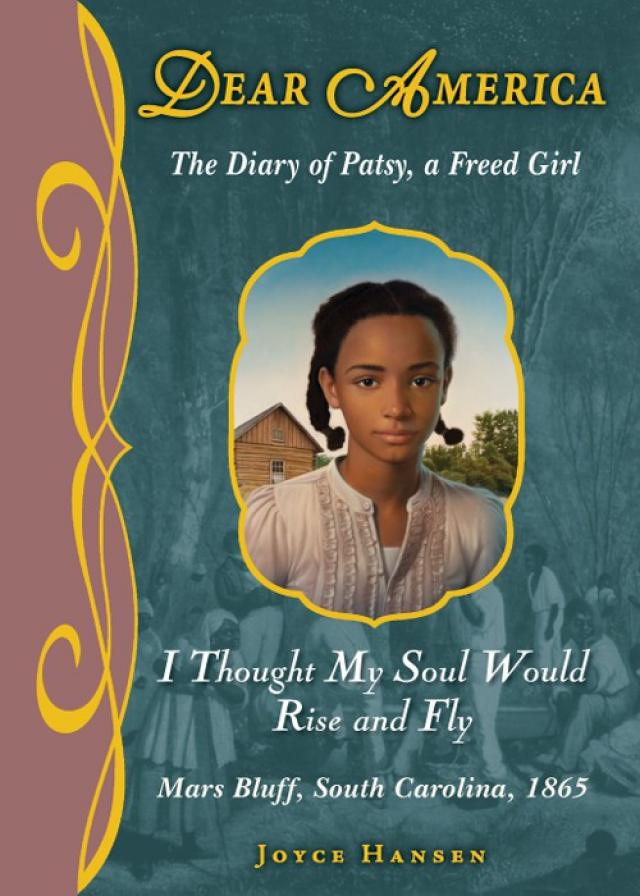
Joyce Hansen is the distinguished author of three Coretta Scott King Honor books, I Thought My Soul Would Rise and Fly and The Captive, both published by Scholastic, as well as Which Way Freedom?. She has done extensive research and writing, both fiction and nonfiction, on the Civil War and the Reconstruction Era, and has won a Children’s Book Award from the African Studies Association, as well as an Edgar Allan Poe Award.
Writing I Thought My Soul Would Rise and Fly evolved from a serendipitous research experience.
“A few years ago when I was writing a nonfiction book on Reconstruction, I read the diary of a woman, Emma Holmes, who had lived in Charleston, South Carolina, during and after the Civil War. In a May 1865 entry, she described a servant girl, a former slave, named Ann. She wrote that Ann was ‘lame, solitary, very dull, slow, timid, and friendless.’
“The description resonated for me. I’d found one of those little gems that I sometimes discover when doing historical research. I was fascinated by this ‘timid, friendless’ girl. Was she really timid and dull? Why was she friendless? What had happened to her mother and father? Had she always lived with Emma Holmes? Suppose she wasn’t as mentally slow and dull as Holmes thought? What if she were actually quite bright?