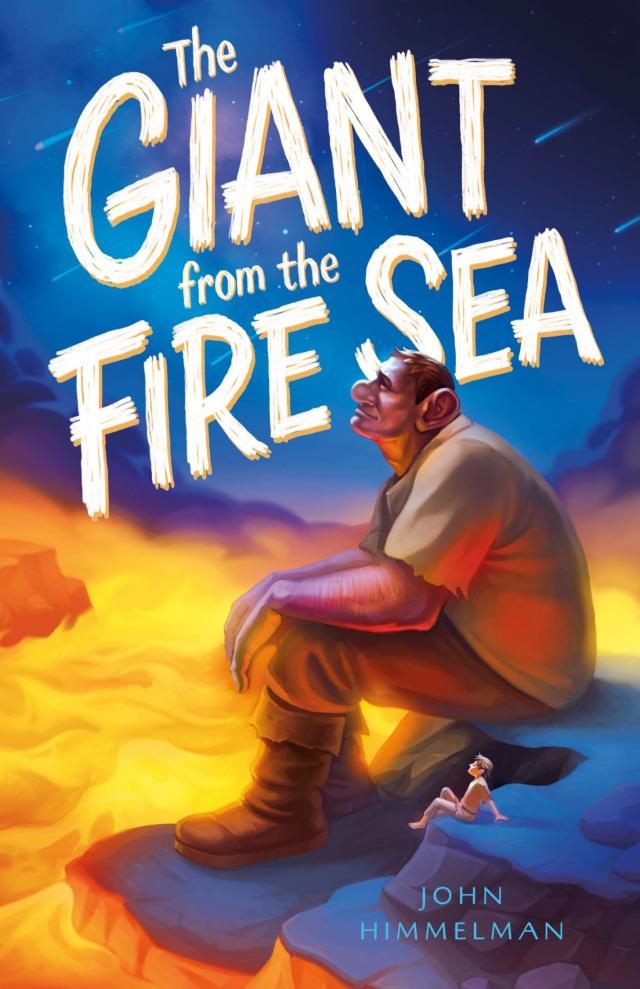
The Giant from the Fire Sea, page 8


Newton laughed. “I am of a thought that glassss can be made into many shapes, but windows and teleoscope first.”
“What do you need to make it?” asked the boy.
Newton smiled. “Everything we need is here beneath our boots.”
Jat looked down. “There is sand beneath my boots.”
“Yes, there is.”
“You can’t see through sand.”
“You can if you melt it,” said the giant.
“You can’t melt sand! It’s … sand! It’s small rocks!”
“We spoke of this already, Jat. Remember? Skyfire, or shooting stars? This giant is of a thought that anything can be melted if you make it hot enough. A time ago, I watched lightning melt the ground. It struck the sand at the edge of the Great Sea. Where it struck, I found little clear rocks. Lightning turned the sand into this waterstone. I thought, ‘Newton, if you can make fire hot as lightning, you can melt sand, too.’”
“Newton—spinning my head round in circles again…”
Newton laughed. “HA! You remind me of someone,” he said.
“Someone dizzy?” asked Jat.
“Oh no,” laughed the giant. “Oh no! Not at all! Someone wise in his own way. A giant dear to me—Pryat. You have seen my drawing of him. I will tell you more about him someday. You would be as friends, I know. Friends with spinning heads.”
TEN
Teleoscopes
Newton and Jat spent the next few months building their glass furnace, although all the heavy lifting was left to the giant. It grew from a section of the cliff face a fair distance from Newton’s house, far enough, they hoped, to keep from burning down his home. A half dome of neatly stacked boulders formed a tight wall against the ledge. Worked into the stones of the inner wall was a granite shelf the width of a small barn. Even Newton had struggled with that one. The stone slab had to be rolled on its edge from a site over ten miles away. People at the most distant ends of the village felt the rumble beneath their feet. Hot firetide coal would be fed into the space beneath the platform. The sand, which would be melted into glass, would sit in a large stone basin on top.
When the last block had been laid, the two stood back and admired their work.
“You really know what you’re doing,” said Jat.
“Giants and stone are as brothers. We feel them. They are in us as if alive. Young giants are taught that we were all once stone before the Makers gave us life.”
“Is that true?”
“Maybe yes. But again, maybe no. I often think the heads of some giants are filled with stones. But think about what we will make—this glassss. What is glassss but stones? Very small stones of sand made hot to stick together. It is inside this giant to make it.”
“Well, I think you have room to make a lot of it. This furnace is huge. I could live in it.”
“I would be happy to make another—a home for my friend,” said Newton. “You could live more close to me.”
“Maybe. Someday. I don’t how much longer I’m staying here, though. For a little while, I know, but I think I might be moving on before next winter.”
“Yes, to travel and to adventure. But, Jat? Can a prying giant ask a question you may not want a prying giant to ask?”
“No, he cannot. I don’t know what it is, but if you put it that way, I know I won’t want to hear it. So no.”
“I am asking anyway,” said Newton. “I know that the Fengiss brothers no longer pound you so much, and that is of a good thing. A good thing you made happen yourself. But I know, too, it is not over. They taunt you, still. They hurt you when they can, still. They drive others away, still. Is this why you wish to leave your—our—home?”
“They don’t drive everyone away. I have other friends now. Or at least people who don’t seem to hate me. Allander Quint, Sam Munken, Little Ran, Mason Twirp … Durd and Sack don’t bother me as much anymore. Maybe because they know I’ll keep coming back after they knock me down. I think I’m tiring them out. They moved on to others now, like Allander, Sam, Little Ran, Twirp…”
“If you were to all join as one in battle, you might…”
“Don’t you think we do? Not all of us, but sometimes a couple of us together make them back off. But sometimes that doesn’t work out so great. I just don’t talk to you about it because I don’t want you helping me with this one,” said the boy.
“Oh,” huffed the giant, “but you let them help you, and this giant cannot?”
“It’s more me helping them, Newton. I don’t mind you helping me with things—we help each other all the time. Just not this, okay? We’re the ones with the problem. It’s a peoples thing. I can’t let a giant fix it.”
“Wait, Mason Twirp? Isn’t he the…”
“Yeah, he’s all right. I think he was just going along with Durd and Sack so he didn’t get punched on himself. Which is exactly what happened when he stopped going along with them. I’m not running away from anything, Newton. I’m running to something, okay?”
“I do know of the dream awakened in my friend. You would be like Theobold the Explorer. Or Newton Big Ears.”
“Of course you would come. Of course, right?”
“Of course, maybe,” said the giant. “Of course, maybe not. You are my friend, and I can think of no better life. But I will soon be traveling far, too. Traveling more far than my walking boots can carry me. And my boots will never leave this sand.”
“Staring through some great big tube isn’t really traveling,” said Jat.
“I have learned that to be different, Jat. A giant has a body. Yes?”
“Yes, a big one.”
“Big to you, but not to me, or other giants. A giant has a mind. Yes?”
“Uh-huh.”
“A body can travel with the mind asleep. A mind can travel with the body asleep.” Newton paused, waiting for his friend to nod. “But the body,” he continued, “can go only where its boots can take it. The mind, Jat, can travel to lands beyond the Makers. To worlds of lands, as Flora says. Far beyond a giant’s boots.”
Jat was silent a moment. “Okay,” he said, “BUT can’t a giant do both? Can’t you just walk and look and think all at the same time? I do … sometimes. Or your body can travel, and then your mind can travel, and then your body can travel a little farther, and then your mind can catch up…”
Newton tilted his head, considering the question. “Haroomph … maybe,” he said.
* * *
Winter passed, and then spring. By early summer the giant and the boy had reached the point where they could roll and stretch a piece of glass strong enough to hold its place in a framed wall opening. The trick was to get it to the right temperature to remove all the air bubbles. Fira’s cottage was the first to be adorned with windows. “They are like eyes in my home,” she said. “It feels like they’re looking at me. And I can see myself in them.” She leaned in for a closer look and then grimaced.
“Uhhk. That is my mother looking at me!”
“You don’t like them?” asked Jat.
“I don’t know … I’ll get used to it.” Fira leaned in closer to the glass and ran her fingers down her cheeks. She shook her head and stepped away. “It will be brighter than the hides. Bugs can’t fly through it?”
“It’s glass, Mother. Like Grandmother’s chalice. Nothing can get through it. But it is easy to break, so be careful.”
“I’ll get used to it…”
In time, there was enough glass for anyone who wanted it, and nearly everyone did. All Newton asked in payment was a story. It could be any story. The giant was hungry to learn as much about his people as he could. Some stories made it onto his talking wall, which is what he now called the ever-expanding mural on the cliff face.
Jat, against Newton’s wishes, brought a few panes to Abner Willowhock. The giant told him that the Willowhock was not a good mans. What he made, he made for good mans and womans—good peoples. Not for makers of problems. Not for cursers of babies’ nurses.
“And he will not take it,” he added. “He will demand his fo fum ox cows.”
“I’m just trying to end this,” said Jat.
“So you are trying to help this giant with his trouble with another mans? Hrmmmmph … What does this sound like, this giant wonders…”
“It’s different, Newton.”
“No, it is not,” mumbled the giant.
Abner Willowhock’s fences had long been repaired and a new herd of calves grazed in his field. Their flanks bore a brand in the shape of an X.
“Why did you change your circle-W brand?” asked Jat.
“Never yeh mind. What be this?” he asked, eyeing the glass in the boy’s cart. “Ice?”
“It’s a gift from Newton. He made this for you. We made it. You can put it in the holes in your walls so you can let the light in and keep the wind and rain and snow out. Your place won’t be so dark anymore, on the inside. Also keeps the flies out. You have a LOT of flies here—a real lot of flies … You just have to make a wooden frame for it to hold in place…”
Willowhock had a closer look.
“… which I’m sure you know how to do,” continued the boy.
“Those don’t look like cows to me.”
Jat buried his face in his hands. “AGHH!” he shouted in frustration. He pointed to the corral. “You have cows again—well, calves … Probably someone else’s,” he added under his breath. “Do you want this, Mr. Willowhock? It’s a gift. We’re making peace. Or, as Newton would say, he’s honoring his take-give, or something like that.”
Willowhock lifted the panes from the cart and held them to his face. The distortion in the glass soured further his already soured features. He smashed the windows to the ground, shattering two days’ worth of work at his feet.
“Cheap work. They break too easy. I won’t be acceptin’,” he said, and returned to his house.
When not making windows for the villagers, the giant worked on the waterstones for his farlooker. This took far more time and precision than the comparatively simple process of rolling out flat sheets of glass. Through trial and error, he learned that slight adjustments in the curvature and thickness of the glass added to its performance. Jat had suggested that instead of using a hollow log to join the two “eyes,” as he called them, they could ask Mynar Blodge, a woodworker, to build him something better. Mynar was happy to do it.
“How could I not,” he said. “Those walnut trees from the hills you brought me? Best wood in the land! Dark grain. Tough as iron.”
While he didn’t quite understand what he was making, in a few weeks he had constructed a thirty-foot-long cylindrical tube to hold the waterstones at both ends. The tube consisted of long wooden staves, held together, barrel-like, with copper straps. Fenton Quigley, the town’s blacksmith, attached it to the top of a heavy wooden chair with a curved iron arm. Beneath the chair he had made a pivoting brace that allowed Newton to swivel to any point in the sky by moving his feet on the platform.
Newton’s nights were spent among the stars. He was traveling again, as he had back home. This farlooker, however, was by far superior to the first. His mind flew through swirling clouds of glowing suns, tails of streaming skyfire, colorful bursts of countless stars, seemingly frozen in mid-explosion. The giant, the largest being in the land, felt smaller than what made up a single grain of sand beneath his boots. At times, it made the sizzling pain inside him seem smaller yet. What was a giant’s pain in a sky so big? He was happy.
The Fire Sea glowed offshore, as it always did. Newton suspected its light could be fading the images in the night sky, much in the way a candle’s flame seems brighter in the dark than under the light of the sun. Would I see more up there if it were more dark down here? He would build another and find out. I can make many more for many places, he thought. He liked that thought so much he thought it again and again.
The giant also searched the Fire Sea itself. It was still a mystery to him, and to his fellow villagers, it seemed. Jat, and others, said that it was surrounded on both sides by an ocean of salt water. No one had ever traveled through the flames themselves—no one could, except for him, of course. Once. But likely not again. Theobold found a way around it. At least his boooks did. Not that Newton wished to leave.
One morning, the giant rolled out from beneath the teleoscope. He had fallen asleep under it, as he usually did. He climbed down the ladders and into the big open room of his home. He walked over to the window to another, smaller teleoscope. He had made it for looking at the Fire Sea when it was raining. For a reason he did not yet understand, the smaller size allowed it to work better during the day. He trained it on the distant horizon and searched yet again for the twisting vines of water that had set him on the path to this land. Could he see other lands it led to? Maybe, if he found it, he could show others. Maybe they would know why it was there. And what keeps it there …
The orange-hued air shimmered in the heat, distorting the view. The horizon was a snaking wave, slithering across the land’s end. Then, just at the edge of the farthermost lick of flame, he spotted something. At first he thought he had found the waterspout, but then another speck appeared, soon to be followed by three more. He pulled it away from his face and rubbed his tired eyes.
“This giant has worn his eyes down. Too long with no rest,” he said to himself. But he brought the glass back to his eye. The flickering specks were still there and slowly growing larger. The sun rose higher in the sky, bringing into better view the distant shapes. Newton gasped and lurched back away from the eyepiece. Those were not specks. Those were not shapes. They were giants.
ELEVEN
The Stonehall Blunge
Newton raced to Jat’s house, the pounding of his legs rattling the surrounding trees. He had to tell him what he’d seen. But what can Jat do? he wondered. What can a boy do? What can a village of mans do?
What can a giant do?
Nothing.
But he had to tell him. When he got there, Jat was gone. No one was home. The giant looked around and then clambered up the pile of firecoal next to the house. He couldn’t see much more, looking down through the treetops.
“JAAAAT!” he bellowed. His voice carried for miles.
“What are you doing up there?” shouted the boy from below. “We were right down the path.”
Mason Twirp was with him. He looked up at the giant, his knees shaking. The pug-nosed boy was slightly taller than Jat and seemed to have outgrown his clothes some time ago.
“I didn’t … I wasn’t,” Twirp stammered. “We were going to town to get some pears from Mr. Derring. We…”
“He won’t hurt you, Twirp. He knows we’re friends now.” Jat looked up at the giant. “Is something wrong? Your face looks like something is wrong.”
“Come,” said the giant. “We have to go fast.” He looked at Jat’s friend. “You can wait here, or go home.”
“Wait a—” Jat started to say.
“JAT! NOW!”
“Okay, okay! Twirp, I’ll see you later.” But Mason Twirp was already a good ways down the path and out of sight.
“That wasn’t—” began the boy.
“Get on my shoulder,” said the giant.
“Are you sure? You never let me do that. Told me you’re not a ‘horse-ox.’”
“Just climb on. Do not argue.” The giant bent down so Jat could climb up his arm and onto his shoulder. Then he stood up and tromped back toward his home.
“What … is … going … on?” asked the boy, his fingers wrapped tightly around the heavy threads of the giant’s shirt.
“Giants. They’re coming. They’re here,” said Newton.
They reached his home in short time. Newton clumped over to the teleoscope by the window. He picked it up and put the waterstone to his eye.
“What do you see?” asked Jat, still on his shoulder.
“Giants,” said Newton. He put it down on the sill of the window. “Look.”
Jat climbed down from his shoulder and walked up to the teleoscope. The lens was wider than his face, but he could see something in the distance.
“I see three … four … five. Five somethings. Those are giants? How can you tell? Everything is so wavy. And they’re so far away.”
“They are giants,” sighed Newton. “And they are coming for this one.”
“Why is it so important? Or you so important? They fried you in lightning and then you got out of their way. What more can they want?”
“I do not know. But I do know they are here for me. It is not easy to get here, Jat. I do not know how they found me.”
“They haven’t found you yet, Newton.”
Newton turned away from the window to look at the boy. He smiled. “No, Jat. They have not.”
“So let’s figure this out. Are you in danger?”
“Yes, Jat. They are not coming to watch me dance the Stonehall Blunge.”
“You make your first joke ever, and it’s now?”
“It is my regret,” said the giant.
“Am I in danger? Are the people—my mother and sister—are they in danger, Newton?”
Newton considered this. “Yes, Jat. This giant thinks so. We should act as if you and they are.”
“Okay,” said Jat. “Give me a minute.” He looked back through the lens. “They are really far. We have time. I think we can’t keep this a secret, but I’m afraid that if we tell everyone, they will panic.”
“So…”
“Wait a minute,” said the boy, holding up his hand. He was silent a moment. “I hate to do this, but I think we have to tell Constable Stoggin.”
“This giant agrees,” said Newton. “He is here to protect your peoples, and he should know from what.”
“Back to town?”
“Yes.”
“Do I get a ride?” asked Jat. The giant nodded. He bent over to let the boy climb up.
Back in the village, they spotted the constable across the green. He was in the middle of scolding Bonnie Mullein. He was often in the middle of scolding Bonnie Mullein.