The Giant from the Fire Sea, page 6
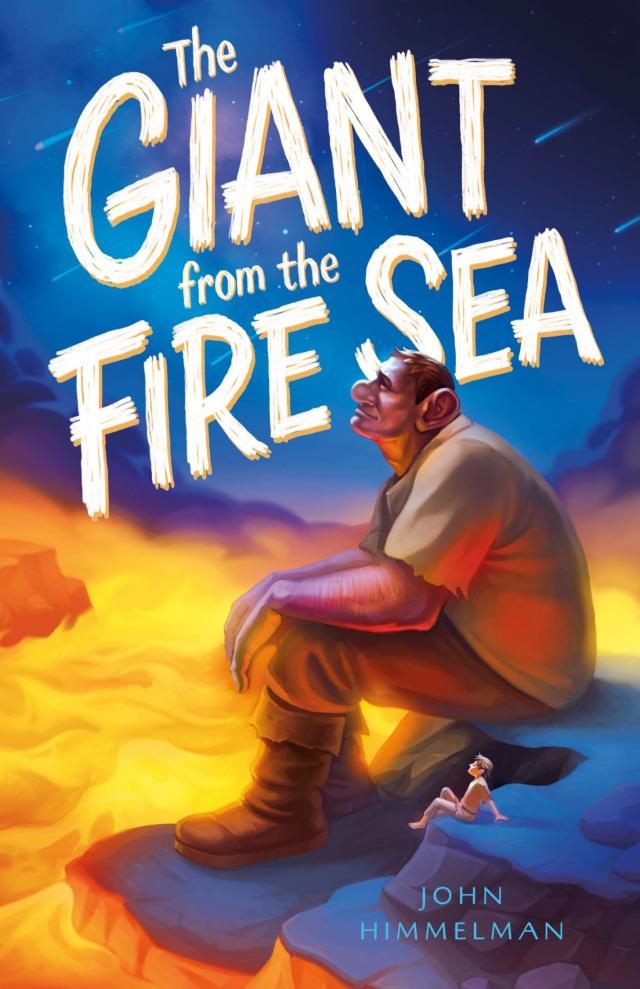


“I will,” said Jat. “Someday soon.”
The giant’s massive face scrunched in concern. “Someday soon is almost now. You will be dead soon, dead in a … clap of my hands. I miss you now, Old Jat, and you are still Young Jat.”
“I AM still here. YOUNG Jat. Don’t worry.”
“But you won’t be. You will be gone … very soon! Burn the Makers! My old friend dies as we sit.”
“Okay, Newton. GAH! That’s enough!”
The giant lifted his head. “Do you smell that?”
“No, what?”
“Horse-ox.”
“There you are!” shouted a voice.
“Constable Stoggin!” said Jat.
The constable rode his horse across the sand, his face flushed with anger. Bonnie and Thumbridge followed. They climbed down off their horses and approached the giant and the boy.
“What’s wrong?” asked Jat.
“You know what is wrong, boy,” the constable said.
“No, I don’t,” said Jat.
“Then yer giant does.”
“This giant does not, either. Is there trouble?”
“Yes,” said Thumbridge, pushing forward. “YOU! You’re the trouble. You threatened to eat three boys!”
“This giant did no such thing!”
“According to the Fengiss boys, you told them you were tired of eating geese and cows and it was time to try something new. Four people in the village saw you pick them up and hold them to your mouth!”
“They are lying!” said Jat. “Newton would never lay a hand on anyone!”
“Durd said he pried your fingers open and escaped.”
“I had a little problem with that part of their story,” muttered Bonnie.
“No,” said Newton. “They are not lying. But also, they are not speaking in truth.” He told them what had happened. Jat listened in silence. By the time Newton was finished, the boy was staring angrily at the sand at his feet.
“So you did not threaten to eat them, but you threatened to hurt them?” asked Stoggin.
“Good!” said Bonnie. “They’re white-livered mudclods!”
“NOT good!” snapped the constable. He looked up at Newton. “You can’t go threatening white-livered mudclods. That’s my job!”
“This giant never told them he would hurt them,” said Newton. “I told them to stop hurting my friend. I would tell them that again. I would tell you that if you were hurting my friend! We are free to tell others to stop doing things we want them to stop doing. We stand up for our friends!”
“And if they didn’t?” asked Thumbridge. “Stop? If they didn’t stop?”
Newton thought a moment. He honestly did not know what he would have done. “This giant can only say to you that he would not have harmed them. And even more, he would not have eaten them!”
Constable Stoggin glared at the giant. No one said anything. Jat continued to stare down at the sand. Bonnie crossed her arms impatiently.
“Well?” she asked.
“Don’t rush me,” said Stoggin. Then he added, “Okay. I’ll believe you. But listen to me, and listen good, giant. You make people nervous—some people … Willowhock won’t shut up about you. And you make me nervous, which is a big problem for you. But so far, up to today, you’ve caused me little trouble. You can’t go pickin’ people up and scarin’ their pants wet. Especially when it comes to the two Fengiss snobbers. I don’t need no trouble from their family. If you have a problem with someone, you tell me. Or my boy.”
Bonnie cleared her throat loudly. Stoggin squinted at her and frowned. He looked back up at Newton. “Me, or the boy. Got it?”
Newton hung his head in shame. “I do,” he said.
“Boy?” he said to Jat. “You gotta control your giant. Got it?”
Jat didn’t look up but gave half a stiff nod.
“And listen,” said the constable to Jat, a little less angrily. “I know these boys are trouble. It ain’t just you. They’re gonna get theirs one day, but”—he pointed up to the giant—“it can’t be from one of these things.”
“No,” said Bonnie, rubbing her fist. “It will be from someone who’ll give it to ’em worse.”
Constable Stoggin rolled his eyes. They got on their horses and rode off. Thumbridge turned and waved a warning finger at the giant. Budge came riding down the beach. The constable shook his head in frustration and motioned for him to turn around and join them. Budge stole a quick nervous look at the giant and tried to keep up with the others.
Newton didn’t know what to say to his friend. Jat still stared at the sand, as if trying to burn holes through it with his eyes.
“Hrm…” said the giant. “That worked out okay. Constable Stoggin is a fair mans if one were to judge such a thing…”
Jat stalked away.
“Jat? It is my great regret I did not tell you. I knew you did not want me to know…”
The boy kept walking.
EIGHT
Isaac Newton
A few days passed with no visit from his friend. Newton went to his house, but Fira didn’t know where he was. She hadn’t seen much of him and was growing worried.
“Would you tell him I came looking for him?” asked Newton.
“I think he’s mad at you about something. What did you do? No, what did he do, is probably a better question. No, actually, it could be either one of you…”
“This giant talks too much, Fira. Maybe it would be best if this time I said nothing.”
He is not treating his friend as he should, he thought, stomping back to his home. I helped him, did I not? Is this another one of his tests of friendships? Maybe this giant should stay away from him for a time!
The next day, Newton went into town to deliver some stones for a new house foundation. In exchange he was to receive some fat ropes to hold up his boots. While the fire from the Fire Sea had no effect on the old ropes—a giant’s clothes are as impervious to flame as a giant—the salt from his journey across the Great Sea had slowly eaten them away. Newton’s floppy boots were causing him to lose his footing more often than the townspeople felt comfortable with. As angry as he was at Jat for the boy’s anger at him, he was less angry today than the day before. He hoped he would find him. He wanted to know why what he’d done was so bad. He saw Mason Twirp crossing the road. He might know where Jat is. The giant started to head toward him but then stopped. It would be best to stay away from him. Too many eyes watching my every breath. Too many mouths to say they saw what did not happen. Newton had grown used to being watched. He knew his size still made mans curious about him.
“Hey, giant!”
Newton turned toward the voice. “Hello, Flora,” he said.
“I’ve been hoping to run into you, not that you’re too hard to find. But I don’t get into the village that much anymore. Do you have a moment?”
“Do you know where Jat is?” asked the giant.
“No, is he missing?”
“Yes, but of his own choice, this giant believes.”
“He’ll turn up,” said the old woman. “No, I’ve been thinking a lot about you. Can we speak?”
Newton frowned and sat down on the pile of boulders he dropped on the ground. “Can we speak?” was never followed by words he wished to hear.
“I would like to talk to you more about something you said a while back. About how you taught yourself how to read.”
“Oh!” said Newton, relieved. “That is something that would please this giant to speak about!”
“Believe it or not,” said Flora, “I was a teacher in my younger days. Taught half the people here when they were kids, and then their kids. Don’t like the word ‘was,’ though. We never stop thinking of ourselves as teachers. It’s something in us. Something we do. I would love to know how you taught yourself to read. And maybe in exchange, I can teach you a little. I remember you saying that there were ‘big empty spaces’ in your understanding. I could maybe help fill them.”
“This giant would be happy for your help. No giant has read words in boooks because we have no boooks to hold words. No giant has ever thought to make them.”
“You do have a history, though, yes? Stories about things that have happened to others before you? I assume you pass it down with stories told mouth to ear?”
“Yes. Mouth to ear, then ear to mouth. Then mouth to next ear. But when a mouth is gone, its stories are lost. In boooks, they can tell the stories long after that mouth goes silent. They speak to the eyes instead of the ears, but it goes to the same place.”
“But how can anyone start from nothing—from no-such-thing-as-books—and go to reading books about things so few understand, even here, where we have books?”
“Hrump,” said Newton. How could he explain what he had done? He never thought much about how he did things. He just did them. And then got his ears pulled for it. “This giant’s understanding came slowly, seasons upon seasons. I looked and looked and looked at the markings—letters, you mans call them—on the bark … no, pages. The letters … held open my head, like a stick propping open an oaken door on a day of snapping winds.”
“You do have a way with words, giant,” said the old woman.
“Thank you. Ooda, my sister, is of a thought that I use too many. With my head open, the great ideas lifted by the snapping winds—from the boooks—fell inside.” He held his hands up and wiggled his fingers, dropping them down to patter like raindrops on his head. “After a passing of some time, I could look at a page of letters and not always understand each mark, but feel, and sometimes…” He sniffed loudly. “Smell, the bigger thoughts of the giants, or mans, or who or what it was that scratched the letters on the pages. Even the empty spaces around the words helped this giant learn their meaning. They are as thoughtful breaths. And Flora.” He bent low to bring his massive face to hers. “They filled Newton’s own life with meaning.” He sat back up. “But yes, there are many words I still cannot understand. This giant feels he is missing large mouthfuls of the stories his eyes swallow.”
“You are something we don’t see a lot of; something we need,” said Flora, her throat choking up with emotion. “Come see me tonight. I can teach you how to better understand what you were reading. But maybe there are things we can teach each other. And bring young Jat. He’s been putting off learning how to read long enough.”
“He is angry at this giant. It would just be me alone.”
“I thought you two were the closest of friends. I never see one without the other.”
Newton’s lips tightened. He didn’t know what to say.
“Friends fight. That’s okay, Newton. In the end, you sometimes become even closer friends. Come tonight. We’ll share some words.”
* * *
That evening, back at home, Newton stepped out his door to leave for Flora’s. He lingered a bit longer, hoping to see Jat bouncing down the beach. His anger had faded, turning to concern. He did not care who was mad at who. I do not like this, he thought, and left his home.
Flora waited for him in her chair outside her front door.
“You’re late. The light’s almost gone,” she said. Newton bent down closer to try and read the expression on her face. She wore her usual frown. But it is not a real frown. It does not reach her eyes. Her silvery hair was neat as always, every strand held in place by a tightly knotted red ribbon on the back of her head. He gave a light sniff and smiled. She is happy I am here … but there is a sadness?
“It is my regret,” said Newton.
“Actually, your lessons can wait. I have something else you’ll find interesting. Heh! I certainly do. This’ll knock you down and shake you up.” Flora sat back and closed her eyes. Her arms were crossed, hugging her body. Her frown softened. She opened her eyes and looked up at Newton. The old woman unfolded her arms and held out two books. Newton gasped! He had seen one of those books before, or one just like it. She handed it to him.
“It is … the silent sp—It’s the boook … by!” Newton slapped his chest, his face awash in amazement. “It is where this giant’s name comes from!”
Flora smiled and nodded. “I thought so. Newton didn’t sound like a giant’s name, not that I know what a giant’s name sounds like. But surely not Newton. And when you mentioned coming across a crate of books, made of pumice—you said ‘stone,’ but it was pumice—things began to come together.”
The giant stared at the tiny book in his fingers. He flipped through a few of the pages with his fingernail, as he had done so many times for so many years. The words that had taken him so far now brought him right back home. “New-ton,” he said softly. “But how is this? My boooks were burned back home! How can this one be here?”
“There are copies,” said Flora. “I’m guessing you read others by men who studied the sky. Galileo?”
“This giant thinks so, but was saying it wrong inside his head.”
“I think I have a copy inside. Not mine, but … Copernicus?”
“YES! But I was hearing that one wrong, too.”
“Might have that as well. Those are the only ones I can think of. I tried reading them, but they’re not for me.”
“There was one by Hal-lee. And one by Cass-eeneee. Ty-ko? Or Ticho? Their words were big on the silent speakers, and I believed them to be the names of the speakers who made them. But some words are made different in the different boooks. This giant wondered if they came from places where they spoke different words for the same things.”
“They did. That’s part of the reason I couldn’t read them—can’t read other languages. You could?”
“Yes. In a way. Thoughts are thoughts are thoughts, no matter the sound of the words they ride on. But you have the one that … this giant chose his name from.”
“Mm-hmm, Isaac Newton. He lives, or lived, in a faraway land. He might still be around. I don’t know. In a place called Anglund, I think. I found this in a crate of books my late husband, Theobold, left behind. This was a newer one of his, and his favorite. I think partly because it was in the language we speak. He had two of them. You had the other one. It had to be his, and then yours. When he could, he’d collect two of every book, one for reading and one for preserving—for future ‘seekers of knowledge.’ He said he couldn’t always understand what he was reading, but he kept at it because he heard stories about the man who wrote it. This Newton used something that sounds like your farlooker to study the stars and other things in the sky. Called it a teleoscope, I think. Something like that. Theobold spent all this time staring at these pages, grousing about how his brain was too small to understand what it meant. He was not an educated man. I shouldn’t say that. He was very educated, but everything he learned, he’d learned on his own.” She paused, as if in thought. “Like you, Newton … It all seemed a great struggle to him. But, heh … struggle he did. He talked about how he needed a teleoscope of his own, but he never actually made one.” She waved her hands in the air and looked up at the darkening sky. “He’d go out night after night staring at the … blasted stars. Out ’til morning, he was. Sometimes I’d find him sleeping in the grass, the fool soaked in dew.”
“What happened to him?” asked Newton.
“Theobold left me, said he needed more of these books to make sense of the things. And that he couldn’t find them by sitting here, waiting for them to show up. Said he’d be back, of course—with answers. Promised me. He promised me…” A momentary look of sadness crossed the old woman’s face. That was what I smelled earlier, thought Newton. She shook it off. “But he said there can be no more important thing than understanding the world. It’s why people are here and what people are meant to do. I don’t agree with that. I think there is more to why we are here, but that doesn’t matter, I guess … Anyway, he said it was like a big question we have to answer, one small clue at a time, and when that was done … Well, he didn’t know. He didn’t know if it could be done. Does anyone? He was the most frustrating of men sometimes.” She laughed. “Yep. Somehow he found a place where the Fire Sea joined up with our ocean, a place where it was not fire but, he said, almost like scalding water. And red. He said the water would be hot, but the boat would not burn. He covered the bottom with sheets of lead. Then he made a tight crate out of stone—pumice, which floats—to collect the books and keep them safe should something happen to him.”
“And that is what I found,” said Newton.
“Yes,” said Flora. “It seems he found quite a few clues to his question before…” She paused. “I’m guessing his boat sank. When you told me about your ‘silent speakers’ bundled in a stone crate, I knew where they came from, and … I learned the fate of my husband.”
“It is my regret, Flora,” said the giant.
“Mine too,” said the old woman. “He chose the mysteries of life over his wife. But who wouldn’t? Well, I wouldn’t have chosen it … over my husband. But different people are different, aren’t they.”
“Yes, Flora. Different peoples are different. So are the same ones—different.”
“Keeps life from getting too boring. Anyway, knowing what happened to him is better than not knowing, I suppose. And,” she added with a smile, “he didn’t come back, but look who came instead! His books found their way into the right hands. I don’t think even he could have imagined how big those hands would be.”
Newton handed the book back to Flora. The old woman pushed it away.
“No, I don’t want it,” she said. “It’s yours.”
“I … I cannot take this,” he said.
“You will,” said Flora. “I lost my husband to that book. You lost your land to its ideas. I don’t want it. Do you really? Look where it’s brought you. You can have the others like it, if you wish.”
Newton smiled. “This giant is happy where it brought him because it brought him to you. Thank you, Flora. I will think of Theobold when I look to the stars. He will travel with me. And with him, his wife.”