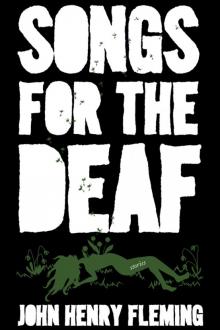
Songs for the Deaf, page 12


We know better. The rain stays with us, and everything that happened in the rain happens again and again.
He said he saw something. Can a license ever look like a gun? Even with rain on your glasses and on the face of your flashlight?
Let me see your license.
You almost say something. Then I see your hand in front of my knees. The glove compartment is open. The flashlight beam is there. You feel around for just a second. You touch the notes from Lila. The owner’s manual for the wrong model. The broken pencil. You feel your license.
Then everything stops. The rain falls over the car and stops everything inside it. The hand touching the license. The gun rising and flashing. Your head falling to my knee. My hand jerking up against the window. A dark streak on the window, not washing away in the rain. I’m thinking, What is that? What is it? The same thought the cop might have asked himself a second earlier. You could have answered it for him, Louis.
All of these things are now one moment, and that moment is stuck inside the rain that falls in us both. Everything’s clear in there. I wonder if the cop ever sees it, too. Or does the cop still see the gun that isn’t there? Does he wonder what it’s like to be you, Louis, stuck inside one rainstorm and always living just that one moment, not remembering anything before or after, nothing ever changing?
I know you know all this, Louis. You don’t need me to tell you what you see. But in all the times I’ve come here, I’ve never talked to you about it. Not once. And when I looked out at the rain last night with the Old Crow warming inside me, I thought maybe you’d like to know that I see it, too. Part of the time I’m out here seeing other things, but most of the time I’ve been in the rain with you, and I thought you might want to know that.
The rain is why you’re here, Louis. It’s why I’ve been coming here up till now, even when everyone else began to fall away into their old lives. They went back in their homes to wait it out. We stayed out in the rain. For you it never stops. But I’ve been thinking about other things, too, and last night I started to put them together. I thought you’d want to know what I’ve been thinking. It’s been so long since I said anything to you, Louis. I didn’t think it would change anything. But now I’m going to tell you everything I know. It’s not much, but it’s something. You already know about the rain. Now I’m going to tell you about the wind.
A week after the shooting, I was back to work on the golf course. The superintendent said he was going to give me busy work for a while, stuff to take my mind off it. The irrigation man would fill in as his assistant. Any paperwork could wait. This went on for a few weeks, and I was beginning to think I’d lost my position. I didn’t say anything, though.
One day I was out raking leaves. There was no wind that day, but there had been the night before, and the wind had blown pine needles and avocado leaves all over the greens. I was working ahead of the greens-mower, Enrique, clearing the leaves off so he could mow the greens evenly. Three-sixteenths of an inch all over. It was mid-afternoon, hot and still. I had to rake because the blower wasn’t working.
The sweat rolled down my neck and got soaked up by my work shirt. There were only a few golfers around. Quiet day. Only the sound of Enrique’s mower one or two holes back, the sound of my rake.
I’d been raking all day, not even stopping for lunch, so I could keep ahead of Enrique. I was doing the same kind of work I started doing there six years ago, and that was getting me worried. That irrigation guy was good friends with the superintendent. They both had agronomy degrees from Gainesville. Here I was doing the work of a high school kid. No offense, Louis, but I’d already been through it. I didn’t want to do it again. I’m older. I’ve got experience.
My arms and back ached from the raking. I was thinking about my job. I was thinking about you. I didn’t bring a flask to work then, but I’d had plenty the night before and plenty in the morning. It was still with me. My head wasn’t right.
It was quiet and hot and then something came out of the clear sky and knocked me in the head. I remember the sound of it, like the crack of a baseball bat. And the echoes in my blood that made it seem for a second all my veins would explode at once. All I could hear was the crack and it was everywhere, and then it was only in one small spot on my head. I rubbed the tears out of my eyes and saw I’d dropped the rake. I reached up and felt my head. It seemed to swell under my hand. It throbbed, and the blood warmed my fingertips.
My eyes still closed, I heard an electric cart whir up beside me, right next to the collar of the green. Someone clicked on the brake lock. I blinked a few times and looked up. There were two old men there, and they were staring at me like I was something in the way of their golf game. Something they had to check the rule book about. A divot that hadn’t been repaired or a tree limb in the way of their backswing.
Then the man stood up next to the cart and turned toward his friend behind the wheel. You ought to thank him, he said. His head kept your ball from slicing into the trees.
They both laughed.
That’s when I first started to think about the wind.
Do you remember when I started work on the golf course? You were only a kid. You said, How do you play that game? I tried to explain it then, but I didn’t know all that much about it myself. Now I do.
Here’s how you play it, Louis. First you go into the woods and yank out most of the trees. Then you bring in truckloads of grass from Kentucky or Bermuda or somewhere else and you carpet over the space you cleared. Next you get your mowers out and you mow the grass again and again until it’s so short you can’t even call it grass anymore. You call it green, because you can’t tell it’s anything else. Some of it you call fairway, which sounds a lot like freeway, which is what they ought to call it, because it’s smooth and wide and the golfers drive up and down it in their little cars, weaving side to side like they own the road. Once you’ve got all the grass in and you’ve mowed it down to its color, then you build a few little mounds and you fill them in with sand, and they’re like little deserts that get in your way, except you rake them real smooth so they’re more like the beach in front of the Breakers Hotel. Once everything’s been torn out and sodded and raked and mowed, then you finally get to knock a little white ball around until it falls into a cup. And if it takes you a long time to do it, it’s nobody’s fault but your own, because everything’s been cleared out and mowed down for you. Everything’s exact. Only the wind can change where your ball goes. If there’s no wind, then you’ve got no excuse. If you hit the ball and it curves, it’s only because you didn’t hit it right, and if you hit the ball and it lands on somebody’s head, it’s because that’s where you aimed it.
This is what I decided was true with those two old golfers standing right in front of me, my head throbbing, and blood on my fingertips. I thought, Any excuse they’ve got has been cleared out and raked up and mowed away. The grass is exact and the fairways are wide open. The only thing left is the wind, and there was no wind. If there’d been wind and the guy had taken the same shot, the ball would have sailed over my head or maybe a little to the right and I wouldn’t have thought any more about it. If the guy had taken a different shot and the wind had pushed it into my head, the guy would have that excuse. But there was no wind. The guy had aimed the shot exactly at my head, and once he’d struck the ball, there was nothing to make it change its course.
It was all clear to me as I watched them smile at each other. The ball was sitting on the collar of the green between me and them. My head was bleeding. I took a step and picked up the ball, then walked over to the man who’d spoken, grabbed him by the back of his white hair, and jammed the ball through his teeth. When the ball fell to the grass, it was spotted with blood.
The board of directors couldn’t understand it. I hadn’t even hit the man who’d swung the club. I’d hit his friend. I don’t know why I hit his friend; it didn’t seem to matter. It still doesn’t.
The board called in the superintendent and asked him about it, and the superintendent told me he couldn’t answer them. He explained my situation to them. They said they understood, but that they couldn’t keep an employee who endangers the golfers, especially ones who’ve done nothing wrong.
I said, So if I’d hit the other guy, I could’ve kept my job?
The superintendent shook his head.
Because I can still go hit him.
The superintendent just stared.
When I walked out of there for the last time, I thought, if there’d been a breeze everything would be different. None of this would have happened.
Bad things happen where there’s no wind, Louis. I know that now. You know something? There was no breeze that night in the rain. Can you see that? There’s lots of rain and I guess you can call it a storm. But there’s no wind at all. I know that because I see how the rain comes straight down. It bounces off the top of the cop’s slicker, off the top of his flashlight, off the top of his gun. Exactly off the top.
I left my job knowing something about the wind. I was going to learn more.
I never told you any of this before. I never thought it would matter. Now I have to. I have to tell you everything.
After I left the golf course, I looked around for a while, but I had to take something quick. This room you’ve got isn’t cheap, and Mom doesn’t make nearly enough cleaning offices. I had to have something. There was this man down at the City Sanitation who remembered Dad. Dad was the first man he’d hired, he said. And somehow he’d heard about what happened to you. Newspapers, maybe. He sent a note to Mom, and Mom told me about him. It was nice of him to remember, she said.
I didn’t want to talk to him, but I had to, and he offered me a job loading garbage. I know you’ve done better, he said. But your father managed it for a long time and he never complained. He was a good man, he said.
I remember the first time I smelled Dad. You were just a baby, and I’d been blowing up balloons all day and throwing them into your playpen. I remember the taste and the smell of those balloons. Like a hospital, clean and dry.
By the time Dad came home, I was out of breath and a little dizzy. I could still smell the clean smell of the balloons until Dad crouched down next to me. Then I smelled him. I’d never smelled him before. I moved my face away and frowned. Dad didn’t say anything, but he might have noticed because he left the room then to take a shower. I tried to make an animal out of the balloon he’d blown up for me. It popped in my hands and I smelled him again.
Once I noticed that smell, I couldn’t forget it even when I tried. Even when Dad took a shower, I smelled it. When I was almost old enough to start working myself I thought, I never want to smell like that. I didn’t mind the smells on the golf course—the grass, the machines, even the chemicals. All those things were better than the smell of someone else’s garbage.
I never asked you, Louis. Did you ever smell Dad that way? I smelled it on him even when he lay in this same hospital breathing through a tube like you. We both went to see him, and I wondered then if you smelled him, too. But I couldn’t ask. Now I wonder if you can smell me. For the last few months I’ve taken a long hot shower before coming here, hoping you wouldn’t be able to smell the garbage on me. Now I’ve changed my mind.
When I started loading garbage, I’d come home every day and stand in the shower for twenty minutes, soaping up and shampooing, trying to get the smell out. I checked myself after I’d dried off, smelling my arm and blowing into my cupped hands. I smelled something. I wasn’t sure.
Out on my route, too. After I dumped a can of garbage into the hopper, I’d put my nose right up to my arm and sniff. There, I’d think, that’s me. I’m a garbage man. Everyone knows it, just like they knew it about Dad. If they forget, all they’ve got to do is get near me. They’ll smell the rotten vegetables they threw out last night.
I had a girlfriend for a little while. She moved in with us when I was between the two jobs. Her name was Melody and she was sweet and understanding. I didn’t deserve her. When I took the sanitation job, I couldn’t tell her right away. It hurt too much. But she figured it out. From Mom, maybe. Maybe from the smell.
One day I asked her how she liked the way I smell.
I don’t mind it, she said. It just smells like you’ve been chopping bell peppers.
I had to kick her out. I couldn’t stand that she smelled me. She might have smelled bell peppers all right. But someone else had chopped them.
I hated myself, and I tried to make it worse. All day long at work, I’d hold my arm up to my nose and smell it. I’d smell my work shirt, too, and my trousers. Before I emptied the garbage into the hopper, I’d stick my nose into it and take a big whiff. It made me feel good to hate myself. Smell that, I said to myself. Nothing changes. It’s the smell you’re going to smell all your life.
I started to bring a flask to work. I thought if I drank enough by afternoon, I’d forget to stick my nose in the garbage and I wouldn’t hate myself so much. Sometimes it worked. Then one day I stopped in to see you on my way to work. I’d never done that in the morning before. That day I just sat there and looked at you from across the room for a minute and that was it. I didn’t say a word to you. But when I got to work I still had that hospital smell with me, and it reminded me of those balloons I’d blown up as a kid.
I didn’t think much of it until I got out on my route. Then I took a big whiff of that first garbage pail, and this time it didn’t smell like garbage. It smelled like rotten vegetables, sour milk, grass clippings, wet newspapers, shampoo bottles, diapers, even plastic bags and cardboard boxes. But not garbage. That one smell had become all those separate smells. I smelled every can I emptied that day and none of them smelled like garbage. They smelled like whatever was put in there—bell peppers or potato skins or splintered wood. Every can had something different in it. Some cans had almost the same smells in them. But none were exactly the same.
After that, I began to pay attention to all the individual smells. I stuck my nose in the garbage like before, only now it wasn’t for self-pity. Now I wanted to pick out all the smells. I wanted to know what was in there by its smell. I got good at doing it, too. The other loaders saw me and started testing me. They’d have me close my eyes, and they’d put a piece of garbage up to my nose. Once they held up a dead gerbil. Once a carton of rotten eggs. I didn’t mind. Almost always, I could tell what it was by the smell. I’d get worried when I couldn’t. Sometimes there was no wind and I’d be smelling the same thing all day. That can dull your nose. It’s all becoming one smell again, I’d think. Then the wind would pick up and I’d be okay.
That’s how I got good at smelling. I can smell just about anything. I can smell the difference between royal palms and coconut palms, between sea grapes and sea oats. I can smell what kind of animal is hiding in the bushes. I can smell a woman’s perfume from half a mile away. When there’s a breeze coming in off the ocean, I can smell what kind of fish are running offshore. Let me tell you, I can smell. And the important thing about smelling is to pay attention to the wind.
Here’s what I’ve found out, Louis. The wind is talking to us all the time. Most people don’t listen, though, because they don’t know how to smell. But smelling is the only way to understand the wind. That’s how it talks. The wind doesn’t make its own smell. It carries the smells of everything else. It might take the smell of a pine tree’s sap and carry it down the street to an old man sitting on the porch of a nursing home, looking out at traffic. Then that old man smells that pine sap and remembers when he was a kid and used to chase lizards and squirrels up those pine trees, and after, when he’d hop down and look at his hands, and they’d be covered with sap and little pieces of bark stuck to the sap, like he’d grown a new skin. He’d think, Mama’s gonna be mad at me because that ain’t never gonna wash off. But now he looks at his old, trembling hands and he sees that it has washed off. He leans back in his chair and smells the sap, remembering what it felt like on his hands, remembering until the smell fades because the wind has taken it somewhere else.
A boy might be walking home one night and he’s mad at himself because he lost all his money shooting pool. He’s had a few drinks so he’s looking at his feet to make sure they move the way he expects them to, and then he smells something, stops, and looks up. He sees that he’s in front of his girlfriend’s house. He has smelled what he smells when her mother opens the door for him, her mother’s housedress that smells a little like floor wax, all the little knickknacks her mother collects that smell like they sat in the Salvation Army store for a year before she bought them, the paint on the mantel that’s just beginning to chip. And from all the smells of the house he finds the ones he knows belong only to his girlfriend. The cup of her palms, the inside of her forearm, the shoulder scar from her vaccination, the curls in her hair, and most of all her breath. He reaches out for these smells especially, and he grabs onto them and holds them for as long as he can. Standing before her house he smells all this and he is happy. The wind has brought these smells to him. It is speaking to him. He is just drunk enough that he might go up and rap on her window.
When these things happen, you might start to wonder if the wind is good or evil. But the wind doesn’t care one way or another. It talks, and it wants us to listen. And the more we listen, the more it will talk. Not everything it tells us is good, but it’s always something we ought to hear.
The only time we should be scared is when the wind stops talking. When the wind is quiet nothing changes. The sky stays the same. The earth stays the same. People stay the same. They smell the same. They smell just like their fathers. When the wind is still, a man can swing a golf club and the ball will go exactly where it is aimed. A man can raise a gun and his hand won’t blow to one side or the other. He can fire the gun and the bullet will go exactly where the gun is pointed. Nothing will change its direction. The time between makes no difference. It doesn’t count. Nothing will change what happens.