Shadowrun: Hell on Water, page 8
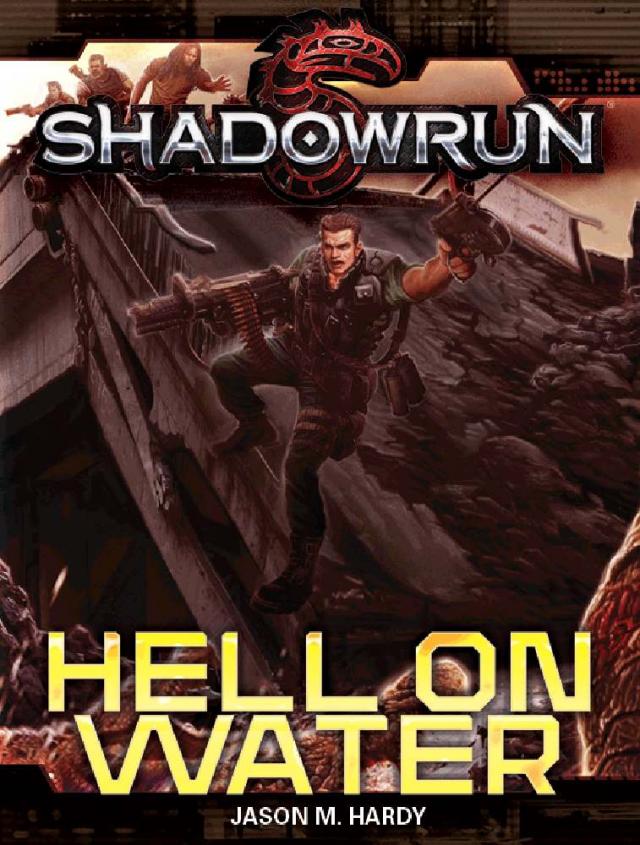


He is now mostly underwater, so he swings his legs back, beneath and behind him, reaching for the submerged portion of the ramp. His legs bend as they find the concrete, then they spring forward, catapulting him toward the other side of the gap. The water he cuts through froths purple and yellow, and around him it churns. He pivots the rifle he holds in his right hand and swings it wildly, butt out. It hits nothing. Then something bumps his left ankle, and Cayman knows he doesn’t have much time to react, so he kicks his left leg forward, his right leg back, and there is a light tug on the back of his left foot, and for a moment he fears it is caught, but then the leg pulls free. He then thrashes his legs, kicking wildly, occasionally making contact with things, once so hard that he wonders if he broke a toe, and he thinks that perhaps he is kicking submerged pieces of concrete instead of ammits.
Then he feels a tug on his left arm and it is the greatest feeling he has ever felt. He bends that arm, pulling his entire body behind him, and he rises out of the water. The winch has finally taken up the slack, he is directly below the other side of the gap, and he is moving up. The ammits know they are very close to losing fresh meat, and they thrash after him, but most of them succeed only in getting in each other’s way. There is one, though, whose large scaled back breaks the water, who looks like it is perhaps the same size as the exploded boat back at the north end of the bridge, that has found a clear path toward Cayman. Even with his arm bent and his legs tucked under him, Cayman has no more than a meter’s clearance of the water as he slowly moves upward. He very desperately wishes he could fire his rifle, but he can’t be assured the barrel is clean and having the thing misfire and break on him now would be bad in case he needs to use it later. So he watches the ammit approach as he slowly rises into the air, and the ammit makes its lunge, breaking the surface of the water, but ammits are built for lunges, not leaps, so it does not get very high. Still, its teeth are many and sharp, and it has the crocodile grin of confidence on its face as its mouth opens. But Cayman wheels a leg around and crashes his heel on the ammit’s snout, shutting it quickly. His other foot is near the ammit’s neck, so he steps on the ammit and then pushes off, like he is running. Then he is running, dashing along the ammit’s back as it twists and then starts to roll. It is bringing its head back around, it wants to snap again, but then it is too late. First Cayman pulls out his legs so they are out of range, and then he is out of range even if his feet are dangling beneath him and his arm is straight. The water stirs beneath him—the ammits are angry, but there is nothing more they can do to him.
He looks up, and he expects to see at least some of the others, cheering him on or maybe happy that he managed to survived, but he cannot see any of them.
“Hey!” he yells. “Anybody up there?”
There is no reply. But he hears voices. In the true way of the idle, they are arguing about something that in truth does not matter much.
The first voice he hears is Groovetooth’s. “I’m telling you, this isn’t how ammits operate. They don’t hang out near shore, and they don’t move in packs. There’s something weird about that group.”
“They kept having food slide down to them,” Akuchi says. “Any animal gathers where there’s food.”
“Ammits never have trouble finding food,” Groovetooth says. “When you have no predators, you can go anywhere you want and find what you need. They wouldn’t be here just for food. There’s something else.”
Then X-Prime speaks. “Like that?”
There is a pause.
“Holy shit,” Groovetooth says.
“What? What? What’s going on!” Cayman says, but he has his answer before anyone speaks.
He turns as the rope twists, and he is looking out into the lagoon. There is a wall, a blue-green wall of water, at least fifteen meters tall.
It is coming straight at them.
Chapter Eleven
One week before the bridge
When Cayman first saw the lagoon, it seemed harmless. Yes, the color of it was not right, it was darker than the nearby ocean and greener, but such is the way of many inland bodies of water, they are not the same as the great nearby oceans. It was just a body of water, as far as Cayman could see, and he had nothing against bodies of water, as there tended to be fewer humans on the water than on the land. This is not to say that Cayman had anything against humanity, but he had been a runner a long time, and when that is the case, you cannot help but notice that it is people who are trying to kill you most of the time, and thus when there is a place where there are fewer people, you conclude that it must be safer, because the number of times you must turn and look to see if someone is sneaking up in back of you is reduced.
The lagoon certainly looked safer than the airport Cayman flew into. He had plenty of time to look at it as his plane kept circling, one, two, three, more times. He wondered what was going on, but the sparse crowd on the rest of the plane seemed to be well-well with what was happening, so Cayman did not let it bother him.
With each pass, with each look he was able to get at the airport, his confidence in its safety decreased. Details emerged, each more troubling than the last. The potholes on the runway, they did not bother him. He had always thought that the worse the runway’s condition, the better, because pilots that landed on such runways tended to be more alert, more aware, and better able to improvise than any other pilots. In the rare occasions when he must put himself in someone else’s hands, those are the kind of people he wanted to be in charge. So the sadly neglected runways were not a problem, but the many, many people who stood around and killed on the airfield were. Some of them were in jeeps, some of them were on foot; a few of them were in uniform, most of them were not. They disembarked from planes that stopped in the middle of some runway, taking whatever piece of tarmac seemed convenient and out of the way, and they grabbed bags that may not have been theirs and ran as fast as they could. Some of them were armed, others—the ones who ran faster—had firearms out, and they were pointing guns here and they were pointing guns there, and many people were trying to look threatening, but Cayman could not tell from his high-up perch how well they were succeeding. They landed in chaos, which is not the best way to start a mission into a foreign city, but what else did Cayman expect? He did his homework, he’d known what he was getting into when he was going to Lagos; he just didn’t want to get the full immersion in the chaos this quickly.
Then the plane straightened out and started to go down. The reactions of the people around him were rapid—as soon as the descent started, they were on their feet, moving around, grabbing their things and putting packs on their backs and pushing their way to the door. If there had been a flight attendant, perhaps he or she would have tried to instill some sort of order in the plane, but there wasn’t, so they didn’t. Cayman faced toward X-Prime, so he could give him a look that said, “We should get up, too,” but the boy was already on his feet and walking to the hatch. Cayman then felt regrettably slow, so he stood and straightened his shoulders and took up as much space as he could so that no one could move by him until he let them.
The plane shook, but Cayman was ready. He had stood in too many moving vehicles to let this one throw him. People around him stumbled this way and that, but most of them looked like they had done this before, too. A few of them stepped past the unfortunate ones who stumbled.
There was a bump, a thump, and many rumbles, and then another solid thump that Cayman guessed was a pothole. There was the roaring, slowing rushing sound of the engines braking the plane, and then the plane stopped, and almost as soon as it wasn’t moving (there was no taxiing anywhere, the plane landed, then stopped, then was done) the hatch was tossed open.
There was nowhere to go, of course, but the two or three people in front poked their heads out and looked here and looked there and one of them stuck his hand out the hatch and waved at someone, and it looked like someone responded, because soon a staircase drove up to the side of the plane.
The first person was out of the plane before the staircase was firmly in place; he jumped across a meter-wide gap and hit the top of the stairs and ran down, three steps at a time, and then was off to whatever place it was that required such speed and urgency. Cayman hoped he made it wherever he was going, but he never liked to bet on a man who was pitted against jeeps full of people with guns.
Cayman walked off the plane when it was his turn, and that put him about five people behind X-Prime. He hated to admit it, but he was impressed with the way the boy moved. The skittishness, the look here and look there that Alex did a few years back, was gone. He couldn’t intimidate people, he never would, but he had learned to walk like he was comfortable wherever he was, and to slip through crowds at whatever speed he desired. Cayman decided he should take credit for the way he moved and seemed comfortable in the street. He walked quickly and caught up to X-Prime.
“I taught you how to walk, you know.”
“Yeah. Thanks, Mom.”
“One day you’ll thank me. Genuinely.”
“Yeah. You brought me to one of the absolute shitholes in the world so we can do a run we don’t know anything about. Thanks.”
“Would you have rather stayed in Seattle?”
Now, let me say that I truly wish that I had time to detail all the reasons why Cayman and X-Prime did not feel like this was a good time to be in Seattle, because it is a good story, but I cannot stop and take time and tell every good story that comes to mind, so I will stick with the one I have already started, and perhaps afterward you can stay later and we will follow one or more of these digressions. Now. Cayman and X-Prime do not, of course, know the layout of the Mohammed International Airport, and it is not the sort of facility that has convenient signs telling you where to go. There are buildings here and buildings there, and some of them are clearly airplane hangars and some are not, and the purposes of the ones that are not hangars were often unclear. The people who exited the plane were not helpful, as they were heading in a myriad number of directions, and so Cayman made a simple call, and that was to head toward the closest thing that looked like it would be a way out. There is a break in the fence not too far away, and while it is guarded, there are people passing through it, so it seemed as likely an egress as any. Cayman angled toward it and X-Prime, as independent-minded as he may have become, still had the instinct to follow Cayman, and so he did.
It did not take long for them to reach the gate, and when they did there was a tall, thin ork with mirrored sunglasses who smiled at them, and it was not a welcoming smile. It was a smile that reflected the amusement and sense of contentment possessed by an ork holding a gun who is surrounded by friends who also hold guns.
“This is a restricted exit,” the ork said. “You have to go through the building.”
“Which one?” Cayman said.
“That one,” the man said, and pointed to a building entirely across the airport.
Cayman looked at the building, then looked back at the man. “That building is a long way away.”
The ork’s smile broadened. “Then perhaps you should have walked that way as soon as you got off the plane.”
Two people edged their way past Cayman, nodded at the guards, and walked out of the airport.
“See, those people just left. So this is an exit, right?” Cayman said.
The guard shook his head. “They are special. They are from here, and they have made the proper arrangements. You—” and here he smiled again “—are not from here, and have not made the proper arrangements.”
Cayman did not bother to ask how the guard knew that, since he had little use for obvious questions. He swallowed, took a deep breath, and did the thing he hated most. He stepped back, looked at X-Prime, and nodded.
“Do your thing.”
X-Prime smiled and stepped forward. “Look. We know we’re oyibos. We know we’re not going to get the same treatment that natives get.”
The ork sniggered and looked back at some of his fellow guards. “Look at that. He knows a word.”
“Here’s another one I know. Hawala.”
The ork pointed to the same building he’d indicated before. “You can find one there.”
X-Prime did not turn around. “I’m sure I could. If I wanted to.” He reached into his pocket and pulled out a white plastic disk. He rotated it slowly in his hand so that the ork could see the picture on it, which was a woman who had a snake wrapped around her neck. “But I don’t need a Hawala.”
The ork barely glanced at the chip. “You got good money. Good for you. But you don’t have very much of it.”
“Yeah, you’re right. Assuming I have only one of these.”
“You could have five, ten of them, and it still wouldn’t do you much good.”
“You’re right again. But look, I’d like you to have this chip anyway. Just for you.”
The other guards had paid a little attention to the conversation once X-Prime had gone digging for money, but the handover of a single white Hawala token did not cause much interest to stir in them. Most of them went back to looking at the people walking toward them and sizing them up.
But the ork had heard something. He had noticed the careful inflection of the last three words X-Prime had said. When X-Prime reached out the hand holding the white chip, the ork grasped it, shook it. When he pulled his hand back, he opened it long enough to verify that the chip that had actually been passed to him was grey. He pocketed the chip.
That was all X-Prime needed. The bribe had been accepted, and since he got to keep it all for himself, the ork should now be quite willing to help X-Prime and Cayman get through. There would have to be more conversation, but it was just to establish a pretext, so that appearances matched the actions that were about to take place.
“You know a single white Hawala chip is not going to do anything for you,” the ork said, perhaps too loudly.
“All I want it to do is buy us a little time to talk,” X-Prime said, and the pretext building began.
Ten minutes later, there was something bothering Cayman, and it was not the fact that he was squeezing through narrow gaps on the city streets while sitting on the back of a bike that had a plastic rear seat for him that cracked and bent alarmingly every time he put the smallest little bit of pressure on it. It was not the dust that seemed like it might be red from its heat as he breathed it in and it scratched and seared his nose and lungs. There were plenty of things that could bother Cayman, but none of them were the thing that was making him feel annoyed. Or maybe they were, because he could not put his finger precisely on what it was that was wrong. But he would figure it out.
Sometimes he was ahead of the okada that was carrying X-Prime, sometimes behind it. Twice, as they moved through the always-shifting street, the two okadas nearly crashed into each other, and the drivers yelled at each other and shook fists at each other, and once even pushed each other, and then they smiled at each other, and squeezed the throttle and drove much faster than safety would recommend. They were on the way to a bar, which was so normal to Cayman that he was firmly convinced that he could tell the entire story of his life as a journey between bars, with stops and places of less importance along the way.
Cayman believed that the traffic in Lagos moved on the right, but he could not be sure because his driver moved freely on either side of the street—to the driver, the only wrong side of the street was the one not currently moving. Cayman worried he was throwing off the balance of the bike, that the driver would make a miscalculation in one of his turns because he was not used to carrying so much weight in the back, but the driver remained quite sure handed. It all seemed like extended improvisation, no planning, just reacting, and it probably was, but it worked. It got the okada from point A to point B, and when Cayman finally arrived at point B he was grateful both to be there and to be moving in a way that did not risk his life each second.
Point B was a place called the Three Friends, and Cayman could almost see the whitewash actively peeling in the afternoon sun. It seemed popular enough, though, and there were many young people who walked in and walked out, with most of them carrying or consuming some sort of food substance, and Cayman figured that meant that whatever was served inside likely would not kill him, which he viewed as a plus. But he was working, so he could not view this place like he would a customer. He would have to look for dark corners, for people who might be watching him too closely, and for anything else that might not run smoothly and that he might be able to fix with the simple, precise application of force.
He walked into the building ahead of X-Prime and found his contact immediately. Hippo was described to him as “the biggest fixer in Lagos,” and there was a table in the Three Friends designed just for him. It was a corner booth underneath peeling, faded posters of Lisbon, Buenos Aries, and Portland, and the tabletop sat on top of a single post that was bolted tightly to the ground. That meant it could not move, which would be a problem for someone of Hippo’s build because he could not fit behind the table unless he placed a significant portion of his bulk on top of the table, which would present an unusual and somewhat unappetizing sight to all in the restaurant. So someone, maybe the restaurant owners, maybe Hippo himself, cut out a nice, large arc from the table, giving him the perfect place to sit. It was possible, Cayman thought, that Hippo was the only person who ever used that table. It was also possible that he only left that spot to sleep, and maybe not even then.
Hippo was at his table, a huge ork with perhaps the roundest, jolliest ork face Cayman has ever seen, though the cheerful effect was set off a bit by the teeth. His eyes lit up when he saw Cayman and X-Prime, and he smiled and waved them over, but of course he did not stand to greet them.
Cayman wondered briefly how Hippo recognized them so quickly, but then he remembered his oyibos-ness. He would have to get used to sticking out on this mission.